

The barbell and dumbbell overhead presses both train the shoulders, but they challenge you in different ways. A barbell often lets you lift more weight and makes it easier to track your progress. Dumbbells let each arm move independently and can demand more stabilization. Neither option is automatically better for building muscle.
If your goal is wider shoulders, the overhead press is only part of the picture. It trains the deltoids, especially the front portion, but lateral raises target the middle deltoid more directly. If your goal is a stronger overhead press, the best choice depends partly on which version you want to improve.


What the Overhead Press Trains
The deltoid has three portions: anterior, medial, and posterior. The anterior portion at the front of the shoulder helps lift the arm forward. The medial portion on the side contributes to lifting the arm out to the side. The posterior portion at the back helps move the arm behind the body and supports other shoulder movements.
During an overhead press, the deltoids work with the triceps to move the weight overhead. The upper back and trunk help keep your body steady. Both press variations train these muscles, but the amount of work each one does can change with your position, technique, and equipment.
The overhead press is a useful compound exercise for general shoulder strength and size. However, a press does not fully replace exercises that target a particular part of the deltoid. Research reviewing shoulder exercise activation found that abduction movements, including lateral raises, produced high activation in the middle deltoid. That makes lateral raises a useful addition if your main aim is to develop the side of the shoulders and create a wider appearance.
Barbell Overhead Press: Best for Building Pressing Strength
The barbell press is a strong option when you want to lift heavier loads and build strength in that specific movement. Both arms hold one bar, which gives you a fixed grip and makes it straightforward to add small amounts of weight over time. That can make the barbell a good main lift for someone who wants to improve their barbell overhead press.
A direct study comparing seated and standing barbell and dumbbell shoulder presses found that participants could lift the least weight in the standing dumbbell variation. Standing with a barbell allowed a higher one repetition maximum than standing with dumbbells. This is one reason the barbell can work well for strength training, although it does not mean that barbell pressing automatically creates more shoulder muscle.
The bar also limits how independently each arm can move. For some lifters, that provides a stable and predictable pressing path. For others, the fixed hand position may feel less comfortable than pressing with dumbbells. Your shoulder mobility, proportions, and experience can all affect which variation feels natural.
A barbell can be pressed while seated or standing. Standing adds a balance and trunk control challenge, while sitting with back support reduces some of the demand on the body to stay upright. Neither position is universally better. Choose the version that lets you perform controlled repetitions and progress without pain or unnecessary changes in technique.
Dumbbell Overhead Press: More Freedom for Each Arm
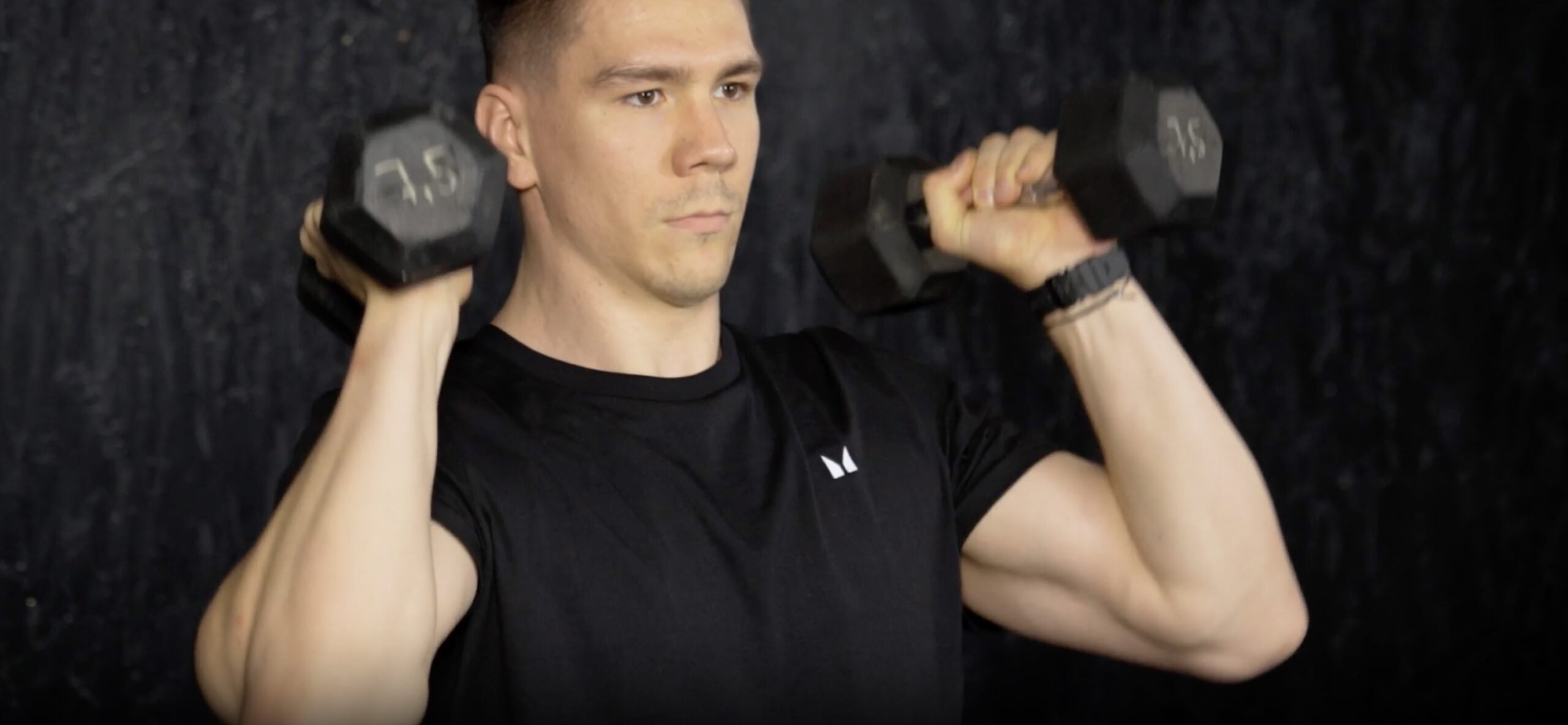
With dumbbells, each hand controls its own weight. You can adjust your grip and pressing path more freely, and the two arms do not have to move in exactly the same way. This can make dumbbells a comfortable option for lifters who prefer a more flexible movement.
Dumbbells also require you to control two separate weights. In a study comparing shoulder press variations, standing dumbbell presses showed higher deltoid muscle activity than the other tested conditions, while also producing the lowest one repetition maximum. This suggests that the more demanding stabilization of the standing dumbbell press may increase the challenge of controlling the movement, even though it limits the load you can lift.
3 Best Dumbbell Exercises for a Strong and Jacked Chest
That finding needs context. The study measured muscle activity during a short test, not long term muscle growth. An increase in electrical activity during an exercise does not prove that the exercise will build more muscle over months of training. It also involved 15 healthy men, so its findings should not be treated as a guarantee that every lifter will respond in the same way.
Dumbbells are also useful for training each side separately. If one arm is noticeably weaker or less coordinated, you can pay attention to how each side performs. However, dumbbells do not automatically correct imbalances. Consistent technique and manageable loads still matter.
Which Builds Wider Shoulders?
Neither the barbell nor the dumbbell press is a guaranteed shortcut to wider shoulders. Both can help build the deltoids, but the side deltoid is especially important for shoulder width. A shoulder program focused only on pressing may leave less direct work for that area.
A sensible approach is to use an overhead press as one part of your shoulder training and include lateral raises for more direct middle deltoid work. The choice between barbell and dumbbell pressing can come down to the version that feels comfortable, fits your equipment, and lets you train consistently. You can use either variation while working toward wider shoulders.

Do not interpret exercise activation research as a ranking of which movement grows muscle fastest. EMG studies measure electrical activity during exercise. They help researchers compare how muscles behave under specific conditions, but they do not directly measure changes in muscle size after a training program. For long term growth, the practical priorities are doing enough challenging work, using sound technique, and gradually progressing your training.
Which Builds Stronger Shoulders?
If “stronger” means improving your one repetition maximum in the barbell overhead press, practice the barbell overhead press. Strength gains are specific to the movement you train, so regular practice with the barbell is likely to transfer best to that test. The same principle applies if your goal is to improve your dumbbell press.
For general pressing strength, either option can work. The barbell may be more convenient for heavier loading and small weight increases. Dumbbells can build strong pressing ability too, but each hand has to control its own load, and you may not be able to use as much total weight.
Heavy loads are not the only route to muscle growth. Research comparing lower and higher loads found that both can increase muscle size when sets are performed with sufficient effort, while heavier loading tends to be more useful for maximizing strength. The load you choose should allow controlled repetitions and fit the purpose of the session.
How to Choose the Right Variation
Choose the barbell press if you want to prioritize barbell pressing strength, prefer a single implement, and can press through a comfortable range of motion with good control. It can also be a practical choice when your gym has small plates that allow gradual increases in load.
Choose dumbbells if you prefer independent arm movement, want to adjust your grip, or find the barbell position uncomfortable. They are also a reasonable option if your training space does not have a rack or barbell setup. Start with a load you can control, since getting dumbbells into position can be part of the challenge.
You do not have to commit to one variation forever. You could use a barbell press as your primary strength exercise for one training block and dumbbells in another block, or use one as the main press and the other as lighter accessory work. If you change exercises, keep the overall training plan consistent enough to judge whether you are progressing.
The key is to track your sets, repetitions, load, and technique. Add weight or repetitions gradually when you can complete your planned work with consistent control. A systematic review on exercise variation found that planned changes can support strength and regional muscle development, while frequent, random exercise changes may make progress harder to assess.
How to Program Your Overhead Press
For shoulder growth, begin with a manageable number of challenging sets and build from there as you recover well and continue progressing. The 2026 American College of Sports Medicine position stand supports performing at least two sets per exercise and notes that hypertrophy generally responds to training volume, with diminishing returns as volume gets high. The right amount depends on your training history and how much other pressing and shoulder work you do.
For strength, include the version of the press you want to improve and practice it regularly. Use loads that let you maintain a controlled range of motion and avoid turning each repetition into a push press by driving with your legs. If you are also doing bench presses or other upper body exercises, remember that they add to your overall training workload.

A balanced shoulder routine could include one overhead press variation, lateral raises for the middle deltoid, and pulling exercises that train the upper back and rear shoulder. You do not need to add every possible variation. Give each movement a clear role and keep it in your routine long enough to measure progress.
The Verdict
For heavier barbell overhead press strength, the barbell is the more direct tool. For adjustable hand positions and independent arm movement, dumbbells offer more freedom. Both can build stronger and more muscular shoulders when trained with consistent technique and progressive effort.
For wider shoulders, neither press variation should be your only exercise. Include lateral raises to train the middle deltoid more directly, and choose the press that you can perform comfortably and progress over time.
Key Takeaways
| Goal | Best choice | Why |
|---|---|---|
| Improve barbell overhead press strength | Barbell press | Practice is specific to the lift you want to improve, and many lifters can use heavier loads. |
| Use a more adjustable pressing path | Dumbbell press | Each arm moves independently and the grip can be adjusted. |
| Develop wider looking shoulders | Press plus lateral raises | The press trains the shoulders, while lateral raises provide more direct work for the middle deltoid. |
| Choose between the two | The variation you can perform consistently | Comfort, control, progression, and training goals matter more than the equipment alone. |
References
- Currier, B.S. et al. (2026) ‘American College of Sports Medicine Position Stand. Resistance Training Prescription for Muscle Function, Hypertrophy, and Physical Performance in Healthy Adults: An Overview of Reviews’, Medicine & Science in Sports & Exercise, 58(4), pp. 851 to 872.
- Coratella, G., Tornatore, G., Longo, S., Esposito, F. and Cè, E. (2020) ‘An Electromyographic Analysis of Lateral Raise Variations and Frontal Raise in Competitive Bodybuilders’, International Journal of Environmental Research and Public Health, 17(17), article 6015.
- Kohler, J.M., Flanagan, S.P. and Whiting, W.C. (2010) ‘Muscle activation patterns while lifting stable and unstable loads on stable and unstable surfaces’, Journal of Strength and Conditioning Research, 24(2), pp. 313 to 321.
- Kassiano, W., Nunes, J.P., Costa, B., Ribeiro, A.S., Schoenfeld, B.J. and Cyrino, E.S. (2022) ‘Does varying resistance exercises promote superior muscle hypertrophy and strength gains? A systematic review’, Journal of Strength and Conditioning Research, 36(6), pp. 1753 to 1762.
- Saeterbakken, A.H. and Fimland, M.S. (2013) ‘Effects of body position and loading modality on muscle activity and strength in shoulder presses’, Journal of Strength and Conditioning Research, 27(7), pp. 1824 to 1831.
- Schoenfeld, B.J., Grgic, J., Ogborn, D. and Krieger, J.W. (2017) ‘Strength and hypertrophy adaptations between low- versus high-load resistance training: a systematic review and meta-analysis’, Journal of Strength and Conditioning Research, 31(12), pp. 3508 to 3523.