

If you are new to exercise, holding a wall sit for 20 to 30 seconds with good form is a useful first goal. If you can already hold one for longer, that is fine too. There is no single time every beginner should reach, and a shorter hold does not mean you are unfit. Your result depends on your leg strength, body weight, experience, the depth of your squat, and how strictly you keep your position.
For training, work toward 30 to 60 seconds per hold at a depth you can control. You do not need to reach a particular time before you count the exercise as worthwhile. Wall sits are a way to challenge your legs while they hold a fixed position. A controlled 20 second hold can be more useful than a longer hold where your hips rise, your knees collapse inward, or you hold your breath.


What a Wall Sit Measures
A wall sit is an isometric exercise. That means your muscles produce force while your joints stay in roughly the same position. In a wall sit, the main challenge is to keep your body lowered against the wall as your thigh and hip muscles work to support you. Researchers studying wall squats have measured how changes in knee angle affect the exercise’s workload and the body’s response. A deeper position generally makes the hold more demanding.
The time you can hold a wall sit is therefore one measure of lower body muscular endurance under a particular set of conditions. It does not measure your overall fitness, and it is not a direct measure of how much weight you can squat or how well you move during everyday activities. A wall sit also has no standardized result unless the position and test instructions are kept consistent. A person holding a shallow squat cannot be compared fairly with someone holding their thighs close to parallel with the floor.
A Practical Beginner Benchmark
For a first attempt, try a controlled hold of 20 seconds at a comfortable depth. If that feels manageable and your position stays steady, try 25 or 30 seconds next time. If you need to come out sooner, shorten the hold or raise your hips so the squat is less deep. That gives you a clear starting point without turning the test into an all out effort.
Push-Ups vs Dumbbell Press: Which Builds a Bigger Chest?
As a training target, beginners can build toward sets of 30 to 60 seconds. That range is a practical coaching goal, not a scientifically established pass mark for beginners. Research does not provide one universal wall sit standard that applies to every age, body size, training history, and squat depth. One large retrospective study measured wall sit performance in adults before and after a 12 week exercise program, but results from people enrolled in a structured program do not create a universal standard for all beginners.
If you reach 60 seconds with steady technique, you do not have to keep extending the hold to make progress. You can instead use a slightly deeper position, add another set, or choose a dynamic leg exercise such as a squat or step up. A longer hold is only a useful target when the position remains safe and controlled.
How to Do a Wall Sit Consistently
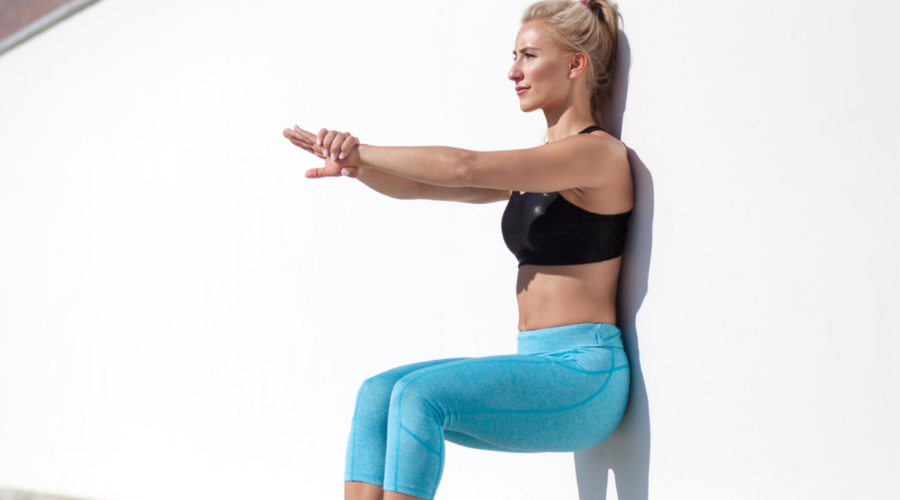
Stand with your back against a clear, sturdy wall. Place your feet about hip width apart and step them forward enough to let you slide down without your knees moving far past your toes. Lower yourself only as far as you can control. For a challenging version, your thighs may approach parallel with the floor, but a higher position is a sensible starting point if a deeper squat feels uncomfortable or too difficult.

Keep your back in contact with the wall, your feet flat, and your knees pointing in the same direction as your toes. Avoid letting your knees fall inward. Keep your head and shoulders relaxed, and breathe steadily throughout the hold. Do not push your lower back into an exaggerated arch or brace so hard that you stop breathing.
Use the same foot position and squat depth each time you track your hold. Small changes can make the exercise easier or harder, so a result only tells you much when the setup stays similar. If you want to compare your time over several weeks, record the duration and note whether you used a high, medium, or deep position.
How to Build Up Your Hold
Start with a hold you can finish while keeping your form steady. For example, if 20 seconds feels challenging but controlled, begin with two or three holds of about 15 to 20 seconds, resting between them. Once you can complete all the holds comfortably, add a few seconds to each one. You can also add a set, as long as your legs recover well and your technique stays consistent.
There is no need to test your maximum time every workout. Repeated all out holds can make it harder to maintain good form and may leave your legs excessively fatigued. For most beginners, practicing wall sits a couple of times a week alongside other lower body exercises is a reasonable way to learn the movement and build tolerance. Treat that as a simple starting routine rather than a prescription that fits every person.
Wall sits can be included in a broader strength routine, but they do not replace exercises that move your joints through a range of motion. Squats, sit to stands, step ups, and other exercises challenge your legs in different ways. If your goal is general leg strength, combining controlled holds with dynamic movements gives you more variety than trying to improve only your maximum wall sit time.
Why Your Time May Vary
Your wall sit time can change even if your fitness has not changed much. A deeper squat increases the challenge. A higher squat usually lets you hold longer. Body size and the amount of body weight your legs support also affect the task, as can fatigue from earlier exercise, sleep, and how familiar you are with the position.
Because the wall sit is a body weight hold, people should not compare times without considering technique and setup. A time from a standardized test may be useful for tracking one person’s progress, but it should not be treated as a universal grade. If your time improves while your squat depth and form stay consistent, that is a more meaningful sign of progress than a single impressive number.
When to Stop
End the hold when you can no longer keep your position, when your knees move inward, or when you feel sharp pain. A strong burning sensation and muscle fatigue can happen during a demanding hold, but sharp or worsening joint pain is a reason to stop. Rest and adjust the depth before trying again. If pain continues, seek advice from a qualified health professional.
Like other strenuous isometric exercises, a wall sit can raise blood pressure during the effort. Keep breathing rather than holding your breath. If you have a cardiovascular condition, uncontrolled high blood pressure, or have been told to limit strenuous exercise, check with your healthcare professional before doing hard or prolonged holds. A wall sit does not need to become a maximal test to be useful.
The Takeaway for Beginners
Aim first for a smooth 20 to 30 second wall sit at a depth you can control. Build toward 30 to 60 seconds over time if that suits your goals, but treat those numbers as practical targets rather than a pass or fail standard. Keep your setup consistent, breathe normally, and prioritize position over the clock. Your best benchmark is a hold you can repeat with the same form and compare with your own previous efforts.
Key Takeaways
| Topic | Beginner guidance |
|---|---|
| First target | Try 20 to 30 seconds with controlled form. |
| Training goal | Build gradually toward 30 to 60 seconds if comfortable. |
| Form | Keep your back on the wall, feet flat, knees aligned with toes, and breathing steady. |
| Progress tracking | Use the same squat depth and foot position each time. |
| When to stop | Stop if you lose position or feel sharp or worsening pain. |
| How to interpret your time | Treat it as a personal progress marker, not a universal fitness grade. |
References
- Goldring, N., Wiles, J.D. and Coleman, D. (2014) ‘The effects of isometric wall squat exercise on heart rate and blood pressure in a normotensive population’, Journal of Sports Sciences, 32(2), pp. 129–136.
- Lea, J.W.D., O’Driscoll, J.M., Coleman, D.A. and Wiles, J.D. (2021) ‘Validity and reliability of RPE as a measure of intensity during isometric wall squat exercise’, Journal of Clinical and Translational Research, 7(2), pp. 248–256.
- Lea, J.W.D., O’Driscoll, J.M., Coleman, D.A. and Wiles, J.D. (2021) ‘Validity and reliability of the Isometric Exercise Scale for measuring ratings of perceived exertion during continuous isometric exercise’, Scientific Reports, 11, article 5334.
- Oranchuk, D.J., Storey, A.G., Nelson, A.R. and Cronin, J.B. (2019) ‘Isometric training and long term adaptations: Effects of muscle length, intensity, and intent: A systematic review’, Scandinavian Journal of Medicine & Science in Sports, 29(4), pp. 484–503.
- Wiles, J.D., O’Driscoll, J.M., Wiles, J.W. and Taylor, K. (2018) ‘The safety of isometric exercise: Rethinking the exercise prescription paradigm for those with stage 1 hypertension’, Medicine, 97(10), e0105.