

Press ups are one of the simplest and most effective ways to measure upper body strength and muscular endurance. They require no equipment, can be performed almost anywhere, and provide valuable insight into your overall fitness.
Many people wonder how many press ups they should be able to complete. The answer depends on factors such as age, sex, body weight, training history, and technique. However, researchers have established benchmarks that can help you compare your performance with healthy adults.


The number of press ups you can perform is more than a party trick. Scientific research has linked higher press up capacity with better cardiovascular health, greater muscular endurance, improved functional fitness, and even lower risk of certain health problems. This guide explains what counts as a good score, why press ups matter, how to improve your performance, and what your results say about your fitness.
Why Press Ups Are Such a Good Fitness Test
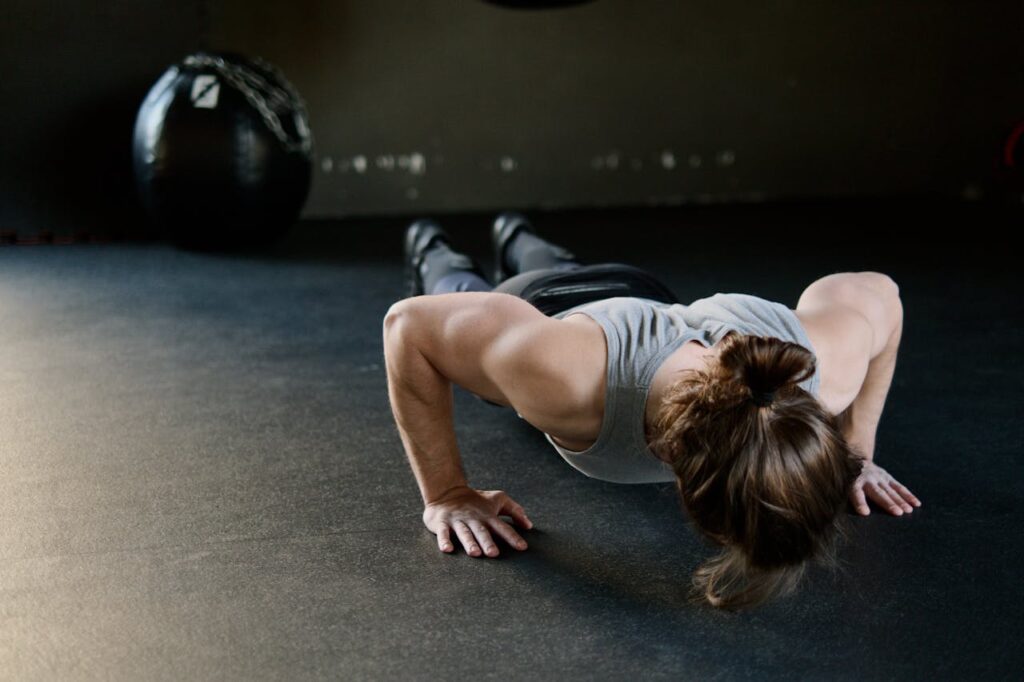
A press up is a compound movement that requires multiple muscle groups to work together. During each repetition you primarily use your chest, shoulders, and triceps while your core, glutes, and back stabilize your body.
Unlike isolated strength exercises, press ups test several physical qualities at the same time. These include muscular endurance, relative upper body strength, trunk stability, shoulder control, and movement coordination. Research has consistently shown that muscular endurance tests provide valuable information about overall health. They are simple, inexpensive, and correlate well with functional ability in both younger and older adults.

Because the exercise uses your own body weight, press up performance reflects how effectively you can move your body rather than simply how much weight you can lift.
How Many Press Ups Should You Be Able to Do?
One of the largest sources of normative data comes from the American College of Sports Medicine, which has developed fitness standards for healthy adults. For men, these general standards represent a single continuous set performed with proper technique.
Men
| Rating | Press Ups |
|---|---|
| Excellent | 40 or more |
| Good | 27 to 39 |
| Average | 17 to 26 |
| Below Average | 6 to 16 |
| Poor | 5 or fewer |
For women, the standards are as follows.
Women
| Rating | Press Ups |
|---|---|
| Excellent | 30 or more |
| Good | 21 to 29 |
| Average | 11 to 20 |
| Below Average | 5 to 10 |
| Poor | 4 or fewer |
These values represent broad guidelines for healthy adults. Individual performance will naturally vary depending on body composition, age, and training background.
Press Ups and Age
As people get older, muscle mass and strength gradually decline. This process, known as sarcopenia, begins as early as the fourth decade of life and accelerates after age 60 if resistance training is not maintained.
That means press up performance naturally decreases with age. Even so, physically active adults often outperform sedentary people decades younger.
Age adjusted norms from fitness organizations suggest the following targets for healthy individuals.
| Age | Men | Women |
|---|---|---|
| 20 to 29 | 30 to 40 | 20 to 30 |
| 30 to 39 | 25 to 35 | 15 to 25 |
| 40 to 49 | 20 to 30 | 12 to 20 |
| 50 to 59 | 15 to 25 | 10 to 18 |
| 60 and over | 10 to 20 | 8 to 15 |
These numbers should not be viewed as strict requirements. Instead, they offer realistic benchmarks that reflect the gradual changes associated with aging.
Why Relative Strength Matters
One reason press ups are so valuable is that they measure relative strength rather than absolute strength. Someone who benches 300 pounds but weighs 280 pounds may struggle with high repetition press ups because they must repeatedly move a large amount of body mass.
Meanwhile, a lighter athlete with excellent muscular endurance may complete 50 or more repetitions despite lifting less weight in the gym. Research consistently shows that relative strength is strongly associated with athletic performance, mobility, and functional independence.
Improving body composition by increasing muscle while reducing excess body fat often leads to dramatic improvements in press up performance.
Are Press Ups Good for Building Muscle?
Yes. Numerous studies have demonstrated that press ups can stimulate muscle growth when performed close to muscular failure. One well known study compared traditional bench presses with weighted press ups using elastic resistance. Researchers found nearly identical improvements in chest, shoulder, and triceps muscle thickness and strength after eight weeks of training. The key factor was not the exercise itself but the level of effort.
3 Best Dumbbell Exercises for Beginners to Build a Jacked and Muscular Torso
If a set becomes challenging within approximately five to thirty repetitions, it can effectively stimulate muscle growth. This means beginners can build impressive upper body muscle using only body weight, while more advanced athletes may need weighted variations to continue progressing.
What Does Your Press Up Score Say About Your Health?
One of the most interesting studies on press ups came from researchers at Harvard University. They followed more than 1,100 male firefighters over a ten year period. Participants capable of performing more than 40 consecutive press ups had a significantly lower risk of cardiovascular events than those who could perform fewer than 10 repetitions.
Although this study focused on occupationally active men and does not prove that doing more press ups directly prevents heart disease, it suggests that muscular fitness is closely linked with cardiovascular health.
Higher muscular strength has also been associated with lower all cause mortality, improved insulin sensitivity, healthier body composition, and better quality of life. Press ups should not replace medical screening, but they can provide a surprisingly useful snapshot of overall physical fitness.
Common Reasons People Struggle with Press Ups
Many people assume weak arms are the limiting factor. In reality, several issues often reduce performance. Poor core stability allows the hips to sag, making each repetition less efficient.
Limited shoulder strength prevents proper control throughout the movement. Weak chest and triceps muscles reduce pushing force. Excess body fat increases the amount of weight that must be lifted every repetition. Insufficient muscular endurance causes early fatigue even when maximal strength is adequate. Improving any one of these factors usually leads to better performance.
How to Perform a Perfect Press Up
Technique matters just as much as strength.
- Begin with your hands slightly wider than shoulder width.
- Keep your head, shoulders, hips, knees, and ankles aligned in a straight line.
- Brace your abdominal muscles and squeeze your glutes throughout the movement.
- Lower your chest until your elbows reach approximately 90 degrees or your chest lightly approaches the floor.
- Push back to the starting position without allowing your hips to sag or your lower back to arch excessively.
- Maintain controlled movement throughout every repetition.
- Using strict technique produces more reliable fitness assessments while reducing injury risk.
The Muscles Worked During Press Ups
Press ups recruit a surprisingly large number of muscles.
- The pectoralis major generates most of the pushing force.
- The anterior deltoids assist shoulder flexion and stabilization.
- The triceps brachii extend the elbows during the upward phase.
- The rectus abdominis, transverse abdominis, obliques, spinal erectors, glutes, and quadriceps stabilize the body throughout the exercise.
Electromyography research shows high activation across these muscle groups, making the press up one of the most efficient body weight exercises available.
How to Increase the Number of Press Ups You Can Do
Improving press up performance requires both strength and endurance. Beginners often improve rapidly simply by practicing the movement several times each week. One effective strategy involves performing multiple submaximal sets rather than training to failure every session.
For example, if your maximum is 15 repetitions, complete five sets of eight to ten repetitions two or three times per week. This approach builds technique while accumulating more total training volume.
Once you can comfortably perform more than 25 repetitions, adding more challenging variations often becomes beneficial. These may include weighted press ups, deficit press ups, ring press ups, or tempo repetitions. Strength training exercises such as the bench press, overhead press, dips, and rows can also improve the muscles involved in pressing.
Should You Test Yourself Often?
Testing every day is generally not recommended. Maximum effort testing creates fatigue that can interfere with training progress.
Instead, most coaches recommend testing every four to six weeks. Perform the test after a thorough warm up. Use strict technique. Avoid rushing the repetitions. Stop when you can no longer maintain proper form. Recording your score over time provides a simple way to measure improvements in muscular endurance.
How Many Press Ups Should You Aim For?
For most healthy adults, reaching 20 to 30 strict press ups is an excellent goal. This level reflects above average muscular endurance for much of the population and supports everyday activities, recreational sports, and general health.
Athletes, military personnel, firefighters, and competitive fitness enthusiasts often aim much higher. Completing 40 or more strict repetitions demonstrates exceptional upper body endurance and relative strength. Rather than comparing yourself with elite performers, focus on improving your own score over time. Consistent progress is a much better indicator of long term fitness than a single test result.
Final Thoughts
Press ups remain one of the most valuable exercises ever created because they combine simplicity with remarkable effectiveness. They assess strength, muscular endurance, core stability, and movement quality using nothing more than your own body weight. Most healthy adults should strive to perform at least 20 well executed repetitions, while reaching 40 or more represents an outstanding level of fitness.
Remember that quality always matters more than quantity. A smaller number of strict repetitions provides far more useful information than a larger number completed with poor technique. Whether you are just learning your first press up or working toward your fiftieth, regular practice, progressive overload, and consistent resistance training will steadily improve your performance and your overall health.
Key Takeaways
| Topic | Key Takeaway |
|---|---|
| Why press ups matter | They measure upper body strength, muscular endurance, core stability, and relative strength. |
| Good target for most adults | Around 20 to 30 strict press ups indicates solid fitness. |
| Excellent performance | Forty or more consecutive press ups demonstrates outstanding muscular endurance. |
| Health benefits | Better press up performance is associated with improved cardiovascular health and overall fitness. |
| Muscle building | Press ups can effectively build muscle when performed close to failure. |
| Technique | Maintain a straight body line, controlled movement, and full range of motion. |
| Improving performance | Train two to three times per week using progressive overload and good technique. |
| Beginners | Knee and incline press ups provide effective stepping stones toward full press ups. |
| Retesting | Assess your maximum every four to six weeks rather than every workout. |
| Long term goal | Focus on steady improvement rather than comparing yourself with others. |
References
- American College of Sports Medicine, 2021. ACSM’s Guidelines for Exercise Testing and Prescription. 11th ed. Philadelphia: Wolters Kluwer.
- American College of Sports Medicine, 2022. ACSM’s Health Related Physical Fitness Assessment Manual. 6th ed. Philadelphia: Wolters Kluwer.
- Cormie, P., McGuigan, M.R. and Newton, R.U., 2011. Developing maximal neuromuscular power. Sports Medicine, 41(1), pp.17-38.
- Contreras, B., Schoenfeld, B., Mike, J., Tiryaki Sonmez, G., Cronin, J. and Vukovich, M., 2012. The biomechanics of the push up exercise. Strength and Conditioning Journal, 34(5), pp.41-50.
- Edwards, E.S., Steele, J., McCaw, S.T. and Tufano, J.J., 2017. Characteristic muscle activation patterns for the bench press and push up at comparable loads. Journal of Human Kinetics, 57, pp.15-27.
- García Ramos, A., Pérez Castillo, I.M., Torrejón, A., Morales Artacho, A.J., Jaric, S. and Feriche, B., 2018. Differences in the load velocity profile between the bench press and push up exercises. Sports Biomechanics, 17(4), pp.457-468.
- Kraschnewski, J.L., Sciamanna, C.N., Poger, J.M., Rovniak, L.S., Lehman, E.B., Cooper, A.B., Ballentine, N.H. and Ciccolo, J.T., 2016. Is strength training associated with mortality benefits. Journal of Physical Activity and Health, 13(2), pp.123-130.