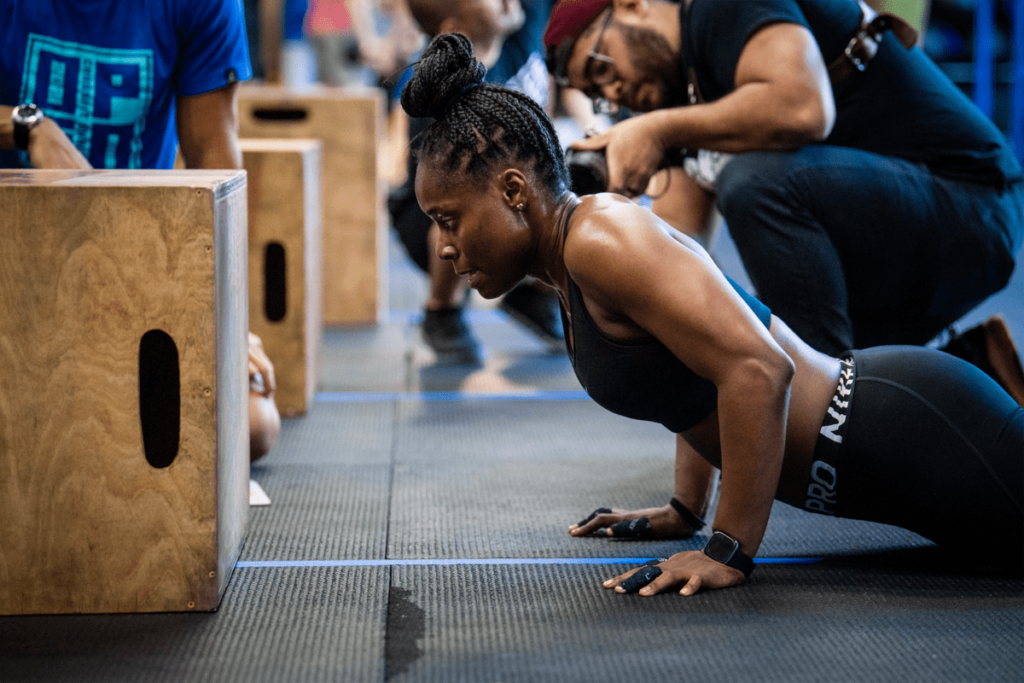


A one-minute push-up test looks simple: get into position, start the clock, and count your reps. But your score can change depending on how deep you go, how quickly you move, whether you pause, and whether you use a full-body or modified push-up. That makes it surprisingly easy to compare your result with a number that came from a different test.
So what can a one-minute score tell you, and which numbers are useful to compare? The table below gives one research-based reference, with the details you need to interpret it fairly.
One-Minute Push-Up Benchmarks by Age
The table shows the middle 50 percent of scores in the Cooper Institute’s one-minute push-up norms. In other words, the lower number marks the 25th percentile and the higher number marks the 75th percentile in that reference group. The median is the middle score.
| Age | Men: middle 50 percent | Men: median | Women: middle 50 percent | Women: median |
|---|---|---|---|---|
| 20 to 29 | 24 to 44 | 33 | 11 to 27 | 18 |
| 30 to 39 | 19 to 36 | 27 | 9 to 19 | 14 |
| 40 to 49 | 13 to 29 | 21 | 7 to 15 | 11 |
| 50 to 59 | 9.5 to 24 | 15 | Not available | Not available |
| 60 and older | 7 to 22 | 15 | Not available | Not available |
These are reference values, not targets that everyone should be expected to hit. The men’s data came from an employee wellness program. The women’s data came from female US Army soldiers tested in the 1990s. The groups were not drawn from a single representative sample of the public, and the source does not provide women’s results above age 49. That missing information is not a reason to assume women should use the men’s scores.
The table also uses full-body push-ups for both men and women. If you do knee push-ups, incline push-ups, or another variation, your score cannot be compared directly with these figures.
What a One-Minute Push-Up Test Measures
A push-up uses the chest, shoulders, and triceps to move the body away from the floor. Holding a stable body position also requires the trunk and other muscles to contribute. Repeating the movement for a minute tests muscular endurance: your ability to keep producing force over repeated repetitions.
It is not a complete measure of fitness. The result does not directly tell you how strong you are in every movement, how healthy your heart is, or how well you perform in sports. It is one measure of how many push-ups you can complete under a particular set of rules.
Research has found a relationship between push-up capacity and other measures of physical fitness, but that does not make the test a diagnosis. A study of 152 adults found that push-up performance was associated with grip strength. The participants were a convenience sample, and the study’s authors described their results as an initial assessment rather than a universal standard.
How to Count Your Reps Fairly
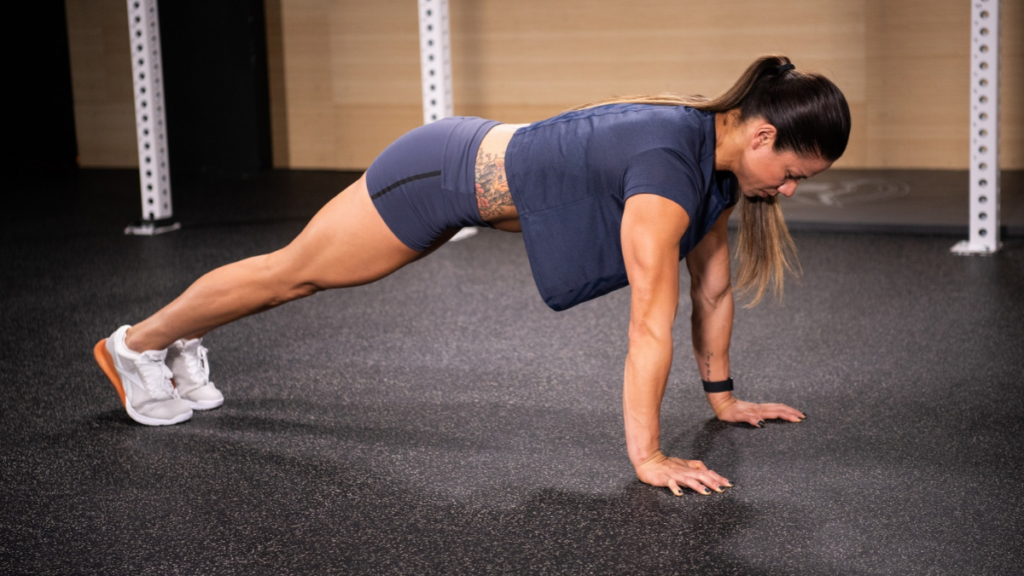
Before testing, decide which push-up variation you will use and stick with it whenever you repeat the test. The benchmark table above is based on full-body push-ups. Start with your hands slightly wider than shoulder-width apart, elbows straight, and body held in a straight line from shoulders to feet.
Lower under control until your chest reaches a consistent depth target or your elbows bend to about 90 degrees. Then press back up until your elbows are straight. Count a repetition only when you complete both parts of the movement while keeping your body position steady.
The Cooper-style test allows you to rest in the top position, but the clock keeps running. If your hips sag, your chest does not reach the chosen depth, or you do not straighten your arms at the top, that repetition does not meet the test standard. These rules matter because shortening the movement can raise your score without showing an improvement in full-range push-up endurance.
Warm up before you test. Use a few easy arm movements and several comfortable push-ups, then rest before starting the timed attempt. Try to test under similar conditions each time, including the same variation, depth, and rest rules. That makes your own progress easier to interpret, even if your result is not a perfect match for a published norm.
Why Your Score May Differ From the Table
A push-up count depends on more than age. Training history, body size, technique, fatigue, health, and the test rules can all affect how many repetitions you complete. A faster pace may produce a higher count, but only if the repetitions still meet the agreed movement standard.
The reference groups also matter. The Cooper Institute’s age and sex norms are descriptive comparisons drawn from specific populations. They do not establish a minimum score needed for good health. A separate study of state highway patrol officers reported age-specific push-up data for male officers, but those results describe an occupational group, not the general public. That is one reason different charts can show different numbers.
Do not compare a one-minute test with a test that has no time limit, uses a set cadence, or counts modified push-ups. Those formats measure performance under different conditions. A score from one format cannot be converted into another with a reliable, universal formula.
Does a Higher Score Mean Better Health?
A higher score generally means you completed more repetitions in that test. It does not prove that you are healthier overall. Push-ups do not measure every part of health, and one test should not be used to diagnose a medical condition.
A study of 1,104 active adult men found that higher push-up capacity was associated with fewer cardiovascular events during the study period. The participants were men attending an occupational health assessment, and the test did not use the same one-minute format as the Cooper table. The researchers also said that further research was needed to determine how well the findings apply to the general population. The result is interesting, but it does not mean a specific push-up score can predict an individual’s health.

If your score is lower than the table’s middle range, it is still just a starting point. You can record your current result and repeat the same test later. A gradual increase in clean repetitions can show that your performance on this test has improved. If push-ups cause pain, or you have a health concern that affects exercise, choose a comfortable alternative and consider getting advice from a qualified health professional.
How to Use Your Result
Use the age table as context, not a verdict. If your result falls within the middle range, it means your count is similar to many people in that particular reference group. A result below or above it does not define your overall fitness, and the table is especially limited for women over 49.
What Is a Good Zone 2 Heart Rate Based on Your Age and Fitness Level?
For a more useful comparison, track your own result using the same technique and test rules each time. Record the number of full repetitions, the variation, and any changes to the test. That gives you a clearer picture of your progress than comparing scores from different charts or testing methods.
References
- Cooper Institute (2013) Physical fitness assessments and norms for adults and law enforcement. Dallas, TX: The Cooper Institute.
- Dawes, J.J., Orr, R.M., Flores, R.R., Lockie, R.G., Kornhauser, C. and Holmes, R. (2017) ‘A physical fitness profile of state highway patrol officers by gender and age’, Annals of Occupational and Environmental Medicine, 29, article 16.
- Winslow, B., Natarajan, A., Mravca, S., Duong, J.J., Choudhary, S. and Norman Giest, T. (2025) ‘Active assessment of fitness and performance in a general population’, Frontiers in Sports and Active Living, 7, article 1552365.
- Yang, J., Christophi, C.A., Farioli, A. et al. (2019) ‘Association between push-up exercise capacity and future cardiovascular events among active adult men’, JAMA Network Open, 2(2), article e188341.
Key Takeaways
| Topic | Key takeaway |
|---|---|
| Age benchmarks | The table gives reference ranges from specific groups, not required scores for everyone. |
| Test technique | Compare scores only when you use the same push-up variation and movement rules. |
| Women over 49 | The Cooper Institute source does not provide age-based values for this group. |
| Health meaning | A push-up count is one measure of muscular endurance, not a diagnosis or complete health assessment. |
| Progress | Repeating the same test under similar conditions can help you track your own performance. |