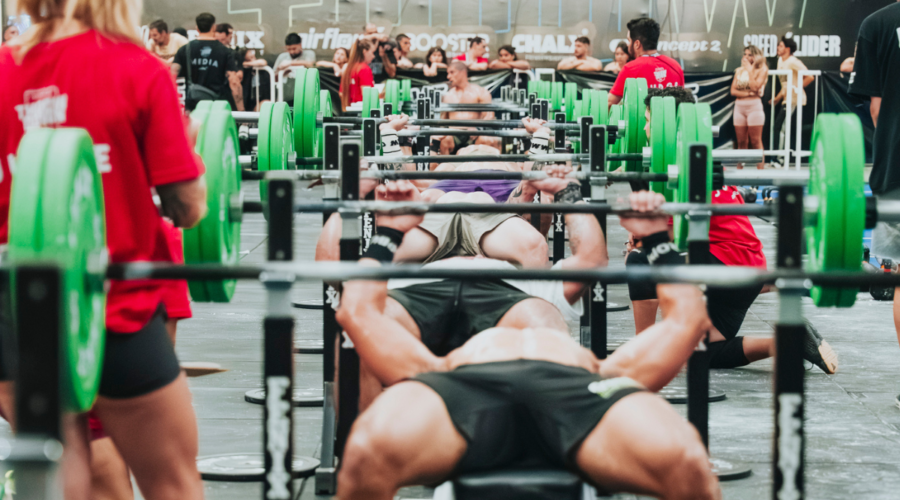


The dead stop bench press is often presented as a tougher, more honest version of the standard bench press. Each repetition starts from a complete pause on the safety pins, which removes the chance to bounce the bar from the chest or use momentum to escape the hardest part of the lift. That sounds ideal for chest growth, but muscle building is more nuanced than choosing the most difficult variation.
A bigger chest comes from accumulating enough hard, well performed training over time, usually through a combination of mechanical tension, sufficient weekly volume, progressive overload, and recovery. The dead stop bench press can contribute to those factors, especially if you need to improve strength from the bottom position or make your pressing more consistent. However, it is not automatically the perfect chest exercise, and its limitations matter just as much as its strengths.


What Is the Dead Stop Bench Press?
A dead stop bench press is performed in a power rack with safety pins set close to chest height. You lower the bar under control until it reaches the pins, allow it to settle completely, and then press from a motionless position. The pause should remove momentum rather than becoming a relaxed rest at the bottom.
This version differs from a paused bench press performed on the chest. In a chest pause, the bar remains supported by your body and the chest, shoulders, and arms continue to manage the load. In a dead stop rep, the pins carry the bar briefly before each press. That alters the task because you must create force from a static position without assistance from the stretch shortening cycle.
The stretch shortening cycle describes how a fast lowering phase can store elastic energy and support force production during the following upward phase. Research on resistance exercise has found that removing or reducing this rebound can make the concentric phase harder and reduce the load or repetition performance that trainees can achieve. This is why a true dead stop often feels dramatically harder than a touch and go bench press with the same weight.
Why Chest Growth Depends on More Than Exercise Difficulty
Muscle hypertrophy is strongly influenced by the amount of high effort work a muscle performs across training sessions. Research consistently shows that multiple sets produce more muscle growth than very low set volumes, although the ideal amount differs between people and must be balanced with recovery. Increasing weekly training volume can support hypertrophy when the work is productive and the trainee can continue progressing.
Mechanical tension is another major driver. In practical terms, the chest needs challenging sets in which the pectoral muscles must produce force through a meaningful range of motion. Heavy sets can provide high tension, but lighter sets can also build muscle when they are performed close enough to muscular failure. This gives you flexibility when selecting a bench press variation.
The dead stop bench press can create high tension, particularly near the bottom of the press. Yet a variation that is so demanding that it sharply reduces your usable range of motion, training volume, or technical consistency may not be the best hypertrophy choice. The most valuable exercise is usually the one that loads the target muscle effectively, feels stable, allows progressive overload, and can be repeated week after week without excessive joint irritation.
The Potential Benefits of the Dead Stop Bench Press
It Builds Strength From a Disadvantaged Position
Starting from a complete stop removes the assistance gained from a fast transition between lowering and lifting. The first few inches of the press require force production without a rebound, so the dead stop variation can expose weak points near the bottom position.

This can be useful for lifters who lose tightness when the bar reaches the chest, rely heavily on bouncing, or struggle to press heavy loads from the bottom. Specificity also matters in strength training. Adaptations are closely related to the demands imposed by the exercise, so practicing force production from a paused or static position can improve performance in similar pressing tasks.
For chest growth, this strength benefit can be valuable indirectly. Becoming stronger may allow you to use more load or perform more quality repetitions over time, provided that the movement remains controlled and the chest receives enough work.
It Encourages More Disciplined Technique
A dead stop creates a clear end point for every repetition. You cannot easily blur the bottom position with a rushed bounce, and you must reestablish a stable pressing position before driving the bar upward. For some lifters, this makes it easier to control bar path, shoulder position, and repetition quality.
Resistance training studies indicate that a full range of motion generally produces at least as much, and often more, hypertrophy than partial range training when the movements are comparable. A dead stop bench press can support consistent range of motion if the pins are set appropriately. The bar should reach a depth that allows the chest to work through a productive pressing range, rather than stopping several inches above the torso simply to move more weight.
It Can Reduce the Load Needed to Create a Hard Set
Because the lift starts from a dead stop, the weight that challenges you will usually be lower than in a fast touch and go bench press. That does not make the set less effective. Muscle growth can occur across a broad range of loads when sets are taken sufficiently close to failure.
Using somewhat lighter loads may be helpful for lifters who want demanding chest training without repeatedly exposing themselves to maximal or near maximal loading. However, lighter does not automatically mean easier on the joints. Pin height, grip width, bar path, fatigue, and individual shoulder tolerance all affect how the movement feels.
The Limitations for Chest Hypertrophy
The Pins Can Shorten the Effective Range of Motion
The biggest issue is setup. If the pins are too high, the bar stops before the chest reaches a long, stretched position. This may reduce the amount of productive work performed by the pectorals. Training at longer muscle lengths has attracted growing interest because several studies suggest that hypertrophy may be enhanced when resistance training includes challenging work in longer muscle positions.
That does not mean every chest exercise must force an extreme stretch. It does mean that a dead stop bench press should not become a disguised partial repetition. If the safety pins prevent a comfortable and consistent depth, a normal paused bench press, dumbbell press, or machine press may be a better chest building choice.
It May Limit Total Productive Volume
Dead stop reps are fatiguing. Each repetition demands a new forceful start, and the absence of momentum can reduce the number of repetitions you can perform with a given load. This makes the exercise useful for building strength, but it can also make it difficult to accumulate enough quality chest volume if it becomes your only press.
For example, a lifter may perform strong dead stop sets of three to five repetitions but find that their triceps, shoulders, or general fatigue limit the session before the chest has received enough stimulating work. In that situation, dead stop bench pressing can remain in the program while more stable, moderate repetition chest exercises supply additional hypertrophy volume.
It Is Not Necessarily More Chest Focused
The bench press involves the pectoralis major, triceps brachii, and anterior deltoid. Changes in grip, elbow position, torso arch, and bar path can shift the emphasis, but no barbell bench variation isolates the chest. A dead stop does not change this basic fact.
Electromyography research can describe muscle activation during exercises, but activation alone cannot prove superior hypertrophy. It is useful for understanding what muscles contribute to a movement, yet actual growth depends on the complete training dose over time. For that reason, it is better to judge the dead stop bench press by whether it helps you train the chest hard, progressively, and pain free rather than expecting it to outperform every other press by default.
How to Use It for a More Muscular Chest
Use the dead stop bench press as one tool within a broader chest program. Most lifters will benefit from setting the pins so the bar reaches a repeatable depth near the chest without forcing the shoulders into a painful position. Lower the bar with control, let it settle fully, keep the upper back tight, and press without losing your setup.
Moderate repetition work is usually the most practical starting point for hypertrophy. Sets of roughly six to ten repetitions can provide challenging loading while still allowing enough total work, although higher repetition sets can also be effective when performed close to failure. Leave a small margin before technical breakdown, especially when the bar starts on pins and the shoulders must remain stable at the bottom.
A sensible approach is to use the dead stop bench press for a few hard sets early in the session, then add a chest exercise that allows more volume and a comfortable stretch. A dumbbell press, cable fly, machine chest press, or standard paused bench press can fill that role depending on your equipment and joint tolerance. The exact exercise matters less than progressive training, adequate effort, and consistent execution.
So, Is It the Perfect Exercise?
The dead stop bench press is not the perfect exercise for a more muscular chest because no single movement is perfect for every lifter. It is a strong option for improving bottom position strength, limiting momentum, and making your bench press more disciplined. It can also provide a demanding chest stimulus when the pins are set at an appropriate depth and the exercise is programmed with enough total work.
Is Your Resting Heart Rate Healthy for Your Age?
Its main weakness is that it can become too limited if the pins shorten the range of motion or if the fatigue of repeated dead stops prevents you from accumulating productive chest volume. For most people, it works best as a valuable variation rather than the only chest exercise in the program.
If your goal is chest size, use the dead stop bench press when it feels good, helps you progress, and allows you to train the pectorals through a meaningful range. Combine it with enough weekly hard sets and at least one additional press or fly variation that you can load consistently. That is a more reliable path to building a muscular chest than searching for one magical lift.
Key Takeaways
| Factor | What it means for chest growth |
|---|---|
| Bottom position strength | The dead stop can improve force production from a static bottom position, which may support long term pressing progress. |
| Mechanical tension | It can create a challenging chest stimulus, especially when sets are hard and controlled. |
| Range of motion | Pin height must allow a meaningful depth, because excessively high pins can reduce productive chest work. |
| Training volume | The variation is demanding, so additional chest work may be needed to accumulate enough weekly volume. |
| Best role | It is usually most effective as part of a varied chest program rather than as the only pressing exercise. |
References
- American College of Sports Medicine (2009) ‘American College of Sports Medicine position stand: Progression models in resistance training for healthy adults’, Medicine & Science in Sports & Exercise, 41(3), pp. 687–708.
- Grgic, J., Schoenfeld, B.J., Skrepnik, M., Davies, T.B. and Mikulic, P. (2021) ‘Effects of rest interval duration in resistance training on measures of muscular strength: A systematic review’, Sports Medicine, 51(8), pp. 1623–1635.
- Lasevicius, T., Schoenfeld, B.J., Silva Batista, C., de Souza Junior, S.P., Neto, L.V., de Paula Lima, V., Nabuco, H.C.G., Bezerra, E.S. and Tricoli, V. (2018) ‘Muscle failure promotes greater muscle hypertrophy in low load but not in high load resistance training’, Journal of Strength and Conditioning Research, 36(2), pp. 346–352.
- McMahon, G.E., Morse, C.I., Burden, A., Winwood, K. and Onambélé, G.L. (2014) ‘Muscular adaptations and inflammation with high and low volume resistance training in trained men’, PLoS One, 9(6), e102136.
- Nunes, J.P., Schoenfeld, B.J., Vigotsky, A.D., Radaelli, R., de Souza, E.O., de Salles, B.F. and Cyrino, E.S. (2020) ‘Resistance training performed at a full range of motion produces greater muscular adaptations than partial repetitions: A systematic review and meta analysis’, Journal of Strength and Conditioning Research, 34(9), pp. 2680–2691.
- Schoenfeld, B.J. (2010) ‘The mechanisms of muscle hypertrophy and their application to resistance training’, Journal of Strength and Conditioning Research, 24(10), pp. 2857–2872.