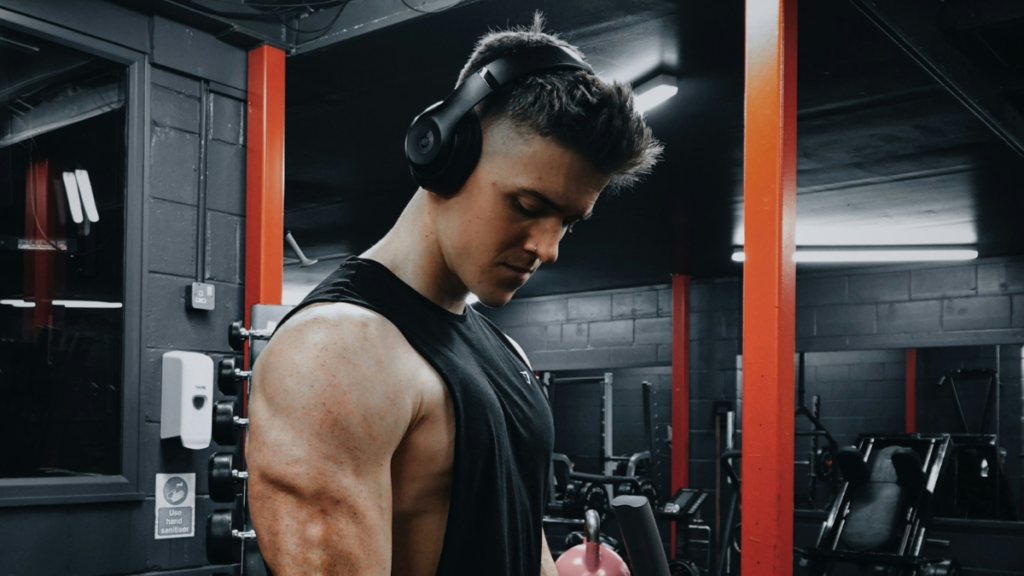


Broad shoulders are mostly a visual effect created by the lateral deltoids, which sit on the outer portion of each shoulder. Building these muscles can make the upper body appear wider and can create a stronger shoulder to waist contrast. Upright rows and lateral raises are both common choices for this goal, but they are not interchangeable.
The short answer is that lateral raises are usually the better primary exercise for building wider shoulders because they are designed around shoulder abduction, the main action of the lateral deltoid. Upright rows can still contribute to lateral deltoid development, especially when performed with a wider grip, but they also involve the upper traps, biceps, and other muscles to a greater degree. Neither exercise has been directly compared in a long term hypertrophy study, so the best answer comes from anatomy, biomechanics, muscle activation research, and the broader evidence on resistance training.


What Actually Makes Shoulders Look Wider?
The deltoid has three main regions: anterior, lateral, and posterior. The anterior deltoid sits at the front of the shoulder and assists with lifting the arm forward. The posterior deltoid sits at the rear and contributes to pulling the arm backward. The lateral deltoid lies between them and is the region most directly responsible for adding visible width from the front.
A well developed lateral deltoid does not literally change clavicle length or bone structure. It does, however, add muscle mass to the outer shoulder, increasing the apparent width of the upper torso. This is why people who already do plenty of pressing often still need direct lateral deltoid work. Pressing exercises strongly train the chest, triceps, and anterior deltoid, but they do not necessarily provide the same focused stimulus for the lateral deltoid as exercises based on shoulder abduction.
Shoulder width also depends on the upper back, body fat level, posture, and genetics. Nevertheless, if your goal is to build the widest possible shoulder silhouette through training, the lateral deltoid deserves deliberate attention.
How Lateral Raises Train the Lateral Deltoid
The Movement Pattern
A lateral raise involves lifting the arms outward from the sides of the body. This is shoulder abduction, which is a primary action of the lateral deltoid. Dumbbells, cables, machines, and resistance bands can all be used, although each option changes where the exercise is hardest.
The major advantage of a lateral raise is its specificity. The movement asks the lateral deltoid to perform the main job from the beginning to the end of each repetition. Other muscles contribute, including the supraspinatus and upper traps, but the exercise remains centered on lifting the upper arm away from the torso.
Research using electromyography has found substantial lateral deltoid activity during lateral raise variations. This evidence does not prove muscle growth by itself, because muscle activation and hypertrophy are not identical outcomes. It does show that the lateral deltoid is meaningfully involved in the exercise, which fits the movement’s anatomy and purpose.
Why Load Feels Limited
Many lifters think lateral raises are ineffective because they cannot use very heavy dumbbells. That is not a weakness of the exercise. The lateral deltoid is a relatively small muscle, and the long lever created by the arm makes even modest external loads demanding.
The goal is not to turn a lateral raise into a partial upright row with momentum. The goal is to create hard, controlled repetitions that challenge the target muscle. Resistance training research shows that hypertrophy can occur across a broad range of loads when sets are performed with sufficient effort. It also suggests that muscle growth tends to improve as sets are taken closer to failure, although precise repetition in reserve targets remain difficult to measure perfectly.
Cardio vs Strength Training – Which Is More Important After 40?
For lateral raises, this usually means using a load that allows controlled repetitions without aggressive torso swing. A moderate to high repetition range is often practical because it lets the lifter accumulate challenging work while maintaining a more consistent movement path.
Exercise Variations Matter
Cable lateral raises can be useful because the cable may provide meaningful resistance in the lower portion of the movement, where a dumbbell produces less torque. Machine lateral raises can help people stabilize the torso and focus on the shoulder. Dumbbell lateral raises are simple and accessible, but they require more control because the resistance changes across the arc of motion.
No single variation is mandatory. The best option is the one that lets you train the lateral deltoid hard, progressively, and without persistent discomfort.
How Upright Rows Train the Shoulders
The Movement Pattern
An upright row involves pulling a barbell, dumbbells, cable attachment, or other resistance upward along the torso. The elbows travel outward and upward while the shoulder performs a combination of abduction and elevation. This can recruit the lateral deltoid, but it also recruits the upper trapezius and elbow flexors.
An electromyography study in trained men found that grip width changed muscle activity during upright rows. Wider grips increased activity in the lateral deltoid and trapezius while reducing biceps involvement compared with narrower grips. This makes practical sense because a wider grip allows the elbows to move more outward, creating a movement that more closely resembles shoulder abduction.
That finding supports wide grip upright rows as a potentially useful shoulder exercise. It does not establish that upright rows build more lateral deltoid size than lateral raises. The study measured immediate electrical activity during repetitions, not long term changes in muscle thickness or circumference.
The Upper Trap Factor
Upright rows are not a pure lateral deltoid exercise. The upper traps help elevate the shoulder girdle, particularly as the elbows rise. This is useful if you want a compound movement that trains both the deltoids and upper traps, but it can be less ideal if your only goal is to target the lateral deltoid as directly as possible.
For some lifters, this is a benefit. Heavy or moderately loaded upright rows can efficiently train multiple muscles in a short session. For others, the upper trap contribution can make it harder to tell whether the lateral deltoid is receiving enough focused work. If your traps dominate easily, upright rows may feel more like a shrug combined with a pull than a shoulder width builder.
Comfort and Shoulder Position
Upright rows have a mixed reputation because some people experience shoulder discomfort during them. The combination of shoulder abduction and internal rotation can be provocative for certain individuals, especially when the elbows are pulled very high or a narrow grip is used. Shoulder symptoms are complex and cannot be reduced to one exercise or one joint position, but pain during a lift is still useful feedback.
You do not need to force an upright row simply because it is popular. A wider grip, dumbbells, cables, and stopping when the elbows reach roughly shoulder height may improve comfort for some people. If the movement repeatedly causes pain, lateral raises are usually an easier substitute for shoulder width training.
Which Exercise Is Better for Wider Shoulders?
Lateral raises win as the better primary exercise for wider shoulders. They place the lateral deltoid at the center of the movement, require less contribution from the biceps and upper traps, and are easy to adapt with dumbbells, cables, machines, or bands. They are also straightforward to perform for enough weekly volume to support hypertrophy.
Upright rows are better viewed as a secondary option. They can be productive if you enjoy them, tolerate them well, and want to train the deltoids and upper traps together. A wide grip is the more logical choice when lateral deltoid involvement is the priority. Still, the compound nature of the lift means it is less specific than a lateral raise.
The broader resistance training literature indicates that greater weekly training volume is generally associated with greater muscle growth, although the ideal amount varies between people. This matters more than endlessly debating one exercise. A lifter who performs quality lateral raises consistently, progresses gradually, and recovers well will likely build more shoulder width than someone who keeps changing exercises without accumulating enough productive training.
How to Program Both Exercises

Lateral Raises as the Foundation
Use lateral raises as your main direct lateral deltoid movement. Most lifters can begin with several hard sets per week and adjust based on performance, soreness, and recovery. Multiple sessions can be useful because lateral raises are usually less systemically fatiguing than heavy compound lifts.
Choose a resistance that lets you control the lowering phase and avoid throwing the dumbbells upward. Slight body movement near the end of a demanding set is not automatically a problem, but repeated momentum from the first few repetitions usually means the load is too heavy.
Keep your attention on moving the upper arm outward rather than simply lifting the hands. Raise only through a range that feels controlled and comfortable. There is no scientific requirement to chase a specific arm angle if doing so irritates your shoulders.
Upright Rows as an Addition
If upright rows feel good, use them after pressing or alongside other shoulder work. Dumbbells and cables can make it easier to find a comfortable hand position than a fixed straight bar. A wider than shoulder width grip is supported by the available activation research when your aim is greater deltoid involvement.
Keep the load controlled and avoid treating the movement as an ego lift. The lateral deltoids do not need maximal barbell loading to grow. A movement that you can repeat consistently without discomfort is more valuable than one that occasionally produces impressive numbers but disrupts training.
The Bottom Line
For the specific goal of building wider looking shoulders, lateral raises are the clear first choice. They match the primary function of the lateral deltoid and make it easier to give that muscle focused, repeatable training.
Upright rows can still earn a place in a shoulder program, particularly with a wider grip and a comfortable range of motion. They are best treated as a compound accessory that can complement lateral raises, not replace them. Prioritize progressive, hard sets for the lateral deltoids, use enough weekly volume that you can recover from, and choose movements that let you train without pain.
Key Takeaways
| Exercise comparison | Practical conclusion |
|---|---|
| Best primary exercise for shoulder width | Lateral raises are usually the stronger choice because they directly emphasize shoulder abduction and the lateral deltoid. |
| Role of upright rows | Upright rows can build the deltoids and upper traps together, but they are less specific to the lateral deltoid. |
| Grip choice for upright rows | A wider grip increases lateral deltoid and trapezius activity compared with a narrower grip. |
| Best training priority | Accumulate challenging, recoverable weekly sets and progress gradually over time. |
| If upright rows hurt | Use lateral raises or another pain free shoulder abduction variation instead. |
References
- Campos, Y.A.C., Vianna, J.M., Guimarães, M.P., Oliveira, J.L., Hernandez Mosquera, C.A., Marchetti, P.H. and Simão, R. (2020) ‘An electromyographic analysis of lateral raise variations and frontal raise in competitive bodybuilders’, International Journal of Environmental Research and Public Health, 17(17), 6015.
- McAllister, M.J., Schilling, B.K., Hammond, K.G., Weiss, L.W. and Farney, T.M. (2013) ‘Effect of grip width on electromyographic activity during the upright row’, Journal of Strength and Conditioning Research, 27(1), pp. 181 to 187.
- Schoenfeld, B.J., Ogborn, D. and Krieger, J.W. (2017) ‘Dose response relationship between weekly resistance training volume and increases in muscle mass: A systematic review and meta analysis’, Journal of Sports Sciences, 35(11), pp. 1073 to 1082.
- Terada, M., Pietrosimone, B.G. and Gribble, P.A. (2010) ‘Individuals with chronic ankle instability exhibit altered postural control and neurophysiological measures’, Journal of Athletic Training, 45(5), pp. 439 to 447.
- Vieira, A.F., Umpierre, D., Teodoro, J.L., Lisboa, S.C., Baroni, B.M., Izquierdo, M. and Cadore, E.L. (2024) ‘Exploring the dose response relationship between estimated resistance training proximity to failure, strength gain, and muscle hypertrophy: A series of meta regressions’, Sports Medicine, 54, pp. 2209 to 2231.