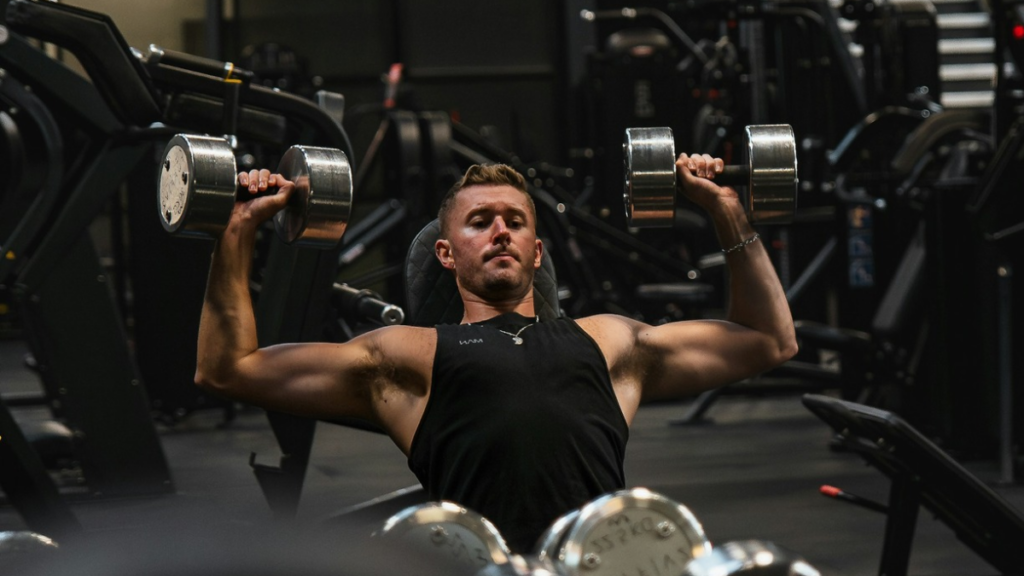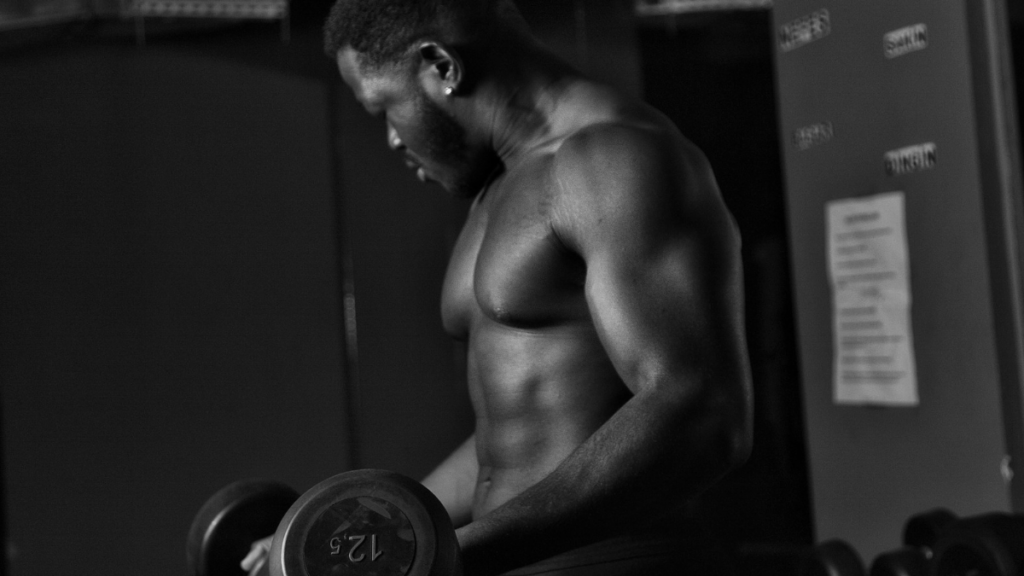


A more attractive upper body is not about chasing one “perfect” body type. It is about building a balanced shape that looks strong in clothes and feels capable when you train. For most people, that means developing the chest, shoulders, and upper back. These areas create much of the visual width and structure of the torso, while stronger pressing and pulling muscles also make everyday movements and gym training easier to perform.
You do not need a complicated exercise menu to make meaningful progress. A pair of dumbbells gives you enough versatility to train the major muscles of the upper body through challenging ranges of motion. Dumbbells also let each side work independently, which can help prevent the stronger side from doing a disproportionate share of the work.


The three exercises in this article are the dumbbell bench press, dumbbell lateral raise, and single arm dumbbell row. Together, they train the chest, triceps, front and side shoulders, lats, upper back, and biceps. That combination covers the areas most people want to improve when they say they want a stronger, more athletic looking upper body.
Add them into your training and start seeing the results that you want!
Why These Muscles Change Your Upper Body Shape
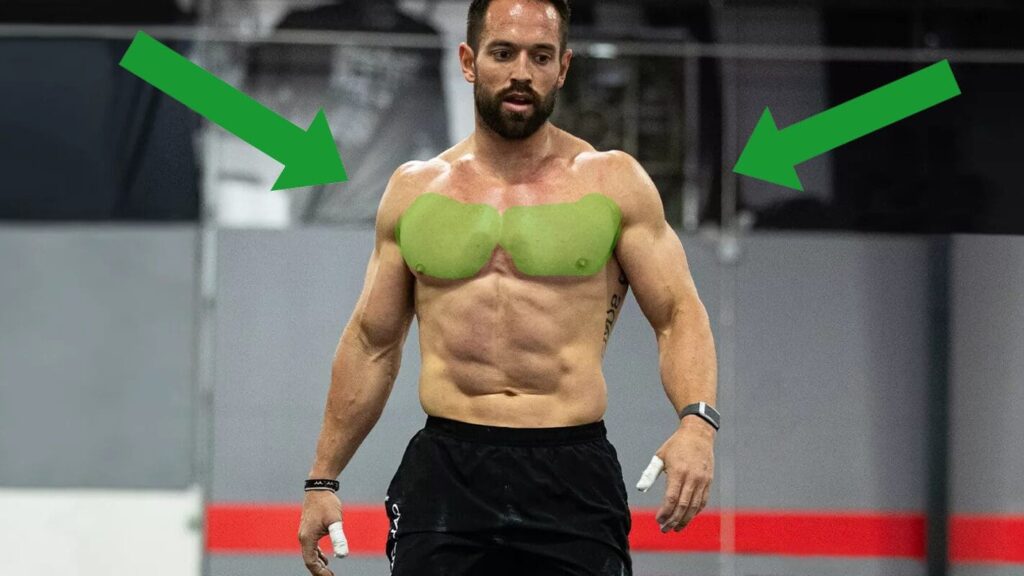
Your chest, shoulders, and upper back have a major influence on your silhouette. A well developed chest can make the torso look more substantial from the front. Strong side deltoids can add visible shoulder width. Developing the lats and upper back can create more contrast between the upper torso and waist, contributing to the broad upper body shape many lifters want.
There is also a practical reason to train all three areas. Pressing movements train muscles on the front of the body, while rowing movements train muscles on the back. Including both helps create a more complete upper body program instead of putting all your effort into chest and arm exercises. Strength training can increase muscle size when exercises are performed consistently with sufficient effort and progressive overload, meaning the training demand gradually becomes harder over time.
3 Best Cable Machine Exercises for a Jacked and More Attractive Upper Body
Research suggests that higher weekly training volume is generally associated with greater muscle growth, although the right amount varies from person to person. You do not need to perform endless sets in one session. The more useful approach is to give each target muscle several hard sets across the week, recover well, and increase the repetitions or load when your current workout becomes manageable.
Exercise One: Dumbbell Bench Press
The dumbbell bench press is one of the most efficient exercises for building the chest while also training the triceps and front of the shoulders. It is a strong first choice because you can load it progressively, use a substantial range of motion, and make small adjustments to suit your shoulder comfort.
How to Perform the Dumbbell Bench Press
Sit at the end of a flat bench with a dumbbell resting on each thigh. Carefully lie back while bringing the dumbbells to chest level. Keep your feet planted firmly on the floor and allow a small natural arch in the lower back.
Start with the dumbbells over the middle of your chest, with your palms facing forward or turned slightly inward. Lower the weights slowly until your upper arms are close to parallel with the floor and your elbows are comfortably below the bench line. Your exact depth will depend on your shoulder mobility and whether you can maintain a stable position without pain.
Press the dumbbells upward and slightly inward until your arms are straight, but do not aggressively bang the weights together at the top. Keep your shoulder blades gently pulled back and down against the bench throughout the set. This gives your chest and shoulders a stable platform from which to press.
Why It Works
The chest is the primary mover in pressing exercises such as the bench press, with assistance from the triceps and anterior deltoid. The dumbbell version requires each arm to stabilize and press its own load. This can make the movement feel more demanding than a barbell press with the same total weight, especially when you first begin using it.
Dumbbells may also allow a slightly more individualized path than a fixed barbell. Some people find that a neutral or semi neutral grip is more comfortable for the shoulders. Comfort matters because the best chest exercise is one you can perform hard, consistently, and with sound technique.
Use a weight that lets you complete around six to 15 controlled repetitions. The final few repetitions should feel difficult while still allowing you to keep your shoulder blades stable and your wrists stacked over your elbows. If the dumbbells wobble uncontrollably or your shoulders roll forward, reduce the load.
Exercise Two: Dumbbell Lateral Raise
The dumbbell lateral raise directly targets the side deltoid, the part of the shoulder that contributes most clearly to upper body width. It is not an exercise for ego lifting. In fact, using a weight that is too heavy often shifts the work away from the shoulders and turns the movement into a momentum driven swing.
How to Perform the Dumbbell Lateral Raise
Stand tall with a dumbbell in each hand and your arms by your sides. Keep a soft bend in the knees and brace your midsection. Turn your palms toward your thighs or slightly forward.
Raise both dumbbells outward and upward in a wide arc. Keep a small bend in the elbows as you lift. Stop when your upper arms are roughly level with your shoulders, or slightly below that point if going higher causes discomfort. Lower the dumbbells slowly and under control until they return to your sides.
Think about moving your elbows outward rather than trying to lift the dumbbells with your hands. Keep your neck relaxed and avoid shrugging your shoulders toward your ears. A slight forward lean can help some people keep the tension on the side deltoids, but it should be subtle and controlled.
Why It Works
The deltoids are made up of several regions that contribute to different shoulder movements. Pressing exercises involve the front of the shoulder, while lateral raises specifically train shoulder abduction, which is the action of lifting the arm away from the body. This makes lateral raises a useful complement to pressing movements rather than a redundant extra.
Because the side deltoids are relatively small muscles, they usually respond better to controlled repetitions than maximal loads. Select dumbbells that allow you to feel the shoulders working without leaning backward, swinging the weights, or snapping through the bottom of the movement. Sets of around 10 to 20 repetitions are often practical for this exercise.
As you become stronger, progress by adding repetitions first. When you can perform the upper end of your chosen repetition range with clean technique, increase the dumbbell weight by the smallest available amount. Small improvements add up quickly when you train the exercise consistently.
Exercise Three: Single Arm Dumbbell Row
The single arm dumbbell row builds the latissimus dorsi, upper back, rear shoulders, and elbow flexor muscles. It is an essential counterbalance to pressing and one of the most useful movements for developing a thicker, more complete looking upper body.
How to Perform the Single Arm Dumbbell Row
Place one knee and the same side hand on a flat bench. Keep the other foot on the floor and hold the dumbbell in the free hand. Set your torso so it is close to parallel with the floor, while keeping your spine in a comfortable neutral position.
Let the dumbbell hang toward the floor beneath your shoulder. Pull your elbow back toward your hip, keeping it reasonably close to your body. Think about driving the elbow rather than curling the weight with your hand. Pause briefly when you reach the top of the movement, then lower the dumbbell slowly until your arm is straight again.
Avoid twisting your torso to get the dumbbell higher. A small amount of natural movement is normal with challenging weights, but large rotation usually means the load is too heavy. Your goal is to train the back muscles through a controlled pull, not to find the heaviest dumbbell you can move from the floor to your ribs.
Why It Works
Rowing movements train the back through shoulder extension and scapular movement. The latissimus dorsi is particularly important because it is a large muscle of the back that contributes to the appearance of upper body width. The muscles around the shoulder blades also help support strong posture and stable pressing mechanics.
The single arm setup lets you focus on one side at a time and can make it easier to use a long, controlled range of motion. You can adjust the elbow path slightly to emphasize different areas of the back. Pulling the elbow closer toward the hip generally encourages a stronger lat focused sensation, while allowing the elbow to travel somewhat farther out can involve more of the upper back and rear shoulder area.
Use a load that allows around eight to 15 repetitions per side with a controlled lowering phase. Train both sides evenly, beginning with the side that feels weaker if there is a noticeable difference.
How to Turn These Exercises Into Muscle Growth
Performing the right exercises matters, but results come from how you organize and progress them. Train the three movements two or three times per week, leaving enough recovery between sessions for your muscles to adapt. You can complete them in one upper body workout, or include them in full body sessions.
Start with two or three challenging sets for each exercise in a workout. For the bench press and row, stop with roughly one to three repetitions left before technical failure. For lateral raises, you can work closer to failure provided your form remains controlled. Research indicates that a wide range of loads can stimulate muscle growth when sets are performed with enough effort, so you do not need extremely heavy dumbbells to build muscle.

Progressive overload does not always mean adding weight every session. Add one repetition, improve your range of motion, slow down the lowering phase, or use better control before increasing the load. Keep a simple record of your weights and repetitions. If you perform three sets of 10 repetitions on the dumbbell bench press one week, aim for 11 repetitions on one or more sets next time. Once you reach your chosen repetition target, move up to heavier dumbbells and build again.
Food and recovery also affect progress. Resistance training provides the stimulus, but adequate energy intake and dietary protein support the muscle building process. Evidence indicates that protein intake above the basic minimum recommendation can further support gains in lean mass from resistance training, particularly when total daily intake is sufficient and protein is spread across regular meals.
Common Mistakes That Limit Results
The first mistake is changing exercises too often. Variation can be useful, but constantly replacing movements makes it difficult to measure progress. Keep these three exercises in your program long enough to get stronger at them.
The second mistake is using poor technique to lift more weight. A partial repetition with a swinging torso may look impressive for a moment, but it gives you less reliable training stimulus and raises the chance that your joints will become irritated. Controlled technique makes it easier to train hard and repeat that work every week.
The third mistake is training only the muscles you can see in the mirror. Chest and shoulders are important, but your back deserves equal attention. Strong rows improve the balance of your program and help develop the upper body from the side and back as well as the front.
The Bottom Line
You can build a more muscular, balanced, and attractive upper body with a simple dumbbell routine. The dumbbell bench press develops the chest and pressing muscles. The lateral raise helps build shoulder width. The single arm row trains the lats and upper back, giving the torso more depth and visual balance.
Train each movement consistently, use controlled technique, and make gradual progress over time. You do not need a crowded workout plan. You need a handful of effective exercises, enough hard sets, and the patience to keep improving them.
Bibliography
- Schoenfeld, B.J., Ogborn, D. and Krieger, J.W. (2017) ‘Dose response relationship between weekly resistance training volume and increases in muscle mass: A systematic review and meta analysis’, Journal of Sports Sciences, 35(11), pp. 1073–1082.
- Schoenfeld, B.J., Grgic, J., Ogborn, D. and Krieger, J.W. (2017) ‘Strength and hypertrophy adaptations between low versus high load resistance training: A systematic review and meta analysis’, Journal of Strength and Conditioning Research, 31(12), pp. 3508–3523.
- Schoenfeld, B.J., Contreras, B., Tiryaki Sonmez, G., Wilson, J.M., Kolber, M.J. and Peterson, M.D. (2015) ‘Regional differences in muscle activation during hamstrings exercise’, Journal of Strength and Conditioning Research, 29(1), pp. 159–164.
- Trebs, A.A., Brandenburg, J.P. and Pitney, W.A. (2010) ‘An electromyography analysis of 3 muscles surrounding the shoulder joint during the performance of a chest press exercise at several angles’, Journal of Strength and Conditioning Research, 24(7), pp. 1925–1930.
- Wirth, K., Hartmann, H., Mickel, C., Szilvas, E., Keiner, M. and Sander, A. (2016) ‘Core stability in athletes: A critical analysis of current guidelines’, Sports Medicine, 47(3), pp. 401–414.
- Vigotsky, A.D., Halperin, I., Lehman, G.J., Trajano, G.S. and Vieira, T.M. (2018) ‘Interpreting signal amplitudes in surface electromyography studies in sport and rehabilitation sciences’, Frontiers in Physiology, 8, article 985.
- Morton, R.W., Murphy, K.T., McKellar, S.R., Schoch, R.D., Henselmans, M., Helms, E., Aragon, A.A., Devries, M.C., Banfield, L., Krieger, J.W. and Phillips, S.M. (2018) ‘A systematic review, meta analysis and meta regression of the effect of protein supplementation on resistance training induced gains in muscle mass and strength in healthy adults’, British Journal of Sports Medicine, 52(6), pp. 376–384.
Key Takeaways
| Exercise | Main muscles trained | Practical target | Main purpose |
|---|---|---|---|
| Dumbbell bench press | Chest, triceps, front shoulders | 2 to 3 sets of 6 to 15 repetitions | Builds pressing strength and chest size |
| Dumbbell lateral raise | Side shoulders | 2 to 3 sets of 10 to 20 repetitions | Adds visible shoulder width |
| Single arm dumbbell row | Lats, upper back, rear shoulders, biceps | 2 to 3 sets of 8 to 15 repetitions per side | Builds back width, thickness, and upper body balance |
| Weekly approach | All target muscles | Train two or three times weekly | Build progress through consistent hard sets and gradual overload |