

A stronger, more muscular chest comes from training the pectoralis major with exercises that let you press against resistance and gradually do more over time. Compound movements are useful because they train the chest alongside muscles such as the triceps and front of the shoulders. They also give you several ways to adjust your training, from adding weight to changing the angle or using your body weight.
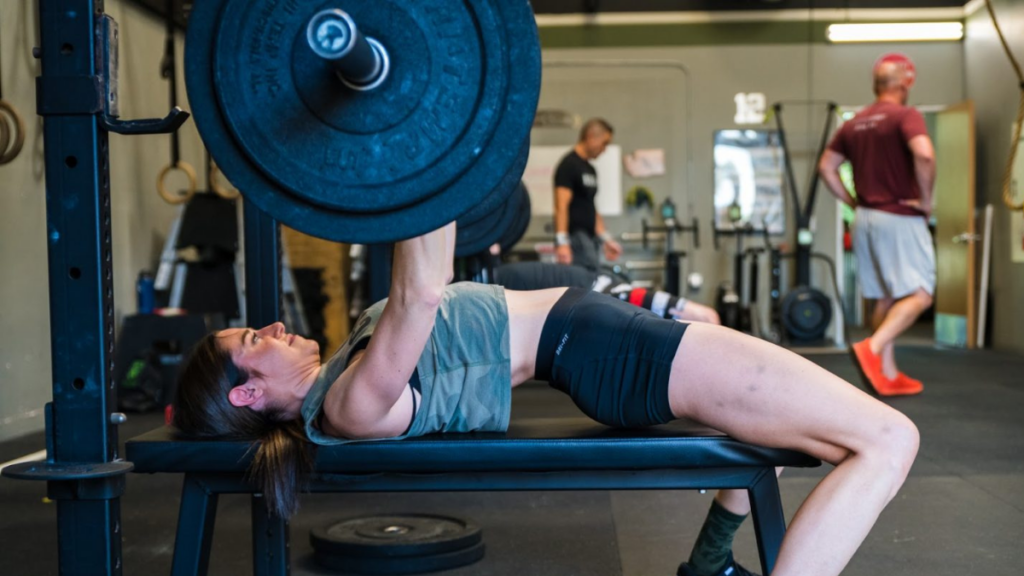
These three exercises make a practical chest routine: the flat bench press, the low incline dumbbell press, and the push up. The first two let you train with external loads, while the push up is easy to adapt to your current strength and equipment. Research on pressing angles suggests that a flat press and an incline press can place different emphasis across regions of the pectoralis major. Push ups can also build chest muscle when the challenge is appropriate and the sets are sufficiently demanding.


No single exercise guarantees a bigger chest. Consistent training, sets that are challenging while still controlled, and gradual progression matter more than chasing a perfect movement. The exercises below give you a good starting point.
What Makes a Compound Exercise Useful for Chest Growth?
The pectoralis major is a large chest muscle with fibers that run in different directions. The clavicular region is nearer the collarbone, while the sternocostal region covers much of the middle and lower chest. Pressing movements train the chest as the arms move forward and inward, but changing your body position can shift the emphasis between regions.
Push-Ups vs Dumbbell Press: Which Builds a Bigger Chest?
Compound presses also involve the shoulders and elbows. That means the front of the shoulders and the triceps help move the weight. This is useful for building pressing strength, although it also means that the chest is not working alone. A press that feels comfortable, allows a stable range of motion, and can be progressed over time is a better choice than a variation that causes pain or requires you to sacrifice control.
Studies comparing flat and inclined bench pressing have found differences in muscle activity across regions of the pectoralis major. These studies measure acute muscle activity, however, which does not prove that one exercise will always produce more long term growth. A training study comparing horizontal and incline bench presses found muscle thickness changes at one measurement site differed between groups, while other outcomes were similar. Together, this supports using pressing angles to provide a useful training variation without treating one angle as a universal solution.
1. Flat Bench Press
The flat bench press is a strong foundation for chest training because it lets you use a barbell or dumbbells to progressively increase the resistance. The horizontal position places substantial demands on the middle and lower regions of the pectoralis major, while the shoulders and triceps assist with the press.
How to do it
Lie on a flat bench with your eyes beneath the bar. Set your feet firmly on the floor, and keep your upper back stable against the bench. Grip the bar a little wider than shoulder width, then lift it from the rack with your elbows extended. Bring the bar down under control toward the middle of your chest, keeping your forearms close to vertical near the bottom. Press the bar upward until your arms are extended without forcefully locking your elbows.
Keep your wrists stacked over your forearms and avoid bouncing the bar off your chest. Use a range of motion that lets you lower the bar comfortably while keeping your shoulders stable. If you have a spotter, ask them to help with the unrack and to stand by during challenging sets. If you train alone, use safety arms set just below the depth you can reach while maintaining your normal position.
Dumbbells offer another way to perform a flat press. They allow each arm to move independently and can be easier to set up for some lifters, although getting heavy dumbbells into position can be difficult. Choose the version that you can perform safely and consistently.
Why it works
The flat bench press trains the chest through a pressing action while allowing you to use loads that can be adjusted in small increments. A study that compared different bench angles found greater activity in the middle and lower regions of the pectoralis major during the horizontal press than during steeper inclines. Those findings describe muscle activity during the exercise rather than guaranteed muscle growth, but they help explain why the flat press is a useful chest movement.
For muscle growth, the amount of weight on the bar is only one part of the picture. A load you can lift with control, for enough repetitions, can be productive if the set is challenging. If your repetitions become uneven, your shoulders start to hurt, or you need to bounce the bar to finish, reduce the load and rebuild with better control.
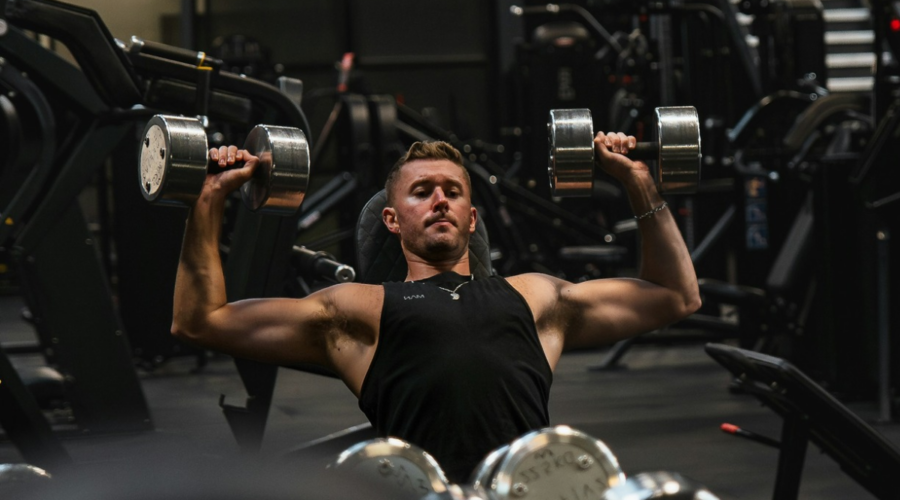
2. Low Incline Dumbbell Press
A low incline press changes the angle of the pressing movement and can place greater emphasis on the clavicular region of the chest. Dumbbells give each arm room to move independently, which some people find more comfortable than a fixed bar path. Set the bench at a modest incline, around 15 to 30 degrees, rather than raising it steeply.
How to do it
Sit on the bench with a dumbbell resting on each thigh. Use your legs to help bring the dumbbells into position as you lie back. Hold them above your chest with your palms facing forward or slightly turned inward. Lower the weights slowly toward the upper chest, keeping your elbows below your wrists and your forearms close to vertical. Press the dumbbells upward and slightly inward, stopping before they collide.
Keep your shoulder blades supported against the bench and avoid letting your lower back arch excessively. The dumbbells should follow a smooth path that feels stable. If you cannot control the weights at the bottom, shorten the range slightly or choose lighter dumbbells. A comfortable depth is more useful than forcing a deep stretch that irritates your shoulders.
Why it works
Inclining the bench changes the direction of the press. In studies of bench angle, a 30 degree incline produced greater activity in the upper portion of the pectoralis major than a flat bench press, while steeper angles increased the contribution of the front shoulder. Another study using a different measurement approach found that the region of highest muscle activity shifted toward the clavicular area during an incline press.
This makes a low incline a sensible complement to the flat bench press. It gives you a second pressing angle and may help you train the upper chest region without turning the movement into something closer to a shoulder press. Research comparing flat and incline training has not shown that everyone needs both angles to make progress, so use the incline as a way to round out your routine rather than as a mandatory fix.
3. Push Up
The push up is a compound chest exercise that needs little equipment. It trains the chest, shoulders, and triceps while asking your trunk to stay firm. You can make it easier by elevating your hands or harder by adding resistance, so it can remain useful as your strength changes.
How to do it
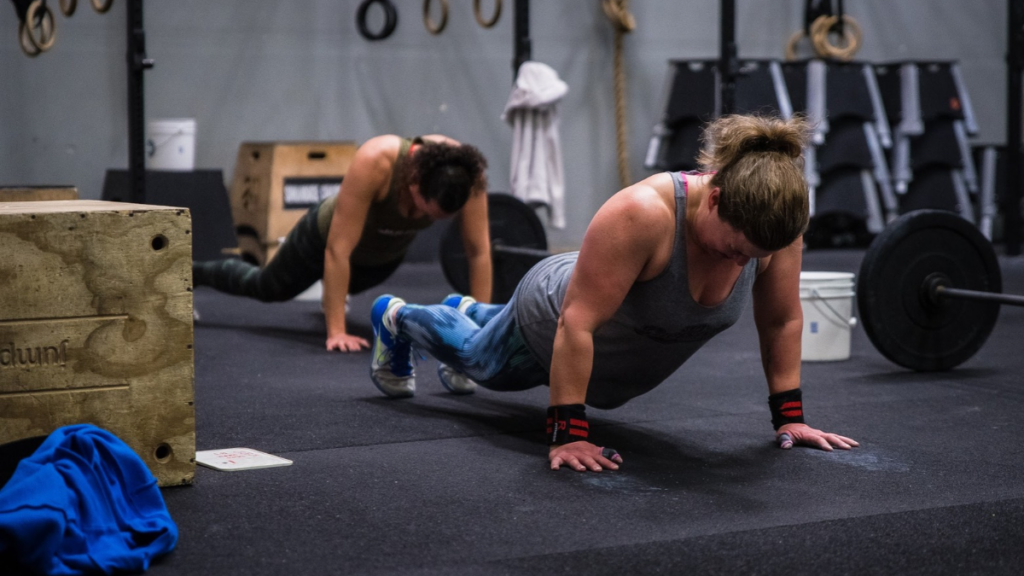
Start in a high plank with your hands slightly wider than shoulder width. Keep your body in a straight line from head to heels, brace your midsection, and look at the floor a short distance in front of your hands. Bend your elbows and lower your chest toward the floor under control. Keep your elbows angled slightly back from your shoulders instead of flaring them directly out to the sides. Push the floor away until your arms are extended and return to the starting position.
If a full push up is too difficult to perform with steady form, place your hands on a bench or sturdy elevated surface. As you become stronger, lower the hand position gradually until you can perform the movement from the floor. If standard push ups become easy, add a resistance band across your upper back or use a securely fitted weight vest. Avoid placing a loose plate on your back without a training partner who can position and remove it safely.
Why it works
A small randomized training study in untrained young men found that push ups adjusted to create a load similar to a light bench press produced comparable chest muscle thickness and strength changes over eight weeks. The study was limited in size and duration, so it does not establish that push ups are equal to every bench press program for every lifter. It does show that body weight training can provide a meaningful chest stimulus when the exercise is challenging enough.
The main challenge with push ups is progression. If you can complete many repetitions without approaching a demanding effort, change the variation or add resistance. If you cannot keep your body aligned, use an easier angle and build up gradually. A challenging set should leave you with only a few good repetitions in reserve, rather than forcing you to continue with sagging hips or shortened repetitions.
How to Put These Exercises Into a Chest Workout
A straightforward session could include the flat bench press, low incline dumbbell press, and push up. Start with the press that matters most to you while you are fresh, then move to the other exercises. For example, you could perform three sets of the flat bench press, three sets of the incline dumbbell press, and two or three sets of push ups. Use a repetition range that lets you maintain good technique, such as 6 to 12 repetitions for the presses and 8 to 20 repetitions for push ups.

These numbers are a practical starting point, not a rule that guarantees growth. Research supports a range of resistance loads for building muscle, provided the sets are sufficiently challenging. Training to the point where you cannot complete another repetition is not required on every set. Leaving one or two good repetitions in reserve can help you maintain control, particularly on demanding presses.
Rest long enough between sets to repeat high quality work. If your repetitions fall sharply because you rushed the rest period, take more time before the next set. Track the weight, repetitions, and sets you complete. When you can perform the top of your chosen repetition range with steady technique, add a small amount of weight or choose a more difficult push up variation.
Weekly training volume matters too, but adding sets without limit is not a reliable shortcut. A systematic review found a dose response relationship between weekly resistance training volume and muscle growth across the studies it analyzed. That does not mean you should immediately do a very high number of chest sets. Begin with a manageable amount, recover between sessions, and add work only when your progress and recovery indicate you can handle it.
Train the chest regularly and give it time to recover before another hard session. If you have shoulder pain or a history of injury, adjust your range of motion and exercise choice, and seek guidance from a qualified health professional when needed. The best chest program is one you can perform safely, progress gradually, and repeat consistently.
Key Takeaways
| Key point | What to remember |
|---|---|
| Flat bench press | A foundational chest press that can be loaded progressively and emphasizes the middle and lower chest regions. |
| Low incline dumbbell press | Adds a second pressing angle and may place more emphasis on the upper chest region. |
| Push up | A practical body weight press that can be made easier or harder by changing the angle or adding resistance. |
| Effort and control | Use challenging sets while keeping your repetitions smooth and your technique consistent. |
| Progression | Add repetitions, load, or a more difficult variation gradually as your strength improves. |
References
- American College of Sports Medicine (2009) ‘Progression models in resistance training for healthy adults’, Medicine & Science in Sports & Exercise, 41(3), pp. 687–708.
- Cabral, H.V., de Souza, L.M.L., de Oliveira, L.F. and Vieira, T.M. (2022) ‘Non-uniform excitation of the pectoralis major muscle during flat and inclined bench press exercises’, Scandinavian Journal of Medicine & Science in Sports, 32(2), pp. 381–390.
- Chaves, S.F.N. et al. (2020) ‘Effects of horizontal and incline bench press on neuromuscular adaptations in untrained young men’, International Journal of Exercise Science, 13(6), pp. 859–872.
- Kikuchi, N. and Nakazato, K. (2017) ‘Low-load bench press and push-up induce similar muscle hypertrophy and strength gain’, Journal of Exercise Science & Fitness, 15(1), pp. 37–42.
- Refalo, M.C., Helms, E.R., Trexler, E.T., Hamilton, D.L. and Fyfe, J.J. (2023) ‘Influence of resistance training proximity-to-failure on skeletal muscle hypertrophy: a systematic review with meta-analysis’, Sports Medicine, 53(3), pp. 649–665.
- Rodríguez-Ridao, D. et al. (2020) ‘Effect of five bench inclinations on the electromyographic activity of the pectoralis major, anterior deltoid, and triceps brachii during the bench press exercise’, International Journal of Environmental Research and Public Health, 17(19), 7339.
- Schoenfeld, B.J., Grgic, J., Ogborn, D. and Krieger, J.W. (2017) ‘Strength and hypertrophy adaptations between low- versus high-load resistance training: a systematic review and meta-analysis’, Journal of Strength and Conditioning Research, 31(12), pp. 3508–3523.
- Schoenfeld, B.J., Ogborn, D. and Krieger, J.W. (2017) ‘Dose-response relationship between weekly resistance training volume and increases in muscle mass: a systematic review and meta-analysis’, Journal of Sports Sciences, 35(11), pp. 1073–1082.