

A muscular upper body is built by developing the chest, shoulders, upper back, and arms in a balanced way. The goal is not simply to lift as much weight as possible. It is to train the major muscles through controlled, repeatable movement patterns, gradually increase the challenge over time, and recover well enough to make progress.
Barbells are exceptionally useful for this job. They allow you to use substantial loads, make small and measurable increases in weight, and train several joints and muscle groups at once. Research consistently shows that resistance training increases muscle size and strength, particularly when it includes enough hard weekly sets and is progressed over time.


The three exercises below cover the main patterns needed for a fuller and stronger looking upper body. The barbell bench press develops the chest and pressing muscles. The standing overhead press builds the shoulders and triceps. The bent over barbell row adds the upper back development that creates width, thickness, and balance.
Performing all three well will give you a far stronger foundation than focusing only on chest exercises or arm isolation work.
Why These Three Barbell Exercises Work
Muscle growth happens when resistance training provides a repeated challenge that the body must adapt to. Mechanical tension is a major driver of that adaptation. In practical terms, this means using a load that makes the target muscles work hard while maintaining sound technique.
Compound barbell exercises are highly efficient because they train multiple muscles in a single movement. The bench press trains the chest, triceps, and front shoulders. The overhead press develops the deltoids and triceps while demanding trunk stability. Rows train the lats, upper back, rear shoulders, and elbow flexors.
These movements also make it easier to track progression. You can add a small amount of weight to the bar, perform an extra repetition with the same load, or improve the quality and range of motion of each set. Any of these improvements can indicate that you are becoming stronger and creating a better stimulus for long term muscle growth.
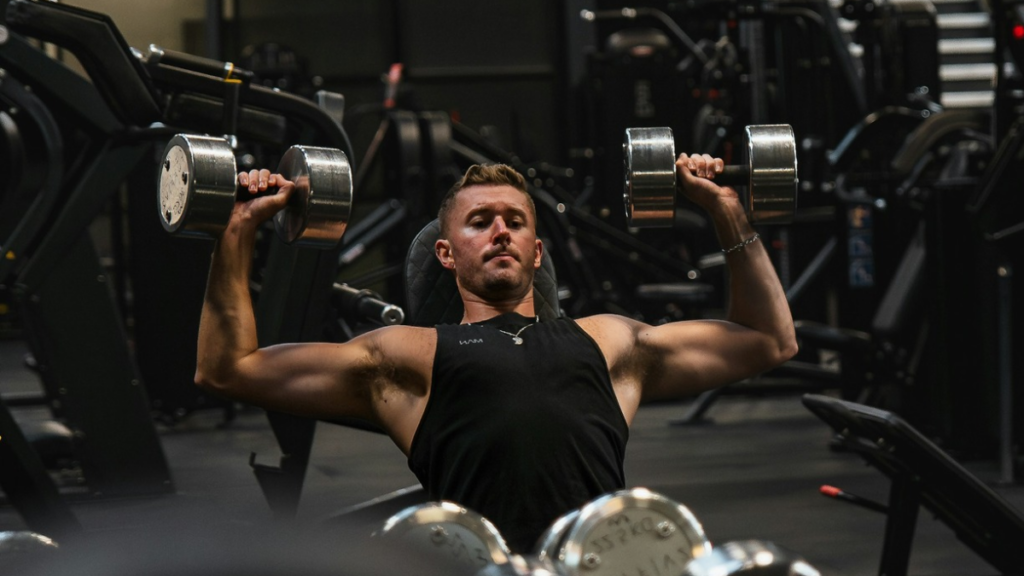
What Happens If You Only Use Dumbbells for Your Chest?
There is no single perfect repetition range for hypertrophy. Muscle can grow across a broad range of loads when sets are challenging enough. Moderate loads are often practical for these exercises because they allow solid technique, sufficient repetitions, and manageable joint stress. For many lifters, working mostly in the range of six to twelve repetitions is an effective place to start.
1. Barbell Bench Press
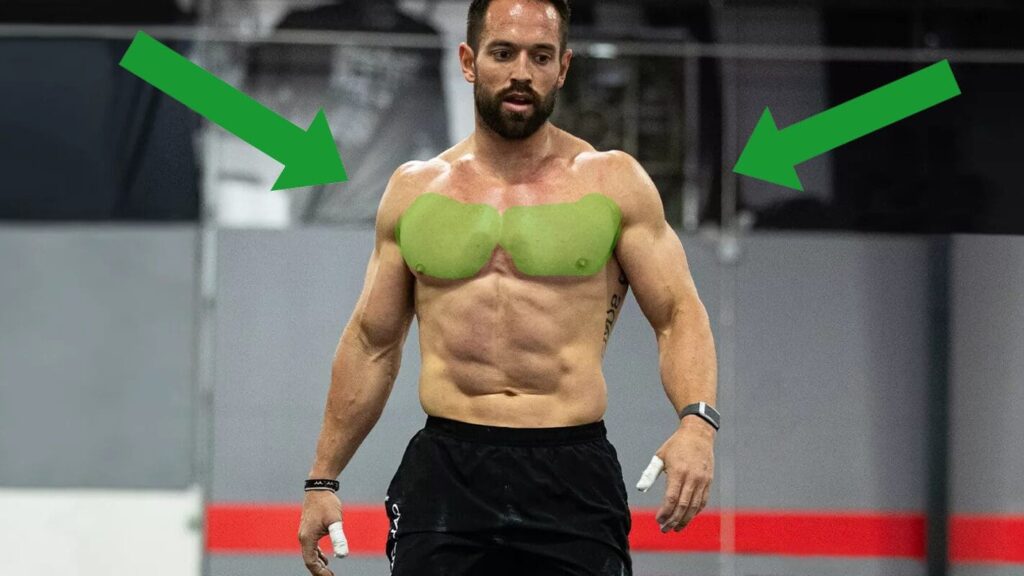
The barbell bench press is one of the most effective exercises for developing a stronger and more muscular chest. It also trains the triceps and anterior deltoids, making it a powerful upper body builder when it is performed consistently and with control.
A well developed chest can add noticeable depth to the upper body, while stronger triceps help create more arm size and support pressing strength in other exercises. The bench press lets you load these muscles heavily and progress clearly over time.
How to Perform the Barbell Bench Press
Lie on a flat bench with your eyes underneath the bar. Place your feet firmly on the floor and create a stable base before lifting the bar from the rack. Grip the bar slightly wider than shoulder width, although the exact grip should be comfortable and allow your forearms to remain close to vertical near the bottom of the repetition.
Lower the bar under control toward the lower portion of your chest. Keep your shoulder blades pulled back and down against the bench, and avoid allowing the shoulders to roll forward. Press the bar upward by driving through the chest and triceps, returning it to the starting position without losing control.
The bar should move smoothly rather than bouncing off the chest. A controlled descent improves consistency and helps you keep tension on the working muscles. A spotter or safety arms are sensible when training close to fatigue.
Why It Builds a Better Upper Body
The bench press gives the pectoralis major a demanding loaded stretch and contraction while also involving the triceps and front deltoids. This combination makes it a highly productive exercise for building pressing strength and upper body mass.
Research on bench press training has shown increases in pectoralis major cross sectional area after structured training. The exercise is also easy to adjust. A moderate grip can provide a comfortable balance between chest and triceps involvement, while a slightly closer grip may allow some lifters to emphasize the triceps more.
Do not chase extremely heavy single repetitions if your main goal is muscle growth. Productive sets performed with stable technique are more valuable than lifting a weight that forces poor control. Aim to leave roughly one to three repetitions in reserve on most sets, then push closer to muscular fatigue when your technique remains reliable.
For a strong starting point, perform three to five sets of six to ten repetitions once or twice per week.
2. Standing Barbell Overhead Press
The standing barbell overhead press is one of the best exercises for building shoulders that look broad, strong, and athletic. It emphasizes the deltoids, especially the anterior deltoids, while the triceps help straighten the elbows and the upper back contributes to a stable position.
Unlike a seated machine press, the standing barbell press requires you to control the weight with your entire body. Your trunk, glutes, and legs must work isometrically to keep your torso steady while the bar travels overhead. This does not replace lower body training, but it makes the exercise a more complete strength movement.
How to Perform the Standing Barbell Overhead Press
Set the bar in a rack around upper chest height. Stand with your feet about hip width apart and grip the bar just outside shoulder width. Begin with the bar resting near the upper chest, with the wrists stacked as comfortably as possible beneath the bar.
Squeeze your glutes, brace your abdominal muscles, and press the bar upward in a mostly vertical path. Move your head slightly back only long enough for the bar to pass, then bring your head through so the bar finishes above the middle of your body. At the top, your arms should be straight and the bar should be balanced over your shoulders, hips, and feet.
Lower the bar slowly back to the upper chest and reset before the next repetition. Avoid turning the movement into a standing incline press by leaning far backward. A small amount of natural torso movement can occur, but excessive lower back extension usually means the load is too heavy or the lifter has lost position.
Why It Builds a More Impressive Frame
The deltoids contribute greatly to the visual width of the upper body. Building stronger shoulders can make the waist appear narrower by comparison, which is one reason shoulder training has such a large influence on an athletic physique.
The overhead press allows progressive loading of the shoulders and triceps with a movement that can be repeated for years. It also trains the scapular muscles to work with the upper arm as the load moves overhead. This coordinated movement is important for a strong and stable pressing pattern.
The overhead press should not be treated as a test of ego. Small increases matter. Adding one repetition, improving bar control, or progressing by a small plate can all move the exercise forward. Progress is especially rewarding here because overhead strength often develops more slowly than bench press strength.
Perform three to four sets of six to ten repetitions once or twice per week. If you are new to the movement, begin with a lighter barbell or a manageable fixed bar and make clean technique the priority.
3. Bent Over Barbell Row
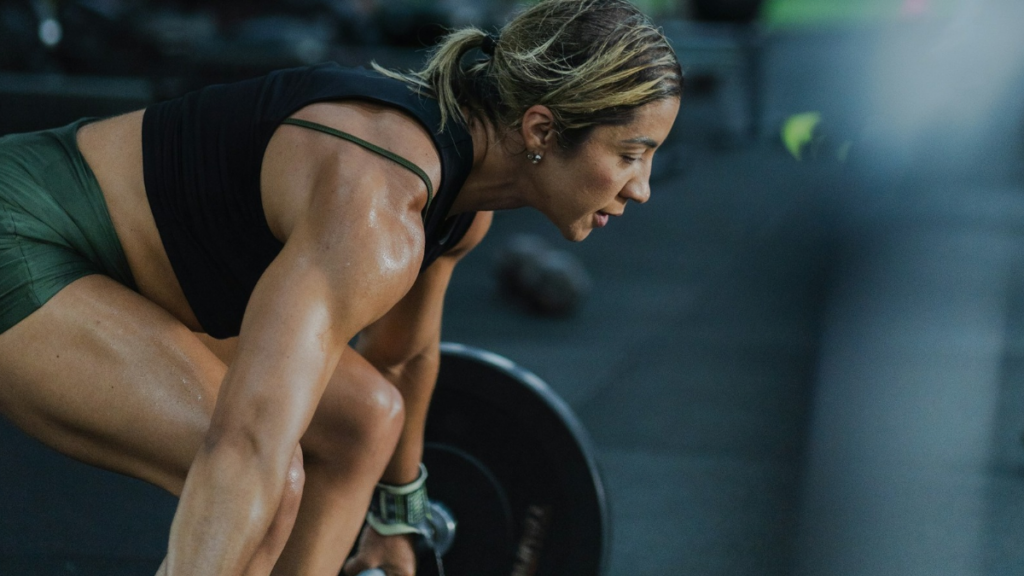
The bent over barbell row is the essential pulling counterpart to pressing movements. It trains the latissimus dorsi, trapezius, rhomboids, rear deltoids, and elbow flexors. These muscles add thickness through the middle and upper back, contribute to a wider looking torso, and help create the balanced posture that a chest focused routine often lacks.
A muscular upper body should look strong from the back as well as the front. Rows provide the heavy horizontal pulling work needed to develop that back thickness.
How to Perform the Bent Over Barbell Row
Stand with the bar over the middle of your feet and take a grip just outside shoulder width. Push your hips backward while keeping a slight bend in your knees. Lower your torso until it is roughly between forty five degrees and parallel to the floor, choosing the position you can hold without rounding your lower back.
Brace your trunk and allow the bar to hang below your shoulders. Pull the bar toward your lower chest or upper abdomen by driving your elbows backward. Keep the bar close to your body and avoid jerking it upward with the hips.
Pause briefly near the top if you can do so without losing position, then lower the bar under control until the elbows are straight. Keep your neck neutral and look toward the floor a short distance in front of you.
If your lower back becomes the limiting factor long before your upper back, reduce the load, perform fewer repetitions, or use a chest supported row as an additional exercise. The barbell row is demanding, but it should be a back exercise rather than an uncontrolled full body heave.
Why It Builds a Stronger Looking Back
The muscles of the upper back and lats help create the outline often associated with a powerful upper body. The lats contribute to torso width, while the middle back and trapezius add density around the shoulder blades. The rear deltoids also support more complete shoulder development.
The row balances the pressing work from the bench press and overhead press. This does not mean every program must use exactly the same number of pushing and pulling sets. However, regular pulling volume is important for developing the upper back and avoiding a routine that gives all its attention to the chest and front shoulders.
Research examining common resistance exercises supports rows as a useful way to train the lats, although muscle activation research should not be mistaken for a direct measure of long term hypertrophy. The most reliable approach is to use a row variation you can perform consistently, take through a controlled range of motion, and progressively overload without sacrificing trunk position.
Perform three to five sets of six to twelve repetitions once or twice per week. Use a load that lets you feel the back working rather than one that turns every repetition into a momentum driven lift.
How to Program the Three Exercises
A simple effective approach is to perform these exercises twice each week, with at least one day between sessions. You might use slightly heavier sets on the first session and moderately higher repetitions on the second. For example, use six to eight repetitions for the first session and eight to twelve repetitions for the second.
Start with three hard sets for each exercise. Add sets only when you can recover well, your technique remains consistent, and you are still making progress. More training is not automatically better. The productive amount is the amount you can perform consistently while recovering between sessions.
Use a double progression method. Choose a repetition range such as six to ten. When you can complete ten controlled repetitions on all working sets, increase the load slightly and return toward the lower end of the range. This gives you a clear way to progress without needing to test maximum strength regularly.
Adequate protein intake, sleep, and total calorie intake also matter. Resistance training supplies the stimulus, but muscle is built during recovery. If your goal is to add noticeable size, make training consistent for months rather than expecting dramatic visual changes after a few workouts.
The Bottom Line
The barbell bench press, standing overhead press, and bent over barbell row are three outstanding exercises for building a muscular upper body. Together, they train the chest, shoulders, triceps, lats, and upper back with movements that are easy to progress and highly effective when performed well.
Use controlled technique, train hard enough to challenge the muscles, and make gradual improvements over time. Build the front and back of your upper body with equal intent, and the result will be a stronger, more balanced, and more athletic looking physique.
References
- American College of Sports Medicine (2009) ‘American College of Sports Medicine position stand: Progression models in resistance training for healthy adults’, Medicine and Science in Sports and Exercise, 41(3), pp. 687–708.
- Grgic, J., Schoenfeld, B.J., Davies, T.B., Lazinica, B., Krieger, J.W. and Pedisic, Z. (2018) ‘Effect of resistance training frequency on gains in muscular strength: A systematic review and meta analysis’, Sports Medicine, 48(5), pp. 1207–1220.
- Lasevicius, T., Schoenfeld, B.J., Silva, V.R., Barros, T.S., Leite, T.C., Filho, P.J., Aihara, A.Y., Cardoso, F.N., Tricoli, V. and Teixeira, E.L. (2018) ‘Muscle failure promotes greater muscle hypertrophy in low load but not in high load resistance training’, Journal of Strength and Conditioning Research, 36(2), pp. 346–351.
- Rodiles Guerrero, L., Cornejo Daza, P.J., Sánchez Valdepeñas, J., Alcazar, J., Rodriguez López, C., Sánchez Moreno, M., Alegre, L.M., León Prados, J.A. and Pareja Blanco, F. (2022) ‘Specific adaptations to 0%, 15%, 25%, and 50% velocity loss thresholds during bench press training’, International Journal of Sports Physiology and Performance, 17(8), pp. 1231–1241.
- Schoenfeld, B.J., Ogborn, D. and Krieger, J.W. (2017) ‘Dose response relationship between weekly resistance training volume and increases in muscle mass: A systematic review and meta analysis’, Journal of Sports Sciences, 35(11), pp. 1073–1082.
- Schoenfeld, B.J., Grgic, J., Van Every, D.W. and Plotkin, D.L. (2021) ‘Loading recommendations for muscle strength, hypertrophy, and local endurance: A re examination of the repetition continuum’, Sports, 9(2), 32.
- Swann, G. and Barry, G. (2026) ‘Optimising lat activation: A comparative analysis of grip width in the bent over barbell row’, Graduate Journal of Sports Science, Coaching, Management, and Rehabilitation, 2(1), pp. 1–15.
Key Takeaways
| Exercise | Main muscles trained | Practical starting prescription | Main technique priority |
|---|---|---|---|
| Barbell bench press | Chest, triceps, front shoulders | Three to five sets of six to ten repetitions | Keep the shoulders stable and lower the bar with control |
| Standing barbell overhead press | Shoulders, triceps, upper back | Three to four sets of six to ten repetitions | Brace the trunk and finish with the bar balanced overhead |
| Bent over barbell row | Lats, upper back, rear shoulders, elbow flexors | Three to five sets of six to twelve repetitions | Hold a stable torso and pull without using excessive momentum |