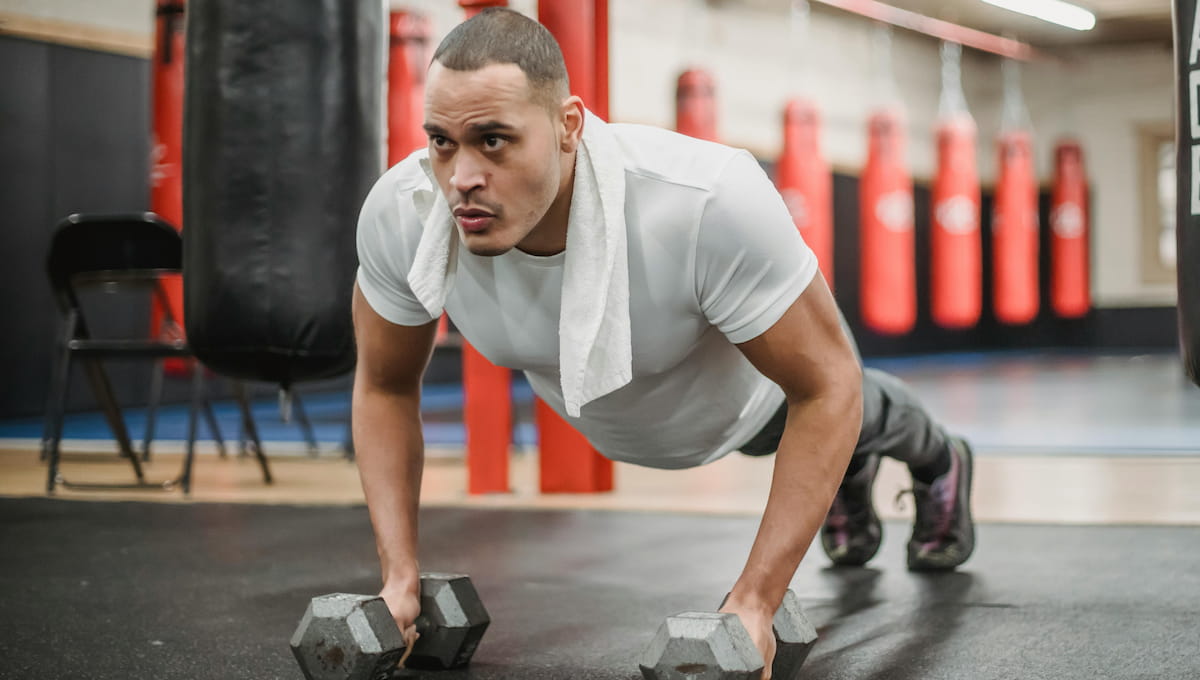


Push ups are a useful chest exercise, but they are not the only way to build a stronger, more muscular upper body. Some beginners cannot yet perform them comfortably. Others find that their wrists, shoulders, or lower back become the limiting factor before their chest gets enough quality work. You may also simply want more control over the resistance than bodyweight allows.
The good news is that your chest responds to resistance training, not to one specific exercise. The main chest muscle, the pectoralis major, produces horizontal pressing and arm movements across the body. Train these actions with sound technique, enough effort, and gradual progression, and you can get stronger without doing a single push up.


For beginners, the best chest exercises are usually the ones that are stable, easy to learn, and simple to load progressively. That lets you focus on the target muscles instead of worrying about balance or complicated technique. The three exercises below provide a strong foundation: the machine chest press, dumbbell bench press, and cable chest fly.
What Builds a Stronger Chest?
Building chest strength requires repeated exposure to challenging resistance. Your body adapts to training by improving coordination, strengthening connective tissue, and increasing muscle size over time. Muscle growth is strongly linked to completing enough hard, high quality training sets over weeks and months, rather than chasing soreness or constantly changing exercises.
A beginner does not need to lift maximal weights to make progress. Moderate loads performed with control can build muscle effectively when the sets are challenging. The final few repetitions should feel demanding, while technique remains stable. This is a much better starting point than using a weight that forces you to shorten the range of motion, bounce the resistance, or lose control of your shoulders.
Consistency matters more than finding a supposedly perfect exercise. Research shows that resistance training can increase muscle size across a broad range of loads, provided effort and training volume are appropriate. Heavier weights can be useful for developing maximal strength, but a beginner can make excellent chest gains with manageable loads and controlled sets.
Aim to train your chest two times per week. This gives you regular practice and enough stimulus to improve, while leaving time to recover. Start conservatively, learn the movements, and add repetitions or small amounts of resistance once your current workload becomes comfortable.
1. Machine Chest Press
The machine chest press is one of the best starting points for anyone who wants a stronger chest without push ups. It gives you a guided movement path and external stability, allowing you to concentrate on pressing with your chest, shoulders, and triceps.
Free weight exercises are valuable, but they require more balance and coordination. A chest press machine reduces these demands. That makes it easier for a beginner to train the pressing muscles hard without feeling that the weight is moving unpredictably. It can also make it simpler to stop a set safely when fatigue builds.
How to Perform the Machine Chest Press
Adjust the seat so the handles begin around the middle of your chest. Sit with your feet planted firmly on the floor and your back supported against the pad. Hold the handles with your wrists in a neutral, straight position.
Before pressing, gently pull your shoulder blades back and down. Do not force an exaggerated position, but avoid letting the shoulders roll forward toward your ears. Press the handles forward in a smooth motion until your arms are nearly straight. Keep a slight bend in the elbows rather than aggressively locking them out.
Pause briefly, then return the handles slowly until you feel a comfortable stretch across the chest. Keep your body in contact with the back pad instead of lifting your chest or arching excessively to move more weight.
The goal is not to turn every repetition into a maximal effort. The goal is to make the chest do the work through a consistent range of motion.
Why It Works
The machine chest press trains the pectoralis major through the same broad pressing pattern used in many chest exercises. The front of the shoulders and triceps also contribute, which is normal. Chest training is rarely completely isolated, because pressing movements naturally involve several muscles.
For beginners, stability can be an advantage rather than a limitation. You can use a predictable movement path, focus on steady repetitions, and safely work close to muscular fatigue. This makes the machine chest press particularly useful when learning how a hard set should feel.
Start with two or three sets of eight to 12 repetitions. Choose a resistance that allows you to control the lowering phase and still complete the final repetitions with effort. Once you can perform all sets at the top of that repetition range with clean form, increase the resistance slightly.
2. Dumbbell Bench Press
The dumbbell bench press is a highly effective free weight exercise for chest strength and muscle development. Unlike a barbell, dumbbells allow each arm to move independently. This can help you identify strength differences between sides and encourages you to control the weights rather than relying on one fixed bar path.
Dumbbells also allow a comfortable hand position. You can hold them with the palms facing forward or turn the hands slightly inward if that feels better for your shoulders. There is no single grip angle that is ideal for every person, so use the position that lets you press smoothly and without pain.
How to Perform the Dumbbell Bench Press
Sit on the end of a flat bench with the dumbbells resting on your thighs. Carefully lie back while bringing the dumbbells to either side of your chest. Keep your feet flat on the floor and your upper back in contact with the bench.
Begin with the dumbbells roughly level with your lower chest. Your elbows should be angled slightly away from your body rather than flared directly out to the sides. This is often a more comfortable and controllable position for beginners.
Press the dumbbells upward and slightly inward until they are above your chest. They do not need to touch at the top. Keep your wrists stacked over your forearms and avoid letting the weights drift backward toward your face.
Lower the dumbbells slowly and under control. Stop at a depth that gives your chest a comfortable stretch without shoulder pain or a loss of control. Your range of motion should be consistent from repetition to repetition.
Why It Works
The dumbbell bench press challenges the chest in a large range of motion while requiring each side to stabilize its own load. The pectoralis major is heavily involved in bringing the upper arm toward the center of the body during the press. Your triceps extend the elbows, while the front of the shoulders assists the movement.
Research comparing common chest exercises shows that both pressing and fly variations can activate the pectoralis major effectively. This matters because it gives you flexibility. You do not need to force yourself through push ups if a controlled dumbbell press suits your current ability and training environment better.
Start with two or three sets of six to 10 repetitions. Dumbbells can feel less stable than a machine, so begin lighter than you think you need. Your first priority is learning a repeatable setup and a smooth path. A weight that looks modest but can be controlled well will build more strength than a heavier weight performed with unstable shoulders and shortened repetitions.
If you train alone, be careful when finishing the set. Bring the dumbbells back toward your thighs before sitting up. Do not drop them from above your chest or attempt a repetition that you cannot safely complete.
3. Cable Chest Fly
The cable chest fly complements pressing exercises because it emphasizes the action of moving your arms toward the middle of your body. This action is called horizontal adduction, and it is one of the main jobs of the pectoralis major.
A fly is not a replacement for all pressing work, especially if your main goal is overall pressing strength. However, it is an excellent accessory movement because it lets you train the chest with a relatively light load while maintaining tension through much of the movement.
Cables are useful because their resistance comes from the pulley rather than gravity alone. This can provide a steady challenge as you bring the handles together. For beginners, the key is to use a light enough setting that you can avoid turning the exercise into a swinging shoulder movement.
How to Perform the Cable Chest Fly
Set two cable pulleys around chest height. Attach single handles, select a light resistance, and stand in the middle of the cable station. Take one small step forward into a stable split stance, with your knees softly bent and your torso tall.
Begin with your arms open to the sides and your elbows slightly bent. Keep that gentle elbow bend throughout the exercise. Think of your arms as moving around a large tree rather than repeatedly bending and straightening at the elbows.
Bring the handles forward and together in front of your chest. Squeeze your chest briefly at the point where your hands meet or nearly meet. Then allow the handles to travel back slowly until you feel a controlled stretch through the chest.
Keep your ribs stacked over your pelvis. Avoid leaning far forward, shrugging your shoulders, or using a large body swing. If you need momentum to move the handles, the resistance is too heavy.
Why It Works
The cable fly teaches you to feel and control the chest through its primary movement pattern. Because the load is usually lighter than in a press, it can be a useful place to practice clean repetitions and a controlled stretch.
It also provides variety without making training needlessly complicated. Pressing and fly movements place the chest under resistance in related but slightly different ways. Combining one stable press, one free weight press, and a cable fly can create a complete beginner chest routine without requiring push ups.
Perform two or three sets of 10 to 15 repetitions. Focus on the quality of the stretch and squeeze rather than trying to use a large stack of weight. A fly should feel challenging in the chest, not painful in the front of the shoulder.
How to Build These Exercises Into a Beginner Routine
You do not need to perform every exercise at maximum volume on your first day. Start with a manageable amount of work and give yourself time to recover. A good beginner session could include the machine chest press and cable chest fly on one day, then the dumbbell bench press and cable chest fly on another day later in the week.
For example, perform two sets of machine chest press for eight to 12 repetitions, followed by two sets of cable chest fly for 10 to 15 repetitions. On your second session, perform two sets of dumbbell bench press for six to 10 repetitions, followed by two sets of cable chest fly for 10 to 15 repetitions.

As your technique and recovery improve, build toward three sets per exercise. Research suggests that performing multiple hard sets over the week is generally more productive for muscle growth than doing only one set. Still, more is not always better. If your shoulders ache, your form worsens, or your performance declines from session to session, reduce the workload and focus on recovery.
Rest for around one to two minutes between cable fly sets and two to three minutes between challenging press sets. Longer rest can help you maintain better performance across sets, particularly with multi joint exercises such as chest presses.
Progress Without Rushing
Progressive overload simply means making your training gradually more demanding. You can do this by adding a repetition, adding a small amount of weight, improving your range of motion, or performing the same work with better technique.
Do not increase everything at once. If you begin with two sets of eight repetitions on the machine chest press, first aim to reach 10, then 12 repetitions with that same load. Once you can complete the prescribed repetitions cleanly, make a small increase in resistance and repeat the process.
Keep a simple record of your workouts. Note the exercise, resistance, sets, and repetitions. This shows you whether you are getting stronger and prevents you from guessing. It also helps you stay patient. Chest strength is built over many sessions, not one heroic workout.
Pain is different from training effort. Muscle fatigue and a temporary burning sensation during a set are normal. Sharp pain, pinching, numbness, or joint discomfort is not something to push through. Stop the movement, reassess your technique and range of motion, and seek guidance from a qualified health professional if symptoms persist.
The Bottom Line
Push ups are optional, not mandatory. A stronger chest can be built with stable machine presses, controlled dumbbell presses, and cable flys that train the chest through its key movement patterns.
Start with a load you can control, train consistently, and add difficulty gradually. Learn to make each repetition steady and purposeful. That approach is more valuable than rushing toward heavier weights or copying an advanced lifter’s routine.
References
- American College of Sports Medicine (2009) ‘American College of Sports Medicine position stand: Progression models in resistance training for healthy adults’, Medicine and Science in Sports and Exercise, 41(3), pp. 687 to 708.
- Grgic, J., Schoenfeld, B.J., Skrepnik, M., Davies, T.B. and Mikulic, P. (2018) ‘Effects of rest interval duration in resistance training on measures of muscular strength: A systematic review’, Sports Medicine, 48(1), pp. 137 to 151.
- Krieger, J.W. (2010) ‘Single versus multiple sets of resistance exercise for muscle hypertrophy: A meta analysis’, Journal of Strength and Conditioning Research, 24(4), pp. 1150 to 1159.
- Lasevicius, T., Schoenfeld, B.J., Silva Batista, C., Barros, T.D.S., Aihara, A.Y., Cardoso, F.N., Lima, F.V., Cyrino, E.S. and Tricoli, V. (2018) ‘Muscle failure promotes greater muscle hypertrophy in low load but not in high load resistance training’, Journal of Strength and Conditioning Research, 36(2), pp. 346 to 351.
- Schoenfeld, B.J., Grgic, J., Ogborn, D. and Krieger, J.W. (2017) ‘Strength and hypertrophy adaptations between low versus high load resistance training: A systematic review and meta analysis’, Journal of Strength and Conditioning Research, 31(12), pp. 3508 to 3523.
- Schwanbeck, S., Chilibeck, P.D. and Binsted, G. (2009) ‘A comparison of free weight squat to Smith machine squat using electromyography’, Journal of Strength and Conditioning Research, 23(9), pp. 2588 to 2591.
- Trebs, A.A., Brandenburg, J.P. and Pitney, W.A. (2010) ‘An electromyography analysis of three muscles surrounding the shoulder joint during the performance of a chest press exercise at several angles’, Journal of Strength and Conditioning Research, 24(7), pp. 1925 to 1930.
- Welsch, E.A., Bird, M. and Mayhew, J.L. (2005) ‘Electromyographic activity of the pectoralis major and anterior deltoid muscles during three upper body lifts’, Journal of Strength and Conditioning Research, 19(2), pp. 449 to 452.
Key Takeaways
| Exercise | Why it suits beginners | Starting target |
|---|---|---|
| Machine chest press | Provides stability and makes it easier to learn controlled pressing technique | Two or three sets of eight to 12 repetitions |
| Dumbbell bench press | Builds pressing strength while each arm controls its own weight | Two or three sets of six to 10 repetitions |
| Cable chest fly | Trains the chest through the arm movement that brings the hands together | Two or three sets of 10 to 15 repetitions |
| Weekly approach | Train chest twice weekly and make gradual changes when technique is reliable | Add repetitions before adding resistance |