Building a stronger core does not always require long ab circuits or endless repetitions. For those who already have a solid foundation, increasing the challenge and applying progressive overload can make core training more effective.
In a recent YouTube video, fitness content creator and strength coach Kelly Matthews shares her five favorite intermediate to advanced core exercises, demonstrating movements that target the abs and obliques while emphasizing control, stretch, and getting close to failure.


Exercise 1: Supported Leg Raise
Matthews begins with the supported leg raise, using a squat rack and padding to support her back while holding onto a pull-up bar.
The goal is to lift the legs as high as possible while maintaining control. Matthews emphasizes loading the rectus abdominis in a stretched position before bringing the abs into a shortened, contracted position.
If toes-to-bar are too difficult, she suggests reducing the range of motion or performing knee raises instead. The key is working within a challenging range rather than forcing the movement.
Exercise 2: Lying Leg Lift
Next is the lying leg lift, which Matthews uses to place more emphasis on the lower portion of the abs.
Performed from a bench with an ab mat or similar support underneath the back, the movement involves lifting the hips and tailbone rather than simply curling the entire body upward.
Matthews recommends performing the exercise slowly and avoiding momentum. Keeping the legs lower also increases the difficulty.
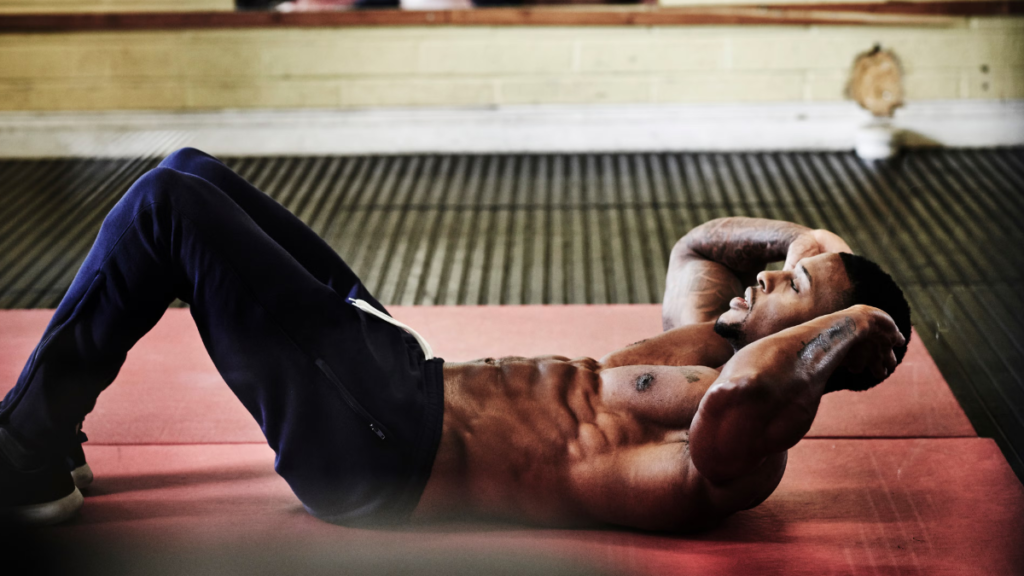
Exercise 3: Lying Crunch
For the lying crunch, Matthews adds external resistance with a dumbbell, although a plate, medicine ball, or bodyweight can also be used.
Rather than coming all the way into a seated position, she recommends stopping when the abs are still under tension. This keeps the focus on the rectus abdominis instead of allowing the movement to become less challenging at the top.
Matthews also highlights the importance of progressive overload, treating the abs like any other muscle that can become stronger through gradually increasing resistance.
Exercise 4: Russian Twist
The Russian twist targets the obliques through rotation. Matthews demonstrates a more stabilized version by anchoring her feet underneath a bench to keep the hips and pelvis in place.
From a slightly leaned-back position, she rotates her trunk from side to side while keeping her lower body stable.
The goal is to create rotation through the trunk rather than allowing the knees and hips to move with the exercise. Holding the weight farther away from the body can make the movement more challenging.
Exercise 5: Lateral Flexion
Matthews finishes with cable lateral flexion, another movement focused on the obliques.
Standing on a box or bench provides a wider base of support while allowing her to create a larger range of motion. She keeps one hand behind her head and bends toward the working side before returning to the starting position.
Matthews recommends using only one weight so the exercise can properly load one side of the trunk. With a cable, progressing can be as simple as increasing the weight once the desired repetitions become manageable.
Train Your Core Like Any Other Muscle
For Matthews, exercise selection is only part of effective core training. The bigger focus is how the exercises are performed.
Rather than relying on high-repetition ab circuits, she recommends challenging the muscles with sufficient resistance, using a controlled range of motion, feeling the stretch, getting close to failure, and applying progressive overload over time.
About the Author
Jeremiah Oliva

Jeremiah Oliva is a writer passionate about fitness, sports, and active living. He has experience in songwriting and managing content and social media for online radio and magazine platforms.
He covers HYROX, CrossFit®, and competitive fitness, with a focus on performance, mindset, and athlete development.
Outside of writing, Jeremiah trains in boxing, cycles, explores the outdoors with his kids, and plays the guitar.