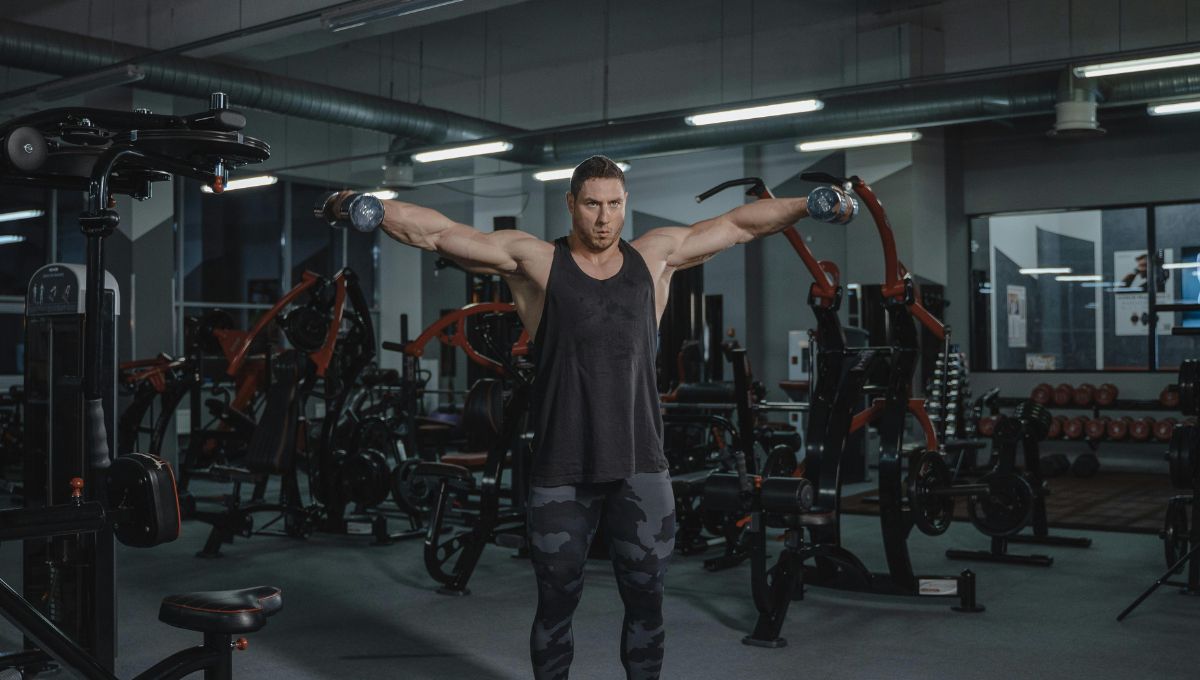


Broad shoulders can make the upper body look more athletic, improve pressing strength, and support better control during everyday lifting tasks. The deltoid muscle has three main regions: the front deltoid, the side deltoid, and the rear deltoid. Beginners often put too much emphasis on pressing movements, which can develop the front of the shoulder while leaving the side and rear regions relatively undertrained.
The fastest sustainable path to bigger shoulders is not chasing complicated exercises or using maximum weight immediately. It is choosing movements that train each major deltoid region, using controlled technique, progressively adding challenge, and allowing enough recovery between sessions. Research consistently shows that resistance training can increase muscle size when exercises are performed with enough effort, sufficient training volume, and a progressively greater stimulus over time.


The three exercises below provide a simple foundation for beginners. Together, they train the front, side, and rear portions of the shoulder while also building coordination and confidence in the gym.
Why Beginners Need More Than One Shoulder Exercise
The shoulder joint is highly mobile, which helps you press, reach, throw, and move your arms in many directions. That mobility also means it needs muscular control from the deltoids and the muscles around the shoulder blade. A balanced program should include movements that challenge the shoulder through more than one arm path.
Overhead pressing strongly trains the front deltoids and involves the side deltoids. Lateral raises place more direct resistance on the side deltoids, which contribute substantially to shoulder width. Rear delt flyes train the rear deltoids, which support balanced shoulder development and help offset the common tendency to perform more pressing than pulling.
For muscle growth, total weekly hard sets matter. Higher training volumes generally produce more hypertrophy than very low volumes, provided recovery and exercise technique remain adequate. Beginners do not need extreme volume, however. A modest amount of focused work performed consistently is enough to produce meaningful early progress.
Exercise One: Seated Dumbbell Overhead Press
Why It Works
The seated dumbbell overhead press is an excellent beginner movement because it trains the front deltoids, side deltoids, triceps, and upper chest in one exercise. It also teaches the body to stabilize weight overhead, a useful skill for many strength movements.
Electromyography research shows that pressing exercises can produce substantial activation in the deltoid muscles. Dumbbells are particularly useful for beginners because each arm works independently, which can expose and gradually reduce side to side differences in control and strength. The seated position also reduces the temptation to use excessive leg drive or lower back extension to move the weight.
This exercise should be the main strength builder in a beginner shoulder routine. It lets you use more load than isolation exercises, which makes it practical for progressive overload.
How to Perform It
Sit on a bench with back support and place your feet firmly on the floor. Hold a dumbbell in each hand at shoulder height, with your forearms close to vertical. Keep your ribs down, brace your abdomen, and press the dumbbells upward until your arms are extended comfortably overhead.
Lower the dumbbells under control until they return near shoulder height. Your elbows do not need to flare directly outward. A slightly forward elbow position often feels more natural and can help you keep the dumbbells moving smoothly.
Avoid forcing the weights behind your head or arching your lower back to finish each repetition. If this happens, reduce the load and rebuild the movement with better control.
Sets, Repetitions, and Progression
Begin with two or three sets of eight to twelve repetitions. Choose a weight that makes the final repetitions challenging while allowing you to keep the same controlled path from the first repetition to the last.
When you can complete the top end of the repetition range for every set with stable form, increase the dumbbell weight slightly. This gradual progression is more useful than regularly testing maximum lifts. Strength and muscle gains are driven by repeated exposure to a challenging training stimulus, not by occasional heroic efforts.
Exercise Two: Dumbbell Lateral Raise
Why It Works
The dumbbell lateral raise is one of the most direct ways to train the side deltoid. This muscle contributes heavily to the visual impression of shoulder width because it sits on the outside of the upper arm and shoulder.
Pressing alone may not provide enough direct work for the side deltoid, especially when a beginner’s technique places more demand on the front deltoid and triceps. Adding lateral raises creates a more complete shoulder program by training the arm in a different direction.
The movement does not require heavy dumbbells to be effective. Because the resistance is far from the shoulder joint, even a light load can create substantial effort. Research on resistance training shows that lighter loads can support muscle growth when sets are performed with sufficient effort and an appropriate amount of volume.
How to Perform It
Stand upright with a dumbbell in each hand and your arms by your sides. Keep a soft bend in your elbows and raise the dumbbells outward until your upper arms are roughly parallel with the floor or slightly below that point if your shoulder comfort requires it.
Think about moving your upper arms away from your body rather than swinging the dumbbells upward. Keep your torso quiet and avoid leaning backward. Lower the weights slowly, returning to the starting position before beginning the next repetition.
A common error is choosing a weight that is too heavy and then using the hips, lower back, and momentum to move it. This reduces the tension on the side deltoid and makes each repetition less consistent. Start lighter than you think you need, then make the set difficult through controlled repetitions.
Sets, Repetitions, and Progression
Perform two or three sets of ten to fifteen repetitions. The lateral raise usually works best with moderate to higher repetitions because heavy loads often make it difficult to maintain the intended movement pattern.
Progress by adding repetitions first. Once you can perform fifteen controlled repetitions on every set, move to the next available dumbbell weight and return closer to ten repetitions. Keep the lowering phase deliberate, since controlled resistance through a useful range of motion helps maintain tension on the target muscle.
Exercise Three: Chest Supported Rear Delt Fly
Why It Works
The rear deltoid is frequently overlooked because it is not as visible in the mirror as the front and side portions of the shoulder. Still, it is essential for complete shoulder development. Training the rear deltoid can also help create a fuller look from the side and back.
The chest supported rear delt fly is a smart beginner choice because the bench limits momentum. With the chest supported, it becomes easier to focus on moving the arms rather than swinging the torso. This can make the exercise easier to learn than a standing bent over variation.
Research examining shoulder exercises has found that different movement patterns create different activation demands across the deltoid regions. Including a rear shoulder movement alongside pressing and lateral raises is therefore a practical way to distribute training across the entire deltoid.
How to Perform It
Set an adjustable bench to a low incline. Lie face down with your chest supported and let your arms hang toward the floor while holding light dumbbells. Keep a slight bend in the elbows and raise your arms out and back in a wide arc.
The Only 3 Machines You Need to Shed Body Fat Faster
Focus on bringing your upper arms away from each other. Stop when your arms are roughly in line with your body. Pause briefly at the top if you can maintain control, then lower the dumbbells slowly.
Keep your neck relaxed and avoid shrugging your shoulders toward your ears. The goal is not to pull the dumbbells as high as possible. The goal is to make the rear shoulder muscles work through a repeatable and comfortable range of motion.
Sets, Repetitions, and Progression
Use two or three sets of twelve to fifteen repetitions. Rear delt flyes are usually best performed with lighter weights because the rear deltoid is a smaller muscle and technique can deteriorate quickly when the load becomes excessive.
Add repetitions until you reach fifteen clean repetitions on all sets. Then increase the weight by the smallest available amount. If you lose the ability to control the lowering phase, the new weight is probably too heavy for now.
How to Build a Beginner Shoulder Routine
Perform these exercises twice per week, leaving at least one day between sessions. This schedule provides frequent practice without overwhelming a beginner’s recovery ability. Training a muscle more than once weekly can be useful when it helps distribute total work across the week, although total volume remains the main driver of hypertrophy.
Start with the seated dumbbell overhead press because it requires the most coordination and energy. Follow it with lateral raises and then rear delt flyes. This order allows you to train the heavier compound movement while fresh, then focus on the smaller shoulder regions with isolation work.

Use a full and comfortable range of motion. Research generally supports training through larger ranges of motion for muscle development, although the right range should always respect individual comfort, mobility, and technique. Mild muscular effort is expected, but sharp pain, catching sensations, or persistent joint discomfort are reasons to stop and seek guidance from a qualified healthcare professional.
Keep a simple training record. Write down the exercise, weight, sets, and repetitions. Your shoulders will not grow because you performed one perfect workout. They grow because you gradually do more quality work over many weeks while eating enough protein, sleeping adequately, and recovering between sessions.
Table of Key Takeaways
| Focus | Best beginner exercise | Main benefit | Starting approach |
|---|---|---|---|
| Front and side deltoids | Seated dumbbell overhead press | Builds overhead strength and trains multiple upper body muscles | Two to three sets of eight to twelve repetitions |
| Side deltoids | Dumbbell lateral raise | Adds direct work for shoulder width | Two to three sets of ten to fifteen repetitions |
| Rear deltoids | Chest supported rear delt fly | Builds balanced shoulder development with less momentum | Two to three sets of twelve to fifteen repetitions |
| Long term progress | All three exercises | Supports complete deltoid development | Train twice weekly and gradually increase repetitions or load |
References
- American College of Sports Medicine (2009) ‘American College of Sports Medicine position stand: Progression models in resistance training for healthy adults’, Medicine and Science in Sports and Exercise, 41(3), pp. 687–708.
- Grgic, J., Schoenfeld, B.J., Davies, T.B., Lazinica, B., Krieger, J.W. and Pedisic, Z. (2018) ‘Effect of resistance training frequency on gains in muscular strength: A systematic review and meta analysis’, Sports Medicine, 48(5), pp. 1207–1220.
- Lasevicius, T., Schoenfeld, B.J., Silva Batista, M.A., Barros, T.S., Leite, T.I., Longo, A.R., Tricoli, V. and Teixeira, E.L. (2019) ‘Muscle failure promotes greater muscle hypertrophy in low load but not in high load resistance training’, Journal of Strength and Conditioning Research, 33(Suppl. 1), pp. S79–S87.
- Ralston, G.W., Kilgore, L., Wyatt, F.B. and Baker, J.S. (2018) ‘The effect of weekly set volume on strength gain: A meta analysis’, Sports Medicine, 48(11), pp. 2585–2601.
- Schoenfeld, B.J., Grgic, J., Ogborn, D. and Krieger, J.W. (2017) ‘Strength and hypertrophy adaptations between low versus high load resistance training: A systematic review and meta analysis’, Journal of Strength and Conditioning Research, 31(12), pp. 3508–3523.
- Schoenfeld, B.J., Ogborn, D. and Krieger, J.W. (2017) ‘Dose response relationship between weekly resistance training volume and increases in muscle mass: A systematic review and meta analysis’, Journal of Sports Sciences, 35(11), pp. 1073–1082.
- Schoenfeld, B.J., Ogborn, D. and Krieger, J.W. (2019) ‘Effects of resistance training frequency on measures of muscle hypertrophy: A systematic review and meta analysis’, Sports Medicine, 49(11), pp. 1725–1738.
- Schoenfeld, B.J., Grgic, J. and Krieger, J. (2021) ‘How many times per week should a muscle be trained to maximize muscle hypertrophy? A systematic review and meta analysis of studies examining the effects of resistance training frequency’, Journal of Sports Sciences, 37(11), pp. 1286–1295.
- Welsch, E.A., Bird, M. and Mayhew, J.L. (2005) ‘Electromyographic activity of the pectoralis major and anterior deltoid muscles during three upper body lifts’, Journal of Strength and Conditioning Research, 19(2), pp. 449–452.