

Well developed triceps do far more than make your arms look bigger. In fact, the triceps brachii account for roughly two thirds of your upper arm muscle mass, meaning they contribute much more to arm size than the biceps. If your goal is to build bigger, stronger arms, your triceps deserve plenty of attention.
The good news is that beginners can make rapid progress with the right exercises. Research consistently shows that novice lifters experience significant improvements in muscle size and strength during their first months of structured resistance training. Choosing exercises that train all three heads of the triceps while allowing progressive overload is one of the smartest ways to maximize those gains. This guide explains the three best beginner exercises for building muscular triceps, why they work, how to perform them correctly, and how to combine them into an effective workout.


Why Your Triceps Matter More Than You Think
The triceps brachii consists of three separate heads.
- The long head originates from the shoulder blade and crosses both the shoulder and elbow joints.
- The lateral head sits on the outside of the upper arm and is responsible for the horseshoe appearance that many people want.
- The medial head lies deeper beneath the other two heads and plays an important role in elbow extension during nearly every pushing movement.
Together, these muscles extend the elbow and assist with shoulder stability during pressing exercises.
3 Reasons Why Most Men Don’t Build a Strong Bench Press (Are You the Exception?)
Studies using electromyography, commonly known as EMG, have shown that different triceps exercises emphasize different portions of the muscle. While no single movement perfectly isolates every head, combining a few well chosen exercises produces comprehensive development. For beginners, mastering basic movement patterns is far more important than chasing complicated isolation exercises.
How Beginners Build Muscle Most Effectively
Muscle growth occurs when resistance training creates sufficient mechanical tension, metabolic stress, and muscular fatigue. Over time, your body adapts by increasing muscle protein synthesis, leading to larger and stronger muscles.
Research from Brad Schoenfeld and colleagues has shown that hypertrophy can be achieved across a wide range of repetition ranges, provided sets are performed close enough to muscular failure.
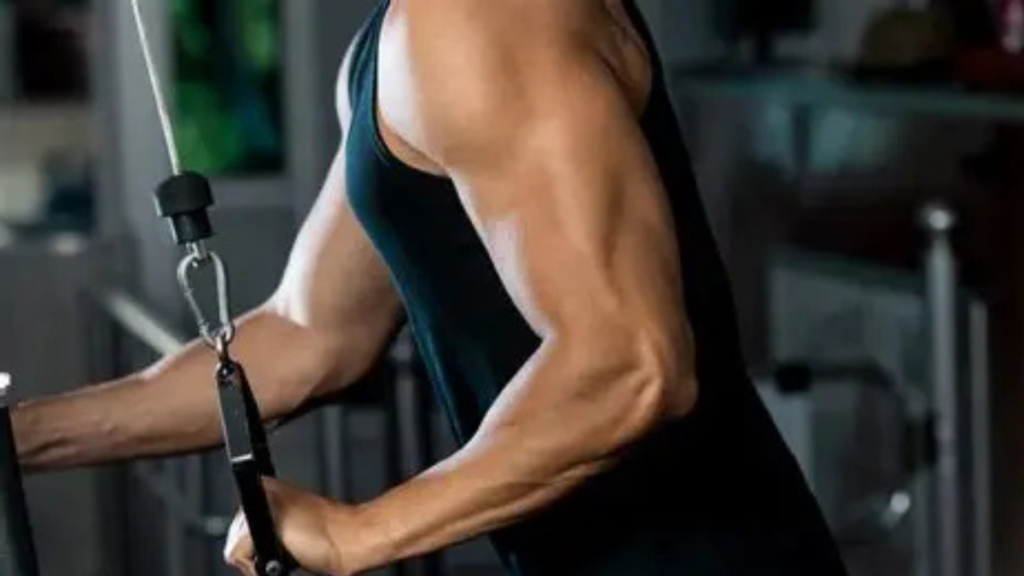
Beginners have an advantage because nearly any well designed resistance program produces impressive results. Early improvements come from both increased muscle size and better nervous system coordination.
To maximize triceps development, beginners should focus on:
- Proper exercise technique.
- Gradually increasing weight or repetitions over time.
- Training each muscle group at least twice per week.
- Getting adequate dietary protein.
- Sleeping enough to recover.
With those fundamentals in place, the following exercises offer an excellent starting point.
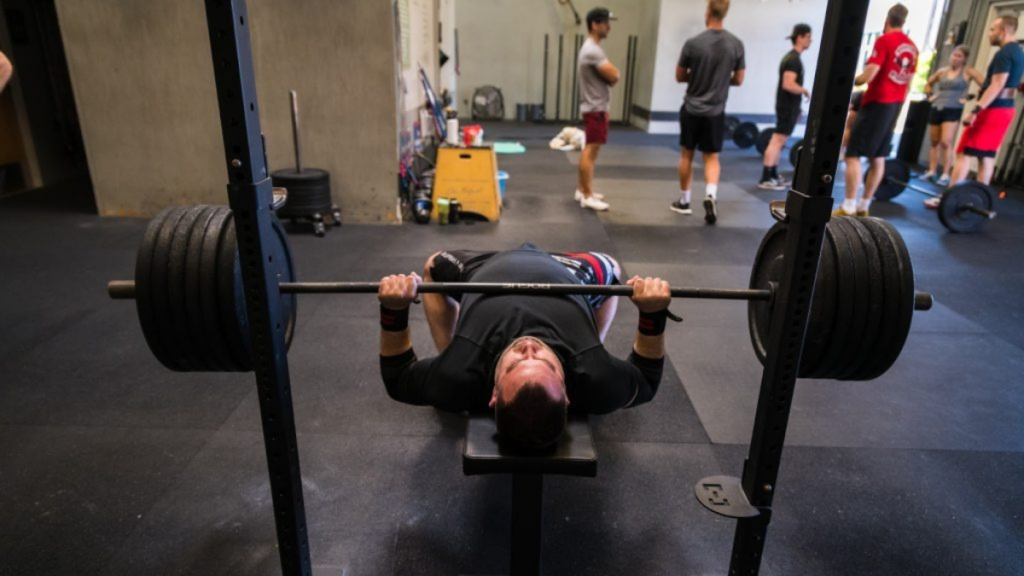
Exercise 1: Close Grip Bench Press
The close grip bench press is arguably the best compound exercise for developing larger triceps. Unlike a standard bench press, bringing the hands closer together increases elbow extension demands while reducing the contribution from the chest.
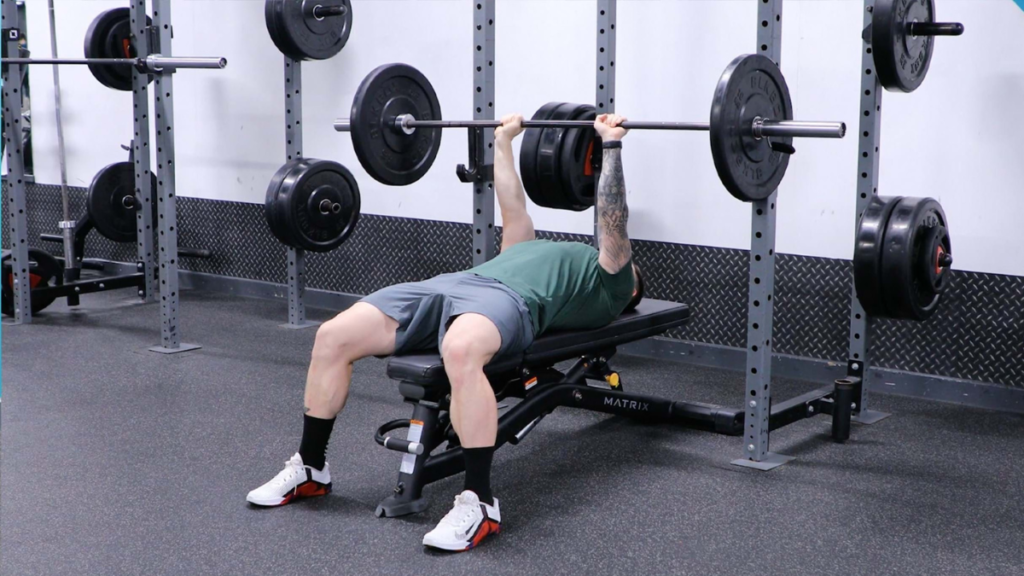
Numerous EMG studies have demonstrated greater triceps activation during close grip pressing compared to wider grip variations.
Why It Works
The close grip bench press allows beginners to lift relatively heavy loads while maintaining excellent stability. Heavy compound movements expose muscles to high mechanical tension, one of the strongest drivers of muscle hypertrophy. Because both arms work together, beginners also find it easier to develop balanced strength and improve pressing mechanics.
How to Perform It
- Lie flat on a bench with your feet firmly planted on the floor.
- Grip the bar slightly narrower than shoulder width.
- Lower the bar toward the lower chest while keeping your elbows relatively close to your body.
- Pause briefly before pressing the bar upward until your elbows are fully extended.
- Avoid excessively narrow hand placement because it can place unnecessary stress on the wrists.
- Maintain control throughout every repetition instead of bouncing the bar off your chest.
Common Beginner Mistakes
Many beginners flare their elbows outward, which shifts emphasis away from the triceps. Others grip the bar too narrowly, making the movement uncomfortable and unstable. Another frequent mistake is shortening the range of motion. Lowering the bar under control through a full range produces better muscle development.
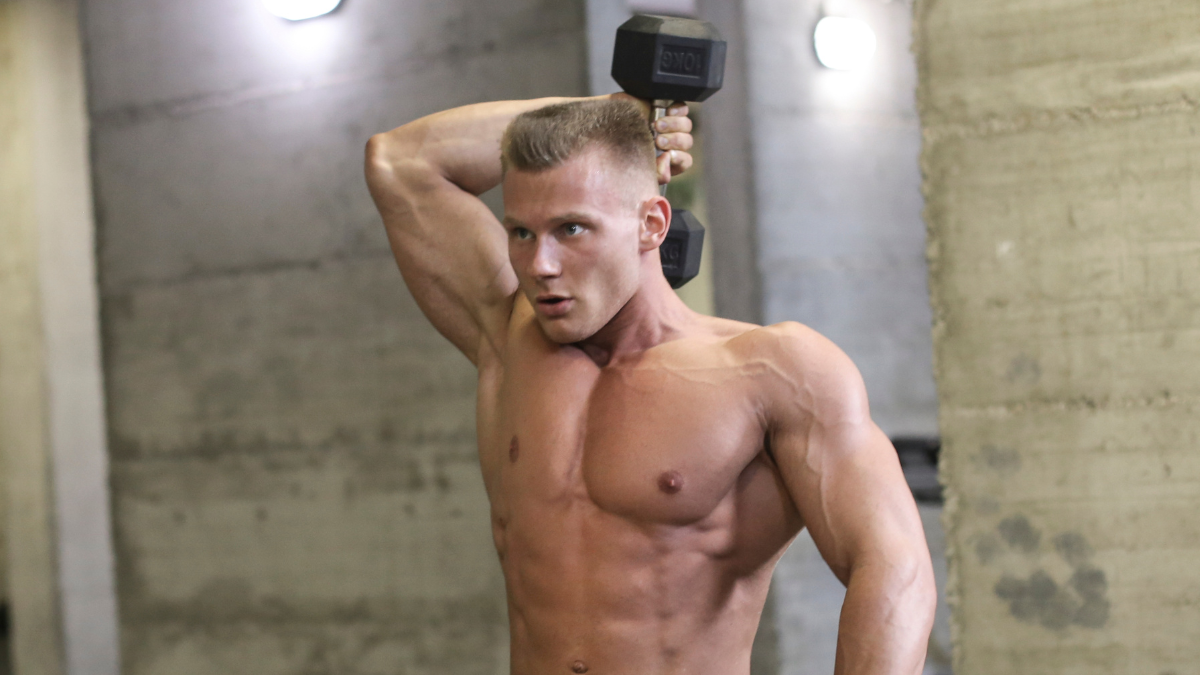
Exercise 2: Overhead Dumbbell Triceps Extension
The overhead dumbbell extension is one of the few exercises that effectively places the long head of the triceps under a significant stretch. Since the long head crosses the shoulder joint, raising the arms overhead lengthens the muscle before contraction.
Recent research has highlighted the importance of training muscles in a lengthened position. Exercises that load muscles while stretched often stimulate greater hypertrophy than those performed primarily in shortened positions.
Why It Works
Many pressing exercises primarily emphasize the lateral and medial heads. The overhead extension complements compound pressing by giving additional attention to the long head.
This balanced approach helps maximize total arm development. Using a single dumbbell with both hands also makes the movement beginner friendly while allowing gradual increases in training load.
How to Perform It
- Sit or stand while holding one dumbbell with both hands.
- Raise the dumbbell overhead with your elbows pointing upward.
- Slowly lower the weight behind your head by bending your elbows.
- Lower until you feel a comfortable stretch through the triceps.
- Press the dumbbell back upward until your elbows are fully extended.
- Keep your upper arms relatively stationary throughout the movement.
Common Beginner Mistakes
Allowing the elbows to flare excessively reduces efficiency. Using momentum by leaning backward also decreases muscular tension. Choose a manageable weight that allows full control throughout every repetition.
Exercise 3: Cable Triceps Pushdown

The cable pushdown remains one of the safest and most effective isolation exercises for beginners. Unlike free weights, cables maintain resistance throughout nearly the entire range of motion. The movement is easy to learn, places minimal stress on the joints, and allows precise progression.
Why It Works
The pushdown isolates elbow extension with very little contribution from other muscles. Because stability demands are low, beginners can focus entirely on squeezing the triceps. Research examining resistance profiles has shown that cable exercises provide consistent muscular tension across large portions of the movement, making them excellent for hypertrophy training. The exercise also allows frequent practice without excessive fatigue.
How to Perform It
- Stand facing the cable machine.
- Grip the attachment with your elbows tucked close to your sides.
- Press the handle downward until your elbows are fully extended.
- Pause briefly while contracting the triceps.
- Slowly return to the starting position without allowing the weight stack to slam.
- Control both the lifting and lowering phases.
Common Beginner Mistakes
Many people lean their body weight onto the handle instead of moving only through the elbows. Others allow the elbows to drift forward, turning the exercise into a shoulder movement. Keep the upper arms stable while focusing on smooth elbow extension.
Why These Three Exercises Work So Well Together
Each movement complements the others.
- The close grip bench press develops overall strength while exposing the triceps to heavy loading.
- The overhead extension emphasizes the long head through a stretched position.
- The cable pushdown provides high quality isolation work with continuous muscular tension.
Together, these exercises train every major portion of the triceps while exposing the muscle to different loading patterns.
This variety is supported by research showing that combining compound and isolation exercises often produces superior hypertrophy compared to relying on only one style of training.
Progressive Overload Is the Key to Bigger Triceps
The exercises themselves do not build muscle. Progressive overload does. Your muscles only continue adapting when training becomes gradually more demanding.
Increase the challenge by adding small amounts of weight whenever you can complete all prescribed repetitions with good technique. If adding weight is not possible, perform additional repetitions before increasing resistance.
Small improvements accumulated over months produce dramatic increases in muscle size. Research consistently identifies progressive overload as one of the most important factors for long term hypertrophy.
Final Thoughts
Building muscular triceps does not require complicated routines or dozens of isolation exercises. For beginners, focusing on three proven movements provides everything needed to stimulate impressive growth. The close grip bench press develops strength and overall muscle mass through heavy compound loading.
The overhead dumbbell extension targets the often neglected long head while training the muscle in a stretched position. The cable triceps pushdown provides continuous tension and excellent isolation for finishing the workout. Combined with progressive overload, proper nutrition, and consistent recovery, these exercises create an effective foundation for bigger, stronger, and more muscular arms.
The most important factor is consistency. Beginners who practice these movements with excellent technique and gradually increase their training demands over time will almost certainly see noticeable improvements in both arm size and strength.
Key Takeaways
| Topic | Key Point |
|---|---|
| Best compound exercise | Close grip bench press builds overall triceps mass with heavy loading. |
| Best stretch exercise | Overhead dumbbell extension emphasizes the long head in a lengthened position. |
| Best isolation exercise | Cable triceps pushdown provides continuous tension and easy progression. |
| Weekly volume | Aim for about 10 to 20 challenging sets per week for the triceps. |
| Repetition range | Six to fifteen repetitions work well depending on the exercise and training load. |
| Progressive overload | Increase weight or repetitions gradually to continue building muscle. |
| Protein intake | Around 1.6 grams per kilogram of body weight daily supports muscle growth for most people. |
| Recovery | Allow at least forty eight hours between hard triceps sessions and prioritize quality sleep. |
References
- American College of Sports Medicine. (2009). Progression models in resistance training for healthy adults. Medicine & Science in Sports & Exercise, 41(3), 687–708.
- Boehm, E., Hiscock, D., and Comerford, M. (2014). Electromyographic analysis of triceps brachii activation during common resistance exercises. Journal of Strength and Conditioning Research, 28(12), 3406–3412.
- Grgic, J., Schoenfeld, B.J., Orazem, J. and Sabol, F. (2022). Effects of resistance training performed to repetition failure or non failure on muscular strength and hypertrophy. Scandinavian Journal of Medicine & Science in Sports, 32(11), 1541–1557.
- Maeo, S., Ando, Y., Kanehisa, H. and Kawakami, Y. (2021). Muscular adaptations to resistance training performed at long muscle lengths. Frontiers in Physiology, 12, 664913.
- Schoenfeld, B.J. (2010). The mechanisms of muscle hypertrophy and their application to resistance training. Journal of Strength and Conditioning Research, 24(10), 2857–2872.
- Schoenfeld, B.J., Grgic, J., Ogborn, D. and Krieger, J.W. (2017). Strength and hypertrophy adaptations between low versus high load resistance training. Journal of Strength and Conditioning Research, 31(12), 3508–3523.
- Schoenfeld, B.J., Ogborn, D. and Krieger, J.W. (2017). Dose response relationship between weekly resistance training volume and increases in muscle mass. Journal of Sports Sciences, 35(11), 1073–1082.