

Visible abs might be the goal for many gym-goers, but Lauren Pak believes effective core training goes far beyond aesthetics. In a recent video on the Jason and Lauren YouTube channel, the certified strength and conditioning coach explains that the core serves as the body’s connection between the upper and lower body, making it essential for strength, athleticism, and injury prevention.
“Your core is the link between your upper and lower body,” Pak explains. “It’s responsible for transferring force, creating movement, resisting movement, and helping you stay strong and stable.”


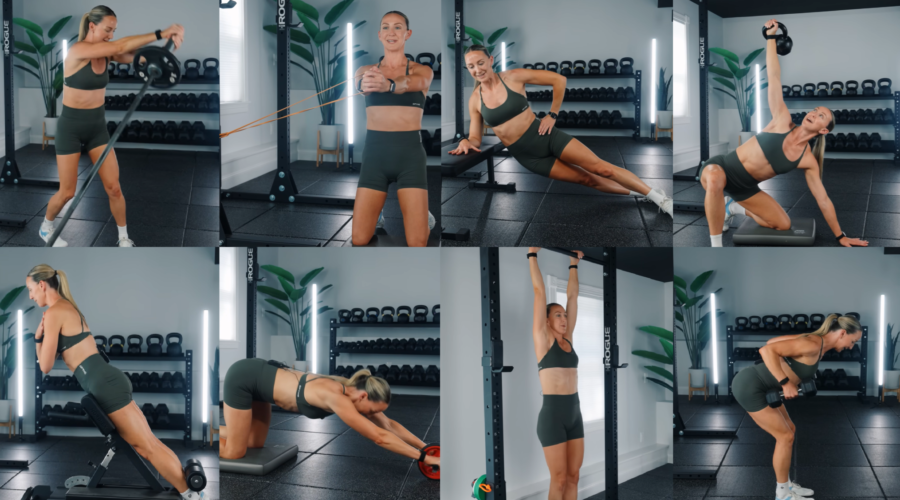
Rather than relying on endless crunches, Pak organizes core training around eight movement qualities that develop strength through every plane of motion.
Rotation
The first quality focuses on producing rotational power. Pak recommends medicine ball rotational throws whenever possible but demonstrates landmine rotations as an effective alternative.

The movement teaches athletes to generate force through the hips, torso, and upper back instead of relying solely on the arms, making it highly transferable to sports that require rotational strength.
Anti-Rotation
To balance rotational power, Pak emphasizes anti-rotation exercises that teach the torso to resist twisting forces.
Her preferred variation is the tall kneeling Pallof press hold, which minimizes assistance from the legs and places greater demand on the obliques while reinforcing proper trunk alignment.
Lateral Flexion
For side bending strength, Pak prefers the side plank hip dip over traditional dumbbell side bends.
The movement combines shoulder stability with controlled movement through the obliques, creating strength while improving mobility through the entire side of the body.
Anti-Lateral Flexion
The half-kneeling kettlebell windmill trains the body to resist collapsing sideways while allowing the hips and shoulders to move efficiently.
Although many people perform windmills as side bends, Pak explains that the goal is maintaining a stacked torso while moving through the hips, making it a full-body stability exercise.
Extension
Pak also reminds viewers that the lower back is an important part of the core.
Using controlled 45-degree back extensions, she recommends strengthening the spinal erectors and glutes through a full range of motion without excessive arching at the top.
Anti-Extension
Among the eight qualities, Pak considers anti-extension the most important.
“If you’re only going to choose one category,” she says, “it’s going to be anti-extension.”
She explains that learning to keep the ribs stacked over the hips while resisting spinal extension carries over to lifting, running, sports performance, and even reducing lower back discomfort. Her preferred exercise is the ab wheel rollout, with stability ball rollouts serving as an excellent regression.
Flexion
While traditional abdominal work still has value, Pak favors hanging knee raises because they integrate grip strength, shoulder stability, and pelvic control alongside abdominal development.
The exercise trains the core in a way that more closely resembles athletic movement than standard floor-based crunches.
Anti-Flexion
The final quality involves resisting spinal rounding under load.
Rather than adding separate isolation drills, Pak notes that exercises like Romanian deadlifts, bent-over rows, good mornings, and conventional deadlifts naturally develop anti-flexion strength when performed with proper posture.
The Takeaway
Pak encourages athletes not to cram all eight qualities into every workout. Instead, she recommends choosing two or three movement patterns at a time and rotating them throughout the week to build a stronger, more resilient core.
By training both movement and stability in every direction, her framework offers a more complete approach than simply chasing six-pack abs, helping improve performance, reduce injury risk, and support long-term athletic development.
About the Author
Jeremiah Oliva

Jeremiah Oliva is a writer passionate about fitness, sports, and active living. He has experience in songwriting and managing content and social media for online radio and magazine platforms.
He covers HYROX, CrossFit®, and competitive fitness, with a focus on performance, mindset, and athlete development.
Outside of writing, Jeremiah trains in boxing, cycles, explores the outdoors with his kids, and plays the guitar.