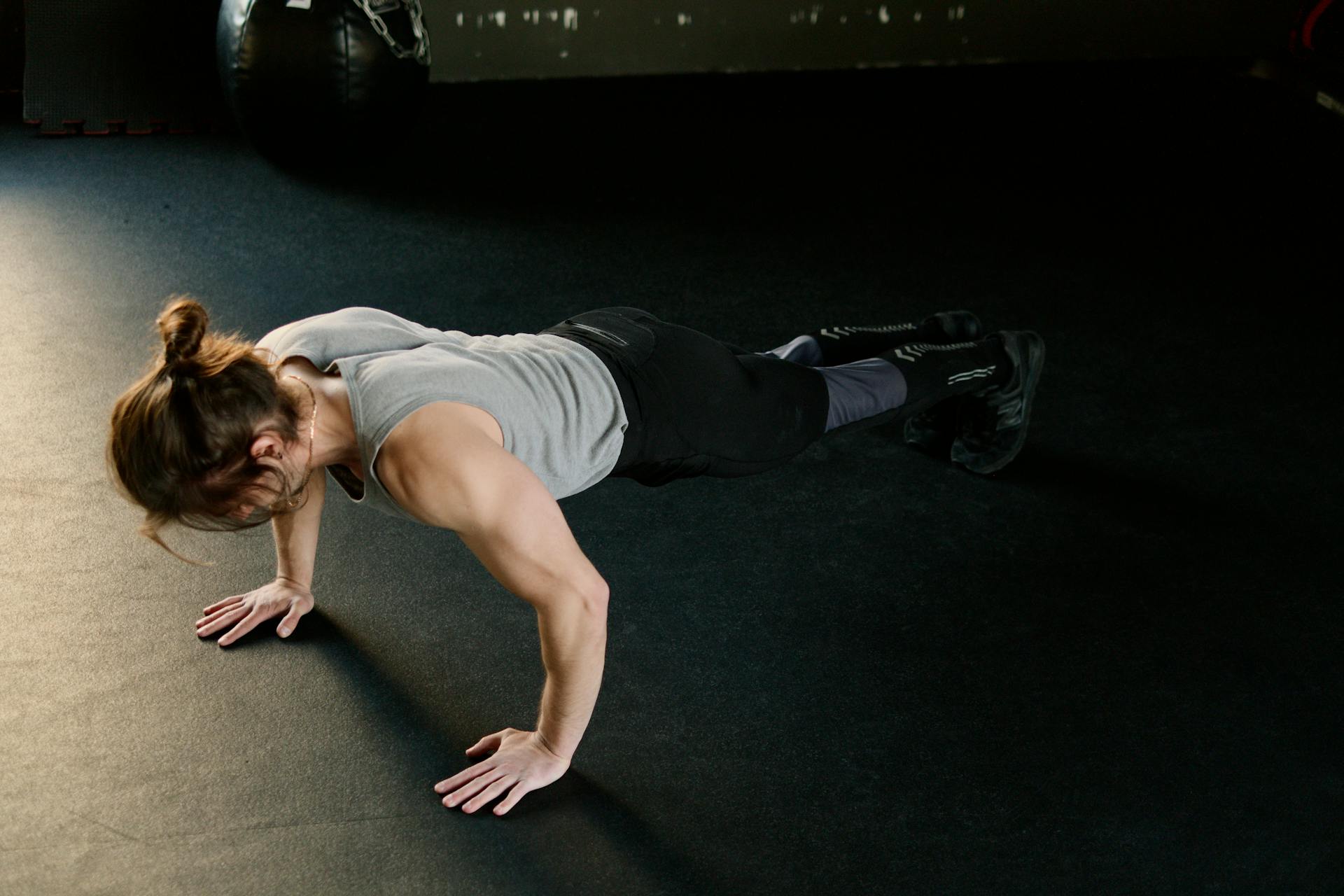


Building a stronger chest does not require a barbell, a bench, or an advanced training plan. Beginners can develop the chest muscles effectively with bodyweight, dumbbells, or resistance bands, provided they use a challenging resistance, move through a controlled range of motion, and gradually make the exercise harder over time.
The chest is mainly made up of the pectoralis major, a large muscle that helps bring the upper arm toward the center of the body and push it forward. The pectoralis minor sits underneath it and contributes to shoulder blade control. Good chest training also involves the triceps and front shoulder muscles, since these muscles assist during pressing movements.


Research consistently supports resistance training as a way to improve strength and muscle size. The equipment matters less than the quality of effort and progression. Bodyweight pushing, dumbbell pressing, and elastic resistance can all create a useful training stimulus for beginners. These three exercises are practical, scalable, and easy to learn without a barbell.
What Makes a Chest Exercise Effective for Beginners?
An effective beginner chest exercise should train the pressing action while allowing you to control the resistance and maintain good shoulder position. It should also offer a simple way to progress. That could mean adding repetitions, lowering the hand position, choosing heavier dumbbells, or using a stronger resistance band.
Muscle activity research suggests that properly loaded push ups can activate the chest and triceps similarly to bench pressing. A training study also found that push up and bench press programs produced similar strength improvements when the exercises were matched for muscular activity and training effort. This matters because it shows that a barbell is not essential for beginner chest development.
Beginners should prioritize consistent practice over exhausting workouts. Resistance training guidelines support training major muscle groups on multiple days each week, using controlled repetitions and progressive increases in training demand. For chest work, two sessions per week is a sensible starting point for most people.
A Simple Rule for Choosing Resistance
Choose a variation that lets you complete your repetitions with steady control while still feeling that the final few repetitions require real effort. You should not need to twist, bounce, hold your breath, or let your shoulders drift toward your ears to finish a set.
3 Top Tips to Build Stronger Hamstrings Without Deadlifts
If you can easily perform many more repetitions than planned, the exercise is probably too easy. If your form breaks down very early, reduce the resistance or use an easier variation. This approach makes training productive while giving you time to learn the movement.
1. Incline Push Up
The incline push up is the best starting chest exercise for many beginners. It uses your bodyweight, requires no equipment beyond a stable elevated surface, and makes it easy to adjust difficulty. You can use a wall, kitchen counter, sturdy table, squat rack bar, or exercise bench.
Raising the hands reduces the percentage of bodyweight you need to press. That gives beginners a more manageable version of the push up while preserving the basic chest, triceps, and shoulder pressing pattern. As you become stronger, lowering the height of the hands gradually increases the challenge.
How to Perform the Incline Push Up
Place both hands slightly wider than shoulder width on a stable elevated surface. Walk your feet back until your body forms a straight line from head to heels. Tighten your stomach and glutes gently so your hips do not sag or rise excessively.
Lower your chest toward the surface by bending the elbows. Keep the elbows angled moderately away from your torso instead of flaring them directly to the sides. Press the surface away until your elbows are straight, then repeat with control.
Your chest should move toward the support instead of your head dropping forward. Think about keeping your neck long and your shoulder blades stable throughout the repetition.
Why It Works
Push ups are not simply an arm exercise. When the load is appropriate, they challenge the chest, triceps, and front shoulder muscles together. Research comparing push ups with bench pressing found comparable chest and triceps muscle activity when exercise intensity was matched. A later training study found similar strength improvements from push ups and bench presses when participants trained at comparable levels of muscle activity.
The incline version is especially valuable because it creates a clear path toward standard floor push ups. Start with a high surface and gradually move to a lower one when you can complete your target repetitions with clean form.
Aim for two to four sets of eight to fifteen repetitions. Rest long enough that you can repeat the next set without rushing, usually around one to two minutes.
2. Dumbbell Floor Press
The dumbbell floor press is a straightforward chest exercise that avoids the need for a bench and limits how far the elbows travel behind the body. The floor acts as a natural stopping point, which can make the movement feel more controlled for a beginner.
You need a pair of dumbbells. If you do not have matching dumbbells, you can still perform the exercise one arm at a time, although keeping both sides even over the session is important.
How to Perform the Dumbbell Floor Press
Lie on your back with knees bent and feet flat on the floor. Hold a dumbbell in each hand with your upper arms resting lightly on the floor and your elbows bent. Your hands should begin roughly above your lower chest.
Press the dumbbells upward until your elbows are straight but not aggressively locked. Keep your wrists stacked above your elbows and avoid letting the weights drift far toward your face. Lower slowly until your upper arms return to the floor, pause briefly, and repeat.
Keep your ribs comfortable and avoid overextending your lower back to push the weights higher. The goal is a controlled press, not the largest possible range of motion.
Why It Works
Free weight chest pressing gives each arm responsibility for controlling its own dumbbell. This can expose side to side differences and encourages steady control through the movement. Research comparing chest press variations has shown that stability demands can alter muscle activity and strength performance. For beginners, the floor press provides a useful balance between a stable body position and independently controlled weights.
The floor reduces the bottom portion of the movement compared with a dumbbell bench press. That does not make it ineffective. It simply makes the exercise a practical entry point, particularly for people training at home or those who are still becoming comfortable with pressing mechanics.
Start with two or three sets of eight to twelve repetitions. Use a weight that makes the last few repetitions demanding while allowing the dumbbells to move smoothly and evenly.
When all planned sets feel comfortable, increase the weight slightly or add a repetition to each set. Small progressions done consistently are more useful than frequent large jumps in weight.
3. Resistance Band Chest Press
A resistance band chest press is an excellent barbell free option when dumbbells are unavailable or when you want a portable chest exercise. Elastic resistance can be used at home, while traveling, or in a gym. It also allows you to train a pressing pattern while standing, kneeling, or using a staggered stance.
A systematic review and meta analysis found no significant difference in strength improvements between elastic resistance training and conventional resistance training across the included studies. The evidence does not mean bands and free weights feel identical. It means elastic resistance can be a legitimate strength training tool when the exercise is challenging and progressed appropriately.
How to Perform the Resistance Band Chest Press
Anchor the band securely behind you at approximately chest height. Check the anchor carefully before every set. Hold one handle in each hand and step forward until the band has light tension.
Stand with one foot slightly in front of the other, soften your knees, and keep your torso tall. Begin with your hands near the sides of your chest and your elbows bent. Press both hands forward until your elbows are straight, then return slowly to the starting position.
Do not let the band pull your shoulders forward as you return. Keep your chest lifted naturally and maintain steady control. If the band feels unstable, perform the movement from a half kneeling position or choose a lighter band until you develop more control.
Why It Works
The resistance band chest press trains the same broad pressing action as other chest exercises. Band tension generally increases as the band lengthens, so the exercise becomes harder toward the end of the press. This can make it useful for learning to finish each repetition with purpose.
Elastic resistance has one practical drawback: it can be harder to quantify than dumbbell weight. Band colors and labels vary between manufacturers, and resistance changes with band length. The simple solution is to track the band used, your stance, your repetitions, and how difficult the set felt. When those variables become easier, move farther from the anchor, use a stronger band, or add repetitions.
Perform two to four sets of ten to fifteen repetitions. Make sure the final repetitions are challenging without requiring your torso to lean forward or your shoulders to lose position.
How to Put These Exercises Into a Beginner Workout
You do not need to perform all three exercises in every session. Choose one main movement and one secondary movement, then train them twice each week with at least one day between sessions.

For example, you could use incline push ups and dumbbell floor presses in the first session. In the next session, use resistance band chest presses and incline push ups. This approach provides practice with the same general movement while keeping training interesting and manageable.
Progressive overload remains the key principle. Once you can complete your chosen repetitions with good control, make a small change that increases the challenge. Lower the incline, add a repetition, increase dumbbell weight, or use a stronger band. Resistance training research and professional guidelines support gradual progression because the body adapts to repeated training demands.
Do not judge progress only by soreness. Better technique, more repetitions at the same resistance, and a gradual increase in load are more useful signs that you are getting stronger.
Common Beginner Mistakes to Avoid
The most common mistake is choosing a variation that is too difficult. A floor push up may look like the obvious starting point, but struggling through partial repetitions with poor alignment is less useful than performing controlled incline push ups. Begin where you can practice good form and progress from there.
Another common mistake is rushing through repetitions. Lowering with control helps you stay aware of your position and makes it easier to keep the chest, shoulders, and triceps working together. Fast, bouncing repetitions often shift stress away from the intended movement pattern.
It is also important not to turn every set into an all out test. Challenging sets are useful, but beginners benefit from leaving enough energy to perform good repetitions in the following sets and sessions. Consistent training with manageable effort is more likely to build confidence and strength than occasional exhausting workouts.
Key Takeaways
| Focus | Practical takeaway |
|---|---|
| Best starting option | Use incline push ups when standard push ups are currently too difficult. |
| Dumbbell option | Use dumbbell floor presses for a stable, easy to learn free weight chest press. |
| Band option | Use resistance band chest presses when you need a portable and adjustable exercise. |
| Weekly frequency | Train chest pressing movements about twice per week as a beginner. |
| Progression | Add repetitions, resistance, or difficulty only when you can maintain controlled form. |
| Form priority | Keep your body stable, shoulders controlled, and repetitions smooth. |
References
- American College of Sports Medicine (2009) ‘American College of Sports Medicine position stand. Progression models in resistance training for healthy adults’, Medicine and Science in Sports and Exercise, 41(3), pp. 687–708.
- Calatayud, J., Borreani, S., Colado, J.C., Martin, F., Flandez, J., Page, P. and Andersen, L.L. (2015) ‘Bench press and push up at comparable levels of muscle activity results in similar strength gains’, Journal of Strength and Conditioning Research, 29(1), pp. 246–253.
- Lopes, J.S.S., Machado, A.F., Micheletti, J.K., de Almeida, A.C. and Pastre, C.M. (2019) ‘Effects of training with elastic resistance versus conventional resistance on muscular strength: A systematic review and meta analysis’, SAGE Open Medicine, 7, pp. 1–7.
- Saeterbakken, A.H., van den Tillaar, R. and Fimland, M.S. (2011) ‘A comparison of muscle activity and one repetition maximum strength of three chest press exercises with different stability requirements’, Journal of Sports Sciences, 29(5), pp. 533–538.