

Calisthenics with Zero Equipment is one of the most effective, accessible, and scientifically supported ways to build strength, muscle, endurance, and athletic performance. You do not need a gym. You do not need machines. You do not even need a pull-up bar to get started.
All you need is your body.


This guide explains exactly how to begin Calisthenics with Zero Equipment in a smart, progressive, and evidence-based way. You will learn why it works, how to structure your training, how to progress safely, and how to avoid the most common beginner mistakes.
What Is Calisthenics with Zero Equipment?
Calisthenics refers to strength training using your body weight as resistance. Movements such as push-ups, squats, lunges, planks, and burpees fall into this category.
Calisthenics with Zero Equipment means you rely entirely on bodyweight and gravity. No dumbbells. No barbells. No machines. No resistance bands.

From a physiological perspective, these exercises create mechanical tension, metabolic stress, and muscular activation — the three key drivers of muscle adaptation and strength development (Schoenfeld, 2010).
Bodyweight training stimulates improvements in:
- Maximal strength
- Muscular endurance
- Hypertrophy (muscle growth)
- Neuromuscular coordination
- Cardiovascular fitness
Research confirms that bodyweight resistance training can significantly improve muscular fitness in both trained and untrained individuals (Kikuchi and Nakazato, 2017; Calatayud et al., 2015).
In short: Calisthenics with Zero Equipment works.
Why Calisthenics with Zero Equipment Is So Effective
Progressive Overload Still Applies
The human body adapts to stress. When you place muscles under increasing demand, they respond by becoming stronger and more resilient. This principle is called progressive overload (ACSM, 2009).
Many people assume you cannot apply progressive overload without weights. That is incorrect.
You can increase difficulty by:
- Increasing repetitions
- Slowing tempo
- Adding pauses
- Reducing rest time
- Changing leverage (e.g., elevating feet)
- Increasing total weekly volume
Research shows that muscle growth can occur across a wide range of rep ranges, provided sets are performed close to muscular failure (Schoenfeld et al., 2017).
This means push-ups done to near failure can stimulate similar hypertrophy to bench press.
High Muscle Activation
Electromyography studies show that push-ups can activate the pectoralis major and triceps at levels comparable to bench press under certain conditions (Calatayud et al., 2015).
Similarly, bodyweight squats and lunges produce meaningful quadriceps and glute activation, especially when performed with controlled tempo and full range of motion (Clark et al., 2012).
You do not need heavy loads to stimulate muscle fibers. You need sufficient tension and effort.
Cardiovascular Benefits
Calisthenics with Zero Equipment often involves compound, multi-joint movements performed with minimal rest. This increases heart rate and oxygen demand.
Circuit-style bodyweight training has been shown to improve aerobic capacity and cardiovascular fitness (Myers et al., 2015).
You are training strength and conditioning at the same time.
The Foundational Movements You Must Master
Before adding advanced variations, you must build strength in fundamental patterns.
These six movement patterns form the foundation of Calisthenics with Zero Equipment:
- Push
- Squat
- Hinge
- Lunge
- Core stabilization
- Full-body conditioning
Let’s break each one down.
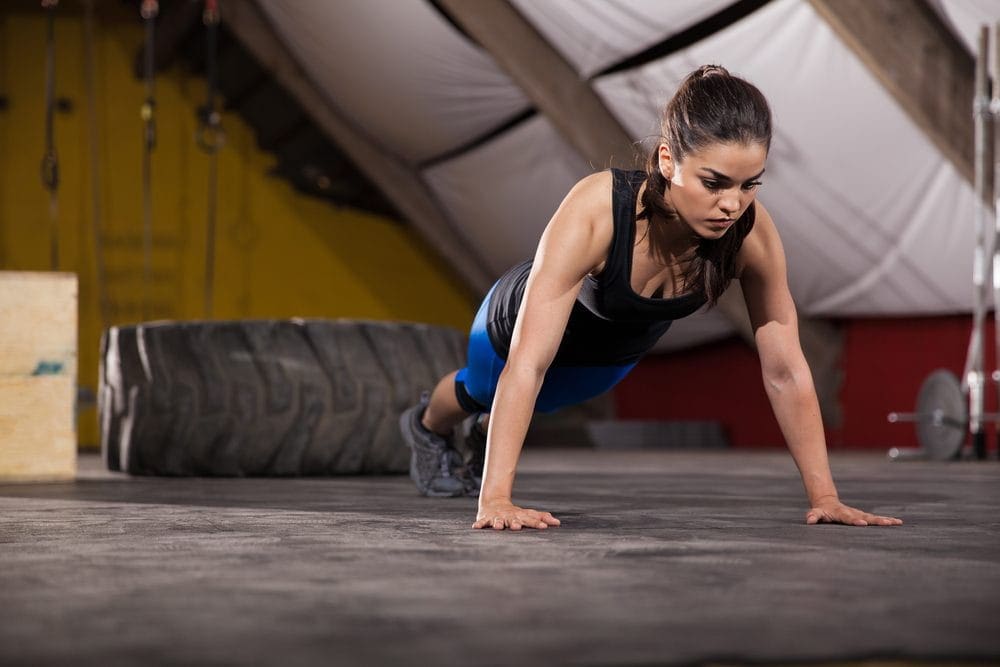
Push: The Push-Up
The push-up trains:
- Chest
- Shoulders
- Triceps
- Core
Research confirms it is an effective upper-body strength exercise (Calatayud et al., 2015).
If standard push-ups are too difficult, begin with:
- Incline push-ups (hands elevated on a table or counter)
- Knee push-ups
If they are too easy:
- Slow the eccentric (3–4 seconds down)
- Add a pause at the bottom
- Elevate your feet
Aim for full range of motion. Partial reps reduce muscle recruitment and adaptation (McMahon et al., 2014).
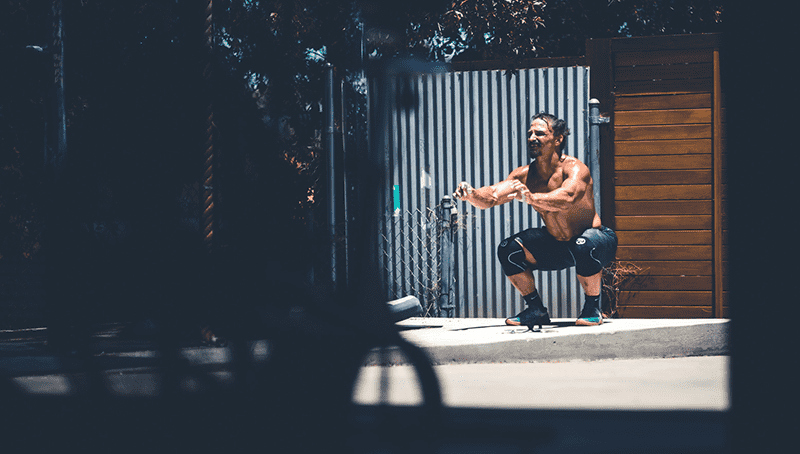
Squat: The Bodyweight Squat
Squats train:
- Quadriceps
- Glutes
- Hamstrings
- Core
Full-depth squatting recruits more gluteal muscle activation than partial squats (Caterisano et al., 2002).
Key points:
- Feet shoulder-width apart
- Sit hips back and down
- Keep chest tall
- Knees track over toes
If it is too easy:
- Slow tempo
- Pause at the bottom
- Perform jump squats
Hinge: The Glute Bridge
Without equipment, hinge work is often overlooked. That is a mistake.
The glute bridge strengthens:
- Glutes
- Hamstrings
- Posterior chain
Strong posterior chain muscles reduce injury risk and improve athletic performance (Suchomel et al., 2016).
Progressions include:
- Single-leg glute bridges
- Elevated feet bridges
- Slow tempo bridges
Lunge: The Split Squat
Split squats and lunges improve:
- Balance
- Unilateral strength
- Hip stability
Unilateral training corrects side-to-side imbalances, which can reduce injury risk (McCurdy et al., 2005).
Start with reverse lunges for better knee comfort.
Core Stabilization: Planks and Dead Bugs
The core’s primary function is resisting movement, not creating it.
Planks activate deep trunk muscles such as the transverse abdominis and internal obliques (Ekstrom et al., 2007).
Begin with:
- Front plank
- Side plank
- Dead bug
Progress by:
- Increasing time
- Extending limbs
- Adding tempo
Conditioning: Burpees
Burpees combine:
- Squat
- Push-up
- Jump
High-intensity bodyweight circuits improve aerobic and anaerobic fitness (Myers et al., 2015).
They also increase total training density, helping with fat loss when combined with appropriate nutrition.
Your First 4 Weeks of Calisthenics with Zero Equipment
Here is a science-backed beginner program based on resistance training guidelines from the American College of Sports Medicine (ACSM, 2009).
Train 3 days per week on non-consecutive days.
Workout Structure
Perform 2–3 sets of each movement.
Rest 60–90 seconds between sets.
Reps should stop 1–2 repetitions before complete failure.
Week 1–2
- Push-ups: 8–12 reps
- Bodyweight squats: 12–15 reps
- Reverse lunges: 8–10 per leg
- Glute bridges: 12–15 reps
- Plank: 20–40 seconds
- Optional: 5–8 burpees at end
Week 3–4
Increase difficulty by:
- Slowing tempo (3 seconds down)
- Adding 1 extra set
- Reducing rest to 45–60 seconds
Progression drives adaptation (ACSM, 2009).
How to Build Muscle with Calisthenics with Zero Equipment
Hypertrophy requires sufficient volume and effort.
Research shows that muscle growth can occur with lighter loads if sets are taken close to failure (Schoenfeld et al., 2017).
To build muscle:
- Train each muscle group 2–3 times per week
- Perform 10–20 total weekly sets per muscle group
- Use controlled tempo
- Work close to failure
Mechanical tension and metabolic stress are the key stimuli (Schoenfeld, 2010).
Slowing the eccentric phase increases time under tension and muscle activation.
Fat Loss and Calisthenics with Zero Equipment
Fat loss depends primarily on energy balance (Hall et al., 2012).
However, resistance training preserves lean muscle mass during calorie restriction (Weinheimer et al., 2010).
Calisthenics with Zero Equipment is ideal because:
- It increases caloric expenditure
- It preserves muscle
- It improves metabolic health
High-intensity bodyweight circuits increase post-exercise oxygen consumption, meaning you burn more calories after training (LaForgia et al., 2006).
How to Progress Without Adding Weight
Progression options include:
Increase Repetitions
Gradually increase reps within a target range.
Manipulate Tempo
Slower eccentric phases increase muscle tension (Schoenfeld, 2010).
Increase Density
Shorter rest intervals increase metabolic demand.
Advanced Leverage
- Decline push-ups
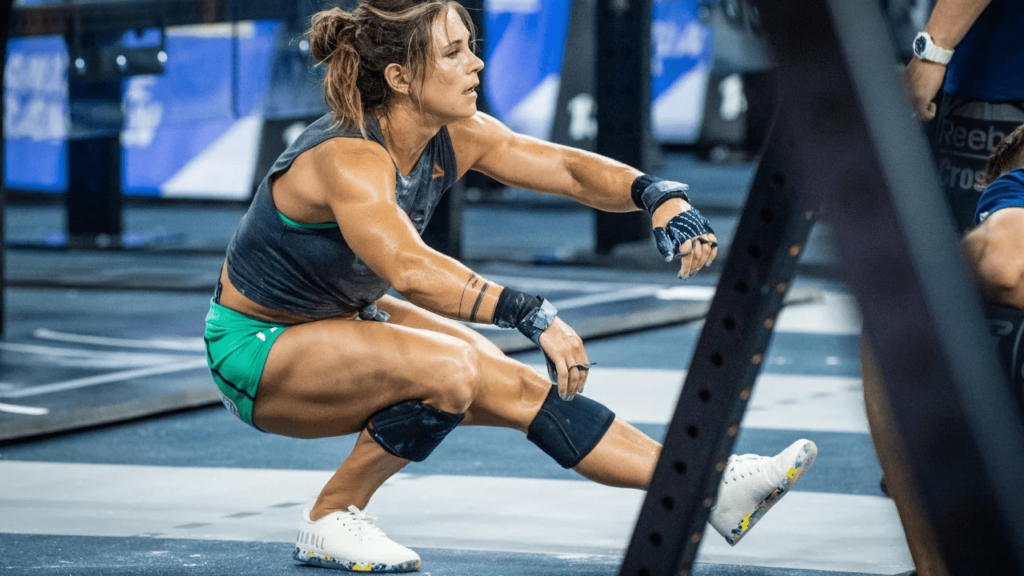
- Pistol squat progressions
- Single-leg bridges
Changing leverage increases mechanical load without external weight.
Injury Prevention and Recovery
Warm-ups reduce injury risk and improve performance (Fradkin et al., 2010).
Before training:
- 5 minutes light cardio
- Dynamic mobility
- Practice reps
Sleep is critical for recovery and muscle repair (Dattilo et al., 2011).
Aim for 7–9 hours per night.
Adequate protein intake supports muscle adaptation. Research suggests 1.6–2.2 g/kg bodyweight for optimal hypertrophy (Morton et al., 2018).
Common Mistakes Beginners Make
Training to Failure Every Set
Chronic failure training increases fatigue and impairs recovery (Sampson and Groeller, 2016).
Ignoring Lower Body
Upper-body bias leads to imbalance.
Skipping Progression
Adaptation only occurs when stimulus increases.
Poor Form
Full range of motion improves strength and hypertrophy (McMahon et al., 2014).
Who Should Do Calisthenics with Zero Equipment?
Almost everyone.
It is particularly effective for:
- Beginners
- People training at home
- Travelers
- Individuals rebuilding fitness
Studies show resistance training benefits adults across all ages, including older populations (Peterson et al., 2010).
Final Thoughts
Calisthenics with Zero Equipment is not a compromise. It is a scientifically validated, scalable, and powerful training method.
If you:
- Train consistently
- Progress intelligently
- Focus on full range of motion
- Work near failure
- Recover properly
You will build strength, muscle, endurance, and resilience.
You do not need a gym to transform your body.
You just need your body.
References
- American College of Sports Medicine (2009) ‘Progression models in resistance training for healthy adults’, Medicine & Science in Sports & Exercise, 41(3), pp. 687–708.
- Calatayud, J., Borreani, S., Colado, J.C., Martin, F., Rogers, M.E., Behm, D.G. and Andersen, L.L. (2015) ‘Bench press and push-up at comparable levels of muscle activity’, Journal of Strength and Conditioning Research, 29(1), pp. 246–253.
- Caterisano, A., Moss, R.F., Pellinger, T.K., Woodruff, K., Lewis, V.C., Booth, W. and Khadra, T. (2002) ‘The effect of back squat depth on the EMG activity of 4 superficial hip and thigh muscles’, Journal of Strength and Conditioning Research, 16(3), pp. 428–432.
- Clark, D.R., Lambert, M.I. and Hunter, A.M. (2012) ‘Muscle activation in the loaded free barbell squat’, Journal of Strength and Conditioning Research, 26(4), pp. 1169–1178.
- Dattilo, M., Antunes, H.K., Medeiros, A., Mônico Neto, M., Souza, H.S., Tufik, S. and de Mello, M.T. (2011) ‘Sleep and muscle recovery’, Sleep Medicine Reviews, 15(3), pp. 175–183.
- Ekstrom, R.A., Donatelli, R.A. and Carp, K.C. (2007) ‘Electromyographic analysis of core trunk, hip, and thigh muscles during 9 rehabilitation exercises’, Journal of Orthopaedic & Sports Physical Therapy, 37(12), pp. 754–762.
- Fradkin, A.J., Zazryn, T.R. and Smoliga, J.M. (2010) ‘Effects of warming-up on physical performance’, Journal of Strength and Conditioning Research, 24(1), pp. 140–148.
- Hall, K.D., Heymsfield, S.B., Kemnitz, J.W., Klein, S., Schoeller, D.A. and Speakman, J.R. (2012) ‘Energy balance and its components’, American Journal of Clinical Nutrition, 95(4), pp. 989–994.