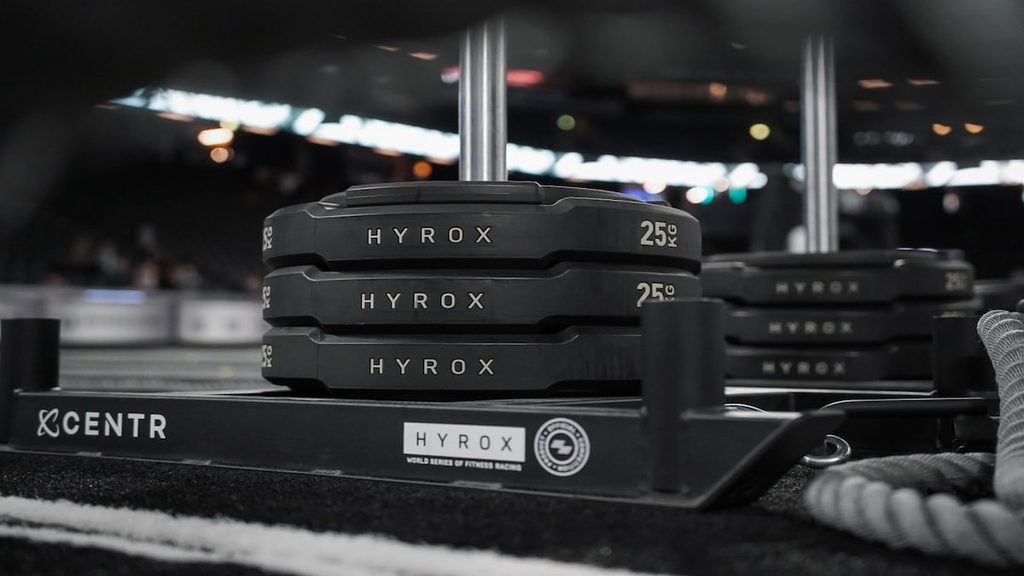
HYROX is not your average fitness race. It is a unique blend of endurance, strength, power, and muscular stamina. Eight 1 km runs are broken up by eight functional stations: SkiErg, sled push, sled pull, burpee broad jumps, rowing, farmer’s carries, sandbag lunges, and wall balls. That combination places extreme metabolic demands on the body.
You are using your aerobic system to run. You are tapping into anaerobic glycolysis during sled pushes and burpees. You are relying on phosphocreatine during explosive efforts. You are asking your muscles to contract repeatedly under fatigue while trying to maintain pacing and technique.


Training is critical. But if you are under-fueled, poorly hydrated, or mistiming your nutrients, performance will suffer — no matter how fit you are.
1. Carbohydrate Is King: Fuel the Glycolytic Beast
HYROX is metabolically demanding. Events typically last 60 to 90 minutes for many athletes. That means a large contribution from both aerobic metabolism and anaerobic glycolysis. Carbohydrate is the primary fuel for both systems during high-intensity exercise.
Why Carbs Matter for HYROX
Muscle glycogen is the stored form of carbohydrate in your muscles. When intensity rises, your body increasingly relies on glycogen rather than fat. As exercise intensity increases beyond 70% of VO2max, carbohydrate becomes the dominant fuel source.
When glycogen levels are low, fatigue increases, power output drops, and perceived exertion rises. Studies consistently show that starting exercise with higher muscle glycogen improves endurance performance, particularly during high-intensity efforts lasting longer than 60 minutes.

HYROX includes repeated bursts of high-force output (sled push, burpee broad jumps) layered on top of sustained running. That combination heavily taxes glycogen stores.
If you are under-fueled, the final stations will feel exponentially harder.
Daily Carbohydrate Targets for HYROX Athletes
Sports nutrition guidelines recommend carbohydrate intakes based on training load:
- Moderate training (about 1 hour per day): 5 to 7 g per kg of bodyweight per day
- High training load (1 to 3 hours per day): 6 to 10 g per kg per day
For a 75 kg athlete training intensely for HYROX, that may mean 450 to 600 grams of carbohydrate per day during heavy training blocks.
Low-carbohydrate approaches can impair high-intensity performance because they reduce glycogen availability and the ability to sustain repeated high-power efforts. Research shows that while fat adaptation increases fat oxidation, it can reduce exercise economy and impair performance at race intensities where carbohydrate oxidation is essential.
HYROX is not a low-intensity ultramarathon. It is high output and glycolytic. Carbs win here.
Carb Timing: Pre- and During-Event Strategy
Pre-event carbohydrate intake improves performance. Consuming 1 to 4 g of carbohydrate per kg of bodyweight in the 1 to 4 hours before exercise increases glycogen availability and improves endurance outcomes.
For events lasting longer than 60 minutes, ingesting carbohydrates during exercise (30 to 60 grams per hour, and up to 90 grams per hour using mixed glucose and fructose sources) improves performance by maintaining blood glucose and sparing glycogen.
For most HYROX athletes, consuming 30 to 60 grams of carbohydrate per hour during the race is realistic. This might be achieved through sports drinks or gels taken strategically before high-output stations.
The bottom line: Do not fear carbs. Periodize them with your training load and prioritize them before race day.
2. Protein Distribution: Support Strength and Recovery
HYROX demands muscular endurance and strength. The sled push, sled pull, wall balls, and lunges place significant stress on muscle tissue. Recovery between sessions is essential.
Protein is the key nutrient for muscle repair and adaptation.
How Much Protein Do You Need?
Meta-analyses show that strength and endurance athletes benefit from protein intakes of 1.6 to 2.2 g per kg of bodyweight per day to maximize muscle protein synthesis and support recovery.
HYROX athletes sit at the intersection of strength and endurance training. Daily protein targets toward the upper half of that range (1.8 to 2.2 g per kg) are often appropriate during heavy training blocks.
For a 75 kg athlete, that equates to approximately 135 to 165 grams of protein per day.
Protein Distribution Matters
It is not just total protein intake that matters. Distribution across the day influences muscle protein synthesis.
Research shows that consuming around 0.3 to 0.5 g of protein per kg of bodyweight per meal, spread across 3 to 5 meals, maximizes muscle protein synthesis more effectively than skewed intake patterns.
For a 75 kg athlete, that means roughly 25 to 40 grams of high-quality protein per meal.
Leucine, an essential amino acid, plays a key role in triggering muscle protein synthesis. Animal-based proteins and high-quality protein blends tend to contain sufficient leucine to reach the threshold needed for maximal stimulation.
Post-Workout Recovery Window
The “anabolic window” is not as narrow as once believed, but consuming protein soon after training remains beneficial — particularly when combined with carbohydrates.
Co-ingesting carbohydrate and protein post-exercise enhances glycogen resynthesis and muscle repair. Carbohydrate intake of 1.0 to 1.2 g per kg per hour during the first few hours after exhaustive exercise maximizes glycogen restoration, especially when recovery time between sessions is short.
If you train twice in a day, recovery nutrition becomes even more important.
HYROX training is not just about surviving workouts. It is about adapting to them. Protein supports that adaptation.
3. Creatine Monohydrate: A Legal Performance Booster
Creatine is one of the most studied and effective supplements in sports nutrition. For HYROX athletes, it can provide a meaningful edge.
Why Creatine Helps in HYROX
Creatine increases phosphocreatine stores in muscle. Phosphocreatine is used to rapidly regenerate ATP during short, high-intensity efforts.
HYROX includes repeated bouts of explosive and high-force output efforts: sled pushes, sled pulls, wall balls, lunges, and burpee broad jumps. Even the transitions between stations require bursts of effort.
Supplementing with creatine monohydrate has been shown to increase strength, power output, and lean mass. It also improves repeated sprint performance and high-intensity interval performance.
That repeated-effort benefit is especially relevant for HYROX, where athletes repeatedly shift between running and high-intensity functional movements.
Dosage and Safety
A common strategy is a loading phase of 20 grams per day (split into 4 doses) for 5 to 7 days, followed by a maintenance dose of 3 to 5 grams per day.
Alternatively, athletes can skip the loading phase and take 3 to 5 grams daily. Muscle creatine stores will still increase, just more gradually.
Creatine monohydrate is well supported by long-term safety data in healthy individuals. It is not a steroid. It is not banned. It is one of the most evidence-based supplements available.

Some athletes worry about weight gain. Creatine can increase intracellular water retention, typically 1 to 2 kg. In HYROX, where absolute strength and power matter, that trade-off is often beneficial. However, individual response varies.
Does Creatine Hurt Endurance?
Research shows that creatine may slightly increase body mass, which could theoretically impact running economy. However, in mixed-modal sports that include strength and high-intensity intervals, the performance benefits in power and repeated effort often outweigh potential downsides.
HYROX is not a pure marathon. It is a hybrid event. Creatine fits that profile well.
4. Hydration and Sodium: Small Details, Big Impact
Dehydration impairs both endurance and cognitive performance. Even a body mass loss of around 2% from fluid loss can negatively affect aerobic performance and increase perceived exertion.
In HYROX, dehydration can happen faster than you think, especially indoors in warm conditions.
Why Hydration Matters for Performance
Sweat loss reduces plasma volume, increases cardiovascular strain, and elevates core temperature. This can reduce stroke volume and increase heart rate for a given workload.
Studies show that hypohydration reduces endurance capacity, power output, and mental performance.
Given the technical nature of stations like wall balls and sled work, cognitive clarity under fatigue matters.
Sodium Is Not the Enemy
Sweat contains sodium. Sodium losses vary widely between individuals, but average sweat sodium concentrations are around 20 to 80 mmol per liter.
Replacing fluids without sodium can dilute plasma sodium levels and may increase the risk of hyponatremia in extreme cases. More commonly, inadequate sodium replacement can impair fluid retention.
Adding sodium to fluids improves fluid absorption and helps maintain plasma volume.
Practical Strategy
Before race day, weigh yourself before and after hard training sessions to estimate sweat rate. Each kilogram of body mass lost roughly equals one liter of fluid.
A general guideline is to aim to limit body mass loss to less than 2% during competition.
Consuming 400 to 800 ml of fluid per hour, adjusted for sweat rate and conditions, is a common starting point. Including sodium (typically 300 to 600 mg per hour, adjusted individually) supports hydration.
Arrive at the start line well hydrated. Pale urine and stable morning body weight can be practical indicators.
Hydration is not glamorous. But it is performance-critical.
5. Caffeine: Smart Stimulation
Caffeine is one of the most reliable ergogenic aids in sport.
It enhances alertness, reduces perceived exertion, and can improve both endurance and high-intensity performance.
How Caffeine Works
Caffeine acts primarily as an adenosine receptor antagonist. By blocking adenosine, it reduces feelings of fatigue and increases central nervous system drive.
It can also increase fat oxidation at lower intensities and enhance calcium release in muscle, potentially improving contractile force.
Meta-analyses show that caffeine improves endurance performance, strength, and repeated sprint performance.
For HYROX, where mental resilience and pacing strategy are key, reduced perception of effort can be a major advantage.
Effective Doses
The most commonly studied and effective dose is 3 to 6 mg per kg of bodyweight taken about 30 to 60 minutes before exercise.
For a 75 kg athlete, that equals 225 to 450 mg of caffeine.
Lower doses (around 2 to 3 mg per kg) can still provide benefits with fewer side effects.
More is not better. High doses increase the risk of jitteriness, gastrointestinal distress, elevated heart rate, and poor pacing decisions.
Train With It First
Caffeine responses vary widely between individuals due to genetics and habitual intake.

Never try caffeine for the first time on race day. Test your dose in training under race-like conditions.
If you train in the evening, be aware that caffeine can impair sleep. Sleep is a powerful recovery tool. Use caffeine strategically, not habitually.
Putting It All Together: Build a Performance System
HYROX rewards well-rounded athletes. Your nutrition should reflect that.
- Fuel your glycolytic system with adequate carbohydrates.
- Support muscle repair with distributed protein intake.
- Consider creatine to enhance repeated high-intensity output.
- Stay hydrated and replace sodium.
- Use caffeine strategically to sharpen performance.
None of these hacks replace training. But together, they create a physiological environment where your training can shine.
If you want to perform at your best in HYROX, stop thinking about nutrition as an afterthought. Think of it as part of your race plan.
Your engine is only as powerful as the fuel you give it.
References
- Branch, J.D. (2003) ‘Effect of creatine supplementation on body composition and performance: a meta-analysis’, International Journal of Sport Nutrition and Exercise Metabolism, 13(2), pp. 198–226.
- Burke, L.M., Hawley, J.A., Wong, S.H.S. and Jeukendrup, A.E. (2011) ‘Carbohydrates for training and competition’, Journal of Sports Sciences, 29(S1), pp. S17–S27.
- Casa, D.J., Armstrong, L.E., Hillman, S.K., Montain, S.J., Reiff, R.V., Rich, B.S.E., Roberts, W.O. and Stone, J.A. (2000) ‘National Athletic Trainers’ Association position statement: fluid replacement for athletes’, Journal of Athletic Training, 35(2), pp. 212–224.
- Cermak, N.M. and van Loon, L.J.C. (2013) ‘The use of carbohydrates during exercise as an ergogenic aid’, Sports Medicine, 43(11), pp. 1139–1155.
- Coffey, V.G. and Hawley, J.A. (2007) ‘The molecular bases of training adaptation’, Sports Medicine, 37(9), pp. 737–763.
- Ganio, M.S., Klau, J.F., Casa, D.J., Armstrong, L.E. and Maresh, C.M. (2009) ‘Effect of caffeine on sport-specific endurance performance: a systematic review’, Journal of Strength and Conditioning Research, 23(1), pp. 315–324.
- Grgic, J., Schoenfeld, B.J., Davies, T.B., Lazinica, B., Krieger, J.W. and Pedisic, Z. (2018) ‘Effect of resistance training frequency on gains in muscular strength: a systematic review and meta-analysis’, Sports Medicine, 48(5), pp. 1207–1220.
- Jeukendrup, A.E. (2014) ‘A step towards personalized sports nutrition: carbohydrate intake during exercise’, Sports Medicine, 44(Suppl 1), pp. S25–S33.