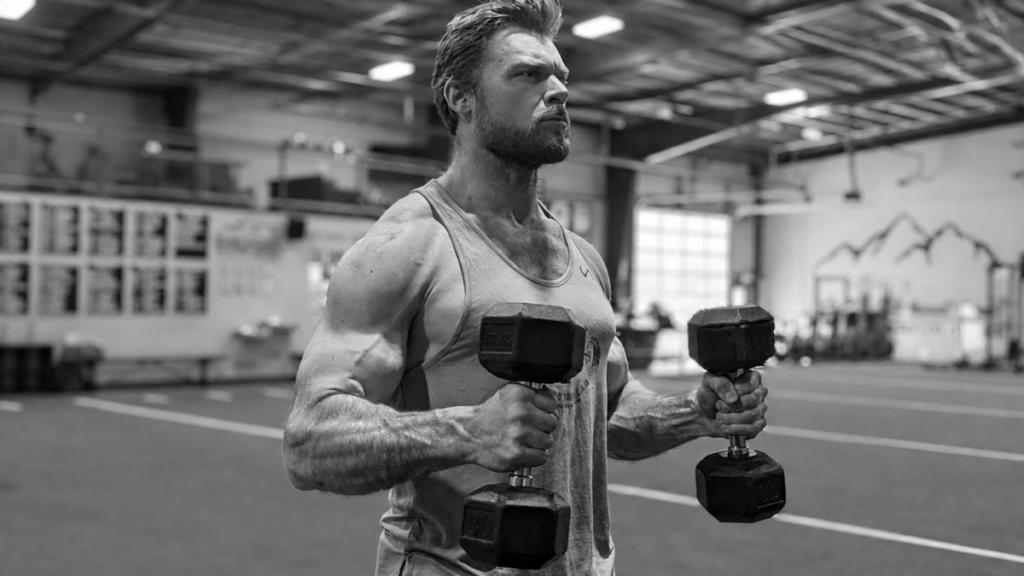


A muscular torso is not built by chasing exotic exercises or endlessly changing workouts. It comes from repeatedly challenging the chest, back, shoulders, and arms with enough effort, good technique, and a plan to make the work harder over time. Bodyweight training can do exactly that, particularly for beginners who are still building coordination and basic strength.
Research on resistance training shows that muscle growth can occur across a wide range of loads when sets are sufficiently demanding. Multiple hard sets performed consistently are especially useful for hypertrophy, while training a muscle more than once per week is a practical way to accumulate productive work. For a beginner, bodyweight exercises offer a simple entry point because the resistance is always available and each repetition teaches control of the body through space.



The three exercises below cover the major muscles of the torso with very little equipment. Push ups build the pressing muscles on the front of the upper body. Inverted rows build the back and elbow flexors through a horizontal pulling pattern. Pike push ups strengthen the shoulders while adding more pressing volume. Together, they form a straightforward foundation for a visibly stronger chest, back, and shoulders.
Why Bodyweight Training Can Build a Muscular Torso
Muscle growth is an adaptation to repeated resistance training. Your muscles need a challenge that is difficult enough to recruit and fatigue a large amount of muscle tissue, and they need that challenge often enough to create a repeated signal for adaptation. The exercise does not need to involve a barbell or a machine. It needs to provide enough resistance and be performed with controlled technique and meaningful effort.
The 3 Best Beginner Exercises for Super Strong and Muscular Forearms
This matters because beginners often dismiss bodyweight work once they can do a few repetitions. That is a mistake. Resistance can be adjusted without adding a plate. You can change leverage, elevate the feet, slow the lowering phase, pause in difficult positions, increase the range of motion, or perform more demanding variations. These changes make an exercise harder and allow progressive overload to continue.
The goal is not to force every set to absolute failure. Evidence suggests that hard sets performed close to failure can support hypertrophy, while always reaching failure is not necessary and can create more fatigue. A useful beginner target is to finish most sets feeling that one to three technically clean repetitions were still possible. If your form collapses long before the target repetition range, use an easier variation. If you can easily exceed the range, progress the exercise.
Exercise 1: Push Ups
Push ups are the most useful first bodyweight exercise for building the front of the torso. They train the pectoralis major, anterior deltoids, and triceps, while the abdominals and glutes work to keep the torso rigid. When the hands and body position create a challenging load, push ups can build pressing strength and muscle in a way that compares favorably with traditional bench press training.
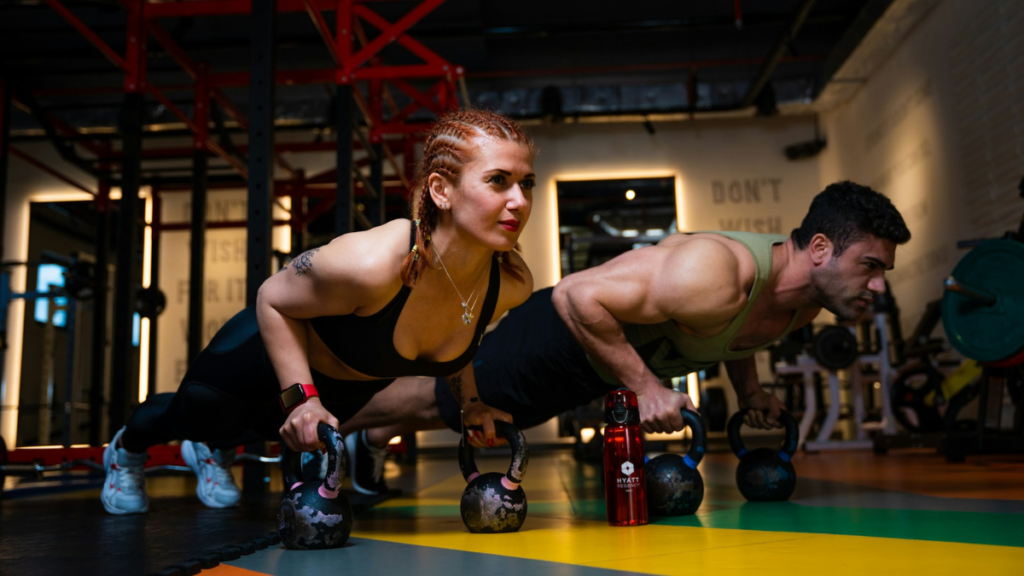
A controlled push up also teaches an important skill: moving at the shoulders while keeping the trunk stable. This makes it more than a chest exercise. The ability to maintain a straight body line while pressing helps beginners develop bracing, shoulder control, and confidence under effort.
How to Do the Push Up
Start in a high plank with your hands slightly wider than shoulder width. Squeeze your glutes, tighten your stomach, and create a straight line from your head to your heels. Lower your chest toward the floor by bending your elbows while keeping them angled naturally away from the ribs rather than flared straight out to the sides.
Descend until your chest is close to the floor or until your shoulder position becomes uncomfortable. Press the floor away and return to the starting position without letting your hips sag or rise first. Keep your neck neutral by looking slightly ahead of your hands rather than craning your chin forward.
If a floor push up is too difficult, place your hands on a stable elevated surface such as a bench, countertop, or sturdy box. This reduces the amount of body mass your arms must move. As you become stronger, lower the height of the surface until you can perform floor repetitions with control. When standard push ups become manageable, elevate your feet or use a slower three second lowering phase.
How to Program the Push Up
Perform two to four sets of six to fifteen controlled repetitions. Rest for at least one to two minutes so the next set is challenging for the right reason rather than limited only by breathlessness. Use an incline that lets you complete the lower end of the range with clean technique, then add repetitions over time. Once you can complete fifteen or more repetitions in every set, make the variation harder.
Exercise 2: Inverted Rows
A muscular torso needs pulling work, not only pressing. Inverted rows are one of the best beginner friendly ways to train the lats, middle back, rear shoulders, and elbow flexors without needing to perform a full pull up. They balance the pushing volume from push ups and give the back the direct training it needs to develop thickness and shape.
The horizontal pulling angle makes this exercise adjustable for almost any starting strength level. The more upright your body is, the less body mass you lift. The more horizontal you become, the harder the row gets. This makes the movement a practical progression that can continue to challenge you well beyond the first few weeks of training.
How to Do the Inverted Row
Use a stable bar set around waist height, a securely anchored suspension trainer, or a similarly safe setup designed to hold your body weight. Hold the handles or bar with straight arms and walk your feet forward until your body forms a straight line. Begin with a more upright body position if needed.
Pull your chest toward the bar or handles by driving your elbows back. Think about bringing your shoulder blades toward each other and down, then squeeze briefly at the top without shrugging your shoulders toward your ears. Lower yourself slowly until your arms are straight again. Keep your ribs down and avoid turning the movement into a hip thrust.
Safety matters here. Do not row from an unstable table, loose furniture, or any surface that could shift. A sturdy bar or properly secured suspension trainer is the sensible option. The exercise is highly effective only when the setup is trustworthy enough to let you pull hard.
How to Program the Inverted Row
Perform two to four sets of six to fifteen repetitions, aiming to keep the torso stiff and the movement smooth. Make the row harder by walking your feet farther forward, lowering the bar, elevating the feet, or pausing for one second at the top. The ability to progressively increase difficulty is what turns this from a basic movement into a serious back builder.
Exercise 3: Pike Push Ups
Pike push ups are a smart third exercise because they shift more of the pressing demand to the shoulders. Standard push ups already train the front deltoids, but the pike position increases shoulder flexion and creates a more vertical pressing pattern. This helps beginners develop fuller shoulders while continuing to train the triceps and upper chest.
Strong shoulders add width to the upper torso and make the chest and back look more balanced. They also need to be trained with patience. A beginner should prioritize a comfortable range of motion, stable shoulder positions, and gradual progression instead of forcing deep repetitions before the strength is there.
How to Do the Pike Push Up
Begin in a high plank and walk your feet toward your hands until your hips rise, creating an upside down V shape. Place your hands about shoulder width apart. Bend your elbows and lower the top of your head toward the floor slightly in front of your hands. Your elbows should travel at a comfortable diagonal rather than pointing directly sideways.
Press through your palms to return to the starting position while keeping your hips high. Do not allow your body to drift into a regular push up. The goal is to keep the torso angled so the shoulders receive a larger share of the work. A short range performed with excellent control is more valuable than a deep repetition that causes pain or loses position.
To make the exercise easier, elevate your hands on a sturdy surface. To make it harder, elevate your feet, increase the range of motion by placing your hands on handles or blocks, or gradually move toward a more vertical body position. Only progress when you can control the lowering phase and press smoothly without pinching or sharp discomfort.
How to Program the Pike Push Up
Start with two or three sets of five to ten repetitions, leaving one to three repetitions in reserve. The shoulder focused angle can make this movement feel harder than a standard push up, so lower repetitions are normal at first. Add repetitions before adding a more difficult variation, and keep at least one rest day between demanding upper body sessions.
A Simple Weekly Plan That Works
Perform these three exercises two or three nonconsecutive days per week. Start with two sets of each movement during the first two weeks. This is enough to learn the patterns, recover well, and establish the habit. Then build toward three or four sets as your recovery and technique improve.
Start each workout with inverted rows or push ups, alternating which movement comes first across sessions. Follow with the other exercise, then do pike push ups last. Beginning with the movement that feels most technically demanding helps preserve quality when you are freshest. Rest long enough to make each set productive, especially once the exercises become difficult.
Record your variation, sets, and repetitions. If you improve a repetition, improve your range of motion, or use a more challenging leverage position while maintaining form, you have progressed. This record is more useful than guessing whether a workout felt hard. Consistent progression over months, supported by adequate food and sleep, is what turns beginner bodyweight work into visible changes in the torso.
Key Takeaways
| Exercise | Main muscles trained | Beginner starting point | Progression goal |
|---|---|---|---|
| Push up | Chest, triceps, front shoulders | Hands elevated on a stable surface | Lower the hand elevation, then elevate the feet |
| Inverted row | Lats, upper back, rear shoulders, biceps | More upright body angle | Move the feet forward, then elevate the feet |
| Pike push up | Shoulders, triceps, upper chest | Hands elevated and a short controlled range | Elevate the feet and gradually increase range of motion |
| Weekly frequency | Chest, back, and shoulders | Two nonconsecutive sessions | Build toward three sessions if recovery remains good |
| Effort target | All working muscles | Finish with one to three repetitions in reserve | Use harder leverage once the target range becomes easy |
References
- Currier, B.S., McLeod, J.C., Banfield, L., Beyene, J., Welton, N.J., D’Souza, A.C., Keogh, J.A.J., Lin, L., Coletta, G., Yang, A., Colenso-Semple, L., Lau, K.J., Verboom, A. and Phillips, S.M. (2023) ‘Resistance training prescription for muscle strength and hypertrophy in healthy adults: a systematic review and Bayesian network meta-analysis’, British Journal of Sports Medicine, 57(18), pp. 1211-1220.
- Grgic, J., Schoenfeld, B.J., Skrepnik, M., Davies, T.B. and Mikulic, P. (2021) ‘Effects of resistance training performed to repetition failure or non-failure on muscular strength and hypertrophy: a systematic review and meta-analysis’, Journal of Sport and Health Science, 11(2), pp. 202-211.
- Kikuchi, N. and Nakazato, K. (2017) ‘Low-load bench press and push-up induce similar muscle hypertrophy and strength gain’, Journal of Exercise Science and Fitness, 15(1), pp. 37-42.
- Kikuchi, N. and Nakazato, K. (2015) ‘Bench press and push-up at comparable levels of muscle activity results in similar strength gains’, Journal of Strength and Conditioning Research, 29(9), pp. 2514-2521.
- Schoenfeld, B.J., Grgic, J., Ogborn, D. and Krieger, J.W. (2017) ‘Strength and hypertrophy adaptations between low versus high-load resistance training: a systematic review and meta-analysis’, Journal of Strength and Conditioning Research, 31(12), pp. 3508-3523.
- Schoenfeld, B.J., Ogborn, D. and Krieger, J.W. (2016) ‘Effects of resistance training frequency on measures of muscle hypertrophy: a systematic review and meta-analysis’, Sports Medicine, 46(11), pp. 1689-1697.