

A bigger pair of shoulders can make the upper body look broader, stronger, and more athletic. For beginners, the overhead press is one of the most useful exercises for building that look because it trains the front deltoids, triceps, and upper chest while requiring the shoulders and trunk to work together.
The main question is whether you should use a barbell or dumbbells. Both can build impressive shoulder muscle mass. The better choice depends less on whether one piece of equipment is magically superior and more on which variation allows you to train hard, progress consistently, use a comfortable range of motion, and keep practicing good technique.
For most beginners, dumbbells offer a slightly more forgiving starting point. They allow each arm to move independently and make it easier to find a pressing path that feels comfortable at the shoulder joint. Barbells become highly valuable when you want to build strength efficiently and track steady progress with heavier loads.
The practical answer is simple. Use the version that you can perform safely and consistently, then consider using both over time.
What Actually Builds Shoulder Muscle?
Muscle growth comes from challenging the muscle repeatedly over time. The deltoids need enough training volume, enough effort, and a gradual increase in the demands placed on them. That increase may come from adding weight, performing more repetitions with the same weight, improving technique, or completing more productive sets.
Research shows that higher weekly resistance training volume is generally associated with greater muscle growth, although the best amount varies between individuals. This means the number of quality pressing sets you complete each week will matter far more than whether you are holding a barbell or a pair of dumbbells.
Load also matters, but perhaps not in the way many beginners expect. Heavier weights are especially useful for improving maximum strength. However, muscle growth can occur across a wide range of loads when sets are performed with sufficient effort. You do not need to use extremely heavy weights to build your shoulders, particularly while you are still learning the movement.
This is good news for beginners because dumbbells often require lighter loads than barbells. You can still create a strong muscle building stimulus if you use controlled repetitions, take sets close to the point where your form would break down, and steadily improve your performance over time.
The Case for the Barbell Shoulder Press
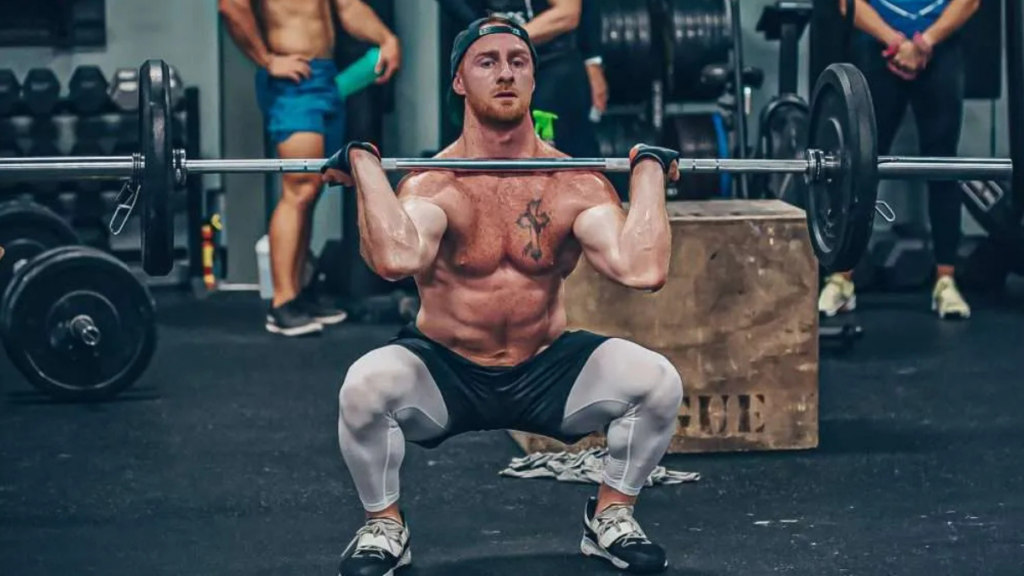
The barbell shoulder press is a classic compound exercise. You press one fixed bar overhead while standing or seated. It allows both arms to work together and makes it relatively easy to load the movement heavily.
Why Barbells Are Effective for Strength
A barbell is stable compared with two separate dumbbells. Because both hands are connected to the same bar, you usually need less effort to control the load from side to side. That often allows you to use more total weight than you could with dumbbells.
This makes the barbell shoulder press a very useful exercise for developing pressing strength. Strength is not identical to muscle size, but becoming stronger can help you handle more productive training over the long term. If you can gradually press more weight while maintaining good technique, you create a clear path for progressive overload.
For beginners, progression is also easy to measure. If you pressed 65 pounds for eight clean repetitions last month and can now press 70 pounds for eight clean repetitions, your improvement is obvious. That clarity can make training more motivating and easier to organize.
The Limits of the Barbell
The same fixed design that makes the barbell stable can also make it less accommodating. A barbell requires both arms to follow the same path. Your shoulder structure, mobility, and limb lengths may not match the bar path perfectly.
Some people feel comfortable lowering the bar to the upper chest and pressing vertically overhead. Others may find that their shoulders, wrists, or elbows feel restricted in this position. This does not mean the barbell press is a bad exercise. It simply means that exercise selection should respect your individual anatomy and comfort.
3 Best Exercises for Beginners that Want to Tone Their Leg Muscles
Beginners can also become tempted to chase heavier weights before they have developed reliable control. Excessive back arching, pressing the bar forward instead of upward, and losing control at the bottom of the repetition can all reduce the quality of the exercise. A standing barbell press demands good coordination from the shoulders, trunk, hips, and legs.
The Case for the Dumbbell Shoulder Press
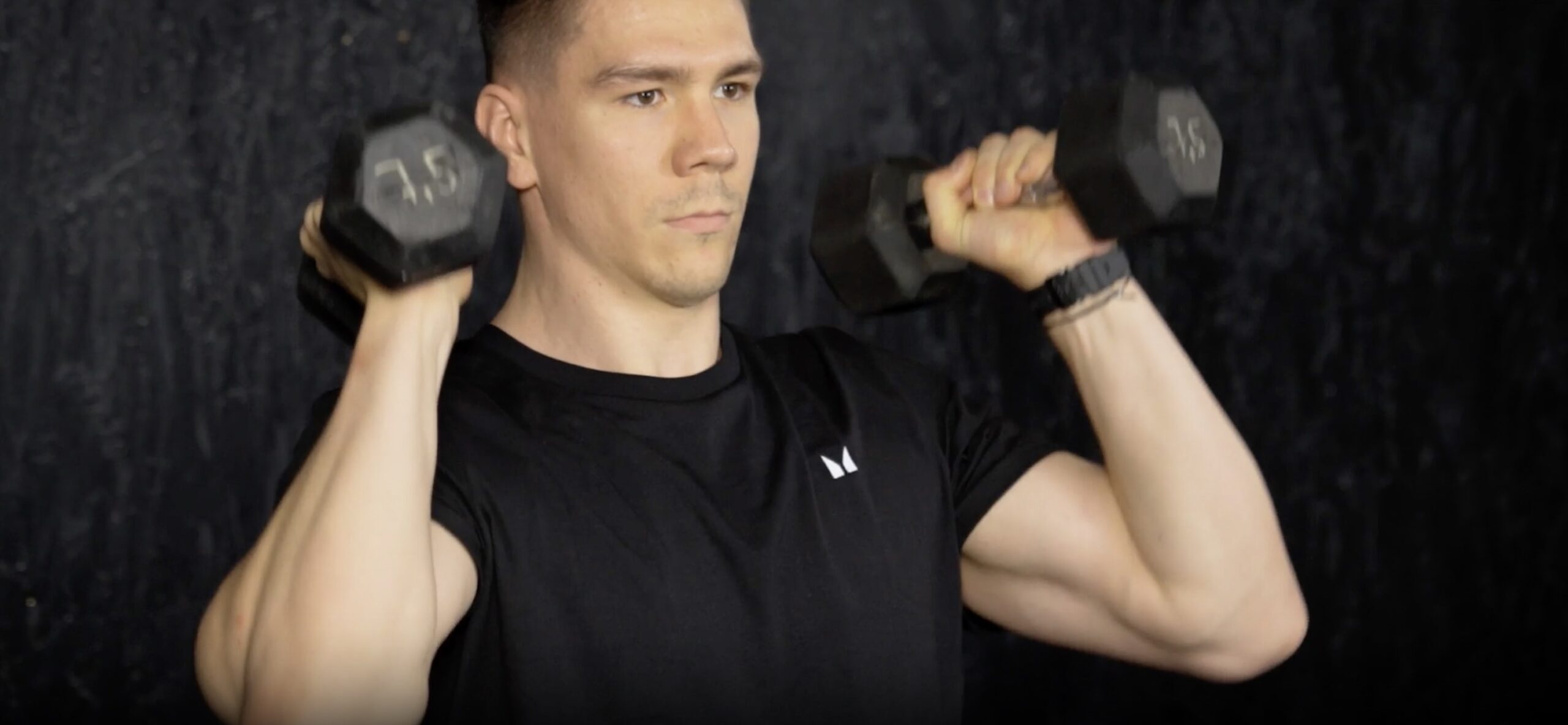
The dumbbell shoulder press uses one weight in each hand. It can be performed standing, seated, with a neutral grip, or with palms facing forward. This flexibility is one of its biggest advantages.
A More Individual Range of Motion
Dumbbells allow each arm to move independently. You can slightly adjust the path of each hand as you press, which may make the exercise feel more natural. You can also use a neutral grip, where the palms face each other, if that feels more comfortable for your shoulders or wrists.
This does not automatically make dumbbells better for muscle growth. It does, however, make them a practical option for beginners who are still learning how their shoulders move under load. An exercise that feels smooth and controlled is more likely to be performed consistently than one that causes irritation or makes you nervous every time you train.
Dumbbells can also make it easier to train both sides evenly. With a barbell, the stronger arm can subtly contribute more force than the weaker arm. With dumbbells, each arm has to press its own weight through the full range of motion. This may help you notice side to side differences early and address them with patience rather than allowing them to become more pronounced.
The Stability Challenge
Dumbbells require more control than a barbell because each weight can move separately. That extra stability demand can make the exercise feel harder even when the total load is lower. The smaller supporting muscles around the shoulder and upper back must contribute to keeping the weights in a controlled position.
However, this should not be exaggerated. More instability does not automatically equal more muscle growth. Research on unstable resistance training suggests that excessive instability can reduce force production and limit the amount of useful load you can apply. Dumbbells create a manageable stability challenge, but they should still be used in a controlled and progressive way rather than turned into a balancing act.
For most beginners, a seated dumbbell press is an excellent starting point because the bench provides support and reduces the demand on the lower back. A standing dumbbell press is also valuable, but it requires more total body control and is often better once you have learned the basic pressing pattern.
Which Exercise Builds More Muscle?
There is no strong long term evidence showing that the barbell shoulder press consistently produces more deltoid hypertrophy than the dumbbell shoulder press when training volume, effort, and progression are properly matched. Studies that compare equipment types often examine short term muscle activity rather than months of muscle growth. Muscle activity readings can be useful for understanding an exercise, but they cannot prove that one variation will build more muscle over a training program.

The best conclusion is that both exercises can build shoulder mass effectively. The version that produces more growth for you will be the one that you can load progressively, perform through a comfortable range of motion, and train with enough consistency.
A barbell may have an advantage when strength progression is your main priority. Being able to add small amounts of weight can make long term progression very straightforward. It is also a strong option for beginners who feel comfortable with the movement and have access to a suitable rack.
Dumbbells may have an advantage when comfort, freedom of movement, and arm by arm control are your main priorities. They are particularly useful if you have limited shoulder mobility, notice an imbalance between sides, or simply prefer the feeling of pressing each arm independently.
Neither variation can replace the other in every situation. The best shoulder training plans often use a barbell press as one primary strength movement and dumbbell pressing as a secondary movement for additional quality volume.
How Beginners Should Use Each Variation
A beginner does not need to press overhead every day to build shoulders. Starting with two sessions per week is enough for most people, especially when combined with other upper body work such as push ups, bench presses, rows, and pulldowns.
Begin with a weight that allows you to perform controlled repetitions without leaning backward, bouncing the weight, or allowing the elbows to drift into an uncomfortable position. Your final repetitions should feel demanding, but your technique should remain recognizable.
For a barbell shoulder press, a practical starting approach is two or three sets of six to ten repetitions. Rest for long enough that you can perform each set with good control. If you can complete all prescribed repetitions with clean technique, add a small amount of weight in a future session.
For a dumbbell shoulder press, two or three sets of eight to twelve repetitions works well. Dumbbells often increase in larger jumps than barbells, so progression may come from adding repetitions before increasing the weight. For example, you might perform three sets of eight repetitions one week, then work toward three sets of 12 before selecting the next heavier dumbbells.
The most important point is that each set should have a purpose. Do not rush through repetitions just to finish a number. Lower the weights under control, press smoothly, and stop each set when another repetition would require you to lose your position.
Technique Priorities for Both Exercises
Start with your feet firmly planted if you are standing. Squeeze your glutes gently and keep your ribs from flaring upward. This helps prevent the lower back from doing work that should come from the shoulders and arms.
At the bottom position, keep the weights close to shoulder level and your wrists stacked over your forearms. Press upward with a smooth path rather than trying to throw the weight overhead. At the top, finish with the arms extended without aggressively forcing the shoulders into an uncomfortable position.
Your grip can change the feel of the movement. A palms forward grip is traditional, while a neutral grip often feels friendlier for many lifters. There is no requirement to use one grip forever. Choose the position that lets you train hard without discomfort.
If overhead pressing causes sharp pain, persistent discomfort, or symptoms that worsen from session to session, stop trying to push through it. A qualified health professional can help determine the cause. In the meantime, a more comfortable pressing variation, a reduced range of motion, or a temporary change in exercise selection may be appropriate.
The Best Choice for Most Beginners
If you are completely new to overhead pressing, begin with the seated dumbbell shoulder press. It is easier to learn at lighter loads, allows each shoulder to find a comfortable path, and gives you valuable feedback about side to side control.
Once you feel confident, add the standing barbell shoulder press if you enjoy it and can perform it with solid technique. The barbell gives you an excellent way to build full body pressing strength and make measurable progress over time.
If you only want to choose one exercise, choose dumbbells when comfort and control are your main concerns. Choose the barbell when you are comfortable with the pattern and want the clearest route to increasing your overhead strength. In either case, the muscle building result will come from focused sets, steady progression, sensible recovery, and enough total weekly training.
References
- American College of Sports Medicine (2009) ‘American College of Sports Medicine position stand: Progression models in resistance training for healthy adults’, Medicine & Science in Sports & Exercise, 41(3), pp. 687–708.
- Behm, D.G. and Colado, J.C. (2012) ‘The effectiveness of resistance training using unstable surfaces and devices for rehabilitation’, International Journal of Sports Physical Therapy, 7(2), pp. 226–241.
- Krieger, J.W. (2010) ‘Single versus multiple sets of resistance exercise for muscle hypertrophy: A meta analysis’, Journal of Strength and Conditioning Research, 24(4), pp. 1150–1159.
- Schoenfeld, B.J., Grgic, J., Ogborn, D. and Krieger, J.W. (2017) ‘Strength and hypertrophy adaptations between low versus high load resistance training: A systematic review and meta analysis’, Journal of Strength and Conditioning Research, 31(12), pp. 3508–3523.
- Schoenfeld, B.J., Ogborn, D. and Krieger, J.W. (2017) ‘Dose response relationship between weekly resistance training volume and increases in muscle mass: A systematic review and meta analysis’, Journal of Sports Sciences, 35(11), pp. 1073–1082.
- Zakrzewska, I., Makaruk, H., Makaruk, B. and Krawczyk, M. (2023) ‘The effect of the weight and type of equipment on shoulder and back muscle activity in surface electromyography during the overhead press: Preliminary report’, International Journal of Environmental Research and Public Health, 20(1), 390.
Key Takeaways
| Question | Practical answer |
|---|---|
| Which press builds more shoulder muscle? | Both can build muscle effectively when training volume, effort, technique, and progression are strong. |
| Is the barbell press better for strength? | Usually, because it is more stable and often allows more total load. |
| Are dumbbells better for beginners? | Often, because each arm can move independently and the grip and pressing path are easier to adjust. |
| What should a beginner prioritize? | A comfortable range of motion, controlled technique, regular training, and gradual progression. |
| Can you use both? | Yes. Dumbbells can build control and volume, while barbells can provide a clear long term strength progression. |