

A strong chest does more than make your upper body look more athletic. Your chest muscles help you push objects away from your body, contribute to pressing strength, and work with your shoulders and triceps during many gym exercises and daily tasks. Dumbbells are an excellent place to begin because each arm works independently, the weights can move naturally, and you can make small increases as you get stronger.
For beginners, the goal is not to find the most complicated exercise or use the heaviest possible dumbbells on day one. The goal is to build good movement habits, train the chest through useful ranges of motion, and gradually apply more challenge over time. Consistent resistance training increases muscle size and strength, with progression, sufficient training volume, and effort all playing important roles in the outcome.


The three exercises below cover the main jobs of a beginner chest workout. The dumbbell bench press builds foundational pressing strength. The incline dumbbell press places more emphasis on the upper chest area while still training the whole pressing chain. The dumbbell chest fly lets you train the chest through a large arc with lighter loads. Together, they create a simple workout that can produce serious results when you perform it consistently and progress sensibly.
Why Dumbbells Are So Effective for Beginner Chest Training
Dumbbells are not automatically better than barbells, cables, or machines. Every form of resistance can help build muscle when the exercise is performed well and the training becomes progressively more demanding. However, dumbbells have practical advantages for beginners who want to improve their chest strength and size.
Each dumbbell must be controlled separately. This means your stronger side cannot easily take over as it can during some barbell lifts. You have to stabilize both weights throughout the movement, which can help you notice and gradually reduce obvious side to side differences in control and strength.

Dumbbells also allow the hands to follow a comfortable path. During a press, your hands do not need to stay locked on a straight bar. You can use a neutral grip with palms facing each other, or turn the palms slightly forward as you press. This freedom can make pressing feel more natural for many lifters, particularly while they are learning how to position their shoulders.
Research comparing chest exercise variations shows that pressing movements consistently recruit the pectoralis major, triceps, and front shoulder muscles. The exact distribution of muscular effort changes with the angle of the bench, grip, load, and technique. That is why a small selection of well performed exercises is more useful than doing numerous random movements in one session.
Beginners should also remember that muscle growth does not require constant soreness, fancy exercise variation, or maximum lifts. Productive training means using solid form, taking sets reasonably close to fatigue, recovering well, and adding repetitions or load when you are ready. Studies of resistance training show that multiple sets and sufficient weekly training volume generally support greater hypertrophy than very low volume approaches.
How to Train These Exercises for Muscle and Strength
Train your chest two times per week if your overall program allows it. This gives you regular practice without cramming all your weekly work into one exhausting workout. Research indicates that weekly training volume is a major driver of hypertrophy, while splitting that volume across more sessions can be a practical way to maintain quality repetitions and manage fatigue.
Start with weights that let you complete each repetition with control. You should feel the chest, shoulders, and triceps working hard near the end of a set, but your technique should not collapse. Stop the set when you believe you could perform around one to three more clean repetitions. This is challenging enough to stimulate progress while still giving beginners room to practice safely.
For the pressing movements, use two or three sets of six to twelve repetitions. For chest flys, use two or three sets of ten to fifteen repetitions because the exercise is more demanding in the stretched position and works best with lighter loads. Rest for around two minutes after hard pressing sets, then take enough rest before flys to repeat the exercise with good control.
When you can perform the top end of the recommended repetition range on every set with clean form, increase the weight slightly at the next session. This gradual approach is called progressive overload. It gives your body a reason to adapt without forcing rushed jumps in load.
1. Dumbbell Bench Press
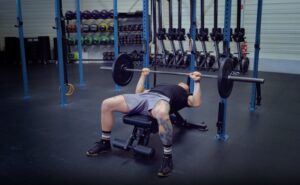
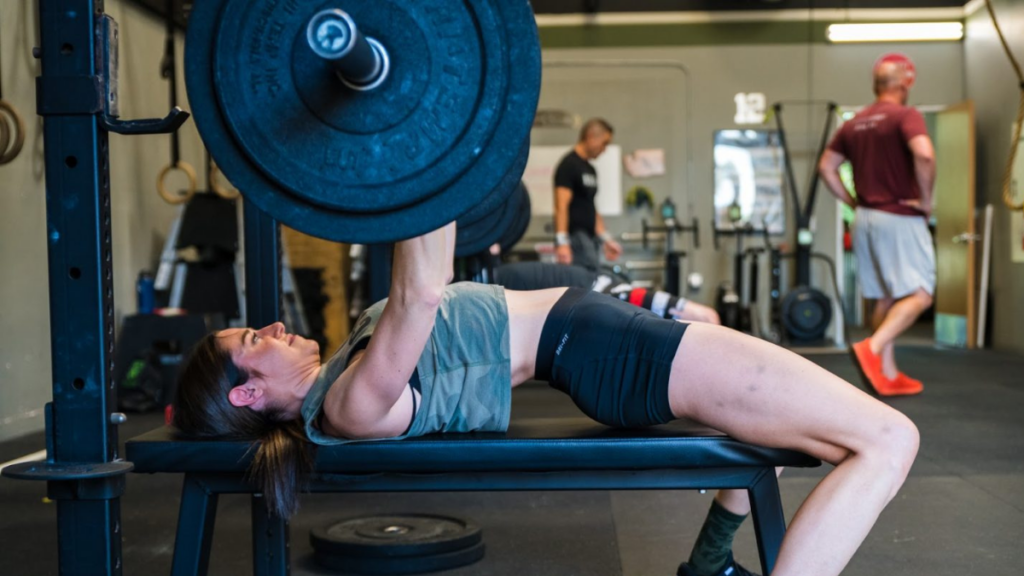
The dumbbell bench press is the foundation of this workout. It trains the pectoralis major, triceps, and front of the shoulders through a large, useful pressing motion. It also teaches you how to create tension through the upper back and keep your shoulders stable while pressing.

A flat bench position makes this movement straightforward for beginners. You can focus on developing a controlled lowering phase, a stable bottom position, and a strong press without worrying about complicated body positioning. The exercise also offers an easy route for long term progression because you can add repetitions, increase dumbbell weight, or complete additional sets as your training experience grows.
How to Perform the Dumbbell Bench Press
Sit on the edge of a flat bench with a dumbbell resting on each thigh. Lean back while bringing the dumbbells to chest level. Plant both feet firmly on the floor and gently pull your shoulder blades down and back against the bench.
Start with the dumbbells over the middle of your chest. Your palms can face forward or turn slightly toward each other. Lower the dumbbells slowly until your upper arms are close to parallel with the floor and your elbows are comfortably below the line of your torso. Keep your wrists stacked above your elbows rather than allowing them to bend backward.
Press the dumbbells upward and slightly inward until your arms are straight but not aggressively locked out. Keep your shoulders from rolling forward at the top. Lower under control and repeat.
Avoid lowering the dumbbells so far that your shoulders feel pinched or unstable. A slightly shorter range that you can control is better than chasing depth at the expense of joint comfort. There is no benefit to bouncing the weights or rushing through repetitions.
Why It Builds Muscle and Strength
The press allows you to use more load than isolation exercises such as flys, which makes it useful for building general upper body strength. Pressing movements place meaningful mechanical tension on the chest muscles, and mechanical tension is considered a central stimulus for resistance training induced muscle growth.
The movement also gives beginners an efficient way to train several upper body muscles at once. Your chest produces much of the pressing force, while your triceps straighten the elbows and your shoulders help guide the weights. This makes the dumbbell bench press a high value exercise when you are building a simple program.
2. Incline Dumbbell Press
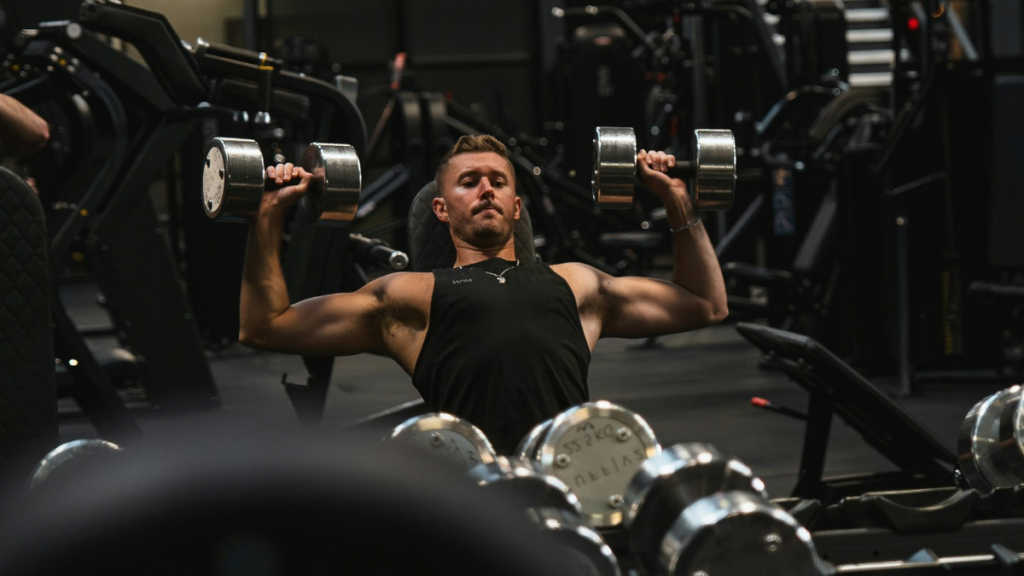
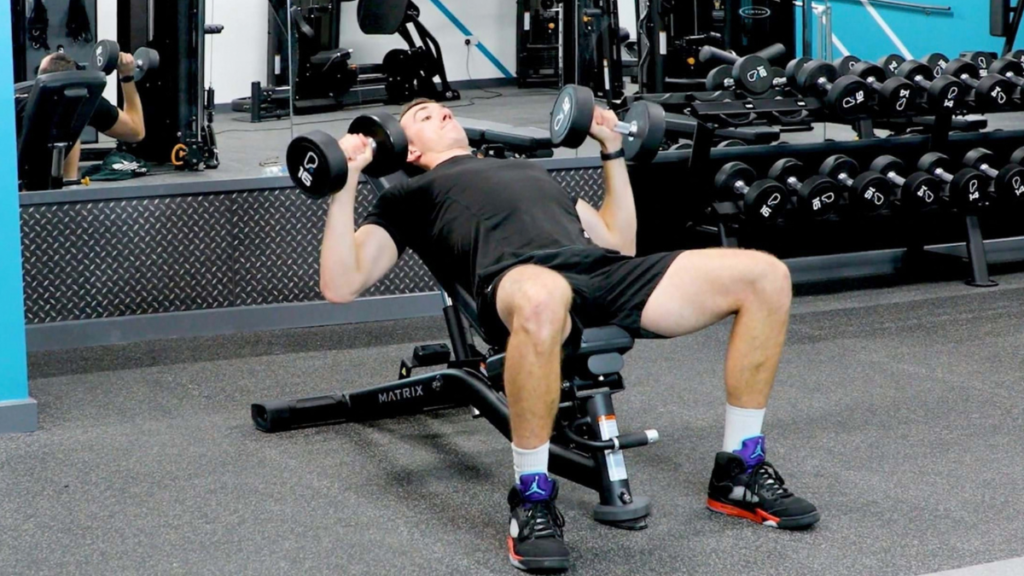
The incline dumbbell press is the best next step because it changes the angle of the press without making the exercise difficult to learn. Set the bench to a modest incline of roughly 30 to 45 degrees. This position shifts the challenge toward the clavicular portion of the pectoralis major, commonly called the upper chest, while still training the entire chest, triceps, and shoulders.
A moderate incline is important. If the bench is too upright, the front shoulder muscles may do much more of the work. A lower incline lets you keep the movement chest focused while adding a slightly different training stimulus from the flat press.
How to Perform the Incline Dumbbell Press
Set an adjustable bench to a moderate incline. Sit down with the dumbbells on your thighs, then lean back and bring the weights to the sides of your upper chest. Place your feet firmly on the floor and keep your upper back in contact with the bench.
Begin with your elbows slightly below the dumbbells and angled about 30 to 60 degrees from your torso. Press the weights upward until they are above your upper chest and shoulders. Keep the path controlled, and do not let the dumbbells drift excessively toward your face.
Lower slowly until you feel a comfortable stretch across your chest. Pause briefly if it helps you stay stable, then press smoothly back to the starting position. Keep your rib cage steady rather than exaggerating a large arch through the lower back.
Why It Builds Muscle and Strength
Bench angle affects how the chest and shoulder muscles contribute to pressing. Research examining bench press variations has found that incline positions can increase activation of the clavicular part of the pectoralis major compared with flatter positions. Muscle activation measurements are not a direct measure of muscle growth, but they are useful for understanding how exercise angle changes the demands placed on the involved muscles.
For a beginner, the incline press also adds valuable practice in controlling dumbbells from a new position. You will need to stabilize the weights while your body is supported at an angle, which can improve coordination and make later upper body training feel more confident.
Use slightly lighter dumbbells than you use for the flat bench press. The angle usually makes the exercise feel harder, and there is no reason to sacrifice form simply to match your flat pressing weight.
3. Dumbbell Chest Fly
The dumbbell chest fly is the isolation movement in this routine. Unlike a press, where you bend and straighten the elbows, the fly keeps a soft elbow bend and moves primarily at the shoulder joint. The chest muscles bring the arms toward each other in front of the body, which is one of their main actions.
This exercise should not be treated as a heavy strength lift. Its value comes from controlled repetitions, a comfortable stretch, and focused tension in the chest. Beginners often make the mistake of choosing dumbbells that are too heavy, turning the movement into an awkward press with stressed shoulders. Start light and make every repetition deliberate.
How to Perform the Dumbbell Chest Fly
Lie on a flat bench with a dumbbell in each hand. Press the dumbbells above your chest to begin, with palms facing each other. Bend your elbows slightly and maintain that same gentle bend throughout the repetition.
Lower the dumbbells out to the sides in a wide arc. Keep your shoulder blades stable against the bench and lower only as far as you can without discomfort or a strong sense that the shoulders are being pulled forward. You should feel a stretch through the chest rather than pain in the front of the shoulder.
Bring the dumbbells back together by squeezing your chest and following the same arc in reverse. Do not smash the dumbbells together at the top. Stop when they are close, keep tension in the chest, and begin the next repetition.
Why It Builds Muscle and Strength
Chest flys complement presses because they train the chest with far less contribution from the triceps. This can make it easier to accumulate additional chest focused work after your pressing exercises. Research on resistance training supports using a range of exercises when it helps you train the target muscles effectively and consistently, although a beginner does not need excessive variety.
The key is load selection. Use a weight that feels demanding only after several controlled repetitions. The lower position of a fly places the chest under a long muscle length, but it also creates a challenging leverage position for the shoulder. Light weights, a slow descent, and a comfortable range of motion make this exercise much more productive and safer to learn.
A Simple Beginner Dumbbell Chest Workout
Perform the dumbbell bench press first because it requires the most strength, coordination, and concentration. Follow it with the incline dumbbell press, then finish with the chest fly. Complete this workout once or twice per week, with at least one rest day between chest sessions.
Begin with two sets of each exercise for the first two weeks. This allows your muscles, joints, and technique to adapt to the new training stress. After that, progress to three sets per exercise if you are recovering well and your form remains consistent.
3 Best Beginner Exercises for Wider and More Muscular Pecs
Your chest should feel worked after the session, but you should not need to destroy yourself to make progress. Eat enough protein, sleep consistently, and allow time for recovery. Resistance training research shows that muscle and strength gains come from repeated productive training sessions over time, not from one exceptional workout.
Build Your Chest by Mastering the Basics
The best beginner chest exercises are not the ones that look impressive on social media. They are the movements you can perform with control, repeat consistently, and gradually make more challenging. The dumbbell bench press, incline dumbbell press, and dumbbell chest fly cover the most useful foundations for beginner chest development.
Focus on clean repetitions, moderate effort, and patient progression. Keep your shoulders stable, choose weights you can control, and record your sets and repetitions. If you add even one repetition here and there before increasing the dumbbell weight, those small improvements will compound into meaningful chest strength and muscle gains.
References
- American College of Sports Medicine (2009) ‘American College of Sports Medicine position stand: Progression models in resistance training for healthy adults’, Medicine & Science in Sports & Exercise, 41(3), pp. 687–708.
- Baz Valle, E., Balsalobre Fernandez, C., Alix Fabregas, A. and Santos Conde, E. (2018) ‘A systematic review of the effects of different resistance training volumes on muscle hypertrophy’, Journal of Human Kinetics, 64, pp. 225–237.
- Krzyszkowski, J. and Kipp, K. (2020) ‘Load effects on the activation of muscle synergies during bench press’, Journal of Sports Sciences, 38(12), pp. 1401–1409.
- Schoenfeld, B.J., Ogborn, D. and Krieger, J.W. (2017) ‘Dose response relationship between weekly resistance training volume and increases in muscle mass: A systematic review and meta analysis’, Journal of Sports Sciences, 35(11), pp. 1073–1082.
- Schoenfeld, B.J., Grgic, J., Ogborn, D. and Krieger, J.W. (2017) ‘Strength and hypertrophy adaptations between low versus high load resistance training: A systematic review and meta analysis’, Journal of Strength and Conditioning Research, 31(12), pp. 3508–3523.
- Vargas, A., Petro, J.L., Cardoso, R., Schoenfeld, B.J., Souza, M.F., Fonseca, H., Vieira, A., Gentil, P. and Teixeira, C.V.L.S. (2023) ‘Electromyographic activity of the pectoralis major muscle during traditional bench press and other variants of pectoral exercises: A systematic review and meta analysis’, Applied Sciences, 13(8), 5203.
- West, D.J., Cunningham, D.J., Crewther, B.T., Cook, C.J., Kilduff, L.P., Owen, N.J., Stewart, C., Robinson, N. and Russell, M. (2013) ‘Influence of the bench press exercise on upper body muscle activation’, Journal of Strength and Conditioning Research, 27(12), pp. 3317–3322.
Key Takeaways
| Exercise | Main purpose | Beginner focus |
|---|---|---|
| Dumbbell bench press | Builds foundational chest, triceps, and pressing strength | Use a flat bench, keep the upper back stable, and progress gradually |
| Incline dumbbell press | Adds upper chest focused pressing work | Use a moderate bench angle and lighter weights than the flat press |
| Dumbbell chest fly | Adds controlled chest isolation work | Use light dumbbells, a soft elbow bend, and a pain free range of motion |
| Weekly approach | Builds muscle and strength through repeated quality work | Train chest once or twice weekly and add repetitions before increasing load |