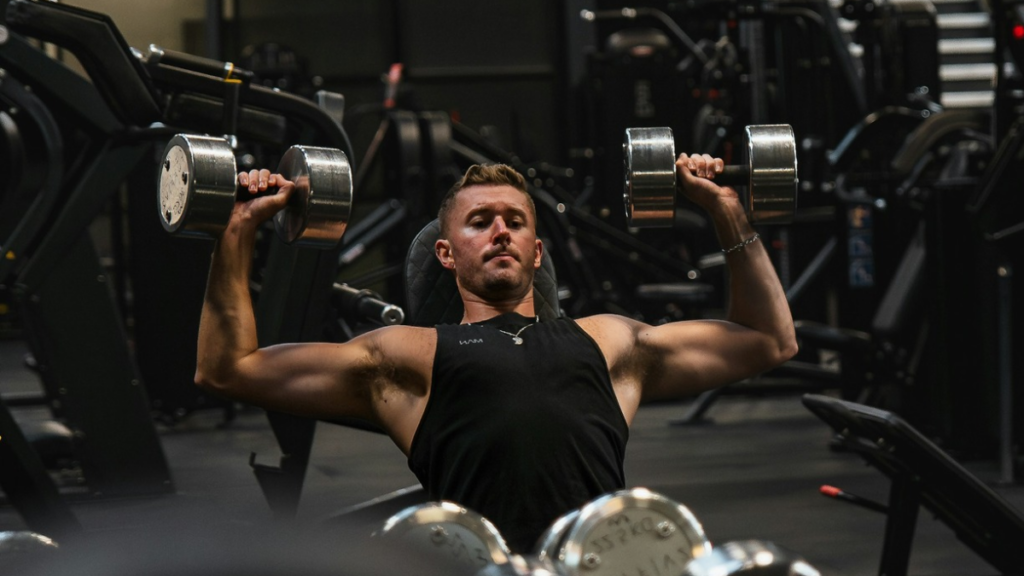
Broad, muscular shoulders can make the upper body look stronger and more athletic, while also improving your ability to press, carry, pull, and stabilize loads overhead. The deltoid is made up of three sections: the anterior deltoid at the front, the lateral deltoid on the outside, and the posterior deltoid at the back. Building complete shoulder size means giving all three areas a reason to grow.
A barbell is especially useful because it lets you load movements progressively and use enough resistance to challenge the muscles over time. Progressive overload remains one of the central principles of muscle growth. When your body adapts to a given training stress, gradually adding repetitions, load, sets, or improving technique can create a new stimulus for adaptation.



The three exercises below give you a practical barbell based shoulder routine. The standing barbell overhead press is the foundation for overall pressing strength and anterior deltoid development. The wide grip upright row can place more emphasis on the lateral deltoids when performed with control and within a comfortable range. The bent over wide elbow barbell row helps address the posterior deltoids and upper back, which are often undertrained compared with the front of the shoulders.
No single exercise is magical. Results come from training consistently, using sound technique, accumulating enough hard work, recovering well, and progressing patiently.
Why Barbell Training Can Build Bigger Shoulders
Muscle growth is driven largely by high quality resistance training volume performed with sufficient effort. Research suggests that completing multiple hard sets per muscle group each week is generally more effective for hypertrophy than performing very low volumes. The exact amount that works best varies between people, but many lifters can make good progress by building toward roughly 10 or more challenging weekly sets for a muscle group.
You do not need to use extremely heavy weights for every set. A wide range of loads can support hypertrophy when sets are performed close enough to muscular failure. Heavier loads are useful for building strength and can make it easier to progress on compound exercises, while moderate and lighter loads can also be productive when they create a high level of effort.
3 Best Cable Machine Exercises for a Jacked and More Attractive Upper Body
Barbells make it simple to measure progress. You can add a small amount of weight, perform an extra repetition with the same weight, improve the control of each repetition, or gradually add a set. These small improvements become meaningful when repeated across months of consistent training.
Barbell exercises do have a limitation. The bar follows a fixed path because both hands are attached to the same load. That means your grip width, range of motion, and body position should feel natural for your individual shoulder structure. Do not force your body into a position that causes sharp pain, pinching, or instability. Productive training should feel demanding in the target muscles, not painful in the joints.
Exercise One: Standing Barbell Overhead Press
The standing barbell overhead press is one of the most useful barbell exercises for building strong, muscular shoulders. It trains the anterior deltoids heavily, while the triceps, upper chest, upper back, and trunk contribute to the lift. It also requires the body to stabilize a load overhead, which makes it a highly transferable strength movement.
Research comparing pressing variations has found that the barbell overhead press produces substantial activity in the deltoid muscles. The front barbell press is particularly useful for the anterior deltoid and pectoralis major, while the standing position also asks the trunk and lower body to resist excessive movement.
How to Perform It
Set the barbell in a rack around upper chest height. Take a grip just outside shoulder width, with your wrists stacked as comfortably as possible under the bar. Step back from the rack and stand with your feet about hip width apart.
Start with the bar resting across the upper chest and front of the shoulders. Brace your midsection as if preparing to take a punch. Squeeze your glutes, keep your ribs from flaring excessively, and press the bar upward in a controlled line.
As the bar passes your forehead, move your head slightly forward so the bar can finish above the middle of your body. At the top, the elbows should be straight and the bar should be balanced over the shoulders, hips, and feet. Lower the bar back to the upper chest with control before beginning the next repetition.
Avoid turning every repetition into a standing incline press by leaning far backward. A slight natural change in torso position can occur, but excessive lower back extension usually shifts stress away from the shoulders and can make the movement less comfortable.
How to Program It
Use the overhead press early in your shoulder workout, when you are fresh enough to use good technique. Three to five sets of five to 10 repetitions is an effective starting point for many lifters. Lower repetitions can be useful when the goal is strength, while moderate repetitions allow you to accumulate more shoulder focused work without requiring maximal loads.
Leave one to three repetitions in reserve on most sets. This means ending the set when you believe you could still complete one to three more technically sound repetitions. Training close to failure can be useful for muscle growth, but constantly forcing failed repetitions on a demanding standing press can reduce technique quality and make recovery harder.
Exercise Two: Wide Grip Barbell Upright Row
The wide grip barbell upright row can be a useful tool for developing the lateral deltoids, which are important for the appearance of shoulder width. The movement also trains the upper trapezius, but grip width and range of motion can help you make it feel more shoulder focused.
The key is not to chase height at all costs. Raising the bar only to about the lower chest, while using a relatively wide grip and keeping the movement controlled, can be a practical option for lifters who find the exercise comfortable. Shoulder anatomy, training history, and mobility vary considerably, so this movement should always be judged by how your shoulders respond.
How to Perform It
Stand upright with the barbell held in front of your thighs. Take a grip wider than shoulder width. Your hands should be far enough apart that your forearms remain close to vertical as the bar rises.
Brace your trunk and begin by leading the movement with your elbows. Pull the bar upward close to your body, but stop when your upper arms are roughly parallel with the floor or when you reach the highest position that feels smooth and comfortable.
Lower the bar slowly to the starting position. Avoid jerking the weight upward with your hips or bouncing through the bottom. The lateral deltoids should feel like they are doing the work, rather than the exercise becoming a fast full body pull.
How to Program It
Use a moderate load that allows you to control the full repetition. Two to four sets of eight to 15 repetitions works well after your heavier pressing. Start conservatively, particularly if you have not done upright rows before.
If you feel shoulder discomfort, reduce the range of motion, widen your grip slightly, lower the load, or replace the movement. There is no need to persist with an exercise that repeatedly irritates your shoulder. Long term training consistency matters more than forcing one specific lift into your program.
Exercise Three: Bent Over Wide Elbow Barbell Row
Many lifters perform plenty of pressing but give less direct attention to the posterior deltoids. This can leave the shoulders looking less complete and may create a training routine that is overly focused on the front of the body. The bent over wide elbow barbell row is a practical way to add more upper back and posterior deltoid work with a barbell.
Unlike a close elbow row that tends to emphasize the latissimus dorsi, this variation uses a wider elbow path and pulls toward the upper abdomen or lower chest. That adjustment can increase the involvement of the upper back and rear shoulder musculature.
How to Perform It
Hold a barbell with a grip slightly wider than shoulder width. Push your hips back and bend forward until your torso is angled roughly 30 to 60 degrees from the floor. Keep your spine neutral, brace your trunk, and let the bar hang below your shoulders.
Pull the bar toward your upper abdomen or lower chest while allowing your elbows to move outward from your body. Think about pulling your upper arms back and squeezing the muscles around the back of the shoulders and upper back.
Pause briefly at the top if you can do so without losing position. Lower the bar under control until the arms are straight. Keep the torso stable throughout the set rather than using excessive body swing to move the weight.
How to Program It
Perform three to four sets of eight to 15 repetitions. This exercise is usually most effective with a moderate load because the target muscles need controlled repetitions and a stable torso position. If your lower back becomes the limiting factor before your upper back and rear shoulders are challenged, reduce the load and improve your hip hinge position.
This exercise will also train the rhomboids, middle trapezius, and other upper back muscles. That is a benefit, not a problem. Strong upper back muscles help create a more balanced physique and provide a stable foundation for pressing movements.
How to Build These Exercises Into a Shoulder Workout
You can perform all three exercises in the same workout two times per week, provided your total training volume and recovery are managed well. Start with the standing barbell overhead press, then move to the wide grip upright row, and finish with the bent over wide elbow row.
A simple approach is to begin with three sets of overhead presses, three sets of upright rows, and three sets of wide elbow rows. This gives you nine direct working sets. As your technique, work capacity, and recovery improve, you can gradually add a set to one or more exercises.
Keep track of your training. Record the weight, repetitions, and how difficult each set felt. When you can perform the top end of your target repetition range with solid technique, add a small amount of weight at the next session. Small increases are enough. Trying to make large jumps too quickly is one of the most common ways to stall progress or compromise form.
Your shoulders also receive work from chest pressing, push ups, dips, pull ups, and rowing movements. Consider that indirect work when deciding how much direct shoulder training to perform. If you already bench press heavily several times per week, your anterior deltoids may need less additional volume than your lateral and posterior deltoids.

Recovery Matters as Much as Exercise Choice
Shoulders are involved in many upper body movements, so they can accumulate fatigue quickly. Allow enough recovery between demanding sessions, eat enough protein and total calories to support your goal, and sleep consistently. Research supports the importance of adequate protein intake for maximizing the adaptation to resistance training, especially when total daily intake is spread across the day.
Pay attention to performance trends. If your repetitions, technique, and motivation are improving over time, your program is likely moving in the right direction. If shoulder discomfort increases, performance falls for several weeks, or every session feels excessively difficult, reduce training stress and assess your exercise technique, total volume, sleep, and recovery.
More muscular shoulders are not built through random exercise variation. They are built through repeated exposure to challenging, well performed training. Make the overhead press your strength foundation, use the wide grip upright row carefully for lateral shoulder work, and include wide elbow rows to build the rear delts and upper back. Train them consistently, progress gradually, and give the results time to accumulate.
Key Takeaways
| Focus | Key takeaway |
|---|---|
| Foundation exercise | The standing barbell overhead press develops pressing strength and heavily trains the anterior deltoids. |
| Shoulder width | A controlled wide grip upright row can add direct work for the lateral deltoids when it feels comfortable. |
| Balanced development | Bent over wide elbow barbell rows train the posterior deltoids and upper back, helping create more complete shoulder development. |
| Productive training | Multiple challenging weekly sets, progressive overload, and good technique support hypertrophy. |
| Joint comfort | Adjust grip, range of motion, or exercise selection if a movement causes persistent shoulder pain. |
| Long term results | Consistency, recovery, adequate nutrition, and gradual progression matter more than constantly changing exercises. |
References
- American College of Sports Medicine (2009) ‘Progression models in resistance training for healthy adults’, Medicine and Science in Sports and Exercise, 41(3), pp. 687–708.
- Coratella, G., Tornatore, G., Longo, S., Esposito, F. and Cè, E. (2022) ‘Front vs back and barbell vs machine overhead press: An electromyographic analysis and implications for resistance training’, Frontiers in Physiology, 13, 825880.
- Grgic, J., Schoenfeld, B.J., Skrepnik, M. and Davies, T.B. (2021) ‘Microloading for improving muscular strength: A narrative review’, Sports, 9(4), 44.
- Schoenfeld, B.J., Ogborn, D. and Krieger, J.W. (2017) ‘Dose response relationship between weekly resistance training volume and increases in muscle mass: A systematic review and meta analysis’, Journal of Sports Sciences, 35(11), pp. 1073–1082.
- Schoenfeld, B.J., Grgic, J., Ogborn, D. and Krieger, J.W. (2017) ‘Strength and hypertrophy adaptations between low versus high load resistance training: A systematic review and meta analysis’, Journal of Strength and Conditioning Research, 31(12), pp. 3508–3523.
- Schoenfeld, B.J., Grgic, J., Van Every, D.W. and Plotkin, D.L. (2021) ‘Loading recommendations for muscle strength, hypertrophy, and local endurance: A re examination of the repetition continuum’, Sports, 9(2), 32.
- Schoenfeld, B.J., Wilson, J.M., Lowery, R.P. and Krieger, J.W. (2016) ‘Muscular adaptations in low versus high load resistance training: A meta analysis’, European Journal of Sport Science, 16(1), pp. 1–10.
- Wernbom, M., Augustsson, J. and Thomeé, R. (2007) ‘The influence of frequency, intensity, volume and mode of strength training on whole muscle cross sectional area in humans’, Sports Medicine, 37(3), pp. 225–264.
- Witard, O.C., Jackman, S.R., Breen, L., Smith, K., Selby, A. and Tipton, K.D. (2014) ‘Myofibrillar muscle protein synthesis rates subsequent to a meal in response to increasing doses of whey protein at rest and after resistance exercise’, American Journal of Clinical Nutrition, 99(1), pp. 86–95.