

Building thicker biceps is not about finding a secret exercise or spending an hour doing curls. It comes down to choosing movements that train the biceps through useful ranges of motion, applying enough hard sets, and gradually making those sets more challenging as your strength improves.
For beginners, the best biceps exercises are the ones you can learn quickly, load safely, and repeat consistently. That matters because muscle growth is driven largely by regular resistance training that creates sufficient mechanical tension in the muscle. Research also shows that higher weekly training volume tends to produce more muscle growth, although beginners do not need huge amounts of work to make excellent progress.


The three exercises below cover the main jobs a beginner needs from biceps training. One builds foundational strength with a simple movement pattern. One challenges the biceps in a lengthened position. One provides stable resistance and makes it easier to train close to fatigue with good form. Combined with smart programming, they can help you build noticeably thicker arms without turning every workout into a curl marathon.
What Actually Makes Biceps Grow?
The biceps brachii has two main jobs. It bends the elbow, which is called elbow flexion, and it helps turn the palm upward, which is called forearm supination. The muscle also crosses the shoulder joint, so shoulder position can change how the biceps is loaded during a curl.
Muscle growth occurs when resistance training provides enough tension and your body has time and resources to recover. Research consistently supports resistance training as an effective way to increase muscle size, with the amount of challenging work performed over time playing a major role. Beginners can grow with relatively modest volumes because they are highly responsive to a new training stimulus.
You do not need to chase soreness, use extremely light weights, or train to total failure on every set. Instead, use a weight that allows controlled repetitions while making the final few repetitions difficult. Reaching failure occasionally can be useful, but research suggests that training close to failure can produce similar muscle growth when the total work is appropriate.
Your larger pulling exercises, including rows and pulldowns, already train the biceps. Direct curls still make sense if thicker arms are a priority because they add targeted elbow flexion work. Adding single joint work can help develop the elbow flexors beyond what compound pulling exercises provide on their own, particularly when overall direct arm volume is otherwise low.
Exercise 1: Standing Dumbbell Supinating Curl
The standing dumbbell supinating curl is the best starting point for most beginners. It teaches you to bend the elbow while actively rotating the palm upward, which matches the important functions of the biceps. It also allows each arm to work independently, making it easier to notice and correct left to right strength differences.
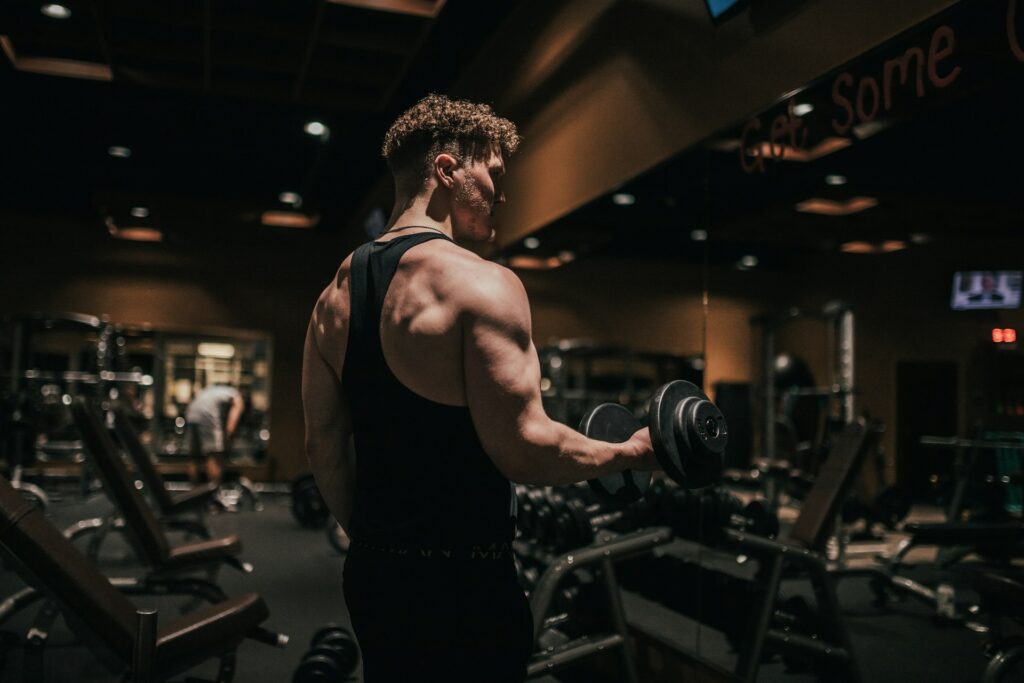
Start standing tall with a dumbbell in each hand and your arms by your sides. Begin with your palms facing inward. As you curl the weight upward, rotate your hand so your palm faces your shoulder near the top. Keep your upper arm close to your ribs and avoid leaning backward to throw the weight upward. Lower the dumbbell under control until your elbow is straight or nearly straight, then begin the next repetition.
This exercise is simple, but the quality of your repetition matters. If your shoulders move forward, your elbows drift far in front of your body, or your torso swings, the biceps do less of the work. Use a lighter load until you can keep your body still and feel the curl happen mainly at the elbow.
Dumbbells are especially useful for beginners because they allow natural wrist and shoulder positioning. Resistance training studies show that many exercise variations can build muscle effectively when effort, range of motion, and progression are appropriate. You do not need a complicated curl variation during your first months of training. You need a repeatable exercise you can perform well enough to add repetitions or load over time.
How to Program It
Perform two or three sets of eight to fifteen repetitions, once or twice per week. Leave roughly one to three repetitions in reserve on most sets, meaning you should finish knowing you could have performed a small number of additional clean repetitions. When you can complete the top of your chosen repetition range with good form on every set, increase the dumbbell weight by the smallest available amount.
Exercise 2: Incline Dumbbell Curl
The incline dumbbell curl deserves a place in a beginner biceps program because it places the upper arm behind the torso. Since the biceps crosses the shoulder, this position can train it at a longer muscle length than a conventional standing curl. Growing interest in long muscle length training comes from studies finding that exercises performed at longer muscle lengths or through fuller ranges of motion can produce substantial hypertrophy benefits in several muscles.
Set an adjustable bench to a comfortable incline, usually around forty five to sixty degrees. Sit back with a dumbbell in each hand, allowing your arms to hang naturally toward the floor. Begin with your palms facing inward or slightly forward. Curl the dumbbells without allowing your elbows to travel forward. Rotate your palms upward as you lift, then lower slowly until the elbows are straight and the biceps feel lengthened.
This movement looks easy, but it is usually harder than a standing curl with the same dumbbells. The stretched starting position reduces your ability to use body movement, so beginners often need less weight than they expect. That is a benefit, not a problem. A manageable load lets you control the lowering phase and train the biceps through a long, productive range of motion.
Do not force an extreme shoulder position if it irritates the front of your shoulder. Adjust the bench slightly more upright, reduce the load, and keep the movement pain free. Resistance training should challenge the muscle, but sharp joint pain is not a necessary part of effective training.
How to Program It
Perform two or three sets of ten to fifteen repetitions once per week at first. Use a slow, controlled lowering phase and avoid fully relaxing at the bottom. Because the exercise creates a demanding stretch, keep the load conservative while you learn the movement. Add a repetition before adding weight whenever possible.
Exercise 3: Cable Curl
The cable curl is a highly useful beginner exercise because the cable provides resistance throughout the movement and makes it easy to control the path of the handle. Unlike a dumbbell, which is affected by gravity in one direction, a cable can maintain tension across more of the curl depending on the pulley setup. That can make the exercise feel smoother and help beginners focus on the biceps rather than balancing the weight.
Set a cable pulley at its lowest position and attach a straight bar, curved bar, or pair of handles. Stand facing the machine with your feet planted and your chest tall. Grip the attachment with palms facing upward, then curl the handle toward your shoulders. Keep your elbows close to your sides and pause briefly near the top without allowing your shoulders to take over. Lower the handle steadily until your elbows are straight or nearly straight.
The cable curl is particularly valuable after you have learned the standing dumbbell curl. It gives you a stable way to accumulate additional hard repetitions without relying on momentum. Research comparing different resistance training variables suggests that a wide range of loading schemes can stimulate hypertrophy when sets are performed with sufficient effort. Cables make moderate and higher repetition work practical, which is useful when heavier dumbbells would encourage sloppy swinging.
You can use a straight bar if it feels comfortable, but an angled bar or individual handles may feel better on the wrists. There is no reason to force a grip that causes discomfort. The best attachment is the one that allows you to train hard with a secure grip and a pain free range of motion.
How to Program It
Perform two or three sets of twelve to twenty repetitions once or twice per week. Use a load that makes the final few repetitions difficult without causing your elbows to drift forward or your torso to rock backward. Keep rest periods long enough to maintain performance, usually at least one to two minutes between sets.
A Simple Beginner Plan for Bigger Biceps
A beginner does not need all three exercises in every workout. Start by training the biceps twice per week and spread the work across the week. For example, use standing dumbbell curls and cable curls in one session, then use incline dumbbell curls in the next session. This approach provides variety without making your training unnecessarily complicated.
A practical starting point is six to eight direct biceps sets per week. That could mean three sets of standing dumbbell curls and two sets of cable curls in one workout, followed by three sets of incline dumbbell curls in the next. Your rows, pulldowns, and chin ups will add further biceps stimulus, so avoid piling on endless direct work just because your arms are a priority.
Progression is the key. Record the weight and repetitions you complete. If you use 20 pound dumbbells for three sets of ten repetitions this week, aim to complete more total clean repetitions next week. Once you reach the top of your target range for all sets, raise the load slightly and build again. This gradual increase in training demand is known as progressive overload, and it is one of the most reliable principles in resistance training.

Nutrition and recovery also matter. Resistance training increases the stimulus for muscle protein synthesis, while consuming enough protein supports the building and repair processes involved in adaptation. Evidence suggests that daily protein intakes around 1.6 grams per kilogram of body mass are sufficient for maximizing resistance training related gains in lean mass for many people, although individual needs can vary.
Common Beginner Mistakes That Slow Biceps Growth
The biggest mistake is using a weight that is too heavy to control. Swinging the dumbbells, leaning backward, and pulling with the shoulders may help move the load, but they reduce the direct challenge to the biceps. A lighter weight performed through a controlled range is usually more effective than a heavier weight performed with momentum.
Another mistake is cutting the lowering phase short. Lowering the weight in a controlled way allows you to train through the full available range and maintain tension on the biceps. Full range resistance training has generally been associated with favorable muscle growth outcomes compared with partial range training, although specific results can vary by exercise and muscle region.
Finally, many beginners change exercises too often. Variety can be useful, but muscle growth requires enough repeated exposure to improve performance. Keep these exercises in your program for at least several weeks. Focus on cleaner form, more repetitions, or modest load increases before deciding that you need a more advanced variation.
The Bottom Line
The standing dumbbell supinating curl, incline dumbbell curl, and cable curl are the three best beginner choices for building thicker biceps because they are simple, effective, and easy to progress. They train the biceps with different arm positions and resistance profiles while keeping the learning curve manageable.
Perform six to eight direct sets each week to start, train with controlled form, and make your sets challenging. Pair that work with regular pulling exercises, adequate protein, and consistent recovery. Do that for a few months, and your biceps will have a much better reason to grow than they would from random high repetition curls at the end of a workout.
Key Takeaways
| Exercise | Main benefit | Beginner target | Key technique focus |
|---|---|---|---|
| Standing dumbbell supinating curl | Builds foundational elbow flexion and supination strength | Two or three sets of eight to fifteen repetitions | Keep the torso still and rotate the palm upward |
| Incline dumbbell curl | Challenges the biceps in a lengthened position | Two or three sets of ten to fifteen repetitions | Keep the upper arms behind the torso |
| Cable curl | Provides stable resistance for controlled higher repetition work | Two or three sets of twelve to twenty repetitions | Keep elbows near the ribs and avoid swinging |
| Weekly direct work | Gives beginners enough targeted volume to progress | Six to eight hard sets per week | Increase repetitions or load gradually |