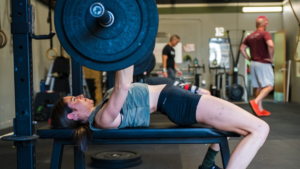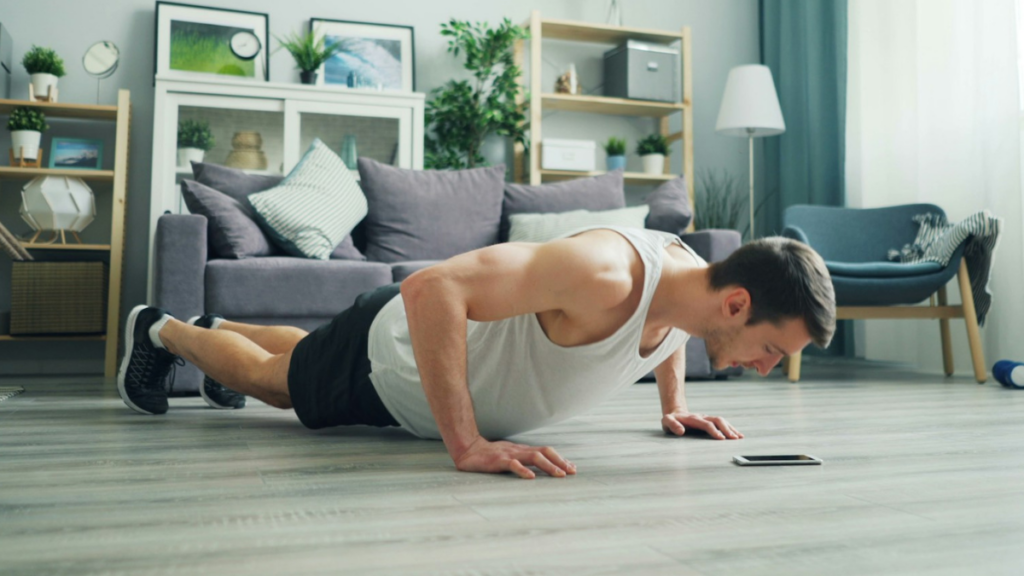


The triceps are the muscles on the back of your upper arm. They help straighten your elbow, so they work whenever you push something away from you. If you want stronger arms or more muscle, training your triceps directly can help. They also contribute to compound movements such as the chest press.
You do not need a complicated routine to get started. These three exercises use familiar gym equipment and train elbow extension in different ways. The cable pushdown is a straightforward place to learn the movement, the overhead cable extension trains the triceps with your arms raised, and the machine chest press adds a beginner-friendly pushing exercise.


The triceps have three heads, called the long, lateral, and medial heads. All help extend the elbow. The long head also crosses the shoulder joint, which means its length changes when you raise or lower your upper arm. Research comparing overhead and neutral arm positions found greater triceps growth from overhead cable extensions over the study period. That is one reason to include an overhead movement alongside a pushdown.
How to Train Your Triceps as a Beginner
Start with a light weight that lets you control the movement and use a comfortable range of motion. A useful starting point is two or three sets of 8 to 12 repetitions for each exercise. This repetition range is consistent with established resistance training guidance for beginners. Rest long enough between sets that you can perform the next one with good control.
You do not need to train every set until you cannot complete another repetition. Instead, end the set when your form begins to change or you feel you could complete only a few more controlled repetitions. Use a load that lets you keep your upper arm and torso steady. If you feel sharp or worsening pain, stop the exercise and ask a qualified trainer or health professional for guidance.
Choose a weight based on the exercise, not on what someone else is lifting. For example, you might use a light load for overhead extensions while choosing a different load for pushdowns. When you can complete all your sets at the top of your chosen repetition range with consistent technique, increase the resistance by a small amount and build back up gradually.
1. Cable Triceps Pushdown
The cable pushdown is a useful first triceps exercise because the cable provides resistance throughout the movement and the setup is easy to adjust. You can use a straight bar, angled bar, or rope attachment. A rope can feel comfortable on the wrists and lets your hands separate slightly at the bottom, but the attachment itself is a matter of comfort.
How to do a cable pushdown
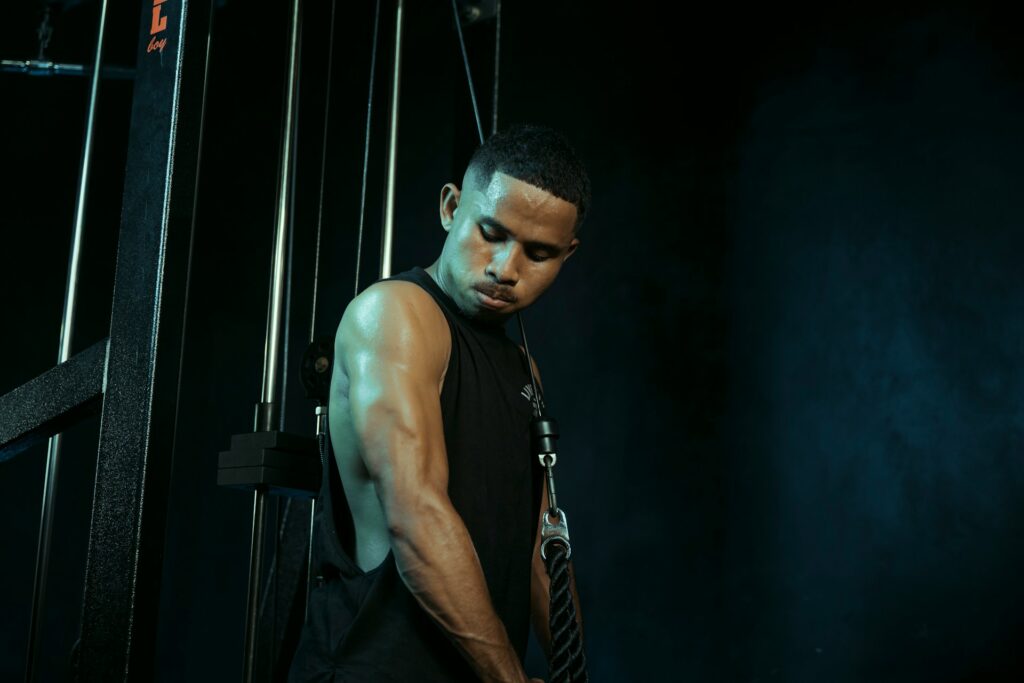
Set the cable pulley near the top of the machine and attach your chosen handle. Stand close enough that the cable pulls upward at an angle. Hold the handle with both hands, bend your elbows, and keep them near your sides. Stand tall with your shoulders relaxed and your feet in a comfortable position.
Straighten your elbows to press the handle toward your thighs. Keep your upper arms mostly still, and avoid leaning your body weight onto the handle. Pause briefly when your elbows are straight without forcing them into a hard lockout. Then bend your elbows slowly and return the handle to the starting position.
Choose a weight that allows you to move smoothly in both directions. If your shoulders roll forward or your torso rocks to push the handle down, reduce the weight. The goal is controlled elbow extension, not moving the heaviest stack in the room. A steady return matters too, because the exercise includes both the pressing phase and the controlled bend back to the start.
Why it belongs in a beginner routine
A pushdown lets you focus on a single joint action without having to balance a dumbbell overhead or manage a heavy bar. It also provides an easy way to learn what controlled elbow extension feels like. Studies of the pushdown have measured activity in the different triceps heads, although muscle activity during a single session does not by itself prove that an exercise will produce more growth over time.
2. Overhead Cable Triceps Extension
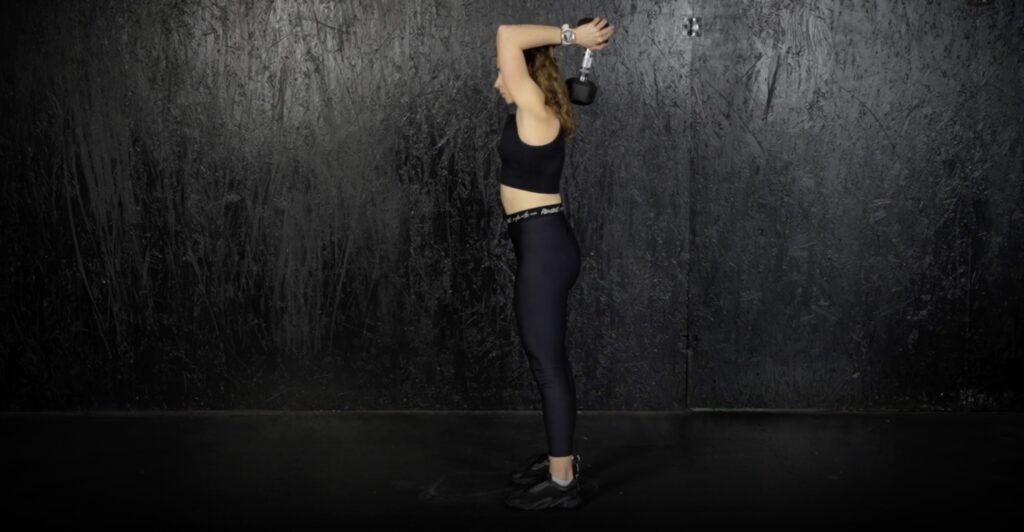
The overhead cable extension trains elbow extension with the upper arms raised. This position lengthens the long head of the triceps at the shoulder. A training study comparing overhead cable extensions with extensions performed with the arms by the sides found greater growth across the triceps, particularly the long head, in the overhead condition. The study involved a specific training program, so it does not prove that overhead extensions are best for every person. Still, it provides a good reason to include this position if it feels comfortable.
How to do an overhead cable extension
Set a cable pulley near the bottom of the machine and attach a rope. Stand with your back to the machine and hold the rope with both hands. Step forward until the cable is taut, then bring your hands up behind your head. Your upper arms should point upward, with your elbows bent and close to a comfortable position.
Straighten your elbows to move your hands upward and forward. Keep your upper arms steady and avoid arching your lower back to help the weight move. Bend your elbows slowly to return the rope behind your head. Use a range of motion that feels controlled and comfortable for your shoulders and elbows.
Start with less weight than you use on pushdowns. The position can feel unfamiliar at first, and a lighter load makes it easier to learn the movement. If you cannot keep your upper arms steady, or if the position causes discomfort, reduce the weight or try a single dumbbell held with both hands. If it still feels uncomfortable, use another exercise instead.
Why it belongs in a beginner routine
The overhead position complements the pushdown because it changes the position of the upper arm while still training elbow extension. That gives beginners a simple way to train the triceps in more than one position. You do not need to add several versions of the same exercise in one workout. Start with one overhead variation and practice it until the movement feels controlled.
3. Machine Chest Press
The machine chest press is a compound exercise, meaning it involves movement at more than one joint. The chest and shoulders contribute to the push, while the triceps help straighten the elbows. A machine can make the movement easier to learn than a free-weight bench press because the handles follow a fixed path.
How to do a machine chest press
Adjust the seat so the handles are around the middle of your chest when you sit down. Place your feet flat on the floor and keep your back against the pad. Grip the handles and begin with your elbows bent. Your wrists should stay in line with your forearms rather than bending backward.
Push the handles forward until your arms are nearly straight. Keep your shoulders relaxed and avoid forcing your elbows into a hard lockout. Return the handles slowly until your elbows bend comfortably and the handles come back toward your chest. Use a range of motion that lets you stay in control without your shoulders rolling forward.
Use a comfortable grip that does not force your elbows into an awkward position. A very narrow grip is not required to involve the triceps, and a grip that feels uncomfortable can make the exercise harder to control. If the machine does not fit your body well, ask a trainer to help adjust the seat or choose another chest press machine.
Why it belongs in a beginner routine
The chest press lets you train the triceps as part of a familiar pushing pattern rather than only through isolation exercises. Research measuring muscle activity during the bench press has recorded activity in the triceps as well as the chest and shoulders. A machine chest press is not identical to a free-weight bench press, but the same basic pushing action makes it a practical way to include the triceps in a broader upper-body workout.
Putting the Exercises Into a Workout
You can use all three exercises in one session, but beginners do not need a long list of triceps movements. If you already do chest or shoulder presses in your workout, your triceps are involved there too. Start with two sets per exercise, and notice how your elbows and shoulders feel during the session and the following day.
3 Best Barbell Exercises for a Jacked and Strong Chest
A simple order is to perform the machine chest press first, followed by the cable pushdown and overhead cable extension. The chest press involves more muscles and joints, so doing it before smaller isolation exercises can help you give the compound movement your attention while you are fresh. If you are new to the gym, ask a trainer to check the machine settings and cable setup before your first set.
Train consistently and increase resistance gradually. Keep a record of the weight and repetitions you complete, so you can see when it is time to make a small increase. Progress can mean adding repetitions with the same load before you add weight. A controlled set of 10 repetitions is more useful for learning than a heavier set where your torso swings and your elbows move all over the place.
No single exercise guarantees bigger arms. Results depend on the training you can perform consistently, how the exercises fit into your overall routine, and whether you gradually challenge your muscles over time. These three movements offer a practical starting point: a stable cable isolation exercise, an overhead variation, and a machine based push.
Key Takeaways
| Exercise | Main purpose | Beginner cue |
|---|---|---|
| Cable triceps pushdown | Practice controlled elbow extension | Keep your upper arms near your sides |
| Overhead cable triceps extension | Train elbow extension with your arms raised | Start light and keep your torso steady |
| Machine chest press | Include the triceps in a compound pushing movement | Adjust the seat and use a comfortable grip |
References
- American College of Sports Medicine (2009) ‘Progression models in resistance training for healthy adults’, Medicine & Science in Sports & Exercise, 41(3), pp. 687-708.
- Maeo, S., Mitsukawa, N., Kanehisa, H. and Nosaka, K. (2023) ‘Triceps brachii hypertrophy is substantially greater after elbow extension training performed in the overhead versus neutral arm position’, European Journal of Sport Science, 23(7), pp. 1240-1250.
- Muyor, J.M., Rodríguez-Ridao, D., Martín-Fuentes, I. and Antequera-Vique, J.A. (2019) ‘Evaluation and comparison of electromyographic activity in bench press with feet on the ground and active hip flexion’, PLOS ONE, 14(6), e0218209.
- Wakahara, T., Fukutani, A., Kawakami, Y. and Yanai, T. (2018) ‘The different role of each head of the triceps brachii muscle in elbow extension’, Acta Orthopaedica et Traumatologica Turcica, 52(5), pp. 347-351.
- Zhang, L., Zhan, Z., Cai, Y., Zhao, W. and Li, L. (2020) ‘Muscle fatigue in the three heads of triceps brachii during intensity and speed variations of triceps push-down exercise’, Frontiers in Physiology, 11, 112.