

Building stronger, more muscular arms does not require a gym full of equipment. Bodyweight exercises can challenge the muscles that bend and straighten your elbows, and you can adjust many of them to suit your current strength level. The key is choosing movements that train both sides of the upper arm: the biceps help bend the elbow, while the triceps help straighten it.
The three exercises below use pushing and pulling movements to train those muscles. Two require a stable bar or similar support, so check that any equipment is designed to hold your weight before you use it. The push-up can be done against a wall, a sturdy counter, or the floor, making it easy to scale as you get stronger.


Research on push-ups suggests that bodyweight training can build muscle when the exercise provides a suitable challenge. In one small study of untrained men, an eight-week push-up program produced similar improvements in muscle thickness and strength to low-load bench pressing. That result does not mean every push-up variation will work equally well for everyone, but it shows that bodyweight exercise can be a useful starting point.
1. Close-Grip Incline Push-Up
A close-grip incline push-up is a beginner-friendly way to train the triceps, the muscles at the back of the upper arm. It also works the chest and shoulders. Placing your hands on a raised, stable surface reduces how much of your body weight you have to push, while bringing your hands somewhat closer together increases the demand on the triceps compared with a wide hand position.
How to do it
Place your hands on a sturdy counter, fixed bar, or other stable surface around waist to chest height. Set them a little closer than shoulder width, rather than forcing them to touch. Walk your feet back until your body forms a straight line from your head to your heels. Brace your stomach gently and keep your shoulders away from your ears.
Bend your elbows and lower your chest toward the surface under control. Keep your elbows angled back rather than flaring them straight out to the sides. Stop at a comfortable depth, then press through your hands to return to the starting position. Keep your body in one line as you move, instead of letting your hips sag or your lower back arch.
Choose a surface height that lets you perform about 8 to 15 controlled repetitions. If you cannot complete 8 repetitions with good form, use a higher surface, such as a wall or a tall counter. If 15 repetitions feel easy and you could do several more, move your hands to a lower surface. Floor push-ups can be a later progression.
Why it works
The triceps straighten your elbows during the pushing part of the exercise. In a study comparing push-ups with different hand positions, a narrower hand position produced more electrical activity in the triceps and chest muscles than a wide position. Muscle activity measurements do not prove that a variation builds more muscle over time, so think of hand placement as one way to adjust the movement rather than a guarantee of better results.
Incline push-ups are also easy to scale. Changing the height of your hands changes how challenging the movement feels without requiring you to learn a completely new exercise. Start at a height where you can lower yourself steadily and press back up without your shoulders or wrists becoming uncomfortable. As you gain strength, lower the surface gradually.
2. Inverted Bodyweight Row
An inverted row trains the upper back and the muscles that bend your elbows, including the biceps. It balances the pushing work of the push-up with a pulling movement. You can change its difficulty by adjusting your body position: the more upright your torso, the easier the row; the closer your body is to horizontal, the harder it tends to be.
How to do it
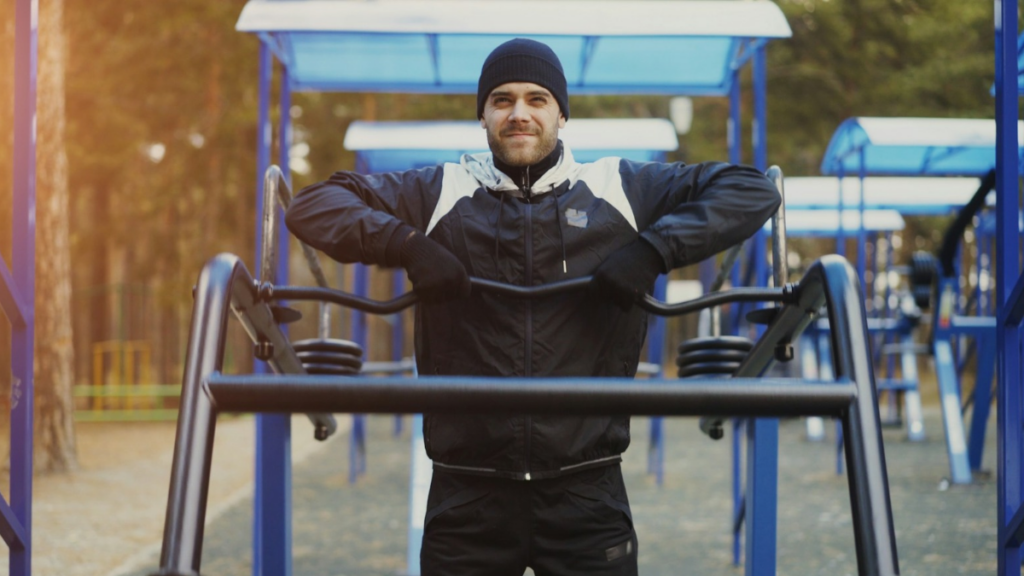
Use a bar secured for bodyweight rows, or another purpose-built support that cannot tip, slide, or collapse. Get beneath it and hold it with an overhand grip, with your hands a little wider than shoulder width. Keep your heels on the floor and your body straight from shoulders to ankles. Begin with your arms extended, without letting your shoulders slump.
Pull your chest toward the bar by bending your elbows and drawing your shoulder blades back. Pause briefly when your chest reaches the bar or as close as you can manage with control. Lower yourself slowly until your arms are extended again. Avoid thrusting your hips upward or using momentum to pull your chest toward the bar.
To make the movement easier, bend your knees and bring your feet closer to your body, or raise the bar so your torso sits at a steeper angle. To make it harder, straighten your legs or lower the bar so your body is closer to horizontal. Pick a version that lets you complete about 8 to 15 smooth repetitions.
Why it works
A row asks you to pull your body toward your hands, so your elbow flexors assist with the movement. Research measuring muscle activity during chin-ups and pull-ups has also found substantial biceps activity, particularly during chin-ups. That study examined the chin-up rather than the inverted row, so it supports the role of the biceps in pulling movements generally, not a precise prediction of how much muscle a row will build.
The inverted row is a practical first step because you can adjust your body angle and use your feet for support. This lets you practice the pulling pattern without needing to lift your entire body vertically. Keep the equipment secure and the movement controlled. If you do not have a safe setup, skip the exercise rather than improvising with a table, door, or unstable furniture.
3. Foot-Assisted Chin-Up
A chin-up is a demanding bodyweight pulling exercise that works the back and biceps. Beginners can make it more manageable by placing a foot on a stable step or box to provide assistance. The foot helps with the upward movement, while you still control the lowering phase.
How to do it
Use a secure overhead bar that is specifically designed to support your body weight. Hold it with your palms facing you and your hands around shoulder width apart. Place one foot on a stable step or box positioned beneath the bar. Begin with your arms extended and your shoulders controlled, without hanging loosely if that feels uncomfortable.
Pull your chest upward while bending your elbows. Use just enough pressure from your foot to help you rise. Lower yourself slowly until your arms are extended again, keeping your foot in position so you can assist as needed. Do not kick or swing your legs to create momentum. If you cannot lower yourself under control, use more help from your foot or practice inverted rows until you are ready to try again.

Aim for 5 to 10 controlled repetitions, since even an assisted chin-up can be challenging. If you cannot complete 5, apply more pressure through your foot. If 10 feels comfortable and you can lower yourself slowly, use less assistance over time.
Why it works
The chin-up combines elbow bending with a pulling action. In a study of chin-ups and pull-ups, researchers recorded biceps activity during both exercises and found higher biceps activity in the chin-up than in the pull-up among the participants tested. This was an acute muscle activity study, not a long-term muscle-building trial, but it helps explain why chin-ups are often included in programs that train the arms and back.
Assistance makes the exercise more accessible. The goal is not to remove all effort from the movement, but to use enough help to maintain a steady range of motion and good control. You can gradually reduce how much you push with your foot as the exercise becomes easier. If your shoulders feel painful or unstable, stop and choose a more comfortable pulling exercise.
How to Put the Exercises Into a Beginner Routine
Start with two workouts per week, leaving at least a day between them. In each workout, perform 2 or 3 sets of each exercise. Use the repetition ranges described above, and rest long enough between sets that you can keep your next set controlled. If you are new to strength training, begin with two sets and add a third when you feel ready.
Choose versions that make the final repetitions challenging while still allowing good form. You do not need to force every set to the point where you cannot complete another repetition. Research reviews suggest that muscle growth tends to improve when sets finish closer to failure, but the exact relationship is still uncertain. For a beginner, a practical target is to stop when you feel you could complete only one or two more clean repetitions.
3 Best Isolation Exercises for Wider Biceps
Progress gradually. First aim to complete the upper end of your chosen repetition range with steady technique. Then make the exercise slightly harder: lower the incline for push-ups, move your body closer to horizontal for rows, or use less foot assistance for chin-ups. Change one factor at a time so you can tell whether the new version is manageable.
These exercises emphasize the arms, but they also involve the chest, shoulders, and back. Bodyweight training can be a useful foundation, especially when the exercises are adjusted to your ability and become progressively more challenging. You may eventually need harder variations or added resistance to keep making progress, but you can build strength and start developing your arms with the basic movements here.
Key Takeaways
| Exercise | Main arm emphasis | Beginner adjustment |
|---|---|---|
| Close-grip incline push-up | Triceps | Use a higher hand support to make it easier |
| Inverted bodyweight row | Biceps and upper back | Keep your torso more upright |
| Foot-assisted chin-up | Biceps and upper back | Use your foot to provide more help |
References
- Cogley, R.M., Archambault, T.A., Fibeger, J.F., Koverman, M.M., Youdas, J.W. and Hollman, J.H. (2005) ‘Comparison of muscle activation using various hand positions during the push-up exercise’, Journal of Strength and Conditioning Research, 19(3), pp. 628–633. doi: 10.1519/15094.1.
- Kikuchi, N. and Nakazato, K. (2017) ‘Low-load bench press and push-up induce similar muscle hypertrophy and strength gain’, Journal of Exercise Science & Fitness, 15(1), pp. 37–42. doi: 10.1016/j.jesf.2017.06.003.
- Refalo, M.C., Helms, E.R., Trexler, E.T., Hamilton, D.L. and Fyfe, J.J. (2023) ‘Influence of resistance training proximity-to-failure on skeletal muscle hypertrophy: a systematic review with meta-analysis’, Sports Medicine, 53, pp. 649–665. doi: 10.1007/s40279-022-01784-y.
- Robinson, Z.P., Pelland, J.C., Remmert, J.F., Cerminaro, R.M., Benitez, B., John, T.A., et al. (2024) ‘Exploring the dose-response relationship between estimated resistance training proximity to failure, strength gain, and muscle hypertrophy: a series of meta-regressions’, Sports Medicine, 54, pp. 2209–2231. doi: 10.1007/s40279-024-02069-2.
- Youdas, J.W., Amundson, C.L., Cicero, K.S., Hahn, J.J., Harezlak, D.T. and Hollman, J.H. (2010) ‘Surface electromyographic activation patterns and elbow joint motion during a pull-up, chin-up, or Perfect-Pullup rotational exercise’, Journal of Strength and Conditioning Research, 24(12), pp. 3404–3414. doi: 10.1519/JSC.0b013e3181f8eb07.