

There is no single dead hang time every beginner should be able to reach. A person’s result depends on factors such as body weight, grip strength, hand size, bar thickness, shoulder comfort, and how familiar they are with hanging. Research has used dead hangs to measure grip endurance in climbers, but those studies do not provide a universal standard for beginners in the general population.
As a practical starting point, a beginner can work toward a controlled, unassisted hang lasting 20 to 30 seconds. Treat this as a training goal, not a pass or fail test or a scientifically established fitness norm. If you cannot yet hang for that long, or cannot hang without discomfort, use an assisted version and build up gradually.


What a Dead Hang Measures
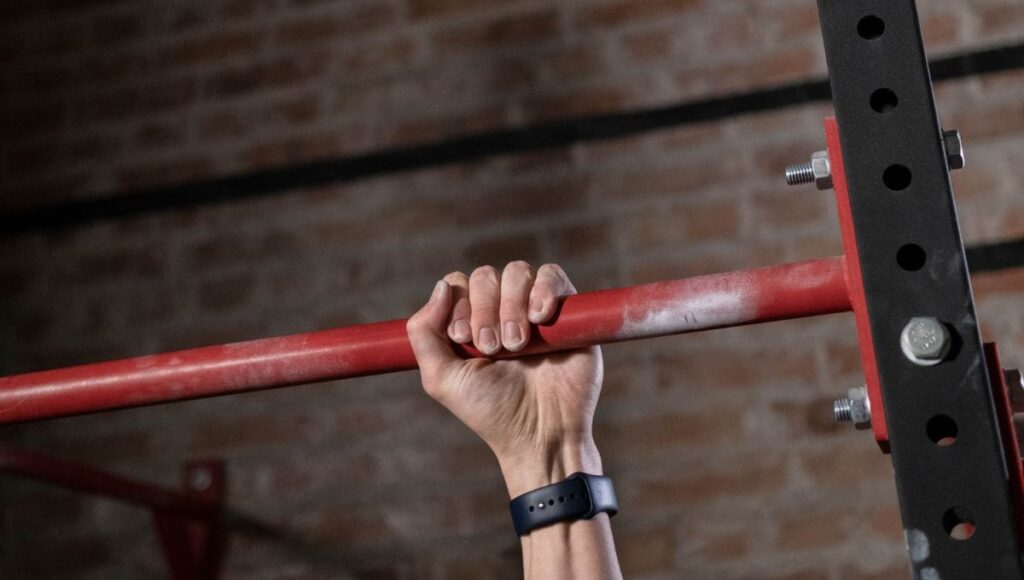
A dead hang is a static hold from an overhead bar with the hands supporting the body. In a standard test, the arms stay extended and the person hangs until they need to release the bar or their feet touch the ground. Researchers have used sustained hangs to assess finger and grip endurance in climbers.
The test does not measure grip alone. Your result reflects how well you can hold the bar while supporting your body weight, as well as your tolerance for the hanging position. The bar, grip, body position, and test rules can all affect the time. That makes comparisons between people difficult unless they use the same setup.
A dead hang also does not tell you everything about your overall strength or fitness. A short time may reflect limited grip endurance, but it can also reflect unfamiliarity with the movement, hand discomfort, or difficulty tolerating the position at the shoulder. A single score cannot identify which factor mattered most.
A Practical Target for Beginners
For a beginner who can hang comfortably, 20 to 30 seconds is a sensible first milestone. It gives you a clear target while leaving room to improve. It is not a medically validated benchmark, and there is not enough evidence to say that a beginner who holds for 15 seconds is unfit or that someone who reaches 30 seconds has reached a standard level of strength.
If you are new to the movement, start with shorter holds. You might begin with several assisted hangs of around 5 to 15 seconds, adjusting the support so that you can keep a secure grip and a comfortable position. As the hold becomes easier, reduce the assistance or add a few seconds. This approach follows the general training principle of increasing the challenge gradually, rather than forcing a maximal effort at the outset.
Your first useful goal is to complete a hang with steady control and no pain. Once you can do that, aim to add a small amount of time across your sets or reach 20 to 30 seconds in one continuous hold. You do not need to chase a two minute hang to get value from the exercise.
Why There Is No Universal Hang Time
Dead hang studies often focus on sport climbers, whose training and grip demands differ from those of beginners. In one study of 36 climbers after a 24 hour climbing competition, average static hang time fell from about 77 seconds before the event to about 38 seconds afterward. That result shows that hang time can change substantially with fatigue. It does not establish a normal score for someone who is starting to exercise.
Other research has examined whether hangboard programs can improve climbers’ grip endurance. In one study, highly advanced male boulderers improved their dead hang and intermittent hang results after four weeks of fingerboard training. A separate study of intermediate to advanced climbers found improvements in some measures after ten weeks of hangboard training, while the researchers cautioned that the test and training conditions were specific to climbing.
These studies are useful evidence that hanging performance can be trained. They are not a basis for age and sex standards for all beginners. A fair comparison requires the same bar, grip, hand position, body position, and stopping rule. Even then, a hang time is best treated as one measure of personal progress rather than a complete fitness assessment.
How to Perform a Beginner Dead Hang
Use a stable pull up bar that can support your weight. Grip it with both hands, with your hands around shoulder width apart or at a position that feels comfortable. Step off a stable platform so you begin in control, rather than jumping up and suddenly loading your hands and shoulders.
Keep your arms extended and your body relatively still. Breathe normally and avoid swinging or regripping during a timed test. End the hold when your grip starts to fail, you cannot maintain the position, or you feel pain, tingling, or numbness. Do not keep hanging just to beat a number.
People use “dead hang” to describe slightly different shoulder positions. In a relaxed hang, the shoulders are allowed to rise naturally toward the ears. In an active hang, the person gently engages the muscles around the shoulder blades and draws the shoulders down. Neither version should be forced into a painful range. For a beginner, a comfortable, controlled position matters more than copying a particular style.
If reaching the bar or stepping off is difficult, use a low bar or sturdy support that lets you keep your feet on the floor. You can hold the bar while keeping some weight through your legs, then gradually place more weight through your hands as you become comfortable. You can also use a resistance band or a partner’s support, but make sure the assistance is stable and predictable.
How Often Should You Practice?
Two or three brief sessions per week is a reasonable place to start if your hands, elbows, and shoulders feel good afterward. This is a practical training suggestion rather than a dead hang frequency proven to be best for every beginner. Climbing studies have used regular hangboard sessions, but they involved trained participants and specialized protocols.
Start with two or three sets, stopping each hold while you can still maintain control. Rest long enough between sets for your grip to recover. When the current holds feel comfortable, increase the total time slightly, reduce the support, or add another set. Change one part at a time so you can tell how your body responds.
Dead hangs can place a high demand on the fingers and forearms, especially when performed on narrow climbing holds. Beginners should use a standard pull up bar rather than small edges or specialized hangboards. The training studies in climbers should not be taken as a recommendation for an untrained person to copy their equipment or workload.
When to Modify or Stop
Stop if hanging causes sharp pain, increasing shoulder pain, numbness, or tingling. If you have a current hand, elbow, or shoulder injury, or a condition that affects your ability to grip or support your body, ask a qualified health professional whether hanging is appropriate for you.
A short hold is not a reason to force a longer one. If your grip gives out quickly, use foot support, a resistance band, or another stable form of assistance. If the shoulders feel uncomfortable even with support, choose a different grip exercise until you can get advice or find a comfortable variation.
How to Track Progress
Record the date, the bar you used, whether the hang was assisted, and how long you held it. Use the same setup when you retest. That makes it easier to judge whether your own performance is changing, even though it does not allow a precise comparison with people who used different conditions.
5 Best Free Weights Exercises for A Wider Back Faster
Retest every few weeks rather than doing a maximal test every workout. Training studies in climbers have found that dead hang performance can improve over several weeks, but the size of the improvement varies and the participants were not general fitness beginners. Your own progress may be gradual, and it may not increase in a straight line.
The useful question is not whether your time matches an online chart. Ask whether you can hang more comfortably, use less assistance, or hold the same position for longer than before. Those are practical signs that your hanging capacity is improving.
Key Takeaways
| Topic | Takeaway |
|---|---|
| Beginner target | Work toward a controlled, unassisted hang of 20 to 30 seconds. This is a practical goal, not an official norm. |
| Starting point | Use foot support or another stable form of assistance if a full hang is too difficult. |
| Technique | Keep the bar secure, your body controlled, and the hold pain free. |
| Progression | Practice two or three brief sessions per week and increase the challenge gradually. |
| Tracking | Compare your results using the same bar, grip, assistance, and test rules. |
References
- American College of Sports Medicine (2002) ‘American College of Sports Medicine position stand. Progression models in resistance training for healthy adults’, Medicine & Science in Sports & Exercise, 34(2), pp. 364–380.
- Hermans, E., Saeterbakken, A.H., Vereide, V., Nord, I.S.O., Stien, N. and Andersen, V. (2022) ‘The effects of 10 weeks hangboard training on climbing specific maximal strength, explosive strength, and finger endurance’, Frontiers in Sports and Active Living, 4, article 888158.
- López-Rivera, E. and González-Badillo, J.J. (2019) ‘Comparison of the effects of three hangboard strength and endurance training programs on grip endurance in sport climbers’, Journal of Human Kinetics, 66, pp. 183–193.
- Medernach, J.P.J., Kleinöder, H. and Lötzerich, H.H. (2015) ‘Fingerboard in competitive bouldering: Training effects on grip strength and endurance’, Journal of Strength and Conditioning Research, 29(8), pp. 2286–2295.
- Yu, E., Lowe, J., Millon, J., Tran, K. and Coffey, C. (2023) ‘Change in grip strength, hang time, and knot tying speed after 24 hours of endurance rock climbing’, Frontiers in Sports and Active Living, 5, article 1224581.