The dumbbell bench press is a straightforward way to train your chest, shoulders, and triceps. You lie on a bench, press a weight in each hand, and lower them under control. The movement looks simple, but it gives beginners plenty to learn, how to control a load, repeat good technique, and make gradual progress.
Dumbbells are not automatically better than a barbell. Both can build strength and muscle, and research has found similar chest and shoulder activation during dumbbell and barbell bench presses. Dumbbells do offer some practical advantages, though. Each arm holds and moves its own weight, and you can adjust the position of your hands as you lift. Those details can make the exercise useful when you are learning to press.



Here are three evidence based reasons to include the dumbbell bench press in a beginner chest workout, along with pointers for getting started safely.
1. It gives you a useful way to build chest strength and muscle
The dumbbell bench press trains the pectoralis major, the large muscle across the chest. The front of the shoulders and the triceps also help move the weights. Because several muscles work together, the exercise can help you practise pushing strength while training your chest.
A small study that measured muscle activity during dumbbell and barbell bench presses found no significant difference in activation of the chest and front shoulder muscles between the two exercises. The study involved 12 college aged men and women, so its results should not be treated as proof that the exercises produce identical long term results for everyone. However, it supports the practical point that dumbbell bench pressing can be a sound choice for working these muscles.
Muscle activity measurements are not the same as measurements of muscle growth. They capture what muscles are doing during an exercise, but they do not tell us on their own how much muscle a person will build after months of training. The best choice is usually an exercise you can perform consistently, with good control, and progress over time.
That progression does not require a complicated plan. Start with a pair of weights that lets you complete several controlled repetitions without your shoulders lifting off the bench or your wrists folding backward. When the same load feels manageable across your sets, increase the challenge gradually. You might add a repetition or choose the next available weight, provided you can still perform the movement with control.
The goal is not to lift the heaviest dumbbells you can get into position. A load that is too heavy can make it difficult to lower the weights safely and keep your arms moving steadily. Beginners benefit from practising the movement with a manageable load while building strength and confidence. General resistance training guidance supports starting with a load that allows roughly 8 to 12 challenging repetitions, but you can use a lighter weight while learning the technique.
What this means for your chest
You do not need to choose the dumbbell bench press because it has been proven superior to the barbell version. The evidence does not support that claim. Instead, think of it as one effective way to train your chest. If you enjoy it and can do it comfortably, it can provide a reliable foundation for your pressing work.
2. Each arm has to control its own dumbbell
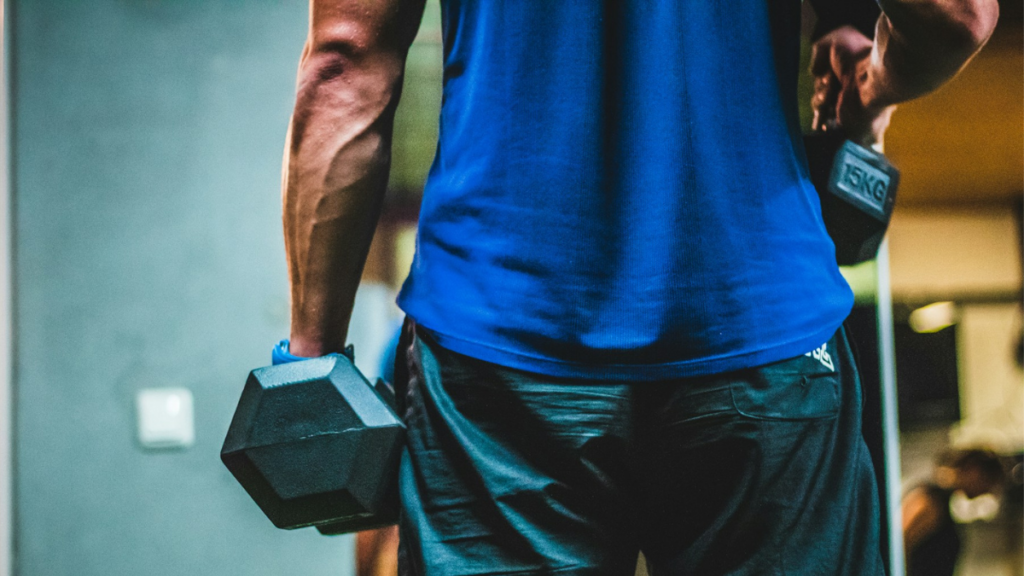
With a barbell, both hands hold the same fixed bar. With dumbbells, each hand controls a separate weight. This means both arms have to manage their own path as you lower and press.
That independent movement makes the exercise a useful way to practise control. One dumbbell may drift outward, move faster, or reach the top before the other. Noticing those differences can help you pay attention to how each repetition feels. Keep both weights moving at a steady pace, and avoid twisting your shoulders or bouncing one side to finish a repetition.

This does not mean dumbbell pressing will automatically correct strength differences between your arms. It also does not prove that one arm is weaker if the weights feel uneven. Differences in coordination, technique, or confidence can affect how the exercise feels, especially when you are new to lifting. Use a manageable weight and practise repeating the same movement on both sides.
Research comparing unilateral and bilateral resistance training generally finds that the training method tends to improve strength in movements that resemble the method being trained. A dumbbell bench press uses both arms at the same time, but each side controls its own implement. That makes it different from a one arm press, and you should not assume that results from one form of training apply exactly to the other.
The main beginner benefit is practical: you have to guide each dumbbell rather than rely on a fixed bar. This can encourage a deliberate pace and help you build coordination while you get used to pressing. If the weights wobble, reduce the load and focus on a smooth, repeatable path.
How to keep the weights steady
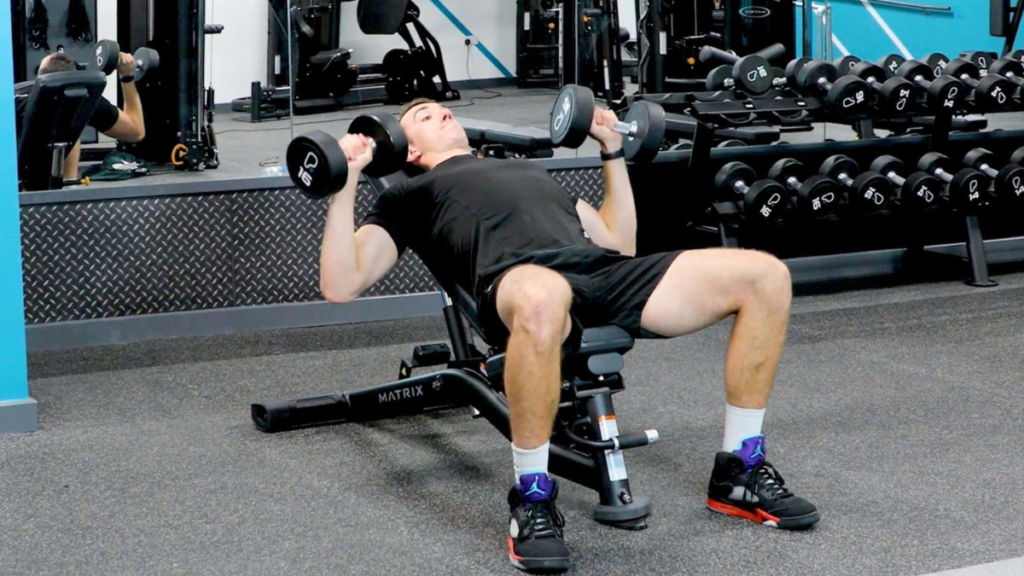
Set up with your feet planted and your upper back supported by the bench. Hold the dumbbells above your chest with your wrists stacked over your elbows. Lower them under control, keeping your elbows at a comfortable angle from your torso. Stop when you reach a depth you can manage without pain or losing shoulder position, then press the weights back up.
You do not need to force the dumbbells to touch at the top. Finish with your arms extended but avoid aggressively locking your elbows or letting the weights collide. A controlled repetition is more useful than a dramatic one.
3. You can adjust your hand position and pressing path
A barbell connects your hands, so it largely fixes their position relative to each other. Dumbbells let you choose how your hands face. You can begin with your palms facing forward, or use a more neutral grip with your palms facing each other. You can also make small adjustments to the angle of your hands as you lower the weights.
That flexibility can make it easier to find a comfortable position for your shoulders and wrists. Comfort is individual, and dumbbells are not guaranteed to remove discomfort. If a position causes pain, stop and adjust the movement or seek advice from a qualified professional. Do not treat pain as something you have to push through to get a good chest workout.
The dumbbell bench press also lets each weight travel separately. Depending on your proportions, mobility, and control, you may be able to lower the dumbbells farther than a barbell would allow. A deeper repetition is not automatically better, and you should not chase extra depth by letting your shoulders roll forward or forcing the weights down. Use the largest comfortable range of motion you can control.
Research on resistance training range of motion suggests that using a fuller range can be beneficial for strength, although findings about muscle growth vary by muscle group and study. These findings are not specific proof that lowering dumbbells farther during a bench press creates more chest growth. They do support practising a controlled range that is as full as your body can comfortably manage.
Make the movement fit your current ability
If lowering both dumbbells feels awkward, start with lighter weights and practise getting into position. Sit on the bench with the dumbbells resting on your thighs, then carefully lie back while guiding them into place. If the weights are still difficult to position safely, ask a qualified trainer to show you a setup or use a lighter load.
You can also adjust the bench setup. A flat bench is a clear starting point for the standard dumbbell bench press. Keep your head and upper back supported, and avoid lifting your hips to turn the movement into an arching contest. A stable setup makes it easier to focus on the press itself.
How to add the dumbbell bench press to your workout
For a beginner, try 2 or 3 sets of 8 to 12 repetitions with a weight you can control. Rest long enough between sets to maintain your technique. You do not need to take every set to the point where you cannot complete another repetition. Stop if your form starts to change or the weights become difficult to control.
Train your chest as part of a balanced program that also works your back, legs, and other major muscle groups. The dumbbell bench press is one exercise, not a complete training plan. Consistent practice and gradual progression matter more than constantly changing exercises or adding weight before you are ready.
If you have a history of shoulder, elbow, or wrist problems, or the exercise causes pain, get guidance from a qualified health or fitness professional. The right range of motion and grip can vary from person to person.
Is the dumbbell bench press right for you?
The dumbbell bench press is a useful beginner exercise because it can build pressing strength, asks each arm to control its own weight, and lets you adjust your grip and movement path. These are practical advantages, not guarantees that dumbbells will build more chest muscle than a barbell.
How Many Chin-Ups Should You Be Able to Do Based on Your Age?
Choose the version you can perform with control and consistency. If that is the dumbbell bench press, start with a manageable load, use a comfortable range of motion, and progress gradually. Your chest will respond to a well planned training routine, not to a particular piece of equipment on its own.
References
- American College of Sports Medicine (2009) ‘Progression models in resistance training for healthy adults’, Medicine & Science in Sports & Exercise, 41(3), pp. 687–708.
- Farias, D. da A., Willardson, J.M., Paz, G.A., Bezerra, E. da S. and Miranda, H. (2017) ‘Maximal strength performance and muscle activation for the bench press and triceps extension exercises adopting dumbbell, barbell, and machine modalities over multiple sets’, Journal of Strength and Conditioning Research, 31(7), pp. 1879–1887.
- Schoenfeld, B.J., Ogborn, D. and Krieger, J.W. (2017) ‘Dose-response relationship between weekly resistance training volume and increases in muscle mass: a systematic review and meta-analysis’, Journal of Sports Sciences, 35(11), pp. 1073–1082.
- Welsch, E.A., Bird, M. and Mayhew, J.L. (2005) ‘Electromyographic activity of the pectoralis major and anterior deltoid muscles during three upper-body lifts’, Journal of Strength and Conditioning Research, 19(2), pp. 449–452.
- Xie, Y. et al. (2025) ‘Comparison of muscle growth and dynamic strength adaptations induced by unilateral and bilateral resistance training: a systematic review and meta-analysis’, Sports Medicine.
Key Takeaways
| Benefit | What it offers beginners |
|---|---|
| Chest training | A practical way to train the chest, shoulders, and triceps |
| Independent control | Each arm guides its own dumbbell, giving you a chance to practise steady repetitions |
| Adjustable position | You can choose a comfortable grip and controlled range of motion |
| Gradual progression | Add repetitions or weight over time while keeping your technique consistent |