Flexibility is an often underrated aspect of fitness that many people overlook, but it can be a fantastic marker for how your body is doing as a whole.
So how flexible should you be? A useful answer starts with checking a few different areas, then comparing your results with the right age and sex reference where one exists. These three simple tests will give you a practical snapshot of your body and how healthy it is.
Is There a Normal Flexibility Score for Your Age?
There is no single flexibility score that applies to everyone. A sit-and-reach test measures a combination of hamstring and lower back movement, for example, but it does not tell you how freely your shoulders or ankles move. Researchers have also found that flexibility can vary between different joints in the same person.
Age-specific comparisons can still help. Researchers have published reference values for some tests, including the chair sit-and-reach and back-scratch tests used in the Senior Fitness Test for adults ages 60 to 94. These comparisons are designed for specific tests and age groups. They are not universal standards for every movement or every adult.
Your result can also depend on sex, body proportions, training history, and how the test is performed. For that reason, the fairest comparison is usually your score on the same test, repeated in the same way over time. Age-based norms can add context, especially for older adults, but they should not be treated as a pass or fail.
| Age group | What to use as a useful guide |
|---|---|
| Under 60 | Record each test carefully and track your own results. Broad age-based targets are limited for these three simple tests. |
| 60 to 94 | Compare chair sit-and-reach and back-scratch results with age and sex references developed for the Senior Fitness Test. |
| Any age | Look at each body area separately. A strong result in one test does not guarantee good mobility elsewhere. |
Before You Start the Tests
Test when you feel comfortable and are not rushing. If possible, do the tests at a similar time of day each time you repeat them. A gentle warm-up, such as a few minutes of easy walking, can help you move comfortably. Do not force a stretch to improve your score.
Move slowly and stop if you feel sharp pain, numbness, or unusual discomfort. These are simple ways to observe movement, not diagnostic tests. If you have an injury or a health condition that affects movement, ask a health professional which tests are appropriate for you.
Test 1: Chair Sit-and-Reach
This test gives you a look at flexibility around your hamstrings and hips. It is also a practical option if getting down to the floor is uncomfortable. The chair version is used in the Senior Fitness Test for older adults, and research has examined its reliability and validity as a hamstring flexibility measure.
How to do it
Sit near the front of a sturdy chair. Keep one foot flat on the floor and extend the other leg in front of you, with the heel down and toes pointing upward. Keep your back relatively straight and place one hand over the other.
Bend forward from your hips and reach toward the toes of the extended leg. Do not bounce or pull on your foot. Measure the gap between your fingertips and toes, or how far your fingers pass them. A gap is recorded as a negative score, reaching the toes as zero, and passing them as a positive score.
Repeat on the other leg. Record both results, because one side may feel different from the other. If you use this test over time, keep the chair, leg position, and measuring method the same.
How to read your result
| Age | Reference group | Lower range | Median score | Higher range |
|---|---|---|---|---|
| 20–24 | Men | Below 15.5 cm | 24.6 cm | Above 33.5 cm |
| 20–24 | Women | Below 22.9 cm | 31.1 cm | Above 38.8 cm |
| 25–29 | Men | Below 15.4 cm | 24.5 cm | Above 33.4 cm |
| 25–29 | Women | Below 22.5 cm | 31.1 cm | Above 39.1 cm |
| 30–34 | Men | Below 15.3 cm | 24.2 cm | Above 32.9 cm |
| 30–34 | Women | Below 22.0 cm | 31.0 cm | Above 39.3 cm |
| 35–39 | Men | Below 15.1 cm | 23.8 cm | Above 32.3 cm |
| 35–39 | Women | Below 21.4 cm | 30.7 cm | Above 39.2 cm |
| 40–44 | Men | Below 14.9 cm | 23.3 cm | Above 31.6 cm |
| 40–44 | Women | Below 20.8 cm | 30.2 cm | Above 38.8 cm |
| 45–49 | Men | Below 14.6 cm | 22.7 cm | Above 30.7 cm |
| 45–49 | Women | Below 20.1 cm | 29.6 cm | Above 38.3 cm |
| 50–54 | Men | Below 14.3 cm | 22.1 cm | Above 29.8 cm |
| 50–54 | Women | Below 19.6 cm | 29.1 cm | Above 37.8 cm |
| 55–59 | Men | Below 14.0 cm | 21.5 cm | Above 28.9 cm |
| 55–59 | Women | Below 19.2 cm | 28.8 cm | Above 37.5 cm |
| 60–64 | Men | Below 13.7 cm | 20.9 cm | Above 28.0 cm |
| 60–64 | Women | Below 19.1 cm | 28.8 cm | Above 37.6 cm |
| 65–69 | Men | Below 13.4 cm | 20.3 cm | Above 27.1 cm |
| 65–69 | Women | Below 19.0 cm | 28.9 cm | Above 37.7 cm |
Test 2: Back-Scratch Test
The back-scratch test checks how close your hands can come behind your back. It gives you a simple way to compare shoulder flexibility on both sides. The test is included in the Senior Fitness Test, which provides age and sex reference values for older adults.
How to do it
Stand comfortably. Reach one hand over the same-side shoulder and down your back, with your palm facing your body. Bring your other hand behind your back from below, palm facing outward, and reach upward.
Try to bring your middle fingers toward each other without leaning, twisting, or forcing the movement. Measure the distance between your fingertips. If they overlap, record the amount of overlap as a positive score. If there is a gap, record it as a negative score.
Switch which arm reaches from above and repeat. Keep the two results separate, since shoulder mobility can differ from one side to the other.
How to read your result
| Age | Reference group | Below middle range | Middle 50% | Above middle range |
|---|---|---|---|---|
| 60–64 | Men | Below −6.6 in | −6.6 to −0.2 in | Above −0.2 in |
| 60–64 | Women | Below −3.0 in | −3.0 to +1.6 in | Above +1.6 in |
| 65–69 | Men | Below −7.4 in | −7.4 to −0.8 in | Above −0.8 in |
| 65–69 | Women | Below −3.7 in | −3.7 to +1.3 in | Above +1.3 in |
| 70–74 | Men | Below −7.8 in | −7.8 to −1.2 in | Above −1.2 in |
| 70–74 | Women | Below −4.2 in | −4.2 to +0.8 in | Above +0.8 in |
| 75–79 | Men | Below −9.0 in | −9.0 to −2.2 in | Above −2.2 in |
| 75–79 | Women | Below −4.8 in | −4.8 to +0.6 in | Above +0.6 in |
| 80–84 | Men | Below −9.3 in | −9.3 to −2.1 in | Above −2.1 in |
| 80–84 | Women | Below −5.4 in | −5.4 to +0.2 in | Above +0.2 in |
| 85–89 | Men | Below −9.4 in | −9.4 to −3.0 in | Above −3.0 in |
| 85–89 | Women | Below −6.9 in | −6.9 to −0.9 in | Above −0.9 in |
| 90–94 | Men | Below −10.4 in | −10.4 to −4.0 in | Above −4.0 in |
| 90–94 | Women | Below −8.0 in | −8.0 to −1.0 in | Above −1.0 in |
Test 3: Knee-to-Wall Ankle Test
Your ankles need to move forward over your feet during movements such as walking, climbing stairs, and squatting. The knee-to-wall test measures ankle dorsiflexion, which is the movement that brings your shin toward the front of your foot. Research has found this type of weight-bearing lunge test can be repeated reliably when the method is kept consistent.
How to do it
Stand facing a wall, with one foot in front of you. Keep the heel of that foot on the floor and point your toes toward the wall. Bend your knee and try to touch the wall without letting your heel lift.
If you can touch the wall, move your foot a little farther back and try again. Continue until you find the farthest distance at which your knee can still reach the wall while your heel stays down. Measure from your big toe to the wall. Repeat with the other foot.
Use the same footwear choice each time, ideally bare feet, and keep your foot pointed straight toward the wall. Record both sides in inches or centimeters.
How to read your result
| Age | Reference group | Below the study’s normal range | Study’s normal range | Above the study’s normal range |
|---|---|---|---|---|
| 18–29 | Men | Below 8.0 cm | 8.0–13.2 cm | Above 13.2 cm |
| 18–29 | Women | Below 9.8 cm | 9.8–12.8 cm | Above 12.8 cm |
| 30–39 | Men | Below 8.8 cm | 8.8–14.0 cm | Above 14.0 cm |
| 30–39 | Women | Below 9.8 cm | 9.8–13.8 cm | Above 13.8 cm |
| 40–49 | Men | Below 8.0 cm | 8.0–14.0 cm | Above 14.0 cm |
| 40–49 | Women | Below 8.6 cm | 8.6–13.0 cm | Above 13.0 cm |
| 50–59 | Men | Below 7.5 cm | 7.5–13.8 cm | Above 13.8 cm |
| 50–59 | Women | Below 7.5 cm | 7.5–11.5 cm | Above 11.5 cm |
| 60–69 | Men | Below 7.0 cm | 7.0–10.6 cm | Above 10.6 cm |
| 60–69 | Women | Below 7.0 cm | 7.0–9.0 cm | Above 9.0 cm |
| 70–79 | Men | Below 5.8 cm | 5.8–9.9 cm | Above 9.9 cm |
| 70–79 | Women | Below 5.0 cm | 5.0–8.0 cm | Above 8.0 cm |
| 80+ | Men | Below 5.0 cm | 5.0–8.0 cm | Above 8.0 cm |
| 80+ | Women | Below 5.0 cm | 5.0–6.2 cm | Above 6.2 cm |
What Your Results Say About Age
Age can influence flexibility, but the effect is not identical across the body. Research using multiple joint measurements has found that age-related mobility loss can be joint-specific. Other population data found sit-and-reach flexibility remained relatively stable with age, which is a useful reminder that not every measure follows the same pattern.
What Is a Healthy Blood Pressure for Your Age, and When Is It Too High?
In practical terms, there is no requirement to become less mobile simply because you have reached a particular birthday. Your results are shaped by your routine, previous injuries, and the movements you regularly practice, as well as by age. It is reasonable to expect variation between people of the same age.
Use age-based norms where they exist, especially the Senior Fitness Test references for older adults. For all three tests, write down your measurements and repeat them periodically under similar conditions. A steady result may be useful, and an improvement can show that your range of motion has changed. A sudden loss of movement, pain, or a new difference between sides is a good reason to seek professional advice.
How to Improve Your Flexibility
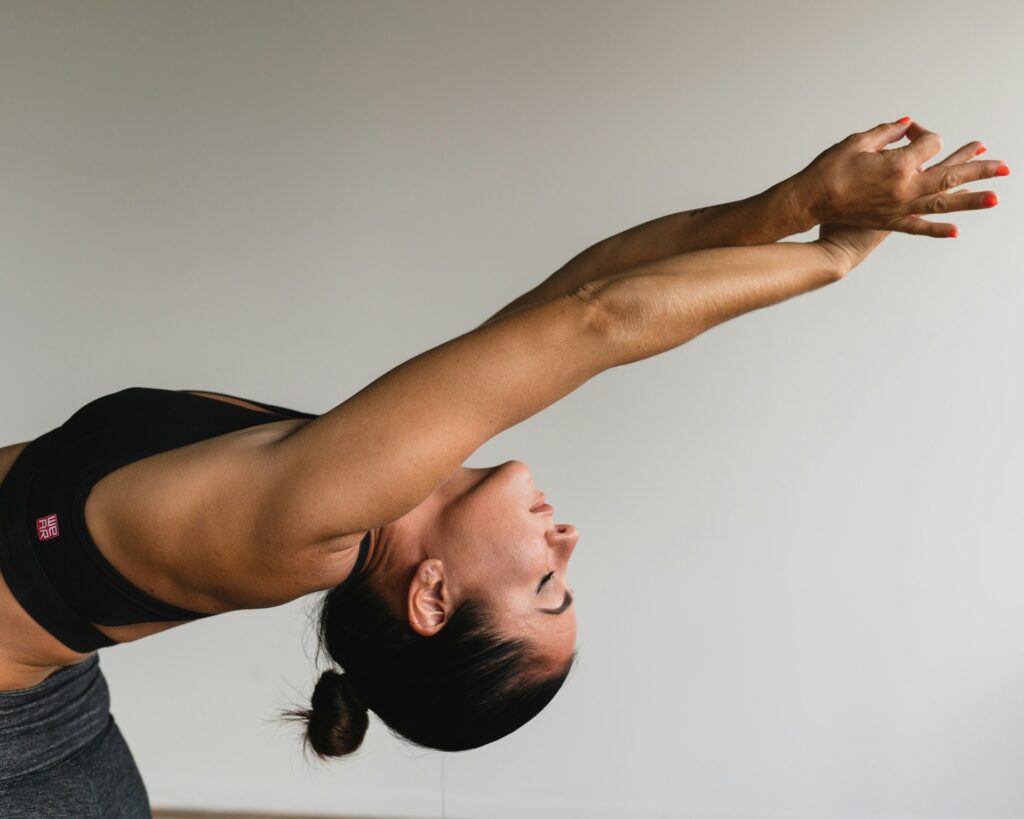
If one test highlights an area you would like to work on, practice movements that gently take that joint through a comfortable range. Keep your breathing relaxed and avoid bouncing or pushing into pain. Consistent, gradual practice is more useful than trying to force a dramatic change in one session.
Retest under the same conditions after a few weeks. Small differences can come from measurement technique, warm-up, or how you feel that day, so focus on repeated patterns rather than reacting to a single score. Your goal is enough comfortable movement for the activities you want to do, not the highest possible score on every flexibility test.
References
- Cejudo, A., Sainz de Baranda, P., Ayala, F. and Santonja, F. (2014) ‘A simplified version of the weight-bearing ankle lunge test: description and test-retest reliability’, Manual Therapy, 19(4), pp. 355–359.
- Hoffmann, M.D., Colley, R.C., Doyon, C.Y., Wong, S.L., Tomkinson, G.R. and Lang, J.J. (2019) ‘Normative-referenced percentile values for physical fitness among Canadians’, Health Reports, 30(10), pp. 14–22.
- McKay, M.J. et al. (2017) ‘Normative reference values for strength and flexibility of 1,000 children and adults’, Neurology, 88(1), pp. 36–43.
- Rikli, R.E. and Jones, C.J. (1999) ‘Development and validation of a functional fitness test for community-residing older adults’, Journal of Aging and Physical Activity, 7(2), pp. 129–161.
- Rikli, R.E. and Jones, C.J. (2013) Senior Fitness Test Manual. 2nd edn. Champaign, IL: Human Kinetics.
- Shephard, R.J., Berridge, M. and Montelpare, W. (1990) ‘On the generality of the “sit and reach” test: an analysis of flexibility data for an aging population’, Research Quarterly for Exercise and Sport, 61(4), pp. 326–330.
- Valer, S.L., Valer, M.C. and Araújo, C.G.S. (2008) ‘Flexibility assessment: normative values for Flexitest from 5 to 91 years of age’, Arquivos Brasileiros de Cardiologia, 90(4), pp. 280–287.