The triceps make up roughly two thirds of your upper arm muscle mass, yet they are often overshadowed by biceps training. If your goal is bigger arms, stronger pressing power, or improved upper body performance, focusing on the triceps is one of the smartest decisions you can make.
Among experienced lifters, the PJR Pullover has developed a reputation as one of the most effective triceps exercises ever created. Popularized by bodybuilding coach Paul Carter and inspired by movements used by the late Anthony DeLuglio, the exercise combines elements of a dumbbell pullover and a triceps extension into one unique movement.



Supporters claim it builds tremendous triceps size while being easier on the elbows than many traditional isolation exercises. But is it really the perfect triceps exercise?
The answer depends on your goals, your technique, and how you use it within a well designed training program.
What Is the PJR Pullover?
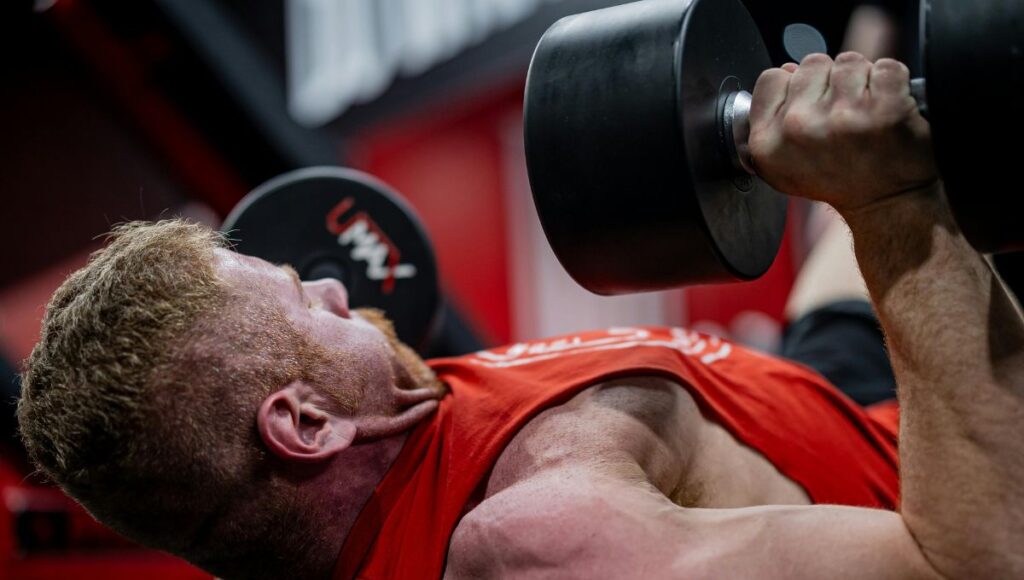
The PJR Pullover is performed lying across a bench or flat on a bench with a single dumbbell held using both hands.
Instead of lowering the dumbbell directly toward your forehead like a skull crusher, the weight travels behind your head in a sweeping arc. As the shoulders flex, the long head of the triceps experiences a substantial stretch before extending the elbows and shoulders together to return the dumbbell to the starting position.
The movement combines shoulder extension with elbow extension, allowing the long head of the triceps to contribute throughout a larger range of motion than many traditional exercises.
Unlike a standard dumbbell pullover, the primary objective is not training the lats or chest. Instead, the focus remains on loading the triceps, particularly the long head.
Why the Long Head Matters
The triceps consist of three separate heads.
- The lateral head contributes to the horseshoe appearance on the outside of the arm.
- The medial head works throughout nearly every elbow extension movement and contributes significantly to overall strength.
- The long head is unique because it crosses both the shoulder and elbow joints. This means it is affected by shoulder position as well as elbow movement.
Research consistently shows that muscles generally produce greater hypertrophy when trained through long muscle lengths. Exercises that place the long head into a stretched position may therefore stimulate greater muscle growth than exercises performed only through shortened ranges of motion.
Because the PJR Pullover stretches the long head while it is actively loaded, it takes advantage of this important physiological principle.
Why Stretch Mediated Hypertrophy Matters
One of the biggest developments in resistance training research over the past decade has been the growing evidence supporting stretch mediated hypertrophy.
Several studies comparing partial repetitions performed in the lengthened position with traditional full range of motion training have found surprisingly large increases in muscle growth when muscles are challenged under stretch.
Although research has primarily focused on calves, quadriceps, hamstrings, and biceps, the underlying mechanisms appear applicable across skeletal muscle.
Scientists believe several factors contribute. Long muscle lengths increase passive tension within muscle fibers. Mechanical tension remains elevated throughout the movement. Satellite cell activation and anabolic signaling may be enhanced when muscles experience heavy loading in stretched positions.
Because the long head of the triceps reaches its greatest length when the shoulder is flexed overhead, exercises like the PJR Pullover may provide an ideal hypertrophy stimulus.
Why the PJR Pullover Feels Different
Many lifters immediately notice that the exercise produces a unique sensation.
Rather than simply extending the elbows, the movement creates a deep stretch through the back of the upper arm before requiring a powerful contraction to return the weight. This combines two important drivers of muscle growth.
- High mechanical tension.
- Large ranges of motion under load.
Compared with skull crushers, many athletes also report reduced elbow discomfort. Although individual experiences vary, the force is distributed differently because the shoulder joint participates throughout the lift rather than placing all stress on repeated elbow flexion and extension.
The Science Behind Triceps Growth
Research on muscle hypertrophy consistently identifies mechanical tension as the primary driver of muscle growth. When muscles are challenged with sufficient resistance and progressively overloaded over time, protein synthesis increases, leading to greater muscle size.
Training volume also plays an important role. Studies suggest that approximately ten to twenty challenging weekly sets per muscle group produce excellent hypertrophy for most trained individuals. Exercise selection matters because different movements emphasize different portions of a muscle.
Electromyography studies demonstrate that overhead triceps exercises generally recruit the long head more effectively than pushdowns or close grip pressing because of the long head’s attachment across the shoulder joint. The PJR Pullover builds on this concept by increasing both shoulder flexion and elbow extension demands simultaneously.
Benefits of the PJR Pullover
Exceptional Long Head Development
The biggest advantage is its ability to challenge the long head through an extended range of motion. The long head contributes substantially to total arm size. Lifters who focus only on pushdowns often leave significant growth potential untapped. Including exercises that stretch the long head can create more balanced triceps development.
Excellent Range of Motion
The exercise uses a larger movement arc than many isolation exercises. Longer ranges of motion generally expose muscles to greater mechanical work and higher total tension. This combination supports both hypertrophy and strength development.
Heavy Loading Potential
Unlike many overhead cable extensions, the PJR Pullover often allows surprisingly heavy dumbbells. As technique improves, experienced lifters frequently progress to loads that would be uncomfortable during conventional skull crushers.
Greater loading increases mechanical tension, one of the primary drivers of muscle growth.
Potentially Better Elbow Comfort
Many lifters struggle with elbow irritation during traditional lying extensions. Because the PJR Pullover shares movement between the shoulders and elbows, it often feels smoother and less stressful. This does not guarantee pain free training, but many experienced bodybuilders prefer it for long term triceps work.
Improved Pressing Strength
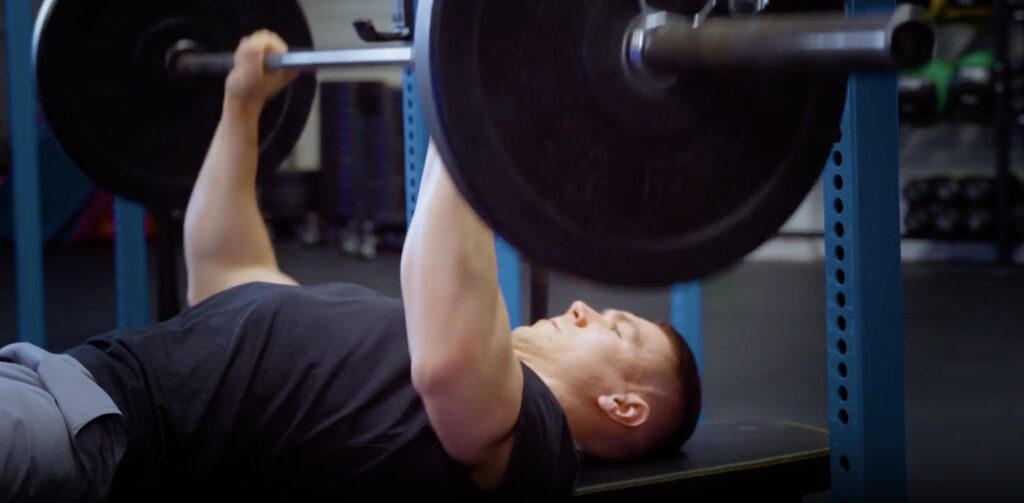
Stronger triceps directly improve performance in compound pressing exercises. Bench presses, incline presses, overhead presses, dips, and push ups all rely heavily on elbow extension strength. Building larger and stronger triceps contributes to improved lockout power during these lifts.
How to Perform the PJR Pullover Correctly
- Lie on a flat bench holding one dumbbell vertically with both hands around the inside of the top plate.
- Begin with the weight above your chest while keeping a slight bend in your elbows.
- Lower the dumbbell behind your head by allowing both your shoulders and elbows to move naturally.
- The upper arms should travel backward while the elbows flex moderately.
- Continue lowering until you feel a deep but comfortable stretch across the triceps.
- Drive the dumbbell back upward by extending the elbows while simultaneously bringing the shoulders back toward the starting position.
- Avoid turning the exercise into a pure pullover by allowing the lats to dominate the movement.
- Keep the triceps actively engaged throughout every repetition.
Programming the PJR Pullover
The exercise works well during hypertrophy focused upper body sessions. Most lifters benefit from performing it after heavy compound pressing exercises when the triceps are already warm.
3 Best Beginner Exercises for Bigger Arms Only Using Machines
Three to four working sets performed for eight to fifteen repetitions usually provide an excellent balance between mechanical tension and metabolic stress. Because the movement creates substantial muscle damage during the stretched position, excessive volume is usually unnecessary. Progressive overload remains essential.
Increase repetitions before adding weight whenever possible while maintaining perfect technique.
Should Beginners Use It?
The exercise requires reasonable shoulder mobility and movement control. Complete beginners may learn elbow extension mechanics more easily using cable pushdowns before progressing to the PJR Pullover.
Once basic technique has been mastered, however, the movement becomes an excellent addition to almost any arm training routine. Starting with lighter dumbbells allows new lifters to develop confidence before increasing resistance.
Is the PJR Pullover the Perfect Triceps Exercise?
Perfection rarely exists in strength training. Every exercise has advantages and limitations. The PJR Pullover stands out because it aligns remarkably well with several evidence based principles known to support hypertrophy.
- It loads the long head at extended muscle lengths.
- It creates high mechanical tension.
- It allows progressive overload.
- It trains through a large range of motion.
- It transfers well to stronger pressing performance.
For many intermediate and advanced lifters, it may be one of the very best exercises available for building bigger triceps. That does not mean it should replace every other triceps exercise.
A balanced program including compound presses, cable work, and movements that challenge all three triceps heads will usually produce superior long term results. If your goal is maximum arm development, the PJR Pullover deserves a permanent place in your training rotation.
Key Takeaways
| Takeaway | Why It Matters |
|---|---|
| The PJR Pullover strongly targets the long head of the triceps | The long head contributes significantly to total arm size |
| The exercise loads the muscle in a stretched position | Training at long muscle lengths may enhance hypertrophy |
| It combines shoulder and elbow movement | This creates a unique stimulus compared with standard extensions |
| Many lifters find it more comfortable than skull crushers | Sharing movement across two joints may reduce elbow stress for some people |
| Three to four sets of eight to fifteen repetitions work well | This range balances muscle tension, volume, and progressive overload |
| It complements rather than replaces other triceps exercises | Combining different movement patterns produces more complete development |
References
- Brandão, L.H.A., Schoenfeld, B.J., Nunes, J.P., Viana, R.B., Aguiar, R., Vieira, C.A. and Gentil, P. (2020). Does greater muscle length during training promote greater muscle hypertrophy? Sports Medicine, 50(11), pp.2001 to 2015.
- Douglas, J., Pearson, S., Ross, A. and McGuigan, M. (2017). Chronic adaptations to eccentric training. Sports Medicine, 47(5), pp.917 to 941.
- Maeo, S., Ando, Y., Takahashi, T., Kanehisa, H. and Nosaka, K. (2021). Muscular adaptations to lengthened partial range of motion resistance training. Scandinavian Journal of Medicine and Science in Sports, 31(11), pp.2101 to 2112.
- Pedrosa, G.F., Lima, F.V., Schoenfeld, B.J., Paz, G.A., Bottaro, M. and Vieira, C.A. (2023). Resistance training at longer muscle lengths enhances muscle hypertrophy. Sports Medicine, 53(7), pp.1409 to 1424.
- Schoenfeld, B.J. (2010). The mechanisms of muscle hypertrophy and their application to resistance training. Journal of Strength and Conditioning Research, 24(10), pp.2857 to 2872.
- Schoenfeld, B.J., Ogborn, D. and Krieger, J.W. (2017). Dose response relationship between weekly resistance training volume and increases in muscle mass. Journal of Sports Sciences, 35(11), pp.1073 to 1082.
- Wakahara, T., Fukutani, A., Kawakami, Y. and Yanai, T. (2012). Nonuniform muscle hypertrophy. Medicine and Science in Sports and Exercise, 44(11), pp.2145 to 2152.
- Yeh, Y.C., Chang, H.Y., Chen, Y.C., Tsai, W.C. and Wang, H.K. (2020). Effects of shoulder position on triceps brachii muscle activation during elbow extension exercises. Journal of Strength and Conditioning Research, 34(7), pp.1908 to 1915.