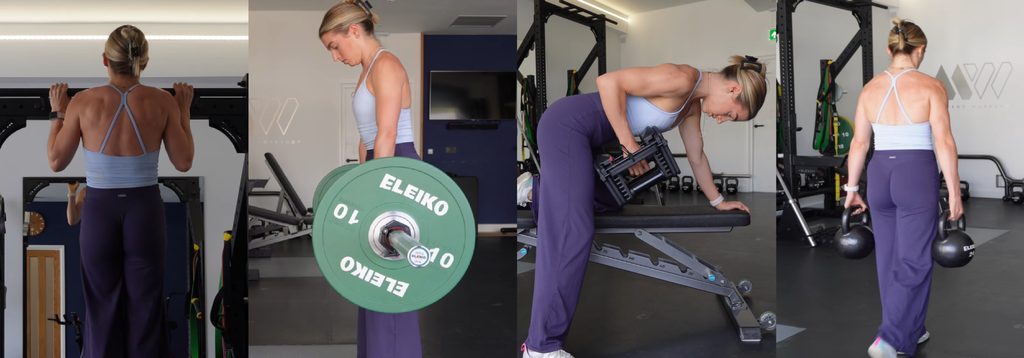
If your goal is to build a wider, stronger back, you have probably come across two exercises that seem to compete for the top spot: the pull up and the cable row. Both are staples of strength training programs, both develop the muscles of the upper body, and both have decades of practical success behind them.
For beginners, however, the choice is not always straightforward. Pull ups have a reputation as one of the best bodyweight exercises ever created, but they are also one of the hardest movements for new lifters to perform. Cable rows are much easier to learn, allow gradual progression, and help develop many of the same muscles, although in a different way. So which exercise is actually better for beginners who want to build a wider back?



The answer depends on your current strength, your movement quality, and your long term goals. Research on muscle activation, strength development, and hypertrophy suggests that both exercises deserve a place in a training program, but one clearly offers a better starting point for most beginners.
Understanding What Makes Your Back Look Wider
A wide back is largely created by the latissimus dorsi, commonly called the lats. These large muscles run from the lower spine and pelvis to the upper arm. When well developed, they create the familiar V taper that makes the shoulders appear broader and the waist look narrower.
The lats do much more than create an impressive physique. They play important roles in shoulder extension, adduction, and internal rotation while contributing to pulling strength during sports and daily activities.
Is The Larsen Press the Perfect Chest Exercise for Muscle Mass Gains?
Other muscles also contribute to back width and overall upper body development. These include the teres major, rhomboids, trapezius, posterior deltoids, and the biceps. While all of these muscles work together during pulling movements, different exercises emphasize them to different degrees.
Vertical pulling exercises such as pull ups generally place greater emphasis on the lats, while horizontal pulling exercises such as cable rows recruit more of the middle trapezius and rhomboids alongside the lats.

Because these muscles work together during most pulling tasks, training both movement patterns produces more balanced back development than relying on only one exercise.
What Makes the Pull Up So Effective?
The pull up requires you to lift your entire body until your chin clears the bar. This simple movement challenges multiple muscle groups simultaneously while demanding significant grip strength, shoulder stability, and core control. Unlike machine based exercises, pull ups require your body to move through space rather than moving an external object.
Muscle Activation During Pull Ups
Electromyography studies consistently show high activation of the latissimus dorsi during pull ups. The exercise also strongly recruits the biceps brachii, brachialis, lower trapezius, posterior deltoids, and forearm muscles.
Since your entire body is suspended from the bar, your core muscles work continuously to prevent excessive swinging and maintain proper alignment.
This combination of muscular demands explains why pull ups are often considered one of the best upper body compound exercises available.
Strength Benefits
Pull ups improve relative strength because the resistance comes from your own body weight. As you become stronger without gaining unnecessary body fat, the movement becomes easier while simultaneously improving athletic performance.
Research on multi joint resistance exercises shows they stimulate large amounts of muscle mass while improving coordination between muscle groups. Compound exercises like pull ups also produce greater overall strength adaptations than isolation exercises because they train movement patterns rather than individual muscles.
The Biggest Limitation for Beginners
Despite their benefits, pull ups present one major obstacle for beginners.
Many people simply cannot perform even one strict repetition.

Studies examining pull up performance have found that upper body strength relative to body weight is the strongest predictor of success. Beginners often lack sufficient pulling strength, making the exercise frustrating rather than productive.
Poor technique can also lead to excessive swinging, shoulder elevation, or incomplete range of motion, reducing effectiveness and increasing injury risk.
Why Cable Rows Are Beginner Friendly
Cable rows involve pulling a cable attachment toward your torso while sitting in a stable position. The exercise allows you to adjust resistance in very small increments, making progression straightforward.
Unlike pull ups, almost anyone can perform cable rows safely during their first workout.
Adjustable Resistance Makes Learning Easier
Progressive overload remains the most important principle for muscle growth. Cable machines allow beginners to increase weight gradually while maintaining proper technique. Instead of needing to lift an entire body weight, a novice can begin with a manageable load and steadily build strength.
This flexibility allows more repetitions with better movement quality, which is especially valuable during the early stages of training.
Muscle Recruitment
Cable rows effectively train the latissimus dorsi along with the rhomboids, middle trapezius, rear deltoids, and elbow flexors. The seated position minimizes balance demands, allowing beginners to focus on pulling mechanics and achieving a full range of motion.
Electromyography studies comparing rowing variations demonstrate consistently high activation across the major back muscles, particularly the middle back stabilizers that contribute to posture and shoulder health.
Lower Technical Demands
Cable rows require less coordination than pull ups.
Because your feet remain supported and the movement path is controlled, beginners can concentrate on squeezing the shoulder blades together and pulling with the back rather than relying excessively on the arms.
Learning these movement patterns carries over to more advanced exercises later.
Which Exercise Builds Wider Lats More Effectively?
This is where things become interesting. Vertical pulling movements generally produce greater emphasis on shoulder adduction, one of the primary functions of the latissimus dorsi. Pull ups therefore provide a particularly strong stimulus for the muscles responsible for creating back width.
However, muscle growth depends on much more than exercise selection. Training volume, proximity to failure, recovery, nutrition, and consistency all influence hypertrophy. A beginner who performs high quality cable rows twice each week with progressive overload will almost certainly gain more muscle than someone who struggles through a few poor quality pull up attempts.
Research comparing different resistance training exercises repeatedly shows that muscle growth occurs across a wide variety of movement patterns provided sufficient mechanical tension and training volume are achieved.
For beginners, the exercise they can perform well often becomes the exercise that delivers the greatest results.
Comparing Pull Ups and Cable Rows

Difficulty
The pull up is significantly more challenging because it requires lifting your full body weight. Cable rows can be adjusted to almost any strength level.
Progressive Overload
Cable rows make progression simple because resistance increases can be very small.
Pull ups become progressively harder unless assistance is used. Beginners may need resistance bands or assisted pull up machines before progressing to full bodyweight repetitions.
Muscle Growth Potential
Both exercises can stimulate substantial hypertrophy.
Pull ups may offer a slight advantage for lat emphasis due to the vertical pulling angle, while cable rows provide excellent stimulation of both the lats and middle back.
When total weekly training volume is matched, both movements contribute meaningfully to back development.
Technique
Cable rows are easier to learn correctly. Pull ups require greater shoulder mobility, grip strength, coordination, and body control. This makes cable rows the more practical starting point for most new lifters.
What Does Science Say About Exercise Selection?
Modern resistance training research increasingly suggests that no single exercise is inherently magical. Recent systematic reviews conclude that muscle hypertrophy can be achieved using a variety of exercises provided they train the target muscles through sufficient range of motion with adequate effort.
Variation in exercise selection may even improve long term development by exposing muscles to different loading patterns. Studies also demonstrate that beginners experience rapid neural adaptations during the first months of training. Learning movement quality often matters as much as lifting heavier weights.
Cable rows allow these motor learning adaptations to occur with relatively low technical difficulty. Once pulling strength improves, adding pull ups becomes much more productive.

Should Beginners Skip Pull Ups?
Absolutely not. Instead, beginners should view pull ups as a long term skill rather than an immediate strength test. Assisted pull ups, band assisted pull ups, eccentric pull ups, and lat pulldowns all help develop the strength required for future success.
Practicing these progressions alongside cable rows creates a balanced approach that develops both muscle and movement skill. Many experienced coaches recommend accumulating pulling volume through easier exercises while gradually introducing pull up practice several times each week. This strategy builds confidence while reducing frustration.
The Verdict
If the question is which exercise beginners should start with to build a wider back, the cable row is the better choice. It is easier to learn, allows precise progression, produces high activation across the major back muscles, and enables sufficient training volume without requiring advanced strength.
That does not make pull ups less valuable. In fact, pull ups remain one of the best long term goals for anyone interested in building an athletic physique and exceptional upper body strength. Once beginners develop enough pulling capacity through cable rows and other assisted variations, pull ups become an outstanding addition to their training.
The smartest approach is not to think of these exercises as competitors. Cable rows build the foundation. Pull ups showcase the strength that foundation creates. Together they provide a complete strategy for developing a wider, stronger, and more muscular back.
Key Takeaways
| Topic | Summary |
|---|---|
| Best beginner exercise | Cable rows are generally the better starting exercise because they are easier to learn and progressively overload. |
| Best for lat width | Pull ups place greater emphasis on the lats through vertical pulling and can contribute strongly to back width. |
| Muscle growth | Both exercises effectively build muscle when performed with sufficient effort and progressive overload. |
| Technical difficulty | Pull ups require significantly more strength, coordination, and body control than cable rows. |
| Long term approach | Beginners should master cable rows while progressively practicing assisted pull ups until they can perform strict bodyweight repetitions. |
| Best overall strategy | Include both horizontal and vertical pulling exercises to maximize balanced back development and long term strength. |
References
- American College of Sports Medicine. (2009). Progression models in resistance training for healthy adults. Medicine & Science in Sports & Exercise, 41(3), 687-708.
- Andersen, V., Fimland, M.S., Brennset, O., Haslestad, L.R., Lundteigen, M.S., Skalleberg, K. and Saeterbakken, A.H. (2014). Muscle activation and strength in squat and leg press at different relative loads. Journal of Strength and Conditioning Research, 28(12), 3423-3432.
- Gentil, P., Fisher, J. and Steele, J. (2017). A review of the acute effects and long term adaptations of single and multi joint exercises during resistance training. Sports Medicine, 47(5), 843-855.
- Grgic, J., Schoenfeld, B.J., Orazem, J. and Sabol, F. (2020). Effects of resistance training performed to repetition failure or non failure on muscular strength and hypertrophy. Journal of Sport and Health Science, 10(3), 275-291.
- Lehman, G.J., Buchan, D.D., Lundy, A., Myers, N. and Nalborczyk, A. (2004). Variations in muscle activation levels during traditional latissimus dorsi weight training exercises. Journal of Strength and Conditioning Research, 18(4), 703-709.
- Lusk, S.J., Hale, B.D. and Russell, D.M. (2010). Grip width and forearm orientation effects on muscle activity during the lat pull down. Journal of Strength and Conditioning Research, 24(7), 1895-1900.
- Schoenfeld, B.J. (2010). The mechanisms of muscle hypertrophy and their application to resistance training. Journal of Strength and Conditioning Research, 24(10), 2857-2872.