

Marathon training throws up plenty of decisions. Which plan to follow, how to fit long runs around work, what to wear when the weather can’t make its mind up. Fuelling deserves just as much thought, though it’s often the part that only gets properly nailed down in the last few weeks, once the bigger structural stuff (the plan, the mileage, the long runs) is already in place.
A good fuelling plan isn’t about finding some elaborate strategy. It’s a routine you’ve tested repeatedly until it feels almost boring, one that works with your stomach, rather than against it. Here’s how to build one.


Figure out roughly how long you’ll be out there
Your fuelling needs depend on time on your feet, not the fact that you’re covering 26.2 miles.
Someone finishing in three hours has a different race to someone still going at the five or six hour mark. Same distance, quite different demands on the body. The longer you’re out there, the more chances there are for energy to dip, thirst to creep up, or your stomach to get fussy about something it was fine with an hour earlier.
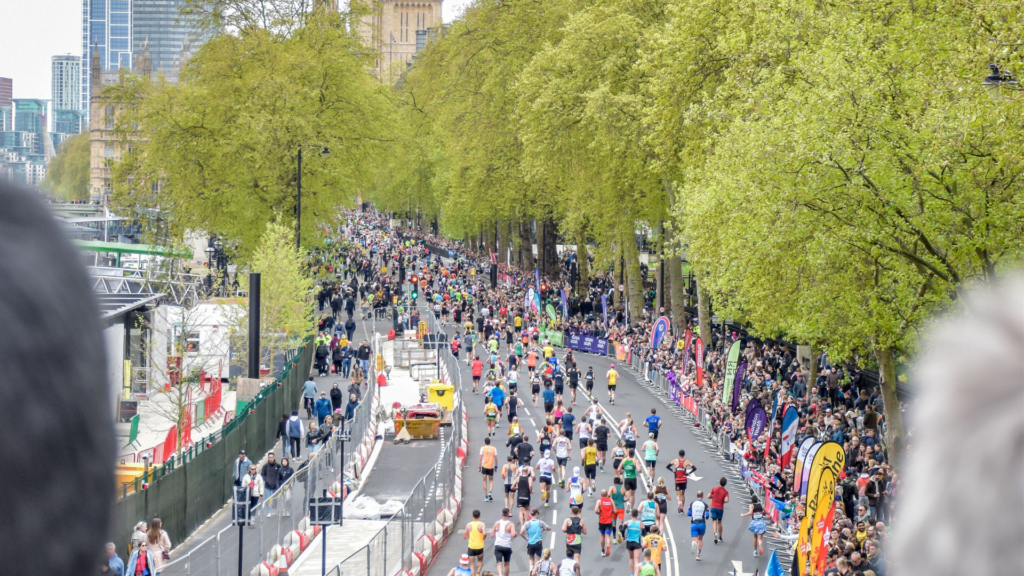
You don’t need a precise number here. Just use your long run pace to get a rough sense of whether you’re planning for three hours, four and a half, or considerably longer. That estimate shapes everything else, including roughly how many fuelling opportunities you’ll need and how much you’ll realistically have to carry.
Get real about your carbohydrate target
General sports nutrition advice often points to somewhere between 30 and 60 grams of carbs per hour, with some experienced runners going higher still. That figure is useful context, but it’s more of a long-term destination than a starting point for a first marathon.
Begin with whatever amount you already handle comfortably, even if it’s modest. If your stomach isn’t used to much during long runs, jumping straight to the top end of that range is a fast way to feel bloated or queasy rather than energised.

A few practical steps that help:
- Check the carbohydrate content of whatever you’re using, it’s usually printed clearly on the packaging
- Increase the amount gradually over several weeks rather than all at once
- Jot down roughly what you’re consuming each hour, nothing more than a quick note
You’re not trying to hit a perfect number by next week. You’re trying to find what your body can actually process without complaint.
Fuel by the clock, not the mile markers
Plenty of new marathoners plan to eat every five miles. It sounds sensible, but it tends to fall apart the moment your pace shifts, which it usually does at some point in a marathon.
Timing your fuel instead of distance gives you something far steadier to build around. A common approach is starting around the 30 or 40 minute mark, then repeating at set intervals from there. Whatever pattern you choose, keep it simple enough to remember without thinking, because after three hours of running, anything complicated tends to get abandoned.
It’s also worth not waiting until you feel completely drained before taking something on. By that point, eating can feel unappealing, and clawing your energy levels back is harder than simply staying ahead of the dip in the first place.
Weighing up your options for race day
There’s no single right way to fuel a marathon, and plenty of runners get round perfectly well on a mix of sports drinks, chews, real food, or whatever their stomach happens to tolerate. That said, it’s worth understanding why so many runners lean on sports gels specifically once they get into serious training.
Part of it is simply consistency. A gel is a fixed, known dose, so once you’ve found a flavour and brand that agrees with you, repeating that exact amount at exact intervals becomes second nature, rather than something you have to judge on the fly. They’re also compact and quick to get down, which matters more than it sounds when you’re breathing hard and don’t want to be chewing for the next mile. And because the carbohydrate content is printed clearly on the packet, tracking your hourly intake is far more straightforward than trying to estimate it from a flapjack or a banana.
None of that makes other options wrong. If you’ve built a routine around real food and it works for you, there’s little reason to change it two weeks before race day. But if you’re still figuring out your approach, gels are a sensible place to start experimenting, precisely because they remove a lot of the guesswork.
Test everything on your long runs
Your long runs are a dress rehearsal, not just a fitness session. Use them to trial the exact breakfast, timing, and fuel you’re considering for race day, and pay attention to how your stomach responds at different intensities. Something that sits fine on an easy jog might not agree with you at marathon pace.
It’s also worth ironing out the practical details while you’ve got the chance:
- Can you open a gel packet easily with cold or sweaty fingers?
- Does your belt or pocket bounce once it’s fully loaded?
- Do you know which pocket holds what, without having to check mid-stride?

These things feel trivial in week six of training and become genuinely irritating by mile 20. Keep a short log after each long run too, noting what you ate beforehand, what you took on during the run, how much you drank, and whether anything felt off. Patterns tend to show up faster than you’d expect.
Keep breakfast familiar
Race morning isn’t the moment to try something new. Stick with a carb-based breakfast you already know works, porridge, toast, cereal, a banana or a bagel, whatever you’ve relied on before long runs already. Be cautious with anything rich, fatty, spicy or high in fibre if those have ever caused problems.
Timing matters too. Some runners are comfortable eating two hours beforehand, others need longer, and early race starts can make this awkward. If eating early doesn’t sit well, a smaller breakfast paired with a planned snack closer to the start might feel more manageable, but test that combination on a long run first rather than discovering it doesn’t work on the day itself.
Plan your fluids separately
Hydration and carbohydrate intake are connected, but they’re not quite the same problem. Find out what’s actually available at the marathon’s aid stations, and where those stations fall on the course. Some races hand out cups, others use bottles, and carbohydrate drinks might only be on offer at a handful of stops rather than every one.
If you’re combining fluids with a gel, practise that on a training run beforehand. Walking briefly through an aid station is usually far more effective than trying to gulp from a cup at pace and ending up wearing most of it instead.
Prepare for the plan to become imperfect
Marathons rarely go exactly to plan. It might be warmer than expected, an aid station might be busier than you hoped, or you might drop something or find your usual flavour suddenly unappealing. Carrying a spare gel or two, if it’s practical, is a simple way to build in a buffer without much extra weight or hassle.
Most importantly, don’t panic if the timing slips by ten minutes. Just pick the plan back up rather than trying to make up for it all at once.
Your fuelling plan doesn’t need to be clever. It needs to be familiar and well-practised, so that by race morning you already know what you’re eating, when you’re taking it, and roughly how your body tends to respond. That’s what frees you up to focus on the parts of the day that actually stick with you: the crowds, the miles, and the moment the finish line finally comes into view.