

Diet. One of those words you hear on the 1st of January or, more commonly, on Mondays when someone attempts to turn their eating habits upside down in order to lose weight, gain muscle, or feel better overall. If you are thinking of losing weight, perhaps you should try the volumetrics diet.
The volumetrics diet was created by Barbara Rolls, a PhD. professor and chair of Nutritional Sciences at Pennsylvania State University, in the United States, where she heads the Laboratory for the Study of Human Ingestive Behavior.
In April 2012 she published a book called The Ultimate Volumetrics Diet: Smart, Simple, Science-Based Strategies for Losing Weight and Keeping It Off. The book is co-author by Mindy Hermann, a writer who specialises in collaborative projects on cooking, food, and nutrition with researchers, health professionals, and chefs.
Although a decade old, the diet has only recently become more known to the general public. It ranked 5th “Best Diets Overall” by U.S. News & World Report’s annual rankings, and 3rd “Best Fast Weight-Loss Diets.”
So, the question on everyone’s mind is: does it work? We talked with Justin Romaire, nutrition coach, founder and CEO of Consistency Breeds Growth to get a professional opinion about it. “It’s a great way to get people to lose weight,” he said.
Disclaimer: all content within this article is provided for general information only and should not be treated as a substitute for the medical advice of your own doctor or any other health care professional.
What Is The Volumetrics Diet?
The golden rule of the volumetrics diet is that you should eat larger portions of low-calorie foods and restrain from high-calorie foods. By doing this, Barbara Rolls explains, your body will feel fuller while ingesting fewer calories, thus helping with weight loss.
That means you should not feel hungry at all during the day if you adopt the volumetrics diet. At the end of the day, you will be consuming somewhere between 1,600 and 2,000 calories.
This diet does not focus solely on your nutrition, but also on your physical activity, as it encourages people to exercise 30 to 60 minutes every day.
Watch the extensive virtual conversation Barbara Rolls had at Penn State University earlier this year.
How Does It Work?
Every food is separated into four different categories:
- Category one: (very low density food) low-calorie foods, such as fruits, non-starchy vegetables, non-fat milk and broth-based soups.
- Category two: (low density food) starchy fruits and veggies, grains, whole grains, low-fat meat, breakfast cereal, legumes and low-fat dairy.
- Category three: (medium density food) meat, cheese, pizza, French fries, salad dressing, bread, ice cream, cake.
- Category four: (high density food) crackers, chips, chocolate candies, nuts, butter, oil, high-fat meats.
Category one should make the bulk of your daily meals with reasonable portions of category two foods. Foods that fall under category three should be consumed in moderation, while category four foods should be eaten only occasionally.
When it comes to exercise, the volumetrics diet encourages you to add 150 steps a day to your routine – most phones have a pedometer, or you can download an app for that. The first goal is to increase 1,000 steps daily by the end of the first week. The ultimate goal is to log in at least 10,000 steps every day.
Read More: Running for Beginners: A Guide to Building Confidence & Keeping Routine
The diet is flexible enough for vegetarians, vegans, and those who need to restrict salt and fat.
“My personal opinion,” Justin Romaire tells us, “is for weight loss, [the volumetrics diet] is a better approach than a restricted diet. When you get into restricting foods, that is not sustainable for people.”
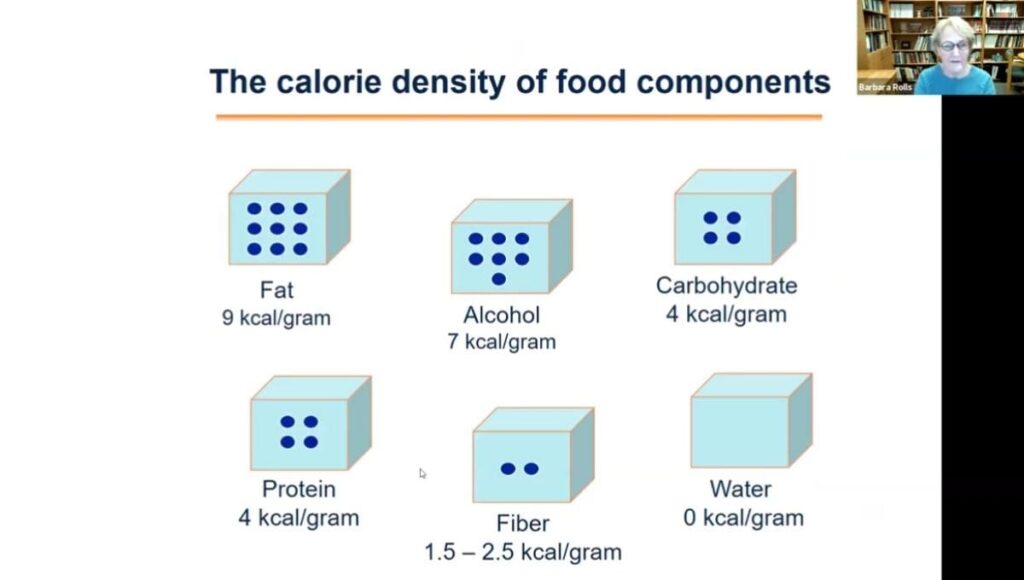
Barbara Rolls’ book can help you learn the calorie density of the foods you want to eat and they also provide a food density list for hundreds of foods that will help you prepare your next meal.
A good tip to keep in mind when going grocery shopping is to look for foods that are high in water content, as water has no calories. Think tomatoes, cucumber, grapefruit, zucchini, watermelon, broccoli, cauliflower and apples.
Sample Volumetrics Diet Meal Plan
In this diet, you are encouraged to have three meals, plus two snacks every day. It sounds a lot for a weight loss diet, but that is the whole point of the program, to make you feel full while eating fewer calories.
Breakfast
- Vegetable omelette with a side of whole-wheat toast
Morning snack
- Smoothie with skim milk, banana and berries
Lunch
- Homemade soup with chickpeas and vegetables; garden salad as a side dish
Afternoon snack
- Low-fat cottage cheese with apples and cinnamon
Dinner
- Baked cod with spiced vegetable couscous
Pros and Cons of the Volumetrics Diet
Now that you know what you should focus on eating in order to lose weight, according to the volumetrics diet, it is time to weigh in the pros and cons of it.
Pros
- Accessible and easy to shop – you do not need to go to a special vendor or local market to be able to buy ingredients and prepare your next meal that follows the volumetrics diet. Soups, casseroles, stews, fruit-based desserts will be the bulk of what you eat and you can get these in any supermarket.
- Flexible – if you enjoy cake, you can eat it, but know that it might force you to eat less calorie-dense food to keep your daily intake within your objective.
- Sustainable – as the volumetrics diet does not restrict any food, you can see it as a long-term lifestyle change, instead of just another diet before your wedding.
- It promotes exercises – unlike usual diets, this one tells you to do some form of exercise at least 30 minutes a day, which is doable and an added bonus to losing weight.
Cons
- Time-consuming – three meals and two snacks a day can take a while to cook, even if you do meal prep in advance. For those with limited free time on their schedule, this diet might be harder to follow.
- Healthy fats are reduced – nuts, seeds, oils. These are healthy fats, but are high in calorie and should be limited to rare occasional moments. Avocados, butter and whole eggs are also considered medium to high-calory foods, although they are incredibly rich in monounsaturated and polyunsaturated fats, which reduce chronic conditions like heart diseases.
- Only do it if you like soup, vegetables and fruits – if you do not enjoy any of these, then the volumetrics diet will be incredibly hard for you to follow, as it relies heavily on vegetables and legumes, which you could make soups, and fruits as snacks and dessert.
Volumetrics Diet Is Good If You Can Maintain It
Justin Romaire is not happy every time he hears the word “diet” as it usually implies a short-term solution to a long-term problem. According to him, the most difficult thing about following a diet is the aftermath.
“The problem is when people start to think about the concept of diet in a short time frame and not build the habits and things that they need, but rather that it’s just a means to an end for them losing weight. They have no game plan for after their diet.”
Is the volumetrics diet advisable then? Well, if you can stick to the plan, then yes. And eventually, you will not call it a diet any longer, but just your new eating habit.
“The volumetrics diet teaches people to pay more attention to calorie intake. It is like a learning curve for most people,” Justin concludes.