

Building wider shoulders does not require a long list of exercises. A focused routine can cover the three parts of the deltoid: the anterior head at the front, the middle head at the side, and the posterior head at the back. Together, these muscles help create the rounded look that makes the shoulders appear broader.
The three exercises in this plan are the overhead press, the lateral raise, and the reverse fly. Each trains the deltoids from a different direction. The overhead press emphasizes the front of the shoulders, the lateral raise directly trains the middle deltoid, and the reverse fly targets the rear deltoid. Pressing and raising movements also involve other muscles, so the goal is not to isolate each shoulder head completely. It is to give each one a useful training stimulus.



Research comparing shoulder exercises has found that presses and lateral raises recruit the deltoid portions differently. Electromyography research measures muscle activity during a movement, but it does not prove that one exercise produces more long term growth. The exercises below are practical choices because they train complementary shoulder actions and are straightforward to progress.
Why these three exercises work
The deltoid has three heads that contribute to different arm movements. The anterior head helps raise the arm forward and contributes to pressing. The middle head helps lift the arm out to the side. The posterior head helps move the arm backward and supports horizontal pulling movements.
A shoulder routine can miss part of the muscle if it relies only on pressing. Presses train the front deltoid, but a lateral raise gives the side deltoid direct work, while a reverse fly gives the rear deltoid a movement pattern that pressing does not provide. A study of trained men found that the shoulder press and lateral raise produced different activation patterns across the deltoid portions. That finding supports using more than one exercise, while keeping in mind that a single session measurement is not the same as a muscle growth study.
3 Best Exercises for Building the Posterior Chain Beginners Often Ignore
The word “wider” also needs a little context. Training can grow shoulder muscle, but it cannot change the width of your bones or where your muscles attach. Visible results depend on your overall frame, muscle growth, body fat, training history, and consistency. These exercises can help build the deltoids that contribute to a broader appearance, but they cannot guarantee a particular shape.
1. Overhead press
The overhead press is the main compound movement in this routine. You can perform it with dumbbells, a barbell, or a machine. Dumbbells allow each arm to move independently, while a machine may feel easier to control if you are new to the exercise. Choose the version that lets you train with a comfortable, repeatable range of motion.
How to perform it
Sit or stand with the weights near shoulder height. Keep your ribs stacked over your pelvis and brace your midsection so you do not lean back to finish the lift. Press the weights overhead in a controlled path, then lower them until your hands return near shoulder level. Use a range of motion you can manage without pain or major changes in posture.
Start with a load you can lift smoothly for 8 to 12 repetitions. Avoid turning the final repetitions into a backbend or using your legs to drive the weights upward. If standing makes it difficult to keep your torso steady, try the seated version. The purpose is to train your shoulders, not to see how much weight you can move with assistance from the rest of your body.
Why it belongs in the routine
The overhead press trains the front deltoid and also involves the triceps and other muscles that help move and stabilize the arm. It is useful for building pressing strength as well as shoulder muscle. But a press alone does not provide the same direct side shoulder work as a lateral raise, which is why the other two movements remain part of the plan.
If the overhead press causes sharp pain or a pinching sensation, stop and try a lighter load or a different variation. Persistent discomfort is a reason to consult a qualified health professional. Do not force a range of motion that feels painful just to complete the repetition.
2. Lateral raise
The lateral raise is the most direct choice of the three for training the middle deltoid. That muscle contributes to lifting the arm out to the side, making this exercise a natural fit for a routine focused on shoulder width. You can use dumbbells, cables, or a lateral raise machine.
How to perform it
Stand tall with a dumbbell in each hand and your arms relaxed by your sides. Keep a slight bend in your elbows and raise your arms out to the sides. Stop around shoulder height, or sooner if you cannot maintain control. Lower the weights slowly until your arms return to the starting position.
Use light enough weights that you do not need to swing your torso or shrug your shoulders to get the dumbbells moving. The exercise often feels harder than expected when performed with a controlled tempo. A modest load and clean repetitions are more useful than heavy weights that shift the work toward momentum.
How to make it productive
Keep your hands and elbows moving in a comfortable path instead of trying to force an exact angle. Some people find it comfortable to lift with their arms slightly forward of their torso, but individual comfort varies. A neutral hand position, with your thumbs pointing generally forward or slightly upward, is a reasonable starting point.
You do not need to raise the weights far above shoulder level to make the exercise effective. Use a range you can control without pain, and lower the weights under control. If dumbbells feel hardest only near the top, a cable or machine variation may provide a different resistance profile. Choose the version that feels comfortable and lets you progress over time.
3. Reverse fly
The reverse fly trains the rear deltoids through a horizontal arm movement. It can be performed with dumbbells while bent at the hips, on a reverse fly machine, or with cables. The machine is often easier to learn because it supports your body and reduces the need to hold a bent over position.
How to perform it
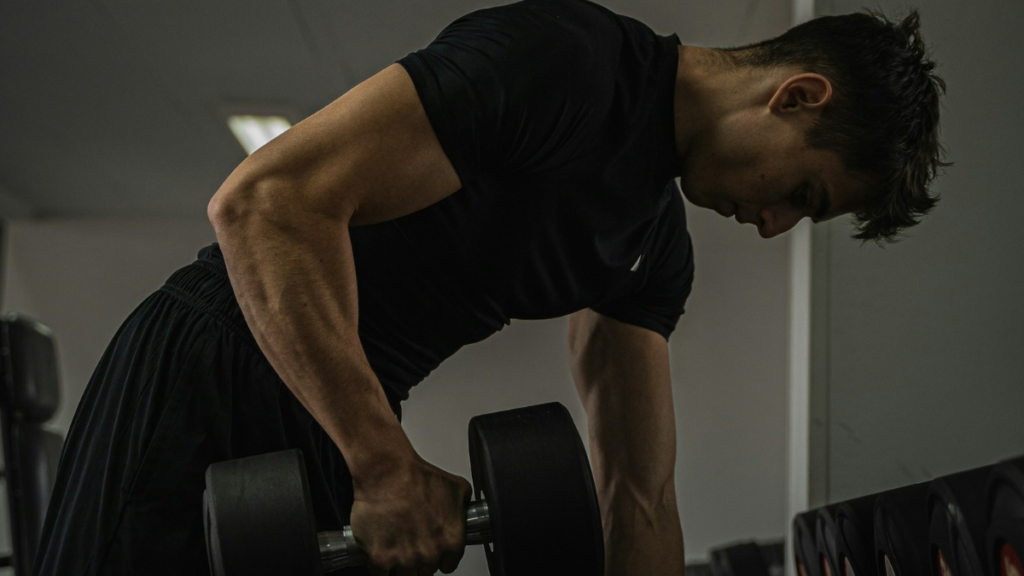
For a dumbbell version, hinge at your hips and let your arms hang beneath your shoulders, with a small bend in your elbows. Raise your arms out to the sides until they are roughly in line with your torso. Pause briefly, then lower the weights with control. Keep your neck relaxed and avoid turning the movement into a shrug.
Choose a light load at first. The goal is to move your upper arms while keeping your trunk steady, not to fling the weights upward. If maintaining the bent over position is uncomfortable, use a chest supported bench or reverse fly machine instead.
Why it completes the routine
The rear deltoid contributes to the back of the shoulder and is involved in moving the arm backward and outward. A pressing movement does not replace this pattern. The reverse fly adds direct rear shoulder work without requiring a heavy load. In a laboratory study, prone horizontal abduction, a movement similar to a reverse fly, produced substantial rear deltoid activity. This was an activation study, so it informs exercise selection without proving that the movement is uniquely best for growth.
How to put the three exercises together
For a simple shoulder session, perform the overhead press first, followed by the lateral raise and reverse fly. Start with 2 to 3 sets of each exercise. Use about 8 to 12 repetitions for the press and 10 to 20 repetitions for the raises and reverse fly. These ranges are practical starting points, not fixed rules. Research reviews suggest that muscle growth can occur across a range of loads when sets are sufficiently challenging, so choose weights you can control and progress.

Rest long enough between sets to maintain good technique. You may need 2 to 3 minutes after overhead presses and about 1 to 2 minutes after raises. If your repetitions drop sharply because you rush your rest, take more time. The quality of the next set matters more than keeping the workout short.
Most working sets should finish with a few good repetitions still possible, especially while you are learning the movements. As you become more experienced, you can take some sets closer to the point where you could not complete another repetition with good form. Current evidence does not show that every set needs to reach momentary failure to build muscle.
Progress gradually by adding repetitions, improving control, or increasing the load when you can complete the top end of your target range with sound technique. Keep a simple record of the weight and repetitions you use. If you train your shoulders more than once per week, spread the sets across those sessions and account for pressing work you already do for your chest. Bench presses also involve the front deltoid, so your total shoulder workload includes more than shoulder specific exercises.
What to expect
Shoulder width changes gradually. You may notice improved control and strength before you see a clear change in size. Give a consistent program time to work, and judge progress over several weeks rather than from one workout. Muscle growth also depends on recovery, sufficient food, and regular training. No single exercise can compensate for inconsistent sessions or a load that never becomes challenging.
These three movements offer a concise starting point: press overhead, raise the arms out to the sides, and train the rear deltoids with a reverse fly. They cover distinct shoulder actions without requiring a complicated workout. Use a comfortable range of motion, keep the repetitions controlled, and progress when your technique stays consistent.
Key Takeaways
| Area | Takeaway |
|---|---|
| Exercise selection | Use the overhead press, lateral raise, and reverse fly to train complementary shoulder movements. |
| Shoulder width | The lateral raise directly trains the middle deltoid, which contributes to the side profile of the shoulders. |
| Technique | Choose a manageable load and use a controlled range of motion that feels comfortable. |
| Programming | Begin with 2 to 3 sets per exercise and progress gradually as your form allows. |
| Effort | Sets should be challenging, but every set does not need to reach momentary failure. |
References
- Campos, Y.A.C., Vianna, J.M., Guimarães, M.P., Oliveira, J.L.D., Hernández-Mosqueira, C., da Silva, S.F. and Marchetti, P.H. (2020) ‘Different shoulder exercises affect the activation of deltoid portions in resistance-trained individuals’, Journal of Human Kinetics, 75, pp. 5–14.
- Refalo, M.C., Helms, E.R., Trexler, E.T., Hamilton, D.L. and Fyfe, J.J. (2023) ‘Influence of resistance training proximity-to-failure on skeletal muscle hypertrophy: A systematic review with meta-analysis’, Sports Medicine, 53(3), pp. 649–665.
- Reinold, M.M., Macrina, L.C., Wilk, K.E., Fleisig, G.S., Dun, S., Barrentine, S.W., Ellerbusch, M.T. and Andrews, J.R. (2007) ‘Electromyographic analysis of the supraspinatus and deltoid muscles during 3 common rehabilitation exercises’, Journal of Athletic Training, 42(4), pp. 464–469.
- Schoenfeld, B.J., Grgic, J., Ogborn, D. and Krieger, J.W. (2021) ‘Resistance training load effects on muscle hypertrophy and strength gain: Systematic review and network meta-analysis’, Medicine & Science in Sports & Exercise, 53(6), pp. 1206–1216.