

A thick back changes your physique from the side and from behind. It gives the torso more depth, makes the upper body look more powerful, and provides the muscular support needed for strong pulling, pressing, carrying, and lifting. While lat focused exercises are excellent for building a wider silhouette, a thicker back requires you to develop several muscles that sit across the middle and rear of the torso.
These include the middle and lower trapezius, rhomboids, spinal erectors, rear deltoids, and the deeper portions of the latissimus dorsi. Building these muscles requires movements that challenge you to pull weight toward your body, stabilize your spine, and control the shoulder blades through a meaningful range of motion.


Research consistently shows that resistance training can substantially increase muscle size and strength when exercises are performed with sufficient effort, volume, and progression. You do not need a complicated routine, but you do need to choose movements that allow you to train hard with good technique and gradually add repetitions, load, or sets over time.
The three exercises below are excellent choices for building a visibly thicker back in the gym. Together, they cover horizontal pulling strength, loaded hip hinging, and supported rowing volume, giving you a practical foundation for long term back development.
What Makes a Back Look Thick?
Back thickness is mainly created by muscles that add depth from front to back. The spinal erectors run alongside the spine and contribute heavily to the dense look of the lower and middle back. The middle trapezius and rhomboids sit between the shoulder blades and add thickness through the upper back. The lats also contribute, particularly when they are trained through rows that pull the upper arm behind the body.
This is why only doing pulldowns and pull ups can leave part of your back development undertrained. Vertical pulling movements are useful for the lats, but they do not always provide the same direct challenge to the muscles responsible for pulling the shoulder blades backward and holding the torso rigid under load.
Rows and hinge movements solve that problem. They train the upper back to create and maintain a strong shoulder blade position, while also forcing the spinal erectors to resist bending. Over time, this combination can develop the dense, layered appearance associated with a muscular back.
3 Best Dumbbell Exercises for Ripped and Powerful Lower Abs
Resistance training research supports the idea that muscle growth can occur across a broad range of loads when sets are performed with enough effort. This means you can build your back with moderate repetitions, heavier sets, or a mixture of both, provided your technique stays controlled and your training gradually becomes more demanding.
Exercise 1: Barbell Row
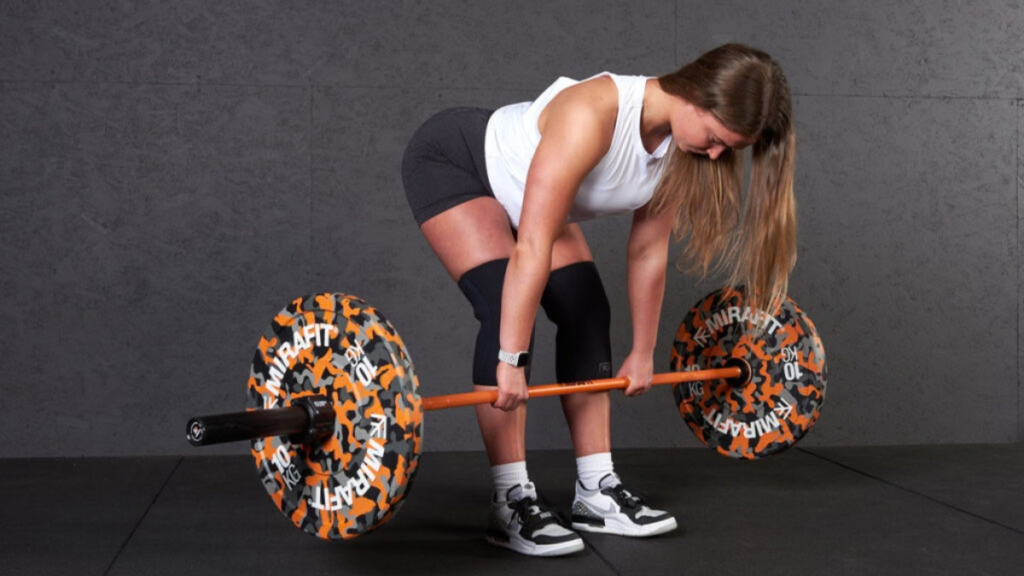
The barbell row is one of the most effective gym exercises for building back thickness because it combines heavy horizontal pulling with a demanding static hinge position. Your upper back must pull the bar toward your torso, while your spinal erectors, glutes, hamstrings, and trunk muscles work to keep your body stable.
Unlike a machine row, the barbell row requires you to control the entire body position. That is useful for lifters who want more than isolated muscle work. It develops a strong connection between the legs, hips, torso, and upper back, which can carry over to deadlifts, pull ups, loaded carries, and many other strength exercises.
How to Perform the Barbell Row
Stand with your feet around hip width apart and hold the bar with an overhand grip just outside your legs. Push your hips backward and bend your knees slightly until your torso is angled forward. Keep your chest proud, your spine neutral, and the bar close to your body.
Pull the bar toward your lower ribs or upper abdomen. Think about driving your elbows backward and bringing your shoulder blades toward each other as the bar reaches your torso. Pause briefly when your back is fully contracted, then lower the bar under control until your arms are straight.
Your torso angle should remain stable throughout the set. A small amount of natural movement is normal, especially with demanding weights, but the goal is not to turn the exercise into an explosive hip movement. If you have to stand upright to complete every repetition, the load is probably too heavy for the purpose of building muscle.
Why the Barbell Row Builds Thickness
Horizontal rowing exercises are especially valuable because they train scapular retraction. This is the action of drawing the shoulder blades back toward the spine. The middle trapezius and rhomboids are heavily involved in this movement, while the lats and rear deltoids assist as the elbows travel behind the torso.
The barbell row also creates a significant isometric demand on the spinal erectors. These muscles have to work continuously to resist spinal flexion while the barbell hangs in front of the body. This gives the movement an important advantage for lifters who want more lower back density as well as upper back development.
Aim for two to four working sets of six to 12 repetitions. Use a load that lets you maintain a stable torso and feel the back doing the work. As you become stronger, add repetitions first and then increase the weight in small amounts.
Exercise 2: Conventional Deadlift
The conventional deadlift is often discussed as a leg exercise, but it is also a major back builder. It trains the spinal erectors to produce and resist force, challenges the lats to keep the bar close to the body, and requires the upper back to maintain a strong position from the floor to lockout.
Deadlifts are not a replacement for rowing because they do not involve the same active pulling motion. However, they can add the dense lower and middle back development that many lifters struggle to achieve with machine work alone. They also build total body strength, which can help you handle heavier loads in rows, pull ups, and carries.
How to Perform the Conventional Deadlift
Stand with the bar positioned over the middle of your feet. Reach down and grip the bar just outside your legs. Bend your knees until your shins lightly touch the bar, then pull your chest upward while keeping your hips in a position that feels strong and balanced.
Before lifting, create tension by pulling the slack out of the bar and tightening your trunk. Push the floor away while keeping the bar close to your legs. Stand tall at the top without leaning backward, then return the bar to the floor by pushing your hips backward first and bending the knees once the bar reaches them.
The most important quality is control of the spine. Your back does not need to be perfectly vertical, but it should stay firm and stable rather than rounding under load. Start conservatively and earn heavier weights through consistent practice.
Why the Deadlift Builds Thickness
Research examining muscle activity during deadlift variations shows substantial involvement from the spinal erectors and other posterior chain muscles. The spinal erectors must work hard to maintain the position of the trunk, particularly when the bar is lifted from the floor with meaningful load.
The lats also have an important stabilizing role. They help keep the bar close to the body, reducing the tendency for the weight to drift forward. This means the deadlift trains the lats differently from a row or pulldown, but still contributes to a stronger and more muscular back.
For most people training primarily for muscle growth, one or two challenging deadlift sessions each week is enough. Three to five sets of three to eight repetitions can work very well. Keep the repetitions crisp, avoid grinding every set, and leave enough recovery capacity for your rows and other back exercises.
If conventional deadlifts irritate your lower back or you struggle to maintain good positions, trap bar deadlifts or Romanian deadlifts can be useful alternatives. The best variation is the one you can perform consistently, progressively, and with confidence.
Exercise 3: Chest Supported Dumbbell Row
The chest supported dumbbell row is an excellent companion to barbell rows and deadlifts because it allows you to train the upper back hard without your lower back becoming the limiting factor. By placing your chest against an incline bench, you reduce the amount of torso stabilization required and direct more attention toward the muscles that pull the arms and shoulder blades backward.
This exercise is especially useful after deadlifts or barbell rows, when your spinal erectors may already be fatigued. It also gives beginners a simpler way to learn how a productive row should feel. You can focus on moving the elbows, controlling the shoulder blades, and reaching a strong contraction without worrying as much about maintaining a bent over position.
How to Perform the Chest Supported Dumbbell Row
Set an adjustable bench to a low to moderate incline. Lie face down with your chest supported and hold a dumbbell in each hand. Start with your arms hanging naturally toward the floor, allowing your shoulder blades to move forward slightly without losing control of the position.
Pull the dumbbells toward the outside of your lower ribs. Keep your neck relaxed and your chest connected to the bench. As you row, drive your elbows backward and slightly outward, then squeeze the upper back without excessively shrugging toward your ears.
Lower the dumbbells slowly until your arms are straight again. This controlled lowering phase is important because muscle growth is supported by repeated exposure to meaningful mechanical tension throughout the range of motion.
Why the Chest Supported Row Builds Thickness
The chest supported dumbbell row is well suited to hypertrophy work because it is stable, easy to load progressively, and less likely to break down into momentum driven repetitions. You can train closer to muscular fatigue while keeping the target muscles under tension.
Using dumbbells also allows each arm to work independently. This can help reveal and gradually reduce side to side differences in pulling strength and control. The neutral grip position used by many lifters can also feel comfortable on the shoulders and elbows.
Use two to four sets of eight to 15 repetitions. Start each repetition from a controlled stretch and avoid rushing the lowering phase. If your upper traps take over, reduce the load slightly and focus on keeping the shoulders away from the ears as you row.
How to Program These Exercises for Back Growth
You do not need to perform all three exercises with maximum intensity in every workout. The deadlift is demanding, so it is usually best placed early in the session or on a separate lower body focused day. Barbell rows can then be trained on one or two upper body sessions, while chest supported rows can provide higher repetition volume without overloading the lower back.
A practical approach is to deadlift once per week, barbell row once or twice per week, and chest supported dumbbell row once or twice per week. This gives you frequent exposure to horizontal pulling while allowing enough recovery for your lower back and grip.
Weekly training volume matters for muscle growth. Research indicates that performing multiple hard sets per muscle group each week tends to produce greater hypertrophy than very low volume training. Your exact number of sets should depend on your experience, recovery, exercise selection, and the amount of other pulling work in your program.
For most gym goers, starting with around eight to 12 challenging sets per week across rows, deadlifts, pulldowns, and related back work is a sensible place to begin. Add more only when you are recovering well, your performance is stable, and you have a clear reason to increase volume.
Technique and Progression Matter More Than Variety
The best back program is not built around constantly changing exercises. It is built around mastering a few productive movements and making them gradually more challenging. Keep track of the weight, repetitions, and sets you complete. When you can reach the top of your target repetition range with strong technique, increase the load slightly.
Training close to muscular fatigue can be effective for growth, but it does not mean every set needs to end in a failed repetition. In compound exercises such as deadlifts and barbell rows, stopping with one or two good repetitions still available is often a smart way to maintain technique and recover for the next session.
Use a full range of motion that you can control. Pull the shoulder blades back during rows, allow the arms to extend on the way down, and do not rush the eccentric phase. The goal is to make the back muscles do the work instead of using momentum to move the weight.
A thicker back takes time, but the process is straightforward. Build your program around challenging rows, include a well performed hinge movement, train consistently, eat enough protein and calories to support your goal, and give your body enough sleep and recovery to adapt.
References
- Camara, K.D., Coburn, J.W., Dunnick, D.D., Brown, L.E., Galpin, A.J. and Costa, P.B., 2016. An examination of muscle activation and power characteristics while performing the deadlift exercise with straight and hexagonal barbells. Journal of Strength and Conditioning Research, 30(5), pp.1183 to 1188.
- Grgic, J., Schoenfeld, B.J., Davies, T.B., Lazinica, B., Krieger, J.W. and Pedisic, Z., 2018. Effect of resistance training frequency on gains in muscular strength: A systematic review and meta analysis. Sports Medicine, 48(5), pp.1207 to 1220.
- Krieger, J.W., 2010. Single versus multiple sets of resistance exercise for muscle hypertrophy: A meta analysis. Journal of Strength and Conditioning Research, 24(4), pp.1150 to 1159.
- Schoenfeld, B.J., Ogborn, D. and Krieger, J.W., 2017. Dose response relationship between weekly resistance training volume and increases in muscle mass: A systematic review and meta analysis. Journal of Sports Sciences, 35(11), pp.1073 to 1082.
- Schoenfeld, B.J., Peterson, M.D., Ogborn, D., Contreras, B. and Sonmez, G.T., 2015. Effects of low versus high load resistance training on muscle strength and hypertrophy in well trained men. Journal of Strength and Conditioning Research, 29(10), pp.2954 to 2963.
- Vigotsky, A.D., Halperin, I., Lehman, G.J., Trajano, G.S. and Vieira, T.M., 2018. Interpreting signal amplitudes in surface electromyography studies in sport and rehabilitation sciences. Frontiers in Physiology, 8, article 985.
Key Takeaways
| Exercise | Main back muscles emphasized | Best use in your program |
|---|---|---|
| Barbell row | Lats, middle trapezius, rhomboids, rear deltoids, spinal erectors | Build heavy horizontal pulling strength and overall back density |
| Conventional deadlift | Spinal erectors, lats, upper back stabilizers, glutes, hamstrings | Develop total body strength and a dense lower and middle back |
| Chest supported dumbbell row | Middle trapezius, rhomboids, lats, rear deltoids | Add controlled upper back volume without heavily fatiguing the lower back |