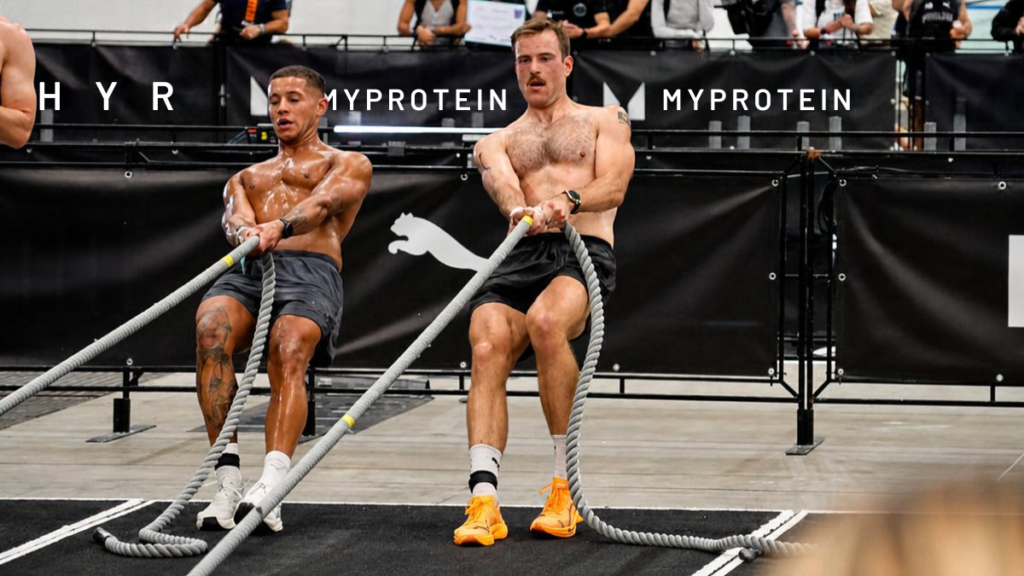
HYROX is simple to describe and very hard to do well. You run 1 km, complete one functional workout station, then repeat that pattern eight times for a total of eight running segments and eight stations.
The format is standardized across events, and there are different race categories (including individual and team formats) so everyday athletes can participate as well as high-level competitors.


That structure matters for mental health, because research is very clear on one big point: exercise improves mental health, and it does so across different ages, populations, and exercise styles. When you zoom in on what HYROX actually demands, it lines up unusually well with the kinds of exercise “ingredients” that show up again and again in mental health research.
First, there is strong aerobic work (running) mixed with hard efforts on machines and functional movements. That combination resembles “mixed” training approaches that include endurance and strength components, both of which are supported as helpful for depression and anxiety symptoms.

Second, HYROX has a built-in goals system. The race is the same sequence, so you can compare your time, split times, and station performance over months or seasons. From a psychology perspective, repeatedly working toward clear, measurable goals is one of the easiest ways to build the kind of confidence that protects your mental health over the long haul. Exercise interventions, in general, have been shown to improve perceived self-efficacy (your belief that you can do hard things and stick with plans).
Third, HYROX is naturally social. Many people train in clubs or with partners, and the event itself is spectator-friendly and includes team divisions. That matters because group and supervised exercise settings can amplify mental health improvements, and belonging to exercise groups can reduce loneliness and lower later depression symptoms.
The rest of this article breaks down the three Mental Health Benefits of HYROX that are most strongly supported by modern exercise science and psychology: improved depression and anxiety symptoms, better stress resilience and confidence, and stronger social connection.
What “mental health benefits” means in real research
When scientists study mental health benefits from exercise, they usually measure at least one of the following:
Depression symptoms (such as low mood, low motivation, and loss of interest), anxiety symptoms (such as persistent worry and tension), stress and perceived stress, and broader well-being or quality of life. Large syntheses of randomized trials consistently show that exercise reduces depression and anxiety symptoms, with meaningful average effects across many different groups of people.
Researchers also study protective factors that reduce your risk of feeling mentally unwell in the first place. These include sleep quality, stress regulation, self-efficacy, and social connection (including loneliness). HYROX training touches all of these, which is why the Mental Health Benefits of HYROX can be bigger than you might expect from a “fitness race.”
Benefit one: HYROX can reduce symptoms of depression and anxiety
If you only remember one thing from the science, make it this: exercise is one of the most consistently supported lifestyle interventions for lowering depression and anxiety symptoms.
A 2026 meta-meta-analysis (an umbrella review of meta-analyses) that pooled evidence across 79,551 participants found that exercise reduced depression symptoms and anxiety symptoms overall. It also found patterns that matter for HYROX athletes: aerobic exercise showed the strongest impact on both depression and anxiety, group and supervised exercise was linked to greater depression reductions, and lower-intensity, shorter-duration programs were most strongly associated with anxiety reduction.
That’s basically the HYROX blueprint: aerobic work (running) plus training environments that are often coached or group-based.
Now zoom in even further. A 2024 network meta-analysis in The BMJ included 218 randomized trials (14,170 participants) involving people meeting clinical cut-offs for major depression. It found moderate reductions in depression for walking or jogging, yoga, strength training, mixed aerobic exercise, and tai chi or qigong, and it reported that effects were proportional to the intensity prescribed. It also noted that strength training and yoga were among the most acceptable (better tolerated) modalities.
HYROX training tends to naturally include the “big winners” from that evidence base: walking/jogging/running, strength training, and mixed-mode conditioning.

Resistance training deserves its own spotlight, because HYROX forces you to become stronger, not just fitter. A major meta-analysis in JAMA Psychiatry concluded that resistance exercise training was associated with a significant reduction in depressive symptoms, with a moderate-sized effect across 33 randomized trials.
HYROX also nudges many people toward interval-style training. This matters, because high-intensity interval training (HIIT) has also been evaluated for mental health outcomes. A systematic review and meta-analysis in British Journal of Sports Medicine reported that HIIT led to moderate improvements in mental wellbeing, depression severity, and perceived stress compared with non-active controls.
And if you want something that looks very similar to HYROX-style classes, there is emerging evidence on high-intensity functional training (HIFT). In a 2025 experimental study, both high-intensity and moderate-intensity functional training sessions were associated with significant reductions in anxiety and stress immediately after the workout, with the high-intensity group showing more pronounced reductions.
Put all that together and you get a clear, evidence-based message: the mental health benefit is not based on HYROX being “magical.” It’s based on HYROX reliably pushing people into exercise types that science already supports for mood and anxiety.
Why HYROX training checks the boxes researchers study
HYROX has three mental-health-relevant training features that are easy to overlook:
It is running-heavy. HYROX includes 8 km of running in the race format, and practical preparation usually includes weekly running and aerobic conditioning.
It is strength-heavy. HYROX stations involve loaded carries, lunges, wall balls, sled work, and other strength-endurance tasks, so most athletes add strength training to improve performance and avoid getting crushed by the stations. Strength training is supported as helpful for depressive symptoms and is also one of the more “acceptable” exercise options in major depression trials, meaning many people can stick to it.
It is structured and repeatable. In depression and anxiety, motivation can be unpredictable. Having a highly structured training target (the same stations, the same order, the same overall event format) lowers decision fatigue and makes consistency easier. The biggest mental health effects of exercise require consistency over time, and structured formats help people keep showing up.
The “feel it today” mechanisms that make HYROX mentally uplifting
You do not need to know biology to benefit from HYROX, but it helps to understand why a hard workout can change your mood fast.
One pathway involves brain plasticity. In a randomized controlled trial in older adults, aerobic exercise training increased hippocampal size and improved memory, and the authors reported that increased hippocampal volume was associated with higher serum levels of brain-derived neurotrophic factor (BDNF), a molecule linked with neuroplasticity.
Another pathway involves the runner’s high and endocannabinoids. In a 2024 study of a 60-minute outdoor run, researchers found significant increases in mood alongside significant increases in the endocannabinoids anandamide (AEA) and 2-AG after the run.
HYROX is not a 60-minute steady outdoor run, but it does include repeated running plus sustained effort under fatigue. That’s a realistic recipe for the kind of chemistry shift that can make you feel calmer, more positive, and more “reset” after training.
Finally, sleep matters. Exercise has been shown to improve multiple aspects of sleep. A meta-analytic review found that both acute exercise and regular exercise had beneficial effects across several sleep outcomes, including sleep quality.
Sleep is not just “nice to have” for mental health. It is one of the foundations. If HYROX training makes you sleep better, that can indirectly amplify the Mental Health Benefits of HYROX even on days when your mood is shaky.
Benefit two: HYROX builds stress resilience and confidence you can feel
A lot of mental health content focuses on “reducing stress.” That is useful, but incomplete.
A better goal is stress resilience: the ability to experience stress, recover, and return to baseline without feeling emotionally wrecked for hours or days. HYROX training is a practical way to build that.
Why? Because HYROX is repeated exposure to controllable stress. You choose the training dose, you practice coping skills while your heart rate is high, and you gradually learn that you can handle discomfort without panicking.
This is not just a motivational idea. Research on stress reactivity suggests that higher physical activity and fitness can be linked with more favorable stress responses.
In a systematic review focused on the Trier Social Stress Test (a standard lab method to provoke psychosocial stress), higher physical activity or better fitness attenuated cortisol reactivity and heart rate reactivity in a substantial portion of included studies, and some studies also reported better mood responses in physically active or fitter participants.
Separately, a meta-analysis on physical activity and cortisol regulation found a small but meaningful association between higher physical activity and a steeper diurnal cortisol slope (often interpreted as healthier daily cortisol rhythm).
You do not need to measure your cortisol to benefit from this. The practical point is that regular training can influence how reactive your body feels under stress, and HYROX training is regular by design if you want to improve.
HYROX also builds confidence in a very specific way: through self-efficacy.
A systematic review and meta-analysis in European Journal of Integrative Medicine found that exercise training significantly improved perceived self-efficacy overall, with a moderate effect size.
That matters because self-efficacy is not just “feeling good.” It is a protective psychological resource that helps you cope with challenges, persist through setbacks, and stick to routines when life is chaotic. For mental health, those are survival skills.
From stress reactivity to self-efficacy: the science of “toughening up”
HYROX is a confidence builder because the feedback loop is so clear:
You train. You get a little better at running under fatigue. You learn to breathe through the sled push. You stop quitting wall balls early. You see the improvement in your sessions and in your race times.
That is the exact kind of “mastery experience” that builds self-efficacy, and the evidence shows exercise interventions can improve that kind of belief.

It is also important that HYROX performance is strongly linked to aerobic capacity in the limited HYROX-specific research we have so far. In the first scientific study focused directly on HYROX, researchers analyzed physiological responses and potential performance determinants during a simulated HYROX competition and highlighted the importance of endurance and aerobic capacity for performance, alongside the mixed demands of the format.
From a mental health angle, this is good news: aerobic work is consistently one of the strongest exercise categories for improving depression and anxiety symptoms in large evidence syntheses.
So even if you get into HYROX “for performance,” the same adaptations that make you faster are often the ones that make your brain feel calmer and more stable.
Benefit three: HYROX strengthens social connection and reduces loneliness
Loneliness and social disconnection are not just uncomfortable; they are strongly linked with mental health outcomes. The best “mental health plan” in the world is shaky if you feel isolated.
HYROX helps here in three ways:
It is built for spectators and shared experiences. HYROX races are hosted indoors in large venues, and the design allows spectators to support athletes throughout the event.
It includes team formats that encourage shared training. HYROX includes doubles and relay categories, which naturally push people into training with partners or groups.
It connects you to an identity-based community. In real life, people stick with demanding training when they feel they “belong” to something. That social identity element is central to long-term adherence, and adherence is central to long-term mental health benefit.
The science supports these ideas strongly.
A classic meta-analysis in PLOS Medicine found that stronger social relationships were associated with a meaningful survival advantage, and the authors argued that social relationships should be taken as seriously as other major health risk factors.
That is not a HYROX study, but it highlights how important connection is for the human system.
When we look specifically at exercise groups, the evidence becomes even more directly relevant. A 2021 study in Social Science & Medicine found that sport or exercise group membership predicted fewer depression symptoms several years later, and this relationship was explained partly by more physical activity and less loneliness.
On top of that, a systematic review of physical activity interventions and loneliness suggests that interventions often include social elements and that group exercise and social support-building components are frequently associated with improvements in loneliness alongside physical activity.
Now layer in one of the most practically useful findings from the big exercise-and-mental-health umbrella research: group and supervised exercise settings tend to show greater reductions in depression symptoms.
This is a huge deal for HYROX, because it is one of the fitness trends that naturally pushes many people into group training environments: affiliate gyms, HYROX-specific classes, coached sessions, and partner workouts.
Why the community element is not “extra,” it’s the multiplier
If you train alone, HYROX can still deliver powerful Mental Health Benefits of HYROX through aerobic work, strength training, and improved fitness.
But the “multiplier” often comes from the community.
When you have other people expecting you at a session, you are less likely to skip training when your mood drops.
When you share the suffering, the pain feels more manageable.
When your identity shifts from “I’m trying to work out” to “I’m a HYROX athlete,” consistency gets easier.
That is not just gym culture talk; it matches what research shows about group engagement, loneliness, and downstream depression symptoms.
How to get the Mental Health Benefits of HYROX without burning out
The Mental Health Benefits of HYROX come from doing the right amount of training consistently, not from doing the most training possible.
Here are evidence-based, athlete-friendly principles that keep the benefits while lowering the chance that stress, fatigue, or injury ruins your momentum.

Train in a way you can repeat. In the biggest evidence syntheses, many types of exercise help, but adherence is everything. A HYROX plan that you can do week after week is more mentally powerful than a “perfect” plan you quit after three weeks.
Use a mix of aerobic and strength work. That is already what HYROX requires, and both modalities have strong mental health support. If your mood is fragile, start with the easiest versions (run-walk intervals, lighter strength work, shorter sessions) and build gradually.
Prefer some sessions with other humans. If depression is the main issue, the evidence suggests group and supervised formats can produce bigger symptom reductions. That could be one coached HYROX session per week or a weekly partner workout.
Respect recovery as a mental health strategy. In a 2025 study profiling HYROX athletes, researchers noted that recovery strategies were often unstructured or insufficient in that sample and highlighted the need to pair preparation with better recovery. Even though that paper is not a mental health trial, the practical message is obvious: poor recovery increases fatigue, and fatigue makes mood worse.
Treat intense sessions as a tool, not a daily requirement. HIIT and high-intensity functional training can improve mental wellbeing, depression severity, and perceived stress, but you do not need to go hard every day to earn those benefits. Balance harder sessions with easier aerobic work and strength sessions that leave you feeling energized afterward.
If you’re dealing with severe depression or anxiety, use exercise as an add-on, not a replacement. Exercise can be comparable to traditional treatments in some analyses and is strongly supported as an effective intervention for symptoms, but severe mental health conditions often require professional support and a broader treatment plan. The research itself emphasizes comparing exercise with psychotherapy and antidepressants, not pretending exercise makes everything else unnecessary.
References
- Ahn, J., Falk, E.B. and Kang, Y. (2024) ‘Relationships between physical activity and loneliness: A systematic review of intervention studies’, Current Research in Behavioral Sciences, 6, 100141. doi:10.1016/j.crbeha.2023.100141.
- Brandt, T., Ebel, C., Lebahn, C. and Schmidt, A. (2025) ‘Acute physiological responses and performance determinants in Hyrox© – a new running-focused high intensity functional fitness trend’, Frontiers in Physiology, 16, 1519240. doi:10.3389/fphys.2025.1519240.
- Bull, F.C., Al-Ansari, S.S., Biddle, S. et al. (2020) ‘World Health Organization 2020 guidelines on physical activity and sedentary behaviour’, British Journal of Sports Medicine, 54(24), pp. 1451–1462. doi:10.1136/bjsports-2020-102955.
- Cruwys, T., Steffens, N.K., Haslam, S.A. et al. (2021) ‘Better together: How group-based physical activity protects against depression’, Social Science & Medicine, 286, 114337. doi:10.1016/j.socscimed.2021.114337.
- Gordon, B.R., McDowell, C.P., Hallgren, M. et al. (2018) ‘Association of efficacy of resistance exercise training with depressive symptoms: Meta-analysis and meta-regression analysis of randomized clinical trials’, JAMA Psychiatry, 75(6), pp. 566–576. doi:10.1001/jamapsychiatry.2018.0572.
- Holt-Lunstad, J., Smith, T.B. and Layton, J.B. (2010) ‘Social relationships and mortality risk: A meta-analytic review’, PLOS Medicine, 7(7), e1000316. doi:10.1371/journal.pmed.1000316.
- HYROX (n.d.) ‘The Fitness Race’.
- Kredlow, M.A., Capozzoli, M.C., Hearon, B.A., Calkins, A.W. and Otto, M.W. (2015) ‘The effects of physical activity on sleep: a meta-analytic review’, Journal of Behavioral Medicine, 38(3), pp. 427–449. doi:10.1007/s10865-015-9617-6.
- Martland, R., Korman, N., Firth, J., Vancampfort, D., Thompson, T. and Stubbs, B. (2022) ‘Can high-intensity interval training improve mental health outcomes in the general population and those with physical illnesses? A systematic review and meta-analysis’, British Journal of Sports Medicine, 56(5), pp. 279–291. doi:10.1136/bjsports-2021-103984.
- Moyers, S.A. and Hagger, M.S. (2023) ‘Physical activity and cortisol regulation: A meta-analysis’, Biological Psychology, 179, 108548. doi:10.1016/j.biopsycho.2023.108548.
- Mücke, M., Ludyga, S., Colledge, F. et al. (2018) ‘Influence of regular physical activity and fitness on stress reactivity as measured with the Trier Social Stress Test protocol: A systematic review’, Sports Medicine, 48, pp. 2607–2622. doi:10.1007/s40279-018-0979-0.
- Munro, N.R., Teague, S., Somoray, K. et al. (2026) ‘Effect of exercise on depression and anxiety symptoms: systematic umbrella review with meta-meta-analysis’, British Journal of Sports Medicine, 0, pp. 1–10. doi:10.1136/bjsports-2025-110301.
- Noetel, M., Sanders, T., Gallardo-Gómez, D. et al. (2024) ‘Effect of exercise for depression: Systematic review and network meta-analysis of randomised controlled trials’, BMJ, 384, e075847. doi:10.1136/bmj-2023-075847.
- Pearce, M., Garcia, L., Abbas, A. et al. (2022) ‘Association between physical activity and risk of depression: A systematic review and meta-analysis’, JAMA Psychiatry, 79(6), pp. 550–559. doi:10.1001/jamapsychiatry.2022.0609.
- Recchia, F., Leung, C.K., Chin, E.C. et al. (2022) ‘Comparative effectiveness of exercise, antidepressants and their combination in treating non-severe depression: A systematic review and network meta-analysis of randomised controlled trials’, British Journal of Sports Medicine, 56(23), pp. 1375–1380. doi:10.1136/bjsports-2022-105964.
- Trujillo-Gutiérrez, F.J., López-Aguilar, J., Álvarez-Salvago, F., Morente-Oria, H. and Jiménez-García, J.D. (2025) ‘Acute effects of a single-bout session of high-intensity functional training and moderate-intensity functional training on cognitive functions, anxiety, and stress in healthy adults’, Applied Sciences, 15(1), 439. doi:10.3390/app15010439.
- Villarroel López, P., Agudo-Ortega, A. and Juárez Santos-García, D. (2025) ‘Characterization of the profile of Hyrox© athletes’, Applied Sciences, 15(21), 11693. doi:10.3390/app152111693.
- Weiermair, T., Svehlikova, E., Boulgaropoulos, B., Magnes, C. and Eberl, A. (2024) ‘Investigating runner’s high: Changes in mood and endocannabinoid concentrations after a 60 min outdoor run considering sex, running frequency, and age’, Sports, 12(9), 232. doi:10.3390/sports12090232.
- Erickson, K.I., Voss, M.W., Prakash, R.S. et al. (2011) ‘Exercise training increases size of hippocampus and improves memory’, Proceedings of the National Academy of Sciences of the United States of America, 108(7), pp. 3017–3022. doi:10.1073/pnas.1015950108.