


Training your chest after 40 is not about “going easy.” It is about training intelligently. Muscle can still grow, strength can still increase, and athletic performance can still improve well into later decades of life when resistance training is applied correctly.
Research consistently shows that adults over 40 retain a strong capacity for hypertrophy, strength gains, and connective tissue adaptation when volume, intensity, and recovery are managed appropriately.


This article lays out five science-backed chest routines designed specifically for people over 40. Each routine addresses age-related changes such as slower recovery, joint stiffness, connective tissue health, and reduced anabolic signaling, while still providing enough mechanical tension and volume to stimulate muscle growth.

No hype. No trends. Just evidence-based programming that works.
How Aging Changes Chest Training (and Why It Still Works)
Muscle Growth Does Not Stop After 40
One of the most persistent myths in fitness is that muscle growth becomes impossible after 40. In reality, studies show that older adults experience robust hypertrophy when exposed to progressive resistance training. While anabolic signaling may be slightly blunted compared to younger individuals, the muscle tissue remains highly responsive to mechanical tension and volume.
Research comparing younger and older adults shows that both groups significantly increase muscle cross-sectional area after resistance training, even when the older group is well past middle age. The key difference is recovery time and tolerance to excessive volume.
Strength Training Protects Joints and Tendons
Chest training often gets blamed for shoulder pain, elbow discomfort, or nagging pec issues. In most cases, the problem is not pressing itself, but poor load management and lack of connective tissue adaptation.
Tendons respond positively to resistance training, increasing stiffness and load tolerance over time. This process takes longer than muscle growth, which means smart progression matters more after 40. Slow eccentrics, controlled tempo, and appropriate weekly volume improve tendon health and reduce injury risk.
Recovery Becomes the Limiting Factor
After 40, recovery capacity tends to decline due to changes in sleep quality, hormonal environment, and cumulative stress. This does not mean you should train less frequently or avoid intensity. It means volume distribution, rest days, and exercise selection become more important.

Evidence suggests that spreading volume across the week, using moderate rep ranges, and avoiding repeated training to failure improves long-term progress and reduces injury risk in older trainees.
Programming Principles Used in These Chest Routines
Before diving into the routines, it is important to understand the principles behind them. These are not random workouts. Each routine is built on well-supported training science.
Moderate to High Mechanical Tension
Mechanical tension is the primary driver of hypertrophy. Moderate to heavy loads, typically between 60 and 85 percent of one-repetition maximum, provide sufficient tension for muscle growth when taken close to failure.
Sufficient Weekly Volume
Most research indicates that 10 to 20 working sets per muscle group per week is effective for hypertrophy. For people over 40, the lower to middle end of this range tends to be more sustainable.
Controlled Tempo and Full Range of Motion
Slower eccentric phases and full ranges of motion improve muscle activation, joint health, and connective tissue adaptation. This is especially relevant for chest training, where shoulder mechanics matter.
Individualized Exercise Selection
Barbells, dumbbells, machines, and cables all have a place. The best option is the one that allows pain-free loading and progressive overload.
Routine 1: Joint-Friendly Hypertrophy Chest Routine
This routine prioritizes muscle growth while minimizing joint stress. It is ideal for people who still want size gains but need to protect shoulders and elbows.
Structure and Frequency
Train chest twice per week with at least 72 hours between sessions.
Exercise Selection and Rationale
Dumbbells and machines allow for natural movement patterns and reduce joint strain compared to fixed barbell paths. Studies show similar hypertrophy outcomes between free weights and machines when volume and intensity are matched.
Workout A
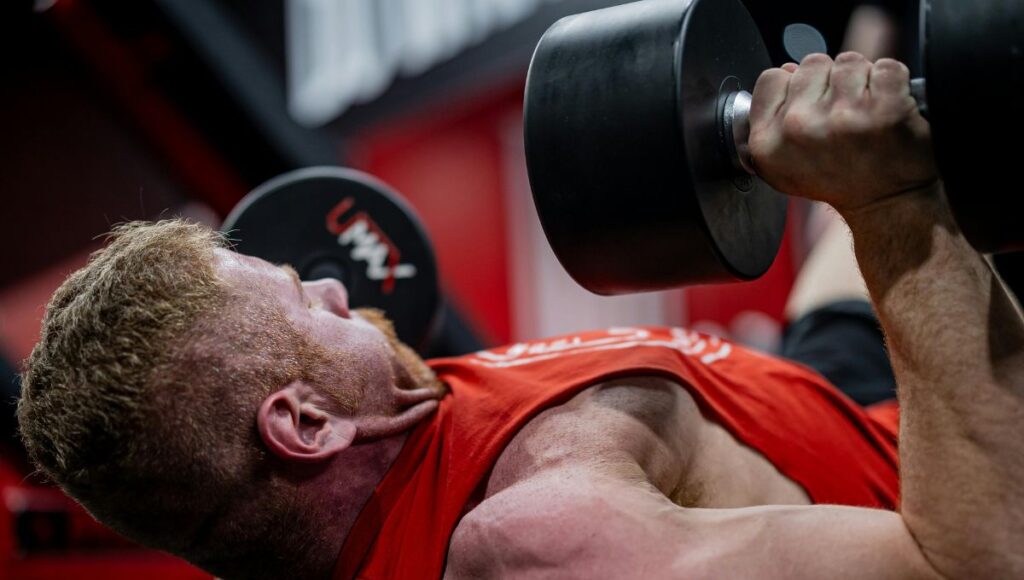
Flat dumbbell bench press
4 sets of 6–10 reps
Rest 2–3 minutes
Incline dumbbell press
3 sets of 8–12 reps
Rest 2 minutes
Machine chest press
3 sets of 10–12 reps
Rest 90 seconds
Cable fly (mid to low angle)
3 sets of 12–15 reps
Rest 60–90 seconds
Workout B
Low-incline machine press
4 sets of 8–10 reps
Rest 2 minutes
Neutral-grip dumbbell press
3 sets of 8–12 reps
Rest 2 minutes
Pec deck or cable fly
3 sets of 12–15 reps
Rest 60–90 seconds
Push-up with controlled tempo
2–3 sets close to technical failure
Why This Works After 40
Research shows that higher-repetition accessory work increases metabolic stress, which complements mechanical tension for hypertrophy. The combination of moderate loads and controlled tempo reduces joint stress while still producing growth.
Routine 2: Strength-Focused Chest Routine for Aging Lifters
Strength matters more as you age. Higher strength levels are associated with improved functional capacity, bone density, and reduced injury risk.
Structure and Frequency
Train chest once per week with higher intensity and lower total volume.
Exercise Selection and Rationale
Compound lifts with longer rest periods allow for greater force production. Studies show that heavy resistance training is safe and effective in older adults when properly supervised and progressed.
Main Workout
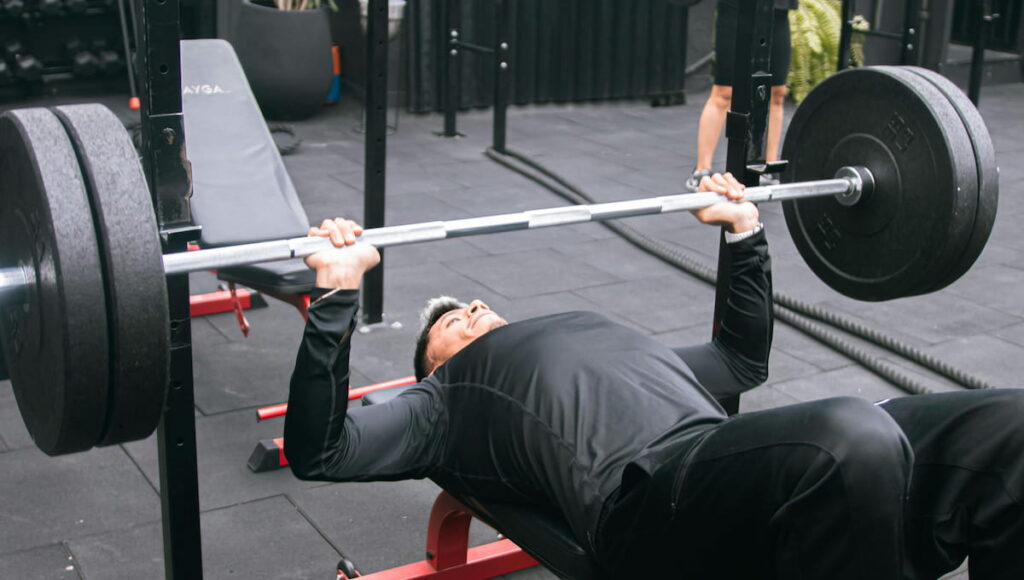
Barbell bench press
5 sets of 3–5 reps
Rest 3–4 minutes
Paused bench press
3 sets of 4–6 reps
Rest 3 minutes
Incline dumbbell press
3 sets of 6–8 reps
Rest 2–3 minutes
Weighted dip (or assisted dip)
3 sets of 6–10 reps
Rest 2 minutes
Optional cable fly finisher
2 sets of 12–15 reps
Why This Works After 40
Heavy resistance training improves neuromuscular efficiency and preserves fast-twitch muscle fibers, which tend to decline with age. Research shows that older adults can safely lift heavy loads and gain significant strength when volume is controlled.
Routine 3: High-Frequency, Low-Stress Chest Routine
This routine spreads volume across the week to reduce soreness and improve recovery.
Structure and Frequency
Train chest three times per week with low per-session volume.
Exercise Selection and Rationale
Shorter, more frequent sessions reduce muscle damage while maintaining total weekly volume. This approach has been shown to be effective for hypertrophy when recovery is a concern.
Day 1
Flat machine press
3 sets of 8–10 reps
Cable fly
3 sets of 12–15 reps
Day 2
Incline dumbbell press
3 sets of 8–10 reps
Push-ups
3 sets close to failure
Day 3
Smith machine bench press
3 sets of 6–8 reps
Pec deck
3 sets of 12–15 reps
Why This Works After 40
Studies comparing training frequencies show that spreading volume across multiple sessions improves recovery and adherence, particularly in older populations. Lower muscle soreness allows for more consistent training.
Routine 4: Minimalist Chest Routine for Busy Schedules
This routine is designed for people who want results without spending hours in the gym.
Structure and Frequency
Train chest once or twice per week.
Exercise Selection and Rationale
Research shows that a small number of compound movements performed with sufficient intensity can produce meaningful hypertrophy.
Workout
Barbell or machine bench press
4 sets of 6–8 reps
Incline dumbbell press
3 sets of 8–10 reps
Cable or dumbbell fly
3 sets of 12–15 reps
Optional push-up burnout
1–2 sets
Why This Works After 40
Consistency matters more than complexity. Studies show that even low-volume resistance training improves muscle mass and strength in older adults when performed consistently.
Routine 5: Chest Routine for Shoulder Longevity
This routine emphasizes shoulder-friendly pressing angles and balanced development.
Structure and Frequency
Train chest twice per week.
Exercise Selection and Rationale
Neutral grips, slight inclines, and controlled tempo reduce shoulder stress. Research indicates that shoulder-friendly pressing reduces impingement risk.
Workout A
Neutral-grip dumbbell press
4 sets of 8–10 reps
Low-incline press
3 sets of 8–12 reps
Cable fly (scapular control)
3 sets of 12–15 reps
Workout B
Landmine press
4 sets of 6–10 reps
Machine chest press
3 sets of 10–12 reps
Slow tempo push-ups
3 sets
Why This Works After 40
Improved scapular control and reduced shoulder stress allow for long-term training consistency, which is the most important factor for progress over time.
Recovery, Nutrition, and Progression After 40

Recovery Matters More Than Motivation
Sleep quality, stress management, and rest days are strongly linked to strength and hypertrophy outcomes. Poor recovery increases injury risk and stalls progress.
Protein Intake Is Critical
Research suggests that older adults may require higher protein intake per meal to maximize muscle protein synthesis. Aim for evenly distributed protein intake across the day.
Progression Should Be Slow and Intentional
Small load increases, additional reps, or improved technique count as progress. Research shows that gradual progression reduces injury risk while still driving adaptation.
References
- American Journal of Physiology-Endocrinology and Metabolism, Phillips, S.M. et al. (2012). Resistance training-induced increases in muscle mass and strength in older adults.
- Journal of Strength and Conditioning Research, Peterson, M.D. et al. (2010). Resistance exercise for muscular strength in older adults.
- Sports Medicine, Schoenfeld, B.J. (2010). The mechanisms of muscle hypertrophy and their application to resistance training.
- Medicine & Science in Sports & Exercise, Franchi, M.V. et al. (2017). Muscle and tendon adaptations to resistance training.
- Journal of Applied Physiology, Kumar, V. et al. (2009). Age-related differences in muscle protein synthesis.
- European Journal of Applied Physiology, Wernbom, M. et al. (2007). The influence of frequency, intensity, volume, and mode of strength training.
- Sports Health, Escamilla, R.F. et al. (2010). Shoulder biomechanics during pressing exercises.