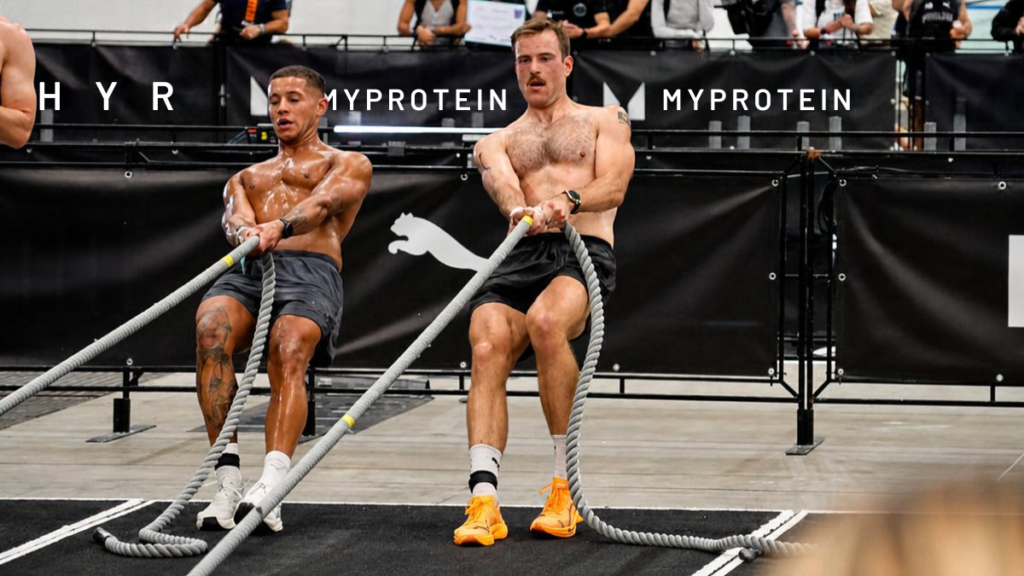


The sled push is one of the most physically demanding elements of a HYROX race. It taxes muscular strength, anaerobic power, aerobic capacity, coordination, and mental resilience all at once. Many athletes lose disproportionate amounts of energy during this station, which then compromises performance for the remainder of the race.
Preserving energy during sled pushes is not about going slower. It is about moving more efficiently, recruiting the right muscles, managing fatigue, and minimizing unnecessary physiological cost.


This article breaks down the sled push from a scientific perspective and translates the evidence into practical, race-ready strategies. Every recommendation is grounded in peer-reviewed research from biomechanics, exercise physiology, and strength and conditioning literature. The goal is simple: help you complete the sled push with the least possible energy expenditure while maintaining competitive speed.
Understanding the Physiological Cost of the HYROX Sled Push

The Metabolic Demands of Heavy Sled Pushing
Heavy sled pushing is classified as a high-force, low-velocity movement. Studies examining resisted sprinting and sled pushing show that the metabolic cost increases non-linearly as load increases, even when movement speed decreases (Cross et al., 2017). This means that heavier sleds do not just slow you down; they disproportionately increase energy expenditure.
Research using oxygen uptake and blood lactate measurements has demonstrated that heavy sled pushes elicit rapid rises in lactate concentration, often exceeding 10 mmol/L, indicating a strong reliance on anaerobic glycolysis (Martinez-Valencia et al., 2015). This is problematic in a HYROX race because elevated lactate levels are associated with reduced force production and impaired endurance performance in subsequent tasks (Brooks, 2018).
Preserving energy during the sled push therefore requires strategies that reduce unnecessary anaerobic contribution while maintaining force output.
Neuromuscular Fatigue and Its Carryover Effects
Neuromuscular fatigue refers to the reduction in muscle force production caused by both central (nervous system) and peripheral (muscle-level) factors. Heavy sled pushing creates significant peripheral fatigue in the quadriceps, gluteals, and plantar flexors due to high mechanical tension and prolonged time under load.
Research shows that high levels of peripheral fatigue can impair movement economy and muscle recruitment patterns in subsequent endurance activities (Enoka and Duchateau, 2016). In HYROX, this often shows up as compromised running mechanics, slower wall balls, or early failure in lunges.
Energy preservation during the sled push is therefore not just about the sled itself, but about protecting neuromuscular function for the rest of the race.
Optimal Body Positioning for Energy Efficiency
Trunk Angle and Force Transmission
One of the most consistent findings in sled biomechanics research is the importance of trunk angle. A forward-leaning torso allows force to be directed horizontally into the sled rather than vertically into the ground.
Morin et al. (2015) demonstrated that horizontal force production is a key determinant of resisted sprint performance. Athletes who maintained a trunk angle between 45 and 60 degrees relative to the ground produced higher horizontal force with lower metabolic cost.
Excessive forward lean, however, increases spinal loading and reduces hip extension contribution, shifting work toward the lower back and quadriceps. This increases perceived exertion and energy cost (Escamilla et al., 2002).

The optimal position is a rigid, neutral spine with a controlled forward lean that allows force to transfer efficiently from the hips through the arms into the sled.
Arm Position and Upper Body Contribution
Many athletes underestimate the role of the upper body during sled pushes. While the legs provide the primary propulsion, the arms act as force transmitters and stabilizers.
Electromyography studies show significant activation of the triceps, deltoids, and pectoralis major during heavy sled pushing (Andersen et al., 2016). Locking the elbows or letting them collapse increases energy leakage and reduces force transfer efficiency.
A slight bend in the elbows, with shoulders packed and wrists neutral, allows isometric upper body contraction. Isometric contractions have a lower metabolic cost than repeated concentric actions, especially at submaximal joint angles (Oranchuk et al., 2019).
This positioning reduces unnecessary upper-body fatigue while maintaining sled velocity.
Stride Mechanics That Reduce Energy Waste
Shorter Steps and Ground Contact Time
Long, bounding strides may feel powerful, but they are metabolically expensive during heavy sled pushes. Research on resisted locomotion consistently shows that shorter step lengths with higher cadence reduce braking forces and energy loss (Alcaraz et al., 2009).
When step length increases under load, ground contact time increases and vertical oscillation rises. Vertical movement does not contribute to sled displacement but still costs energy.
Short, powerful steps keep the center of mass low and maintain continuous horizontal force application. This reduces peak muscular force requirements per step, which in turn lowers metabolic demand (Kram and Taylor, 1990).
Foot Strike and Ankle Stiffness
Foot strike pattern also influences energy efficiency. A midfoot or slightly forefoot strike allows better use of the ankle’s elastic properties while maintaining stability under load.
Studies on ankle stiffness show that increased stiffness improves force transmission and reduces energy loss during resisted locomotion (Hobara et al., 2010). Excessive heel striking increases braking forces and places greater demand on the quadriceps, accelerating fatigue.
Maintaining active ankle stiffness through dorsiflexion control and strong plantar flexor engagement helps preserve energy and maintain sled momentum.
Breathing Strategies to Control Fatigue
Avoiding the Valsalva Trap
Many athletes instinctively hold their breath during heavy sled pushes. While brief breath holding can increase trunk stiffness and force output, prolonged Valsalva maneuvers significantly elevate blood pressure and accelerate fatigue (MacDougall et al., 1985).
Sustained breath holding reduces oxygen delivery to working muscles and increases reliance on anaerobic metabolism. This leads to faster lactate accumulation and earlier performance decline.
A controlled breathing strategy that emphasizes rhythmic exhalation during each step or every second step has been shown to reduce perceived exertion without compromising force output (Brown et al., 2013).
Coordinating Breathing With Movement
Coordinating breathing with movement, often referred to as locomotor-respiratory coupling, improves efficiency in cyclic tasks. While sled pushing is not fully cyclic, research suggests that synchronized breathing patterns reduce oxygen cost during loaded locomotion (Bechbache and Duffin, 1977).
Exhaling during the exertion phase of each push helps maintain trunk stability while allowing continuous oxygen intake. This balances force production with metabolic efficiency.
Load Management and Pacing Within the Sled Push
The Cost of Starting Too Fast
Going all-out from the first meter of the sled push is one of the most common energy-wasting mistakes. Physiological studies on high-intensity efforts show that aggressive starts dramatically increase anaerobic contribution and accelerate phosphocreatine depletion (Bogdanis et al., 1996).
Once phosphocreatine stores are depleted, force output drops and reliance on glycolysis increases, leading to rapid fatigue. This is especially problematic in HYROX, where recovery time is limited.
Starting at a controlled but assertive pace allows force production to stabilize and reduces early metabolic spikes.
Steady Force Output Over Variable Speed
Energy efficiency is improved when force output remains relatively constant, even if speed fluctuates slightly. Research on pacing strategies shows that even pacing reduces overall energy cost and improves task completion time in high-intensity efforts (Abbiss and Laursen, 2008).
Instead of surging and slowing, aim for consistent pressure into the sled. Minor speed reductions are preferable to force drop-offs, as re-accelerating a heavy sled costs significant energy.
Muscle Recruitment Patterns That Save Energy
Prioritizing Hip Extension Over Knee Dominance
The gluteus maximus is one of the most powerful and fatigue-resistant muscles in the body. Shifting sled push mechanics toward hip extension rather than knee extension reduces quadriceps overload and preserves energy.
Biomechanical analyses show that greater hip contribution reduces knee joint stress and distributes load more evenly across large muscle groups (McCurdy et al., 2010). Larger muscles with higher oxidative capacity are better suited for sustained force production.
Cues such as “push the ground back” or “drive the hips through” help reinforce glute-dominant mechanics.
Reducing Unnecessary Muscle Co-Contraction
Excessive muscle co-contraction, particularly around the knee and ankle, increases energy cost without contributing to propulsion. Studies using electromyography demonstrate that trained athletes exhibit lower antagonist co-activation, improving efficiency (Carolan and Cafarelli, 1992).
Relaxing non-essential muscles, such as the hands and neck, while maintaining necessary tension in the trunk and hips reduces overall energy expenditure.
The Role of Strength Training in Energy Preservation
Maximal Strength Lowers Relative Effort
One of the strongest predictors of sled push efficiency is maximal lower-body strength. When absolute strength increases, the relative intensity of the sled load decreases.
Research shows that athletes with higher maximal strength exhibit lower oxygen consumption and lactate production at a given submaximal workload (Hoff et al., 2002). In practical terms, stronger athletes push the same sled with less physiological strain.
Improving squat, deadlift, and hip thrust strength reduces the metabolic cost of sled pushes during competition.
Isometric Strength and Force Transfer
Isometric strength, particularly in the trunk and shoulders, plays a critical role in force transfer. Isometric contractions are more energy efficient than dynamic contractions at similar force levels (Oranchuk et al., 2019).
Training isometric holds in sled-specific positions improves stiffness and reduces energy leakage, allowing more force to reach the sled.
Technical Practice and Motor Learning
Skill Reduces Energy Cost
Movement efficiency improves with practice due to neural adaptations that reduce unnecessary muscle activation. Research on motor learning shows that skilled performers use fewer motor units to achieve the same task, lowering energy expenditure (Latash, 2012).
Practicing sled pushes at competition loads improves coordination, timing, and force application. This reduces wasted movement and improves economy on race day.
Variability Training for Robust Efficiency
Training with slight variations in load, surface, and handle height improves adaptability. Studies show that variable practice enhances motor learning and performance transfer under novel conditions (Schmidt and Lee, 2011).
This is particularly relevant in HYROX, where sled friction can vary between venues.
Nutrition and Energy Availability

Carbohydrate Availability and High-Force Output
Heavy sled pushing relies heavily on carbohydrate metabolism. Glycogen depletion reduces force production and increases perceived exertion (Bergström et al., 1967).
Ensuring adequate carbohydrate intake before the race supports anaerobic and aerobic energy systems, reducing early fatigue during sled pushes.
Caffeine and Neuromuscular Efficiency
Caffeine has been shown to improve force production and reduce perceived exertion during high-intensity exercise (Grgic et al., 2019). By enhancing motor unit recruitment and central drive, caffeine can improve sled push efficiency.
However, excessive doses may increase heart rate and anxiety, potentially increasing energy cost. Moderate dosing is supported by the literature.
Psychological Factors and Energy Conservation
Perceived Effort and Movement Economy
Perceived effort influences movement patterns. When athletes perceive a task as excessively hard, they often adopt inefficient mechanics.
Studies show that lowering perceived exertion through familiarity and confidence improves movement economy and performance (Marcora, 2009). Mental rehearsal and race-specific preparation can therefore indirectly preserve energy during sled pushes.
Focused Attention vs Over-Tension
Excessive cognitive stress increases muscle tension and energy expenditure. Research in sports psychology suggests that external focus cues improve efficiency compared to internal focus cues (Wulf et al., 2010).
Focusing on moving the sled rather than individual body parts promotes smoother, more economical movement.
References
- Abbiss, C.R. and Laursen, P.B. (2008) Describing and understanding pacing strategies during athletic competition. Sports Medicine, 38(3), pp.239–252.
- Alcaraz, P.E., Palao, J.M. and Elvira, J.L. (2009) Determining the optimal load for resisted sprint training with sled towing. Journal of Strength and Conditioning Research, 23(2), pp.480–485.
- Andersen, V., Fimland, M.S., Mo, D.A. and Iversen, V.M. (2016) Electromyographic comparison of barbell deadlift, hex bar deadlift, and hip thrust exercises. Journal of Strength and Conditioning Research, 32(3), pp.841–851.
- Bechbache, R.R. and Duffin, J. (1977) The entrainment of breathing frequency by exercise rhythm. Journal of Physiology, 272(3), pp.553–561.
- Bergström, J., Hermansen, L., Hultman, E. and Saltin, B. (1967) Diet, muscle glycogen and physical performance. Acta Physiologica Scandinavica, 71(2–3), pp.140–150.
- Bogdanis, G.C., Nevill, M.E., Boobis, L.H. and Lakomy, H.K. (1996) Contribution of phosphocreatine and aerobic metabolism to energy supply during repeated sprint exercise. Journal of Applied Physiology, 80(3), pp.876–884.
- Brooks, G.A. (2018) The science and translation of lactate shuttle theory. Cell Metabolism, 27(4), pp.757–785.