

Building a strong chest is not just about aesthetics. The pectoral muscles play a central role in pushing, bracing, throwing, grappling, climbing, and stabilizing the shoulder joint. In functional fitness, chest strength translates into better performance in movements like handstand push-ups, ring dips, burpees, rope climbs, and barbell lifts.
But not all chest exercises are created equal.


Functional fitness demands more than isolated muscle activation. It requires strength across multiple joints, coordination under fatigue, and stability through a full range of motion. The best exercises are those that train the chest while also improving scapular control, shoulder integrity, and core stiffness.
Understanding the Chest in Functional Fitness
The Anatomy of the Pectoral Muscles
The primary chest muscle is the pectoralis major, which has two main heads:
- Clavicular head (upper chest)
- Sternocostal head (mid and lower chest)
The pectoralis minor lies beneath it and contributes to scapular stabilization and movement.
The primary actions of the pectoralis major include:
- Horizontal adduction of the shoulder (bringing arms toward midline)
- Shoulder flexion (clavicular head)
- Internal rotation of the humerus
Functional chest strength therefore involves producing force across the shoulder joint while maintaining scapular control and core stability.
Electromyographic (EMG) research consistently shows that multi-joint pressing movements produce high activation of the pectoralis major compared to isolation exercises. Studies comparing free-weight presses to machine exercises show similar or greater activation in free-weight movements while simultaneously engaging stabilizers.
That is exactly what functional fitness demands.
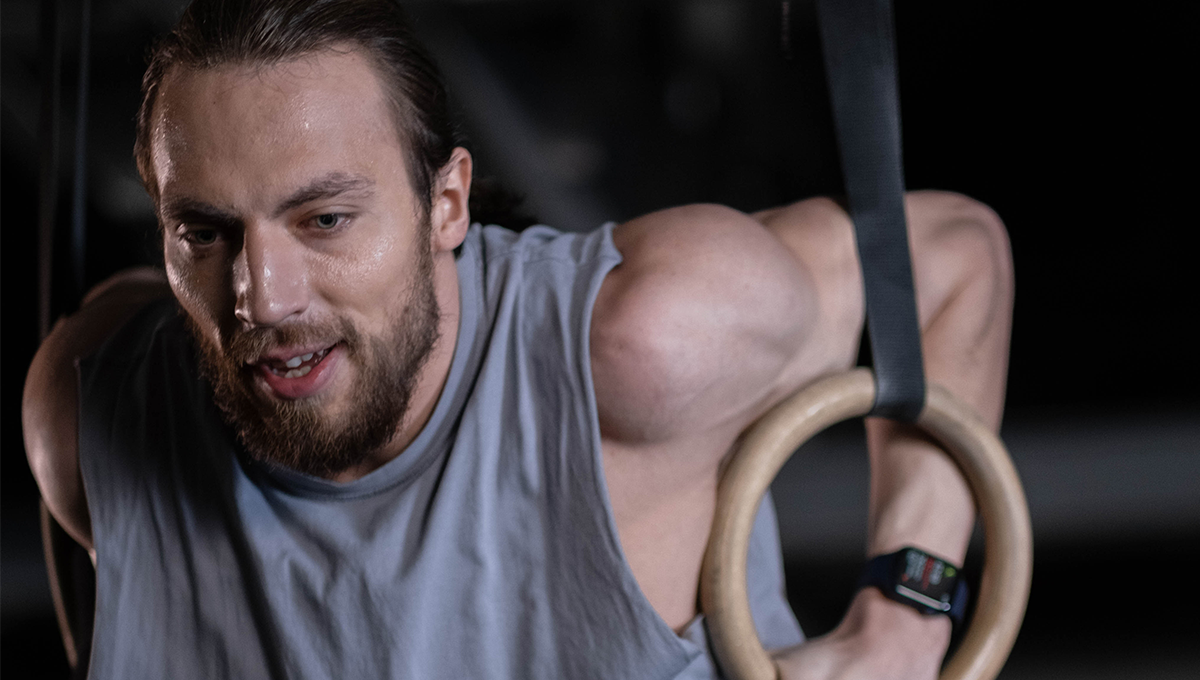
1. Ring Dips
Why Ring Dips Are Superior for Functional Chest Strength
Ring dips are one of the most demanding upper-body pushing movements. Unlike fixed bars, gymnastic rings introduce instability, requiring the athlete to control movement in multiple planes.

Research shows that unstable surface training increases activation of stabilizing musculature without necessarily reducing prime mover activation when the load is appropriate. In upper-body pushing tasks, instability increases demand on shoulder stabilizers and core musculature.
Ring dips create:
- High pectoralis major activation
- Significant anterior deltoid involvement
- Triceps activation
- Increased scapular stabilizer recruitment
- Core engagement due to instability
The chest is heavily loaded during the bottom portion of the dip, especially when the torso leans slightly forward. Biomechanical analyses of dip variations show that forward torso inclination increases shoulder flexion torque demand, which increases pectoralis major involvement.
Additionally, dips load the shoulder in extension at the bottom, producing a deep stretch under tension. Stretch-mediated hypertrophy research indicates that loading muscles in lengthened positions may enhance hypertrophic stimulus.
Ring dips therefore provide:
- High tension
- Large range of motion
- Instability challenge
- Lengthened-position loading
That combination makes them a top-tier functional chest builder.
Proper Technique
- Set rings at hip height.
- Support yourself at the top with arms locked.
- Keep rings close to the body.
- Lean slightly forward to emphasize the chest.
- Lower under control until shoulders are below elbows.
- Press back up while maintaining ring control.
Common errors include flaring elbows excessively, losing scapular control, and collapsing at the bottom.
Progressions and Regressions
- Regression: Bar dips or band-assisted ring dips
- Progression: Weighted ring dips or tempo-controlled dips
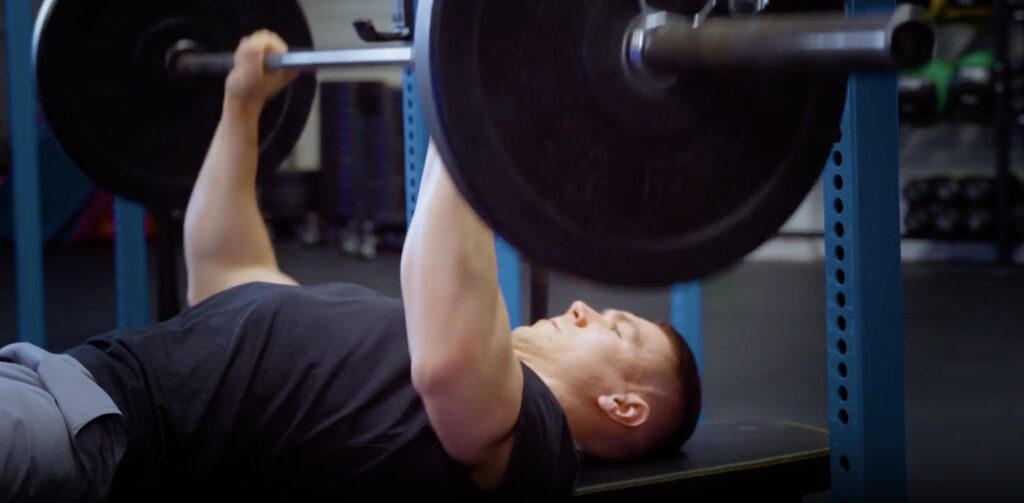
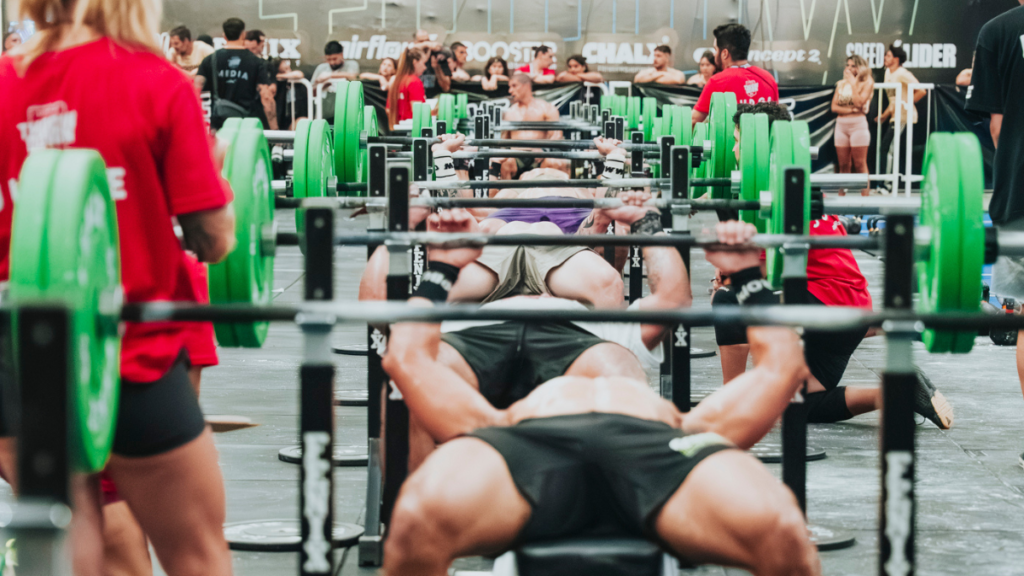
2. Barbell Bench Press
Why the Bench Press Still Matters in Functional Fitness
Some functional fitness athletes avoid the bench press, arguing it lacks transfer to sport. However, this view is overly simplistic.
The barbell bench press remains one of the most thoroughly studied upper-body exercises in sports science. EMG analyses consistently show high activation of both the clavicular and sternocostal heads of the pectoralis major during the flat bench press.
Comparative studies between free-weight and machine pressing show similar or greater prime mover activation in free-weight bench pressing, along with greater stabilizer recruitment.

Maximal upper-body strength strongly correlates with pressing power output and throwing velocity in athletic populations. Additionally, research indicates that increasing maximal strength enhances rate of force development when appropriately trained.
The bench press allows:
- High absolute loading
- Progressive overload
- Quantifiable strength gains
- Bilateral force production
Functional fitness requires athletes to move external loads efficiently. The bench press develops foundational horizontal pressing strength that transfers to:
- Handstand push-up stability
- Ring dips
- Barbell cycling
- Strongman events
Grip Width and Chest Activation
Research shows that moderate grip widths maximize pectoralis major activation while minimizing shoulder stress. Extremely wide grips may increase shoulder joint stress without significantly increasing muscle activation.
A grip width approximately 1.5 times biacromial distance is often recommended in biomechanical studies for balancing activation and joint safety.
Proper Technique
- Feet planted firmly.
- Scapulae retracted and depressed.
- Bar lowered to mid-chest.
- Elbows at approximately 45–75 degrees from torso.
- Press bar upward with controlled tempo.
Maintaining scapular stability protects the shoulder and improves force transfer.
Programming for Functional Athletes
- 3–5 sets of 3–6 reps for strength
- 3–4 sets of 6–10 reps for hypertrophy
- Paused reps to improve stability and power
3. Push-Ups (Advanced Variations)
Why Push-Ups Are Underrated
Push-ups are often dismissed as beginner exercises. However, EMG studies show that standard push-ups produce comparable pectoralis major activation to bench pressing at moderate loads when relative intensity is similar.

Push-ups also require:
- Core stiffness
- Scapular control
- Serratus anterior activation
- Coordinated kinetic chain integration
Closed-chain movements like push-ups can enhance joint stability through co-contraction of surrounding musculature.
Elevated and Weighted Variations
Research shows that elevating the feet increases upper chest activation. Adding external resistance (weight vest, plates, bands) increases muscle activation proportionally to load.
Instability push-ups (rings, suspension trainers) increase stabilizer activity without reducing prime mover engagement significantly when performed under control.
Explosive Push-Ups
Plyometric push-ups improve upper-body power by training rate of force development. Studies on upper-body plyometrics show improvements in throwing and pressing performance.
These variations build:
- Power
- Coordination
- Dynamic stability
All key components of functional fitness.
Proper Technique
- Hands under shoulders.
- Body in rigid plank.
- Lower chest to ground under control.
- Press explosively or steadily depending on goal.
- Maintain neutral spine.
Avoid sagging hips or flared elbows.
Comparing the Three Exercises
Each movement offers unique advantages:
- Ring dips emphasize instability and deep stretch under load.
- Bench press maximizes progressive overload and absolute strength.
- Push-ups integrate core and scapular control with scalable resistance.
Together, they create comprehensive chest development across:
- Strength
- Hypertrophy
- Stability
- Power
The Science of Hypertrophy and Strength for the Chest
Muscle growth is primarily driven by:
- Mechanical tension
- Muscle damage
- Metabolic stress
Current evidence suggests mechanical tension is the dominant factor.
Multi-joint compound movements with sufficient load produce high levels of tension. Meta-analyses show that training with loads ranging from 30–85 percent of one-repetition maximum can produce hypertrophy when sets are performed near failure.
Strength development, however, is maximized with heavier loads (above 80 percent 1RM) due to neural adaptations and motor unit recruitment patterns.
All three exercises can be programmed to target both adaptations.
Programming for Maximum Results
Sample Functional Chest Session
- Barbell Bench Press
4 sets x 5 reps - Ring Dips
3 sets x 8 reps - Weighted Push-Ups
3 sets x 12 reps
Weekly Structure
Train chest 2 times per week with at least 48 hours between sessions.
Periodize phases:
- Hypertrophy block (6–10 reps)
- Strength block (3–6 reps)
- Power block (explosive variations)
Research shows periodized resistance training produces greater strength gains compared to non-periodized programs.
Injury Prevention and Shoulder Health
Functional chest training must prioritize shoulder integrity.
Research indicates that scapular dyskinesis and poor rotator cuff strength contribute to shoulder injury risk.
Incorporate:
- Scapular retraction work
- External rotation strengthening
- Serratus anterior activation drills
Proper technique in pressing movements reduces anterior shoulder stress.
Final Thoughts
A stronger chest in functional fitness is not built through isolation machines or novelty movements. It is built through heavy compound pressing, instability control, and progressive overload.
Ring dips challenge stability and strength through a deep range of motion.
Barbell bench presses build maximal horizontal pressing strength.
Push-ups integrate strength, power, and core control.
Train them consistently, program them intelligently, and focus on technique.
The result is a chest that is not only bigger, but stronger, more resilient, and more functional.
Key Takeaways
| Exercise | Primary Benefit | Functional Carryover | Key Programming Tip |
|---|---|---|---|
| Ring Dips | Lengthened tension + instability | Gymnastics, ring work, shoulder stability | Lean forward and control bottom position |
| Bench Press | Maximal strength and overload | Barbell work, pushing power | Use moderate grip width and progressive loading |
| Push-Ups | Core-integrated pressing strength | Bodyweight conditioning, power | Add load or elevation to scale difficulty |
References
- Behm, D.G. and Colado, J.C. (2012) ‘The effectiveness of resistance training using unstable surfaces and devices for rehabilitation’, International Journal of Sports Physical Therapy, 7(2), pp. 226–241.
- Calatayud, J., Borreani, S., Colado, J.C., Martin, F., Rogers, M.E. and Andersen, L.L. (2014) ‘Bench press and push-up at comparable levels of muscle activity results in similar strength gains’, Journal of Strength and Conditioning Research, 29(1), pp. 246–253.
- Gentil, P., Fisher, J. and Steele, J. (2017) ‘A review of the acute effects and long-term adaptations of single- and multi-joint exercises during resistance training’, Sports Medicine, 47(5), pp. 843–855.
- Grgic, J., Schoenfeld, B.J., Orazem, J. and Sabol, F. (2018) ‘Effects of resistance training performed to repetition failure or non-failure on muscular strength and hypertrophy’, Journal of Sport and Health Science, 10(4), pp. 423–430.
- Lehman, G.J. (2005) ‘The influence of grip width and forearm pronation/supination on upper-body myoelectric activity during the flat bench press’, Journal of Strength and Conditioning Research, 19(3), pp. 587–591.