

Building a muscular upper body is not just about pressing heavy weights and doing endless curls. Many lifters overlook rotational strength, even though the human body is designed to rotate, resist rotation, and transfer force through the torso. If you want broad shoulders, a dense chest, powerful arms, and an athletic looking physique, rotational exercises deserve a place in your training.
Rotation based movements challenge the muscles differently than standard gym lifts. They recruit the core more intensely, improve shoulder stability, increase muscular coordination, and stimulate muscles through multiple planes of motion. This combination can help improve muscle growth, athleticism, and injury resilience.


The upper body does not function in isolation. The chest, lats, shoulders, obliques, and hips work together whenever you throw a punch, swing a bat, wrestle, sprint, or even carry groceries. Rotation exercises teach your body to produce and control force efficiently across these systems.
Science supports this approach. Research has consistently shown that multi planar training enhances neuromuscular activation, athletic performance, and core engagement compared to isolated machine movements. Rotational training also improves trunk stability, which helps lifters produce more force during compound lifts like bench presses and overhead presses.
Why Rotation Matters for Muscle Growth
Traditional bodybuilding exercises mostly happen in the sagittal plane. That means movements move forward and backward. Think bench presses, rows, curls, and pull ups.
While these exercises are essential, the body also moves in the transverse plane, which involves rotation. Ignoring this movement pattern can limit muscular development and athletic function.
Rotation based exercises offer several benefits:
• Greater core activation
• Increased shoulder stability
• Improved force transfer across the torso
• Enhanced muscle coordination
• More athletic movement patterns
• Increased anti rotational strength
• Better posture and movement efficiency
Research has shown that rotational movements increase activation of the obliques, serratus anterior, and deep spinal stabilizers. These muscles are critical for creating a thick and powerful looking torso.
Another important factor is fascial integration. Muscles do not work independently. The body uses myofascial slings to transfer force across joints and segments. Rotational training strengthens these kinetic chains.
For example, when you perform a rotational cable press, your chest, shoulders, obliques, glutes, and lats all contribute to producing and controlling movement. This creates more total body tension than many machine based exercises. Rotational training can also reduce injury risk. Studies show that trunk stability and rotational control are strongly associated with lower injury rates in athletes and recreational lifters.
The Difference Between Rotation and Anti Rotation
Before jumping into the exercises, it helps to understand the difference between rotational and anti rotational training.
Rotational Exercises
These involve actively producing rotation through the torso and hips. Examples include:
• Medicine ball rotational throws
• Landmine rotations
• Cable wood chops
These exercises train power production and dynamic movement.
Anti Rotational Exercises
These involve resisting unwanted rotation. Examples include:
• Pallof presses
• Offset carries
• Single arm farmer carries
These movements strengthen core stability and improve force transfer. The best programs include both. However, the exercises in this article primarily emphasize active rotation because they provide a strong combination of hypertrophy, athletic carryover, and upper body recruitment.
Exercise 1: Landmine Rotations
Landmine rotations are one of the most underrated exercises for building a muscular and athletic upper body.
This movement combines rotational power, shoulder stability, core engagement, and upper back activation in a single exercise. It also places less stress on the shoulder joint compared to many overhead movements.
Why Landmine Rotations Work
The angled path of the barbell changes the loading mechanics. This allows the shoulders to move naturally while still generating high muscular tension.
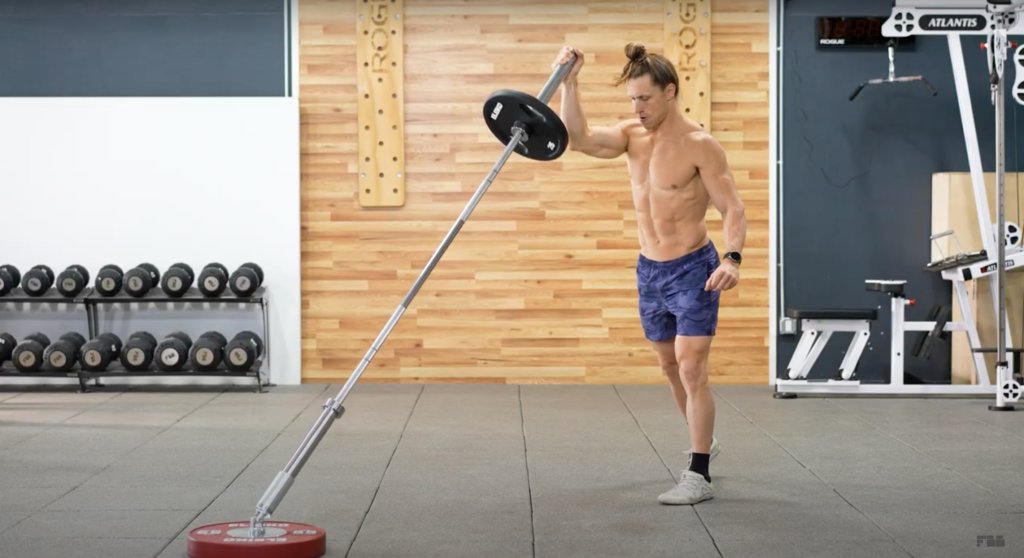
Landmine rotations challenge:
• Deltoids
• Upper chest
• Obliques
• Rectus abdominis
• Serratus anterior
• Lats
• Forearms
The movement also teaches the body to transfer force from the lower body through the core into the upper body.
Research on rotational resistance training suggests that these integrated movement patterns increase neuromuscular efficiency and trunk activation more effectively than isolated exercises.
How to Perform Landmine Rotations
- Secure one end of a barbell into a landmine attachment or corner.
- Stand with feet shoulder width apart.
- Hold the free end of the barbell with both hands.
- Start with the bar near one hip.
- Rotate explosively across the body while pivoting through the feet and hips.
- Control the descent to the opposite side.
- Repeat rhythmically.
The movement should come from the hips and torso, not just the arms.
Common Mistakes
Many lifters make the mistake of using only their shoulders. This reduces core involvement and limits power production. Avoid these errors:
• Keeping the feet planted rigidly
• Moving only the arms
• Using excessive weight
• Rounding the lower back
• Losing control during the lowering phase
Best Rep Ranges for Hypertrophy
For muscle growth and upper body development:
• 3 to 4 sets
• 8 to 12 reps per side
• Moderate load
• Controlled eccentric phase
You can also perform explosive lower rep sets for athletic power development.
Muscles Emphasized
Landmine rotations create a unique stimulus because they blend pushing, pulling, and stabilizing demands. The obliques work intensely to rotate and decelerate the torso. The shoulders stabilize dynamically throughout the movement. The chest and serratus contribute heavily during the press like component.
This combination creates dense muscular development rather than isolated pump focused stimulation.
Exercise 2: Cable Wood Chops
Cable wood chops are one of the best exercises for developing rotational strength and upper body coordination. Unlike crunches or machine based ab exercises, wood chops train the torso to generate and resist rotational force under load. They also heavily involve the shoulders, chest, and upper back.
Why Cable Wood Chops Build a Better Upper Body
The cable machine provides constant tension throughout the movement. This increases muscular recruitment and time under tension.
Cable chops develop:
• Obliques
• Serratus anterior
• Deltoids
• Upper chest
• Transverse abdominis
• Latissimus dorsi
The movement mimics many athletic actions including throwing, striking, swinging, and sprinting mechanics. Research shows that cable based rotational exercises generate high levels of oblique activation and improve core stability more effectively than traditional floor based abdominal exercises.
How to Perform Cable Wood Chops
- Set a cable pulley above shoulder height.
- Stand sideways to the machine.
- Grab the handle with both hands.
- Rotate through the torso while pulling diagonally across the body.
- Finish near the opposite hip.
- Return under control.
The hips should rotate naturally with the movement.
High to Low Versus Low to High
Both variations are useful.
High to Low Chops
These emphasize:
• Obliques
• Lats
• Serratus
• Core stability
They also mimic throwing and striking patterns.
Low to High Chops
These emphasize:
• Upper chest
• Shoulders
• Rotational power
• Hip drive
Using both variations creates more complete muscular development.
Common Errors
Avoid turning this into an arm exercise. The movement should involve:
• Hip rotation
• Core engagement
• Full torso movement
• Controlled eccentric loading
Another mistake is using excessive weight. Heavy loads often reduce range of motion and rotational quality.
Programming Recommendations
For hypertrophy and athletic development:
• 3 to 5 sets
• 10 to 15 reps per side
• Moderate resistance
• Controlled tempo
You can use lighter explosive sets for power work or heavier controlled sets for muscular endurance.
Exercise 3: Medicine Ball Rotational Slams
If you want explosive upper body power and dense athletic muscle, medicine ball rotational slams are incredibly effective. This exercise develops rotational speed, upper body explosiveness, and full body coordination. It also trains the body to produce force rapidly, which can improve athletic performance and muscle recruitment.
Why Rotational Slams Are So Effective
Explosive training recruits high threshold motor units. These are the muscle fibers with the greatest growth potential. Medicine ball rotational slams activate:
• Obliques
• Deltoids
• Lats
• Triceps
• Chest
• Forearms
• Core stabilizers
Research on ballistic and explosive training shows that high velocity movements can improve rate of force development and neuromuscular efficiency. Explosive rotational work also improves power transfer between the hips and upper body.
How to Perform Medicine Ball Rotational Slams
- Stand with feet shoulder width apart.
- Hold a medicine ball at chest height.
- Rotate aggressively through the hips and torso.
- Slam the ball into the ground beside the lead foot.
- Catch or retrieve the ball.
- Repeat explosively.
The hips should initiate the movement.
Key Technique Tips
Focus on:
• Explosive hip rotation
• Full torso engagement
• Aggressive intent
• Strong bracing through the core
Do not simply use the arms to throw the ball downward.
Common Mistakes
Common problems include:
• Moving too slowly
• Using a ball that is too heavy
• Failing to rotate through the hips
• Losing spinal alignment
• Using only the upper body
Power decreases significantly when movement quality breaks down.
Best Programming Strategies
For power and muscle development:
• 3 to 6 sets
• 5 to 8 reps per side
• Maximum explosive effort
• Full recovery between sets
These should be performed early in the workout when the nervous system is fresh.
How Rotation Exercises Improve Shoulder Development
Many people associate shoulder growth only with lateral raises and overhead presses. However, rotational exercises can significantly improve shoulder function and appearance. The shoulders are highly mobile joints that rely on coordinated stabilization from surrounding muscles.
Rotational exercises strengthen:
• Rotator cuff muscles
• Serratus anterior
• Rear deltoids
• Scapular stabilizers
This improves shoulder mechanics and may enhance pressing performance.
Research also suggests that unstable and multi planar resistance exercises increase activation of stabilizing musculature compared to traditional bilateral machine exercises. A stronger and more stable shoulder complex can handle heavier training loads safely over time.
The Core Connection to a Bigger Upper Body
A weak core limits upper body strength. This is because force leaks occur when the torso cannot stabilize effectively during movement. Rotational exercises train the body to transfer force efficiently between the lower and upper body. This can improve:
• Bench press stability
• Overhead pressing mechanics
• Pulling power
• Athletic explosiveness
Studies have shown that trunk stiffness and core activation play major roles in force transmission during compound lifts. When the torso becomes stronger and more coordinated, the upper body can generate higher outputs safely.
How Often Should You Train Rotation?

Rotational training does not need to dominate your program. For most lifters:
• 2 to 3 sessions per week works well
• 2 to 4 rotational exercises per session is enough
• Moderate volume is effective
The key is quality movement and progressive overload.
You can add rotational exercises:
• During warm ups
• As accessory work
• In athletic circuits
• During core training blocks
Avoid excessive fatigue that compromises movement quality.
Best Loading Methods for Rotational Hypertrophy
Different tools create different adaptations.
Landmine
Best for:
• Strength
• Hypertrophy
• Shoulder friendly loading
Cable Machines
Best for:
• Constant tension
• Controlled movement
• Core activation
Medicine Balls
Best for:
• Explosiveness
• Athletic power
• High velocity force production
Using multiple tools creates broader adaptations and prevents stagnation.
Should Bodybuilders Use Rotation Exercises?
Traditional bodybuilding methods remain highly effective for muscle growth. However, adding rotational exercises can improve overall physique development and movement quality. Benefits for bodybuilders include:
• Improved shoulder health
• Better trunk density
• Increased athletic appearance
• Enhanced movement efficiency
• Greater core development
Many physique athletes neglect rotational training because it does not create the same immediate pump as isolation exercises. But long term development often benefits from integrated movement patterns. A thicker torso, stronger obliques, and more stable shoulders contribute significantly to an impressive physique.
Sample Upper Body Rotation Finisher
Here is a simple rotational finisher you can add after upper body workouts.
Rotation Finisher Circuit
Perform 3 rounds:
• Landmine rotations x 10 per side
• Cable wood chops x 12 per side
• Medicine ball rotational slams x 6 per side
Rest 60 seconds between rounds.
This combination develops:
• Core strength
• Shoulder endurance
• Rotational power
• Muscular conditioning
It also creates a serious metabolic challenge without excessive joint stress.
The Science Behind Rotational Force Production
Human movement relies heavily on rotational mechanics. Walking, sprinting, throwing, punching, and lifting all involve rotational force transfer. Research in biomechanics shows that rotational movement patterns depend on coordinated activation between:
• Hips
• Core
• Shoulders
• Spine
The thoracolumbar fascia also plays a major role. This connective tissue system transfers force across the torso and links upper and lower body movement.
Rotational training strengthens these integrated systems. Studies on athletic populations consistently show strong relationships between rotational power and sports performance. Even for non athletes, rotational strength improves movement efficiency and overall physical function.
Rotation Training and Injury Prevention
Shoulders and lower backs are common injury sites in lifters. Many injuries occur because the body cannot stabilize rotational forces effectively. Rotational training improves:
• Trunk stiffness
• Dynamic stability
• Movement coordination
• Force absorption
This may reduce excessive stress on vulnerable joints. Research has shown that athletes with poor trunk control often display higher injury rates. Controlled rotational training helps improve movement awareness and muscular balance.
Can Rotation Exercises Replace Traditional Lifts?
Rotation exercises should complement foundational compound lifts, not replace them. You still need:
• Bench presses
• Rows
• Pull ups
• Overhead presses
• Dips
These exercises remain critical for building maximum muscle mass. However, rotational exercises enhance the system that supports those lifts. Think of rotational training as performance insurance and muscular integration work. It fills the gaps that standard linear training often misses.
Final Thoughts
If your upper body training consists only of presses, curls, and rows, you are missing an important piece of human movement. Rotation exercises develop the torso, shoulders, and upper body in ways that traditional machine based training often cannot. Landmine rotations, cable wood chops, and medicine ball rotational slams each offer unique benefits:
• Landmine rotations build integrated strength and shoulder stability
• Cable wood chops create constant tension and core engagement
• Medicine ball slams improve explosive power and athleticism
Together, they create a more muscular, functional, and resilient upper body. The best physiques are not built from isolated muscles alone. They are built from coordinated systems working together under load. Add rotational training consistently and you may notice improvements not only in aesthetics, but also in strength, movement quality, and athletic performance.
Key Takeaways
| Exercise | Primary Benefits | Main Muscles Trained | Best Rep Range |
|---|---|---|---|
| Landmine Rotations | Integrated strength, shoulder stability, rotational power | Deltoids, obliques, chest, lats, serratus | 8 to 12 reps per side |
| Cable Wood Chops | Core tension, athletic movement, trunk strength | Obliques, shoulders, lats, upper chest | 10 to 15 reps per side |
| Medicine Ball Rotational Slams | Explosiveness, force production, athletic conditioning | Obliques, chest, shoulders, triceps | 5 to 8 reps per side |
| Rotational Training Overall | Improved muscle coordination and stability | Entire core and upper body chain | 2 to 3 sessions weekly |
| Best Programming Strategy | Combine strength, tension, and explosive work | Full upper body integration | Moderate volume works best |
Bibliography
• Behm, D.G., Drinkwater, E.J., Willardson, J.M. and Cowley, P.M. (2010) ‘The use of instability to train the core musculature’, Applied Physiology, Nutrition, and Metabolism, 35(1), pp. 91 to 108.
• Behm, D.G. and Anderson, K. (2006) ‘The role of instability with resistance training’, Journal of Strength and Conditioning Research, 20(3), pp. 716 to 722.
• Escamilla, R.F., Lewis, C., Bell, D., Bramblet, G. and Daffron, J. (2010) ‘Core muscle activation during Swiss ball and traditional abdominal exercises’, Journal of Orthopaedic and Sports Physical Therapy, 40(5), pp. 265 to 276.
• Hibbs, A.E., Thompson, K.G., French, D., Wrigley, A. and Spears, I. (2008) ‘Optimizing performance by improving core stability and core strength’, Sports Medicine, 38(12), pp. 995 to 1008.
• Kibler, W.B., Press, J. and Sciascia, A. (2006) ‘The role of core stability in athletic function’, Sports Medicine, 36(3), pp. 189 to 198.
• Lehman, G.J. (2006) ‘Resistance training for performance and injury prevention in golf’, Journal of the Canadian Chiropractic Association, 50(1), pp. 27 to 42.
• McGill, S.M. (2010) ‘Core training evidence translating to better performance and injury prevention’, Strength and Conditioning Journal, 32(3), pp. 33 to 46.