

Building a muscular upper body does not require a long, complicated list of exercises. You need enough productive training for your chest, back, shoulders, and arms, delivered consistently with good technique and progressive overload. Three well chosen gym machines can do that job extremely well.
Machines are often dismissed as inferior to free weights, but that is not what the evidence shows. When training volume is matched, machine based and free weight training can produce similar muscle growth. Free weights are valuable, especially for sport specific strength and skill, but machines offer a stable setup that can make it easier to train hard, control technique, and take sets close to muscular failure without the same balance demands.


For an upper body that looks bigger from the front, side, and back, focus on a chest press machine, a lat pulldown machine, and a shoulder press machine. Together, these movements train the largest upper body muscle groups through pressing and pulling patterns. They also give the triceps, biceps, and upper back plenty of direct work.
Why Three Machines Can Be Enough
Muscle growth is driven primarily by progressive resistance training. You need to expose muscles to challenging sets, complete enough weekly volume, and gradually increase the training demand as your body adapts. That increase can come from adding weight, performing more repetitions with the same weight, improving range of motion, or gaining more control over the movement.
Research consistently shows that higher weekly training volume tends to support greater muscle growth, although the benefits become less predictable when recovery, exercise quality, and individual tolerance are ignored. For most lifters, a focused routine that delivers multiple hard sets per muscle group each week is more useful than a complicated program filled with exercises they cannot progress consistently.
Best 3 Upper Body Barbell Exercises for Beginners to Get Jacked
Machines help because they reduce unnecessary barriers. You do not need to spend energy balancing a barbell or dumbbells while learning the movement. You can adjust the seat, set up safely, and focus on moving the target muscles through a controlled range of motion. That matters when your goal is muscular development rather than demonstrating a particular lifting skill.
Training close to failure also appears particularly important for hypertrophy. You do not need to reach absolute failure on every set, but your working sets should feel demanding. A machine makes this easier to do safely because the load follows a fixed path and can usually be ended simply by returning the handles to their starting position.
Machine One: The Chest Press Machine
The chest press machine is the foundation of this three machine upper body routine. It trains the pectoral muscles, front deltoids, and triceps in a movement pattern similar to a bench press. The chest is one of the most visually important muscle groups for a muscular upper body, and pressing strength also carries over to many other gym exercises.
What It Builds
The primary target is the pectoralis major, the large chest muscle that gives the torso its width and thickness. The triceps extend the elbow as you press the handles away, while the front portion of the shoulders assists with the movement. A well set chest press machine therefore trains three major upper body areas at once.
The chest press is particularly useful because it allows you to train hard without needing a spotter. You can use a controlled tempo, pause briefly in the stretched position when comfortable, and push close to the point where another clean repetition would be difficult. This creates a high quality stimulus for the chest while limiting the need to worry about stabilizing the load.
How to Set It Up
Adjust the seat so the handles begin around mid chest level. If the handles start near your neck, the movement will likely become too shoulder dominant. If they start too low, you may struggle to press smoothly and comfortably.
Keep your feet firmly planted, your upper back against the pad, and your shoulder blades stable against the seat. Let your elbows travel in a natural path that feels strong and comfortable. Avoid forcing them extremely wide, since this can make the movement feel less stable for many lifters.
Lower the handles under control until you reach a comfortable stretch in the chest. Then press without bouncing or slamming the stack. Your goal is to make the chest and triceps produce the force, not to create momentum with your torso.
How to Program It
Perform three to five challenging sets of six to 15 repetitions, once or twice per week. A moderate repetition range is practical because it allows enough load to create tension while giving you time to control the movement and accumulate high quality repetitions.
Choose a weight that leaves roughly one to three repetitions in reserve for most sets. In other words, you should feel that you could maybe perform one to three more good repetitions if you had to. As you become more experienced, occasional sets taken closer to failure can be useful, provided your technique remains controlled.
Machine Two: The Lat Pulldown Machine
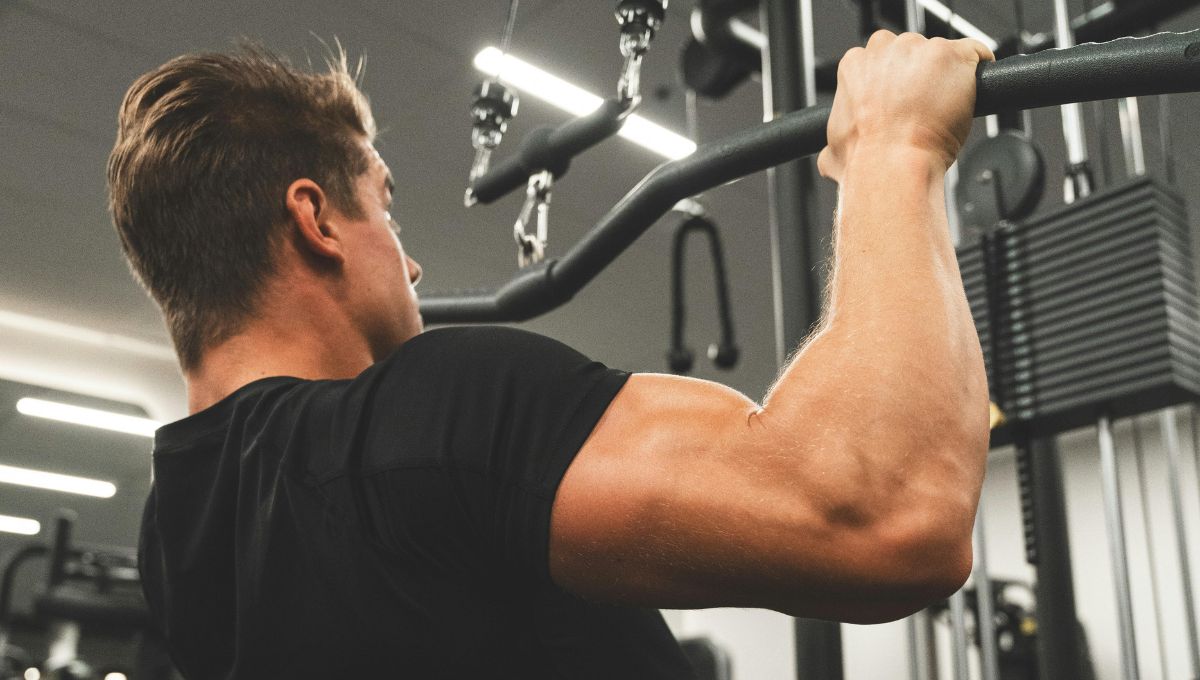
A muscular upper body needs width as well as chest thickness. The lat pulldown machine is the most efficient choice for training the lats, the broad muscles that run from the upper arm down toward the lower back. Developed lats create the wider upper body appearance that makes the waist look comparatively smaller.
The movement also trains the biceps, rear shoulder area, and muscles of the upper back that help control the shoulder blades. It balances the chest press by giving your program a strong vertical pulling pattern.
What It Builds
The latissimus dorsi is the primary target during a well performed pulldown. Its major actions include bringing the upper arm down toward the body and moving it backward. The biceps contribute as the elbow bends, while the middle and lower portions of the trapezius and rhomboids help control the shoulder blade position.
This combination makes the lat pulldown extremely productive for anyone who wants a more athletic looking torso. It gives the upper body more width from the front and back while adding useful arm training through the biceps.
How to Perform It Properly
Set the thigh pad so it holds you securely in place without crushing your legs. Use a grip that feels comfortable on your wrists and shoulders. A shoulder width or slightly wider overhand grip is an effective and simple default.
Begin with your arms overhead and your torso tall. Pull the bar toward your upper chest by driving your elbows down and toward your sides. Think about moving your upper arms rather than simply pulling with your hands.
Avoid leaning excessively backward and turning the exercise into a row. A small natural lean is fine, but your torso should remain mostly stable. Pulling the bar behind your neck is unnecessary and can place some shoulders in an uncomfortable position. Bring the bar toward the front of your body, then return it slowly until your arms are long again.
A full, controlled range of motion is valuable. Do not cut the top half of the movement short, because you lose the stretched position where the lats are lengthened under load. At the same time, do not force range that causes shoulder discomfort.
How to Program It
Perform three to five sets of eight to 15 repetitions, once or twice per week. Start conservatively enough that you can feel the lats working rather than simply jerking the bar down with momentum.
If your biceps fatigue before your back, a neutral grip pulldown attachment may feel more comfortable. You can also use lifting straps if grip strength is the clear limiting factor, although most lifters should first make sure they are using a manageable load and controlling each repetition.
Machine Three: The Shoulder Press Machine
The shoulder press machine completes the routine by training the deltoids, especially the front and middle portions, along with the triceps. Strong shoulders make the upper body look broader, improve the visual transition between the chest and arms, and contribute to a powerful frame in fitted clothing.
The shoulder press is also useful because many chest focused routines already train the front deltoids heavily but do not include enough direct overhead pressing. Adding this machine provides more complete development around the shoulders and upper arms.
What It Builds
The deltoid is made up of three main regions. The front portion helps press the arms overhead, while the middle portion contributes to lifting the arms outward. The rear portion plays a more important role in pulling movements and is supported by your lat pulldown work, although it can benefit from additional training elsewhere.
The shoulder press is especially effective for loading the front deltoids and triceps. Depending on the machine design, it can also provide meaningful work for the middle deltoids. A neutral grip, where the palms face one another, is often a comfortable option for people whose shoulders do not enjoy a fully overhand pressing position.
How to Set It Up
Adjust the seat so the handles begin around chin or ear level. Your elbows should start below or roughly in line with the handles, not far behind your body. Keep your back in contact with the pad and brace your feet against the floor.
Press the handles upward smoothly. Stop just short of a hard elbow lockout if locking out makes the movement feel less controlled, then lower the handles slowly to the starting position. Do not shrug your shoulders aggressively toward your ears during the press. Keep your neck relaxed and let the shoulders work through their natural motion.
Use a load that you can control. Shoulder joints are highly mobile, so forcing heavy, poorly controlled repetitions is rarely a good trade for muscle growth. Consistent training with solid form will build more muscle over time than occasional maximal efforts.
How to Program It
Perform two to four sets of eight to 15 repetitions, once or twice per week. Because the front deltoids and triceps already work during chest pressing, you may need fewer shoulder press sets than chest press or lat pulldown sets.
If your shoulders become sore, first check the machine setup and range of motion. Lowering the seat slightly, using a neutral grip, reducing the load, or stopping just before the point of discomfort may improve the movement. Persistent pain should not be trained through.
The Simple Three Machine Upper Body Workout
Complete this session one or two times per week, leaving at least 48 hours before training the same upper body muscles hard again. If you also perform other upper body work, reduce the number of sets here so that your total weekly workload remains manageable.
Workout Structure
Start with the chest press machine for three to five sets of six to 15 repetitions. Next, perform the lat pulldown for three to five sets of eight to 15 repetitions. Finish with the shoulder press machine for two to four sets of eight to 15 repetitions.
Rest for around two to three minutes between hard sets. Longer rest periods can help you maintain performance and complete more productive repetitions, especially when working near failure. You do not need to rush between sets to make the workout effective.
Aim to progress gradually. Once you can reach the top of your repetition range on every set with clean form, increase the weight by the smallest available increment. Your repetitions may drop at first, but build them back up over subsequent sessions.
For example, if you complete four sets of 12 repetitions on the chest press with a given weight, increase the weight at your next session. You might then complete 10, nine, eight, and eight repetitions. Keep training with that load until you can again perform strong sets near the upper end of your target range.
What This Routine Does Not Cover
These three machines provide a very effective minimalist upper body foundation, but they do not directly isolate every muscle. Your biceps and triceps receive considerable work from pulldowns and presses, but some lifters may eventually want curls and triceps extensions for additional arm size.
Likewise, the rear deltoids and upper back often benefit from a horizontal pulling movement, such as a seated row or reverse fly machine. If you have more time and want a more complete upper body program, those would be excellent additions. They are not essential for getting started, however.
Nutrition and recovery matter as much as exercise selection. Resistance training supports muscle growth best when you eat enough total calories to support your goal, consume sufficient protein, and sleep consistently. Evidence suggests that daily protein intakes around 1.6 grams per kilogram of body weight are sufficient for maximizing average resistance training related gains in lean mass, although individual needs can vary.
The real advantage of this routine is not that these are the only machines that can build a muscular upper body. It is that they give you a focused, evidence based plan you can repeat, improve, and stick with. Train hard, use clean form, add small amounts of progress over time, and these three machines can build an impressive amount of upper body muscle.
Key Takeaways
| Machine | Main muscles trained | Practical target |
|---|---|---|
| Chest press machine | Chest, triceps, front deltoids | Three to five sets of six to 15 repetitions |
| Lat pulldown machine | Lats, biceps, upper back | Three to five sets of eight to 15 repetitions |
| Shoulder press machine | Deltoids and triceps | Two to four sets of eight to 15 repetitions |
| Training effort | All target muscles | Finish most sets with one to three repetitions in reserve |
| Progression | Whole upper body | Add weight after reaching the top of the repetition range with clean form |
| Weekly frequency | Whole upper body | Train the routine once or twice per week based on recovery |
References
- Grgic, J., Schoenfeld, B.J., Davies, T.B., Lazinica, B., Krieger, J.W. and Pedisic, Z. (2018) ‘Effect of resistance training frequency on gains in muscular strength: A systematic review and meta analysis’, Sports Medicine, 48(5), pp. 1207–1220.
- Haugen, M.E., Vårvik, F.T., Larsen, S., Haugen, A.S., van den Tillaar, R. and Bjørnsen, T. (2023) ‘Effect of free weight versus machine based strength training on maximal strength, hypertrophy and jump performance: A systematic review and meta analysis’, BMC Sports Science, Medicine and Rehabilitation, 15, 143.
- Morton, R.W., Murphy, K.T., McKellar, S.R., Schoch, R.D., Henselmans, M., Helms, E., Aragon, A.A., Devries, M.C., Banfield, L., Krieger, J.W. and Phillips, S.M. (2018) ‘A systematic review, meta analysis and meta regression of the effect of protein supplementation on resistance training induced gains in muscle mass and strength in healthy adults’, British Journal of Sports Medicine, 52(6), pp. 376–384.
- Robinson, Z.P., Pelland, J.C., Remmert, J.F., Refalo, M.C., Jukic, I., Steele, J. and Zourdos, M.C. (2024) ‘Exploring the dose response relationship between estimated resistance training proximity to failure, strength gain, and muscle hypertrophy: A series of meta regressions’, Sports Medicine, 54(9), pp. 2209–2231.
- Schoenfeld, B.J., Ogborn, D. and Krieger, J.W. (2016) ‘Dose response relationship between weekly resistance training volume and increases in muscle mass: A systematic review and meta analysis’, Journal of Sports Sciences, 35(11), pp. 1073–1082.