The EZ bar curl is a hugely under-rated exercise for bulking up your biceps.
It naturally angles your arms into a more wrist friendly position, and forces you to work your arms in a different way that traditional curls. If you want to add more muscle mass to your biceps, read on to find out how and why it will work for you.
What Is an EZ Bar Curl?
An EZ bar is a short bar with angled sections along the grips. Holding those angled sections puts your hands in a partly turned position, between the fully palms up position of a straight bar curl and the palms facing each other position of a hammer curl.
That grip affects how the muscles around your elbow and forearm contribute to the movement. The biceps brachii helps bend the elbow and turn the forearm palm up. Other muscles, including the brachialis and brachioradialis, also help bend the elbow. Which grip you use can change how much each muscle is activated during a curl, although muscle activation measurements do not prove which exercise will produce more muscle growth over time.
1. The Angled Grip May Feel More Comfortable
A beginner’s first concern with curls is often the weight. A more useful question is whether you can hold the bar and move it without discomfort that distracts you from the exercise. A straight bar fixes your hands in a fully palms up position. Some people find that position uncomfortable at the wrists or forearms, especially when the bar is loaded. The angled grips on an EZ bar let your hands sit somewhere between palms up and palms facing inward.
Comfort is personal, so an EZ bar will not feel better for everyone. Still, it offers a practical option if a straight bar curl feels awkward. In a study comparing straight bar curls, EZ bar curls, and dumbbell curls, differences in muscle activity between the straight bar and EZ bar were small. The researchers concluded that choosing between those two bars could come down to individual comfort.
This matters for beginners because an exercise is easier to practice when the setup feels manageable. If the EZ bar lets you focus on controlling your elbows and moving the weight smoothly, it can be a sensible place to start. If it causes discomfort, switch to dumbbells or another variation. There is no need to force your hands into a position that does not suit you.
2. It Trains the Biceps Alongside Other Elbow Flexors
The EZ bar curl is not an exercise for only one muscle. Your biceps brachii helps bend the elbow, while the brachialis and brachioradialis also contribute to elbow flexion. The partly turned grip changes the way these muscles work together compared with a fully palms up grip.
Research on curl variations has found that grip position can affect the electrical activity measured in the biceps and brachioradialis. In one study, the EZ bar curl produced higher activity in these muscles than the dumbbell curl under the study’s specific testing conditions. Other research comparing different hand positions found greater biceps activity during the lifting phase with a fully supinated, palms up grip than with neutral or palms down grips.
These findings help explain how grip can change the demands of a curl, but they do not show that one grip will build bigger arms by itself. The studies measured muscle activity during exercise, not long term muscle growth. For a beginner, the useful point is that an EZ bar gives you a slightly different elbow flexor training option while still allowing you to curl with both arms together.
That can be useful if your program includes several kinds of pulling and curling movements. You can use EZ bar curls as your main curl, or include them alongside dumbbell curls if both feel good and fit your overall training plan. You do not need to chase a perfect muscle activation number. Focus on a controlled repetition, a comfortable grip, and gradual progress.
3. It Makes Progress Easy to Track
Beginners often benefit from keeping their training simple. An EZ bar curl has a clear setup and a simple way to measure progress: record the weight, repetitions, and sets, then aim to improve over time while maintaining good control.
For example, you might begin with a weight you can lift for 8 to 12 controlled repetitions. Once you can complete the planned repetitions across all your sets without swinging the weight or changing your form, increase the load by a small amount. If the next weight makes you lose control, return to the previous load and build up again.
Research on resistance training shows that muscle growth can occur across a range of loads when sets are challenging enough. You do not need to test your maximum strength or choose the heaviest bar in the gym. A load that lets you complete controlled repetitions and finish each set with only a few good repetitions left can be a practical starting point. Training to the point where you cannot complete another repetition is not required for every set.
The EZ bar also makes it easy to repeat the same movement from session to session. That consistency helps you see whether you are adding repetitions or weight. Beginners can benefit from this kind of steady progression because it makes training less dependent on guesswork. If you are improving your performance over time and recovering well, you have a clear reason to keep the exercise in your routine.
How to Perform an EZ Bar Curl
Stand with your feet about hip width apart and hold the angled grips. Let your arms hang naturally, keep your shoulders relaxed, and brace your midsection so your torso does not rock as you lift. Begin with your elbows close to your sides and your arms extended as far as is comfortable.
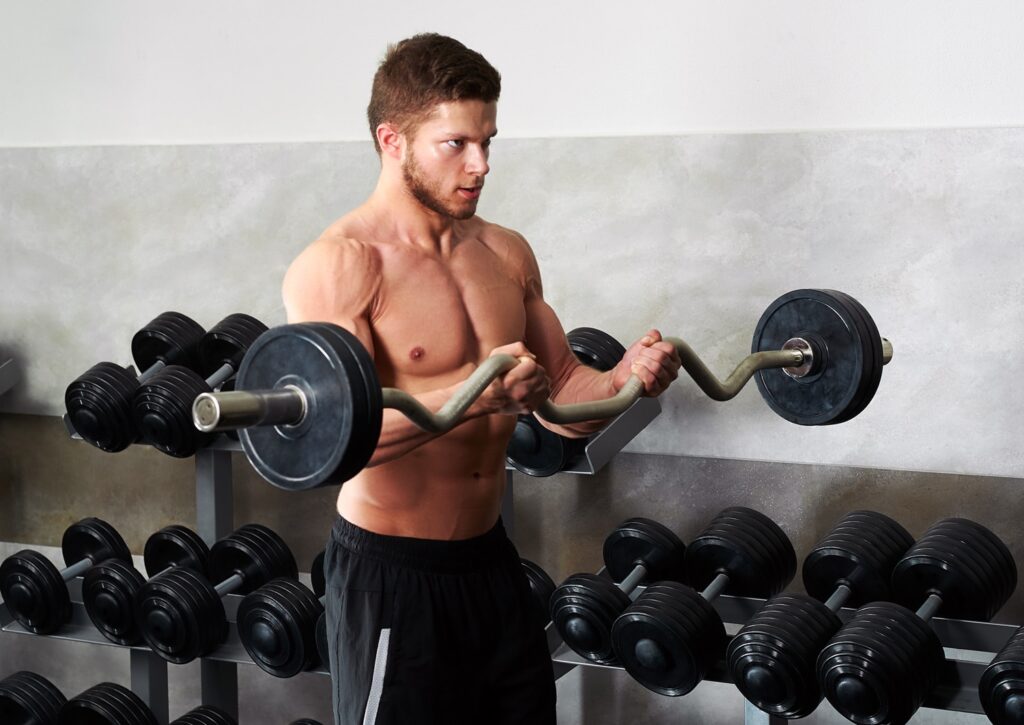
Bend your elbows to raise the bar toward your shoulders. Keep your upper arms mostly still, and avoid leaning back to help the weight move. Lower the bar under control until your elbows are extended again. Use a range of motion that feels comfortable and lets you control the weight throughout the repetition.
If your wrists or elbows feel uncomfortable, check that you are gripping the bar naturally rather than forcing your wrists into a bent position. You can also try a lighter load, a different section of the bar, or dumbbells. A good exercise variation is one you can perform consistently without pain interfering with your training.
How Many EZ Bar Curl Sets Should Beginners Do?
A beginner can start with 2 or 3 sets of EZ bar curls in a workout, performed once or twice a week as part of a broader strength program. The right amount depends on what else you do for your arms and how well you recover. Rows, pulldowns, and other pulling exercises also involve the elbow flexors, so curls are only one part of your weekly training.
5 Tips for Guys That Struggle to Grow Their Chest Muscles
Start with a manageable amount of work and keep a record of your sets and repetitions. If you recover well and your performance is improving, you may not need to change anything. If your elbows feel irritated or your curl performance is declining from session to session, reduce the load or the number of sets and reassess your technique.
Are EZ Bar Curls Better Than Straight Bar Curls?
There is no strong evidence that EZ bar curls are universally better. A small study found little difference in measured biceps and brachioradialis activity between EZ bar and straight bar curls, while other research has shown that changing hand position can affect muscle activity in the biceps and forearm muscles. These short term measurements are useful for understanding exercise mechanics, but they cannot tell us which bar will produce the most growth for every person.
Choose the bar that lets you train consistently, use a controlled range of motion, and add repetitions or weight over time. If the EZ bar feels comfortable, it is a solid beginner option. If you prefer a straight bar or dumbbells, those can work too. The most effective curl for you is one you can perform well and progress without discomfort getting in the way.
References
- Bernárdez-Vázquez, R., Raya-González, J., Castillo, D. and Beato, M. (2022) ‘Resistance training variables for optimization of muscle hypertrophy: an umbrella review’, Frontiers in Sports and Active Living, 4, 949021.
- Coratella, G., Tornatore, G., Longo, S., Toninelli, N., Padovan, R., Esposito, F. and Cè, E. (2023) ‘Biceps brachii and brachioradialis excitation in biceps curl exercise: different handgrips, different synergy’, Sports, 11(3), 64.
- Grgic, J., Schoenfeld, B.J., Orazem, J. and Sabol, F. (2022) ‘Effects of resistance training performed to repetition failure or non-failure on muscular strength and hypertrophy: a systematic review and meta-analysis’, Journal of Sport and Health Science, 11(2), pp. 202–211.
- Marcolin, G., Panizzolo, F.A., Petrone, N., Moro, T., Grigoletto, D., Piccolo, D. and Paoli, A. (2018) ‘Differences in electromyographic activity of biceps brachii and brachioradialis while performing three variants of curl’, PeerJ, 6, e5165.
- Pallarés, J.G., Hernández-Belmonte, A., Martínez-Cava, A., Vetrovsky, T., Steffl, M. and Courel-Ibáñez, J. (2021) ‘Effects of range of motion on resistance training adaptations: a systematic review and meta-analysis’, Scandinavian Journal of Medicine & Science in Sports, 31(10), pp. 1866–1881.
- Schoenfeld, B.J., Grgic, J., Ogborn, D. and Krieger, J.W. (2017) ‘Strength and hypertrophy adaptations between low- vs. high-load resistance training: a systematic review and meta-analysis’, Journal of Strength and Conditioning Research, 31(12), pp. 3508–3523.
Key Takeaways
| Benefit | Why it may help beginners |
|---|---|
| Angled hand position | Offers a grip option that some people find more comfortable than a straight bar. |
| Elbow flexor training | Trains the biceps and other muscles that help bend the elbow. |
| Simple progression | Makes it easy to record repetitions and load and gradually improve. |