

Building a muscular back starts with choosing exercises that you can perform well, progress consistently, and repeat often enough to create a meaningful training stimulus. Cable rows and dumbbell rows can both do that job. Both are horizontal pulling exercises that train the latissimus dorsi, middle trapezius, rhomboids, posterior deltoids, and elbow flexors. The key difference is how each exercise delivers resistance and how much stability it demands from you.
For most beginners, cable rows are the better primary choice for building a more muscular back. They are easier to learn, easier to load gradually, and allow you to focus more consistently on the pulling muscles. Dumbbell rows are still excellent, especially when performed with one hand supported on a bench, but they are usually best used as a secondary exercise or as a way to train each side independently.


The best answer is not that one movement is good and the other is bad. It is that cable rows usually make it easier for beginners to accumulate high quality back training, while dumbbell rows offer valuable variety, unilateral work, and a greater challenge to the trunk.
What Makes a Back Exercise Effective for Muscle Growth?
Muscle growth comes from repeated resistance training that challenges a muscle over time. Research shows that different loads can produce similar hypertrophy when sets are performed with sufficient effort, although heavier loads generally improve maximal strength more effectively. In practical terms, beginners do not need to chase extremely heavy weights. They need a movement they can control, perform through a comfortable range of motion, and gradually make more challenging.
Weekly training volume also matters. More challenging sets generally produce greater hypertrophy up to the point where recovery becomes a problem. That means the most useful exercise is often the one that lets you perform enough productive sets with stable technique, rather than the exercise that feels most complicated or impressive.
For a more muscular back, a row should let you move the shoulder blades and upper arms through a controlled pulling pattern. The lats help bring the upper arm back toward the torso, while the middle back muscles help control and retract the shoulder blades. Your biceps and forearms assist by bending and gripping with the arm.
Cable rows and dumbbell rows both meet these requirements. Their real difference is how easy they are to execute and progress.
Cable Rows for Beginners
Why Cable Rows Are Easy to Learn
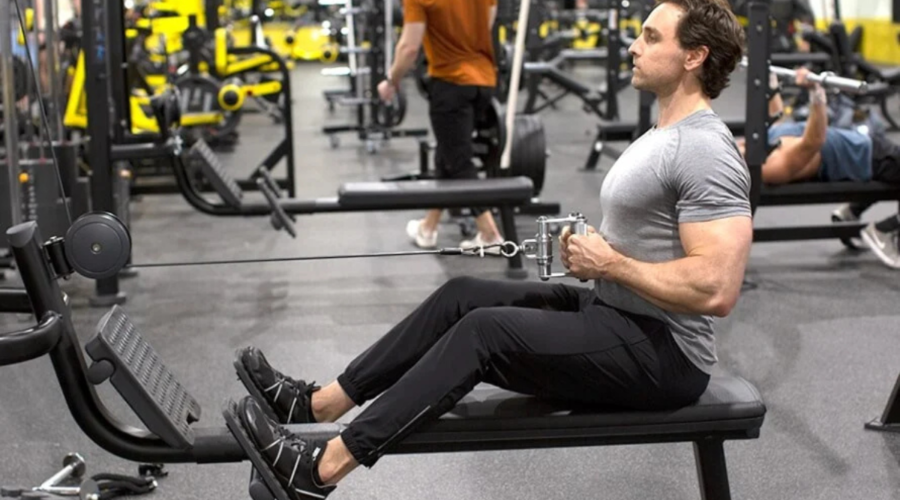
The seated cable row places you in a supported position with the resistance moving along a fixed cable path. You sit with your feet braced, maintain a tall torso, and pull the handle toward your lower ribs or upper abdomen. This removes much of the balance demand that can distract beginners during free weight exercises.
Because the weight stack changes in small increments, cable rows make progression simple. You can add a small amount of load, perform an extra repetition, or improve your control at the same weight. Those small improvements matter because progressive resistance is central to long term muscle growth.
A cable row also gives consistent resistance across the movement. The cable continues to pull the handle forward, so you have to control the weight as your arms extend and pull against it as the handle comes toward you. This makes it easier to feel the target muscles working without needing to stabilize a free weight in space.
The Muscles Cable Rows Train
Cable rows train the latissimus dorsi, middle trapezius, rhomboids, posterior deltoids, biceps, brachialis, and forearm muscles. The exact emphasis changes with your elbow path and grip. Keeping the elbows closer to the torso generally places the shoulder in a position that favors lat involvement, while rowing with the elbows further from the body increases the contribution from the upper back and posterior deltoids.
This does not mean that one handle or elbow position builds only one muscle. Back muscles work together during rows. Beginners should use a comfortable grip and a controlled range of motion rather than trying to isolate a single muscle with extreme positioning.
Research on seated rows also shows that allowing the shoulder blades to move naturally is important. A row should begin with the arms extended under control, followed by a smooth pull that brings the elbows back without aggressively forcing the shoulders into an exaggerated position.
How to Perform a Cable Row
Sit tall with your feet firmly braced and hold the handle with a neutral grip if one is available. Start with your arms extended and your torso stable. Pull your elbows toward your sides and bring the handle toward your lower ribs or upper abdomen. Let your shoulder blades move back naturally as you finish the pull.
Pause briefly when the handle reaches your torso, then return the weight slowly until your arms are extended again. Keep your chest up without leaning far backward. A small amount of natural torso movement can occur, but turning the exercise into a full body swing reduces control and makes progression harder to measure.
Dumbbell Rows for Beginners
Why Dumbbell Rows Are Valuable
A dumbbell row is a free weight exercise that can be performed with one hand and one knee supported on a bench. This supported version is usually the best place for beginners to start. The bench reduces the need to balance, while each arm works independently.
Unilateral training can be useful because each side must contribute its own repetitions. The stronger side cannot directly take over the movement in the way it sometimes can during a bilateral exercise. This makes dumbbell rows a practical option for building confidence and developing control on both sides of the body.
Dumbbell rows also allow the arm to move with a less restricted path than a cable handle. Some people find this more comfortable for their shoulders. You can pull the dumbbell toward the hip for a lat focused row or toward the lower ribs with the elbow slightly wider for more upper back involvement.
The Extra Stability Demand
The main limitation of dumbbell rows is that they require more coordination than cable rows. Even with one hand supported on a bench, you must brace your torso, resist twisting, and keep the dumbbell from swinging. An unsupported bent over dumbbell row demands even more from the spinal erectors and trunk muscles.
That can be useful, but it can also limit the amount of back focused work a beginner can perform. If your grip, lower back, or body position fails before your back muscles receive enough challenging repetitions, the exercise may be less efficient for hypertrophy at that stage of training.
Research comparing rowing variations has found greater erector spinae activity in free weight rows than machine rows. Research comparing unilateral and bilateral rows also shows that unilateral rowing can increase external oblique activity. These findings support the idea that dumbbell rows have a greater stabilizing demand. They do not prove that dumbbell rows automatically build more back muscle.
How to Perform a Supported Dumbbell Row
Place one hand and the same side knee on a flat bench. Put the opposite foot on the floor and hold a dumbbell in the free hand. Keep your spine neutral and let the dumbbell hang under the shoulder.
Pull the dumbbell toward your hip or lower ribs while keeping the elbow close to your body. Avoid twisting your chest open to lift the weight. Lower the dumbbell slowly until your arm is extended and your shoulder blade has returned to a comfortable starting position.
The goal is not to pull the dumbbell as high as possible. The goal is to keep the shoulder and elbow moving smoothly while the back muscles do the work.
Which Exercise Builds More Muscle?

The Best Choice for Most Beginners
Cable rows are usually the better primary back builder for beginners because they make quality training easier to repeat. The seated position limits unnecessary balance demands, the weight stack makes progression simple, and the movement is easier to standardize from set to set.
That matters because hypertrophy depends on accumulating productive training over weeks and months. If you can perform cable rows with clean form, add repetitions or load regularly, and recover well enough to train again, you have a strong foundation for back growth.
Cable rows are particularly useful if you are still learning how to feel your lats and middle back during pulling exercises. The added stability lets you focus on pulling with the elbows, controlling the return, and avoiding momentum.
When Dumbbell Rows May Be the Better Choice
Dumbbell rows can be the better choice when cable equipment is unavailable, when you want to train one side at a time, or when you have already developed enough control to perform them without twisting or swinging. They are also useful for adding variety after cable rows have become familiar.
A supported one arm dumbbell row is generally more beginner friendly than an unsupported bent over row. It gives you the benefits of unilateral training without requiring the same level of lower back endurance and trunk control.
If you are comfortable with dumbbell rows and can progressively add load or repetitions while maintaining technique, they can build substantial back muscle. The exercise does not become inferior simply because it requires more stability. It just has a higher coordination cost.
A Simple Beginner Approach
Start by making the cable row your main horizontal pull. Perform two or three challenging sets in a moderate repetition range, using a weight that allows controlled repetitions and leaves you close to fatigue by the end of the set. As your technique improves, gradually add repetitions or a small amount of weight.
You can add supported dumbbell rows later in the workout or on another training day. Use a load that you can control without rotating your torso. This gives you a reliable cable movement for accumulating volume and a unilateral dumbbell movement for practicing side to side control.
Training a muscle more often does not appear to produce meaningfully greater hypertrophy when total weekly volume is matched. However, spreading your back training across multiple sessions can make the work more manageable and help you maintain better performance in each set.
A simple plan could include cable rows twice per week, with dumbbell rows added once per week if recovery and technique are good. Over time, you can adjust the balance based on which exercise you can perform most effectively and progress most consistently.
The Verdict
Cable rows are the better choice for most beginners who want to build a more muscular back. They are stable, easy to progress, and allow more attention to be directed toward the muscles that should be doing the work.
3 Best Exercises for Beginners that Want Wider Shoulders
Dumbbell rows are still a highly effective exercise and deserve a place in many programs. Their unilateral nature and extra trunk demand can be useful, especially when performed with bench support. They are simply more technically demanding and may be harder to load consistently when you are new to resistance training.
Use cable rows as the foundation, then use dumbbell rows to add variety and train each side independently. Consistent hard sets, gradual progression, and controlled technique will matter far more than choosing one row forever.
References
- Fenwick, C.M.J., Brown, S.H.M. and McGill, S.M. (2009) ‘Comparison of different rowing exercises: Trunk muscle activation and lumbar spine motion, load, and stiffness’, Journal of Strength and Conditioning Research, 23(2), pp. 350 to 358.
- Grgic, J., Lazinica, B., Mikulic, P., Krieger, J.W. and Schoenfeld, B.J. (2017) ‘The effects of short versus long interset rest intervals in resistance training on measures of muscle hypertrophy: A systematic review’, European Journal of Sport Science, 17(8), pp. 983 to 993.
- Saeterbakken, A.H., Andersen, V. and Fimland, M.S. (2015) ‘The effect of performing bi and unilateral row exercises on core muscle activation’, International Journal of Sports Medicine, 36(11), pp. 900 to 905.
- Schoenfeld, B.J., Grgic, J., Ogborn, D. and Krieger, J.W. (2017) ‘Strength and hypertrophy adaptations between low and high load resistance training: A systematic review and meta analysis’, Journal of Strength and Conditioning Research, 31(12), pp. 3508 to 3523.
- Schoenfeld, B.J., Ogborn, D. and Krieger, J.W. (2016) ‘Effects of resistance training frequency on measures of muscle hypertrophy: A systematic review and meta analysis’, Sports Medicine, 46(11), pp. 1689 to 1697.
- Schoenfeld, B.J., Grgic, J. and Krieger, J. (2019) ‘How many times per week should a muscle be trained to maximize muscle hypertrophy? A systematic review and meta analysis of studies examining the effects of weekly resistance training frequency’, Journal of Sports Sciences, 37(11), pp. 1286 to 1295.
- Vigotsky, A.D., Halperin, I., Lehman, G.J., Trajano, G.S. and Vieira, T.M.M. (2018) ‘Interpreting signal amplitudes in surface electromyography studies in sport and rehabilitation sciences’, Frontiers in Physiology, 8, article 985.
Key Takeaways
| Point | Takeaway |
|---|---|
| Best primary exercise for beginners | Cable rows are usually the better main row because they are stable, easy to learn, and simple to progress. |
| Main benefit of dumbbell rows | Supported dumbbell rows train each side independently and add a useful stability challenge. |
| Back muscle growth | Both exercises can build the lats and middle back when performed with controlled technique and progressive overload. |
| Best programming approach | Use cable rows as a foundation, then add dumbbell rows when you can control them without twisting or swinging. |
| Most important factor | Consistent challenging sets and gradual progression matter more than the specific rowing tool you choose. |