

If your goal is to build a bigger chest, both dips and push ups can be effective. Neither exercise is automatically superior in every situation. The best choice depends on your current strength, your ability to progressively make the exercise harder, your technique, your shoulder comfort, and the total amount of quality chest training you can recover from each week.
Push ups are easier to adapt to almost any training level. They can be modified from an elevated surface for beginners, loaded with plates or bands for stronger lifters, and performed through a deep range with push up handles. Dips can provide a demanding chest and triceps stimulus with minimal equipment, but they require more strength and shoulder control from the start.



The short answer is that dips may be the better chest builder for an experienced athlete who can perform them pain free, use a controlled deep range of motion, and add load over time. Push ups are usually the more versatile choice for beginners and can build just as much muscle when they are loaded and taken close enough to muscular failure. For most people, using both intelligently will produce the best long term result.
What Builds Chest Muscle?
The pectoralis major is the large muscle that gives the chest most of its size. Its primary functions include bringing the upper arm toward the body, moving the arm across the torso, and helping control shoulder movement under load. Both dips and push ups train the pectoralis major alongside the triceps and front deltoids.
Muscle growth is driven largely by repeated exposure to sufficient mechanical tension. In practical terms, that means performing challenging sets with enough resistance, a useful range of motion, stable technique, and enough effort to recruit a high proportion of the available muscle fibers. Training volume also matters. Research consistently shows that performing multiple hard weekly sets for a muscle group is generally more effective for hypertrophy than doing only a very small amount of work.
The exercise itself matters less than whether it lets you create and progress this stimulus over time. A push up performed casually for a few easy repetitions will not be a powerful chest building movement. A dip performed with poor control, limited depth, or shoulder pain will not be a good choice either. The goal is to select the version that you can train hard, safely, and consistently.
How Dips Train the Chest
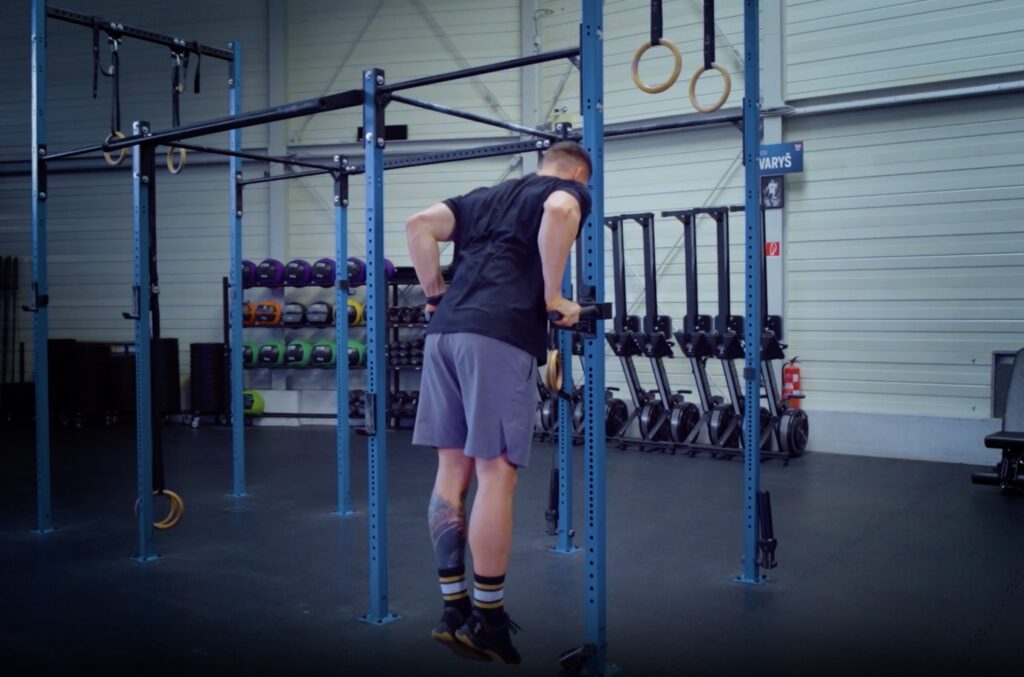
A parallel bar dip starts with the arms straight and the body supported between two bars. You lower the body by bending the elbows and allowing the shoulders to move into extension, then press back to the start. The chest, triceps, and front deltoids all contribute.
Why Dips Can Be Effective for Chest Growth
Dips can be challenging because you are lifting a substantial proportion of your body mass. As your strength improves, you can add external load with a belt, weighted vest, or dumbbell held between the legs. This makes progressive overload straightforward.
The movement also allows the chest to work through a large range of motion when it is performed with control. At the bottom position, the chest and front shoulder muscles are lengthened as the upper arm moves behind the torso. Training muscles at longer lengths can be a useful hypertrophy stimulus, although the practical outcome still depends on overall training quality, exercise execution, and the amount of productive work completed.
Electromyography research confirms that the pectoralis major is active during parallel bar dips. However, muscle activation measurements do not directly prove that one exercise will build more muscle than another. They show that a muscle is active during a movement, but hypertrophy depends on a much wider set of factors, including load, range of motion, effort, volume, recovery, and individual tolerance.
How to Make Dips More Chest Focused
A slight forward torso lean can shift the movement toward the chest rather than making it almost entirely triceps dominant. Keep the chest lifted, allow the elbows to travel somewhat outward, and descend under control. The aim is not to force an exaggerated position. It is to find a stable path that lets you feel the chest working without discomfort in the front of the shoulder.
Your individual shoulder structure will influence how deep you can dip comfortably. Some athletes can reach a deep bottom position without pain, while others feel pinching or instability before they get there. Do not chase depth at the expense of joint comfort. Stop at the deepest position you can control without pain, then press smoothly back to the top.
How Push Ups Train the Chest
The standard push up involves lowering the body toward the floor while maintaining a rigid trunk, then pressing the body back up. The pectoralis major, triceps, and front deltoids produce the pressing force, while the trunk, hips, and shoulder muscles stabilize the body.
Push ups are often dismissed as a beginner exercise, but that is too simplistic. Research comparing push ups with the bench press has found similar improvements in chest and triceps muscle thickness when the exercises are matched for relative intensity and performed with sufficient effort. This matters because it shows that a push up can be a legitimate hypertrophy exercise, not merely a warm up or conditioning drill.
Why Push Ups Are So Useful
The major advantage of push ups is adaptability. A beginner can perform them against a wall, on a bench, or from the knees while learning good pressing mechanics. A stronger athlete can make them harder with a weighted vest, resistance band, plates placed securely across the upper back, rings, suspension handles, or a deficit created by push up handles.
This flexibility makes it easier to keep the exercise in a productive repetition range. If you can perform 40 standard push ups without getting close to failure, the movement is no longer challenging enough for efficient chest growth. Instead of adding endless repetitions, increase the load or use a harder variation.
Push ups also allow the shoulder blades to move naturally across the rib cage. During the final part of the press, the shoulder blades can move forward slightly, which trains the serratus anterior and may feel more comfortable for some people than a fixed bar pressing movement.
How to Make Push Ups More Chest Focused
Place the hands slightly wider than shoulder width, while keeping a position that still feels strong and comfortable. Lower the chest toward the floor with control and avoid allowing the hips to sag or rise. A full push up should involve a stable trunk and a meaningful bend at the elbows, rather than a short, rushed movement.
Elevating the feet can increase the percentage of body weight handled by the upper body and make the movement harder. Deficit push ups using handles or parallettes can increase the available range of motion, provided your shoulders tolerate the deeper position. Adding external load is often the simplest progression once standard bodyweight push ups become too easy.
Which Exercise Loads the Chest More Effectively?
For a strong athlete, weighted dips often provide a faster route to high mechanical loading. Adding five kilograms or ten kilograms to a dip can make a clear difference immediately. This is especially useful for people who have already outgrown standard push ups and want a demanding compound movement without using a barbell or chest press machine.
However, loading does not automatically mean better hypertrophy. A loaded push up can provide a very similar training stimulus if the exercise is hard enough and performed close to muscular failure. The chest does not recognize the name of the exercise. It responds to tension, effort, repeated exposure, and recovery.
The main practical difference is progression. Dips are naturally difficult and simple to load once you can perform solid repetitions. Push ups need more deliberate progression, especially for experienced lifters. If you only perform basic bodyweight push ups, dips will probably become the more challenging chest exercise sooner. If you use a vest, bands, deficit handles, or rings, push ups can remain highly effective for years.
The Shoulder Comfort Question
Dips require the shoulder to move into extension at the bottom of the repetition. This position is not inherently dangerous, but it may irritate athletes with limited shoulder mobility, a history of shoulder pain, poor control, or a current injury. The deeper you descend, the greater the demand on the shoulder.
Push ups are usually easier to adjust around discomfort. You can elevate the hands, reduce the range of motion temporarily, use handles to alter wrist position, or change hand placement. This does not mean push ups are risk free. Poor form, excessive volume, and rapid increases in training load can also cause problems. Still, they are generally the more accessible option.
Pain is useful information, not a challenge to overcome through force. If dips repeatedly cause sharp pain, pinching, or instability, replace them with weighted push ups, dumbbell presses, machine presses, or cable fly variations while you address the issue. There is no muscle building benefit to repeatedly aggravating a joint.
How to Program Dips and Push Ups for a Bigger Chest
For muscle growth, both exercises work best when sets are challenging and close to muscular failure. You do not need to reach absolute failure on every set, but finishing with several repetitions still available is less likely to provide a strong hypertrophy stimulus when the load is light.
Aim to accumulate multiple hard chest focused sets each week. Your exact amount should reflect your experience, recovery, and the rest of your program. If you also bench press, incline press, or use chest machines, remember that those movements contribute to your total chest training volume.
3 Best Beginner Cable Exercises For More Muscular Arms
A simple approach is to use dips as your heavier compound movement for lower repetitions, then use loaded push ups for moderate to higher repetitions. For example, you could perform dips for three sets of six to ten controlled repetitions and loaded push ups for two or three sets of eight to fifteen repetitions. If dips do not feel good, replace them with an additional push up variation.
Progress should be gradual. Add a small amount of load, perform an extra repetition with the same load, improve your range of motion, or use stricter control. These are all valid forms of progressive overload. The goal is not to make every session dramatically harder. The goal is to become measurably stronger over months.
The Verdict
Dips can build a bigger chest because they are demanding, easy to load, and allow a large range of motion. They are particularly useful for stronger athletes who can perform them with stable, pain free technique. Their main limitation is that they are not suitable for every shoulder or every training level.
Push ups can also build a bigger chest, especially when they are loaded and performed close to failure. They are easier to learn, easier to modify, and more accessible for people training at home. Their main limitation is that standard bodyweight push ups eventually become too easy for many experienced lifters.
If you must choose one exercise, choose dips if you can perform them comfortably, progress them consistently, and recover well from them. Choose push ups if you are a beginner, train at home, need more flexible progression, or find dips uncomfortable. For the best chest development, use dips as a heavier movement when they suit you and keep push ups in your program as a versatile way to add productive training volume.
Key Takeaways
| Factor | Dips | Push Ups |
|---|---|---|
| Chest building potential | Excellent when performed with control and progressive loading | Excellent when sufficiently loaded and performed close to failure |
| Best suited to | Intermediate and advanced trainees with comfortable shoulders | Beginners through advanced trainees |
| Progressive overload | Easy with a dip belt or weighted vest | Requires external load or harder variations as strength improves |
| Shoulder demands | Higher, especially in a deep bottom position | Usually easier to modify for comfort |
| Main limitation | May aggravate some shoulders | Standard bodyweight versions can become too easy |
| Best overall use | Heavy compound chest and triceps training | Adaptable chest volume and home training |
References
- Çinarli, F.S., Kafkas, M.E., Soylu, A.R. and Yilmaz, N. (2021) ‘Effect of elbow angle on triceps brachii and pectoralis major muscle activity during parallel bar dip’, Kinesiologia Slovenica, 27(3), pp. 57–69.
- Kikuchi, N. and Nakazato, K. (2017) ‘Low load bench press and push up induce similar muscle hypertrophy and strength gain’, Journal of Exercise Science and Fitness, 15(1), pp. 37–42.
- Schoenfeld, B.J., Ogborn, D. and Krieger, J.W. (2017) ‘Dose response relationship between weekly resistance training volume and increases in muscle mass: A systematic review and meta analysis’, Journal of Sports Sciences, 35(11), pp. 1073–1082.
- Schoenfeld, B.J., Grgic, J., Ogborn, D. and Krieger, J.W. (2017) ‘Strength and hypertrophy adaptations between low versus high load resistance training: A systematic review and meta analysis’, Journal of Strength and Conditioning Research, 31(12), pp. 3508–3523.
- Vigotsky, A.D., Halperin, I., Lehman, G.J., Trajano, G.S. and Vieira, T.M. (2018) ‘Interpreting signal amplitudes in surface electromyography studies in sport and rehabilitation sciences’, Frontiers in Physiology, 8, article 985.