

A V shaped torso comes largely from developing broad lats while building enough upper back, shoulders, and chest to create contrast with the waist. For beginners, lat pulldowns and rows are two of the most useful exercises for this goal. Both train the latissimus dorsi, which is the large back muscle that gives the upper body much of its width. They are not interchangeable, though.
Lat pulldowns emphasize pulling the upper arm down toward the torso. Rows emphasize pulling the upper arm back behind the torso while the shoulder blades move toward the spine. Those differences change which muscles receive the most attention and how the back looks as it develops.


If you can only choose one exercise, lat pulldowns are usually the better starting point for building the visual width associated with a V shaped torso. However, rows are essential for adding upper back thickness, training the muscles around the shoulder blades, and creating a balanced physique. The strongest beginner approach is not choosing one forever. It is using pulldowns as the main width builder and rows as the supporting movement that fills out the rest of the back.
What Creates a V Shaped Torso?
The V shaped look is an illusion created by proportions. Wider shoulders and lats make the waist appear narrower, even if your waist measurement does not change. The latissimus dorsi is especially important because it runs from the lower back and pelvis up toward the upper arm. When it becomes more muscular, it adds width below the armpits and creates the sweeping outline many people associate with an athletic back.
The lats extend, adduct, and internally rotate the upper arm. In simple terms, they help bring your arm down from overhead and pull it toward your body. This is why vertical pulling movements such as pulldowns and pull ups are logical choices when your goal is back width.
Rows also involve the lats, but they place greater emphasis on muscles that pull and stabilize the shoulder blades. These include the middle trapezius, rhomboids, rear deltoids, and parts of the lower trapezius. Those muscles help create a denser upper back and can improve how substantial your torso looks from the side and rear.
Neither exercise can selectively transform your skeleton or directly shrink your waist. Your bone structure, body fat level, and overall muscular development all influence the final appearance. Still, building the lats and upper back is one of the most productive ways for a beginner to improve upper body proportions.
The Case for Lat Pulldowns
Why Pulldowns Are Better for Back Width
The lat pulldown begins with the arms overhead and asks you to bring the bar down toward the upper chest. This movement closely matches one of the main jobs of the lats, which is bringing the upper arm down toward the torso.
Research using electromyography has found that both pulldowns and rows recruit the lats effectively. A study comparing common back exercises found that wide grip pulldowns and seated rows both produced a high ratio of lat activity relative to biceps activity. This matters because beginners often feel their arms working first during pulling exercises. A movement that allows the lats to contribute strongly can make it easier to accumulate useful back training volume.
Pulldowns also make it easy to train the lats through a large and controlled range of motion. You can start with your arms comfortably extended overhead, then pull the elbows down toward your sides. That long path can help beginners learn to feel the upper arm moving rather than simply curling the weight with the elbows.
For the V shaped look, this is the key advantage. Pulldowns let you repeatedly practice a movement pattern that directly targets the broad muscles on the sides of the torso.
Why Pulldowns Are Beginner Friendly
A pulldown machine provides external stability. Your thighs are secured under the pads, your torso can remain upright, and the cable follows a predictable path. This reduces the balance and lower back demands compared with unsupported free weight rows.
That does not make pulldowns effortless. Beginners still need to control the weight and avoid turning every repetition into a backward lean. Yet the machine allows most people to focus on the target movement without worrying about holding a bent over position or keeping dumbbells from swinging.
3 Best Exercises for Bigger Pecs Without the Bench Press
Another advantage is simple progression. The weight stack makes it easy to increase resistance in small increments once you can complete your target repetitions with good technique. Progressive overload is important because muscle growth requires a training stimulus that becomes more challenging over time.
How to Perform a Lat Pulldown
Set the thigh pad so it holds you securely without pinning you down. Use a comfortable overhand grip that is somewhat wider than shoulder width, but do not force an extremely wide hand position. Sit tall with your feet planted, keep your rib cage controlled, and begin with your arms extended overhead.
Start the pull by bringing your elbows down and slightly toward your sides. Pull the bar toward the upper chest area while keeping your neck relaxed. Avoid pulling the bar behind your head, as this position is not necessary for lat development and may be uncomfortable for the shoulders.
Let the bar rise under control until your arms are extended again. Do not rush the upward phase. A controlled return allows you to use a meaningful range of motion and repeat consistent reps.
The Case for Rows
What Rows Add That Pulldowns Miss
Rows are horizontal pulling exercises. Instead of bringing the arms down from overhead, you pull the resistance toward your torso. This makes rows particularly useful for the middle back, including the rhomboids and middle trapezius.
In the study comparing pulldowns with seated rows, rows showed greater activation of the middle trapezius and rhomboid muscle group. These muscles sit between and around the shoulder blades. Developing them contributes to a stronger looking upper back, especially when viewed from behind.
Rows also train the lats, so they are not only a thickness exercise. A well performed seated cable row can build the lats while also challenging the upper back. The practical difference is that rows usually spread more of the work across the muscles that retract and control the shoulder blades.
That is valuable for beginners because a V shaped torso should not be built with lat width alone. If the lats grow but the upper back remains underdeveloped, the physique can look incomplete. Rows provide the density and structure that make the torso appear more athletic from several angles.
Choosing the Right Row
A chest supported row or seated cable row is often the best place to start. Both options reduce the need to stabilize the lower back, allowing you to focus on pulling with the upper body.
Seated cable rows are particularly versatile. You can use a neutral grip handle, keep your torso mostly still, and adjust the resistance easily. A chest supported dumbbell row is also effective because the bench limits momentum and reduces the temptation to turn the exercise into a whole body swing.
A bent over barbell row can be an excellent exercise, but it demands more technique, hip control, and lower back endurance. It is not automatically superior simply because it is harder. For a beginner whose main goal is building muscle, the best row is usually the one that can be performed safely, consistently, and progressed over time.
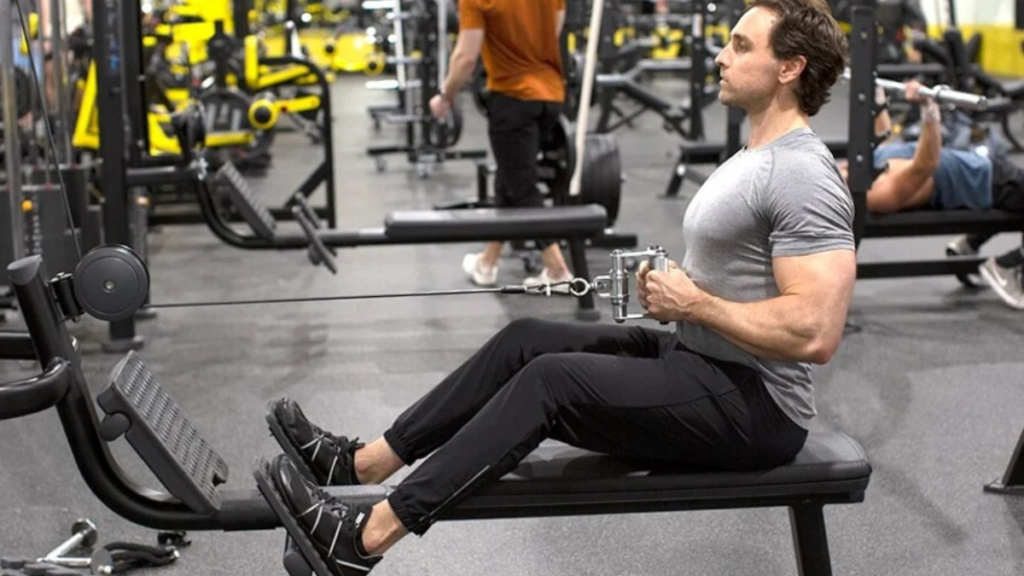
How to Perform a Seated Cable Row
Sit tall with your feet braced and your chest comfortably lifted. Start with the arms extended and your shoulders reaching forward naturally. Pull the handle toward your lower ribs or upper abdomen by driving the elbows back.
Keep your torso stable rather than rocking backward to move the weight. As the handle approaches your body, allow the shoulder blades to move toward each other without aggressively forcing them into an uncomfortable position. Return the handle slowly until your arms are extended again.
The goal is not to use the heaviest weight in the gym. The goal is to create repeatable, challenging repetitions that train the lats and upper back rather than your momentum.
Which Exercise Builds the Better V Shape?
For beginners, lat pulldowns win the narrow question of which movement is more directly useful for building visible back width. The vertical path and overhead starting position make the exercise an especially practical tool for training the lats.

Rows win the question of which movement adds more complete upper back development. They train the lats while placing more emphasis on the muscles that create thickness and support shoulder blade movement.
The important point is that muscle activation studies do not prove that one exercise produces more long term growth than another. Electromyography measures electrical activity during an exercise, not the exact amount of muscle that will be built after months of training. The direct long term evidence comparing rows and pulldowns for lat growth is limited.
That is why it is more useful to look at the exercises as complementary. Pulldowns provide a simple way to prioritize width. Rows ensure that the middle and upper back are not neglected. Together, they offer a more complete stimulus than either exercise alone.
How Much Should Beginners Train?
Research on resistance training volume shows a dose response relationship between the number of hard weekly sets and muscle growth. More volume is not always better, especially when technique and recovery begin to suffer, but beginners generally need more than one casual set to make reliable progress.
Start with six to eight challenging sets per week across pulldowns and rows. For example, you could perform three sets of pulldowns and three sets of seated rows twice per week, or complete three sets of each exercise once per week before gradually adding more work.

Choose loads that allow roughly eight to fifteen controlled repetitions. Research suggests that muscle growth can occur across a wide range of loads when sets are performed with sufficient effort. This gives beginners flexibility. You do not need to use extremely heavy weights to build your back, but the final repetitions should feel demanding while your technique remains solid.
Leave a small margin before complete failure on most sets. Stopping when you feel you could perhaps complete one or two more clean reps is a useful starting point. As your skill and confidence improve, you can occasionally push closer to muscular failure while maintaining form.
A Simple Beginner Plan
Train your back twice each week, allowing at least one day between sessions. Begin each session with lat pulldowns while you are fresh, since they are your main movement for width. Follow them with a row to build the upper back and reinforce balanced development.
Use three sets of lat pulldowns for eight to twelve repetitions. Then perform three sets of seated cable rows or chest supported rows for eight to fifteen repetitions. Rest long enough to recover your breathing and maintain good execution on the next set.
When you reach the top of the repetition range on every set with consistent technique, increase the resistance slightly at your next session. Small, steady increases are more sustainable than dramatic jumps that force you to sacrifice range of motion.
Keep this plan for several weeks before changing exercises. Beginners often make faster progress by practicing a small number of movements consistently than by chasing a new variation every workout.
The Bottom Line
Lat pulldowns are the better first choice if your primary goal is to build the width that makes a V shaped torso more noticeable. They are stable, easy to progress, and directly train the lats through a vertical pulling pattern.
Rows are still necessary because they build the middle back, rhomboids, trapezius, and rear shoulders while continuing to train the lats. They make your back look fuller and more complete.
The best answer is to use both. Make pulldowns your main width exercise, use rows to build thickness and balance, and focus on gradual progression with controlled technique. That combination gives beginners the most reliable route toward a broader, more muscular upper body.
Key Takeaways
| Exercise choice | Main benefit | Best use for beginners |
|---|---|---|
| Lat pulldowns | Prioritize lat development and visible upper body width | Use as the main vertical pulling exercise |
| Rows | Build middle back thickness and shoulder blade control | Use alongside pulldowns for a complete back program |
| Best overall approach | Combines width with upper back density | Train both exercises consistently each week |
| Productive weekly volume | Multiple challenging sets support muscle growth | Begin with six to eight combined working sets and progress gradually |
| Repetition range | Muscle growth can occur with lighter or heavier loads when effort is high | Use loads that allow controlled sets of roughly eight to fifteen reps |
References
- Lehman, G.J., Buchan, D.D., Lundy, A., Myers, N. and Nalborczyk, A. (2004) ‘Variations in muscle activation levels during traditional latissimus dorsi weight training exercises: An experimental study’, Dynamic Medicine, 3, 4.
- Schoenfeld, B.J., Grgic, J., Ogborn, D. and Krieger, J.W. (2017) ‘Strength and hypertrophy adaptations between low versus high load resistance training: A systematic review and meta analysis’, Journal of Strength and Conditioning Research, 31(12), pp. 3508 to 3523.
- Schoenfeld, B.J., Ogborn, D. and Krieger, J.W. (2017) ‘Dose response relationship between weekly resistance training volume and increases in muscle mass: A systematic review and meta analysis’, Journal of Sports Sciences, 35(11), pp. 1073 to 1082.
- Signorile, J.F., Zink, A.J. and Szwed, S.P. (2002) ‘A comparative electromyographical investigation of muscle utilization patterns using various hand positions during the lat pull down’, Journal of Strength and Conditioning Research, 16(4), pp. 539 to 546.