

A V-shaped torso has broad shoulders and a wide back that tapers toward the waist. Your underlying bone structure affects how that shape looks, but you can build more muscle in the shoulders and upper back to create greater width. The most useful free weight exercises for this goal train the deltoids and the muscles that move and stabilize the shoulder blades and upper arms.
No single exercise can guarantee a particular appearance, and a workout cannot change where your body stores fat. The exercises below can help build the muscles that contribute to a wider-looking upper body when you train them consistently and gradually increase the challenge.



Research on resistance training supports using multiple sets and building a sustainable training routine, while studies of exercise technique can help explain which muscles contribute to particular movements. Muscle activity measured in a single workout does not, by itself, prove that one exercise will produce more growth over time.
What Builds a V-Shaped Torso?
The latissimus dorsi muscles, commonly called the lats, cover much of the back and help move the upper arm down and back. Developing them can add visible width below the shoulders. The deltoids form the rounded muscles at the shoulders. Training the middle portion of the deltoid with arm raises, and the front portion with pressing, can add to the appearance of a broader upper body.
A stronger upper back also contributes to the overall look of the torso. Rows train the lats alongside other back muscles, including the trapezius and rear deltoids. These muscles work together during pulling movements, so no row isolates one part of the back completely. A balanced program should train both pulling and pressing patterns, use a range of motion you can control, and leave enough time for recovery.
The five exercises below use dumbbells or a barbell. They are not the only effective options, but together they train the shoulders and back from several angles.
1. Single-Arm Dumbbell Row
The single-arm dumbbell row is a practical way to train one side of the back at a time. It works the lats and other upper-back muscles as you draw your elbow toward your torso. Because each side works independently, you can focus on a controlled movement and notice whether one side feels less coordinated than the other.
How to do it
Place one hand and the same-side knee on a bench, keeping your back steady and close to parallel with the floor. Hold a dumbbell in the opposite hand and let your arm hang beneath your shoulder. Pull the dumbbell toward your hip by driving your elbow back, then lower it under control until your arm is extended again. Keep your torso still rather than twisting to lift the weight.
Think about moving your upper arm, not just curling the dumbbell with your hand. Use a weight that lets you complete each repetition without jerking your body or shortening the lowering phase. If you cannot keep your position steady, reduce the load.
Perform two to four sets of eight to 12 repetitions on each side. This range is a practical starting point, not a special formula that guarantees muscle growth. Choose a load that makes the final repetitions challenging while allowing you to maintain good form.
2. Bent-Over Barbell Row
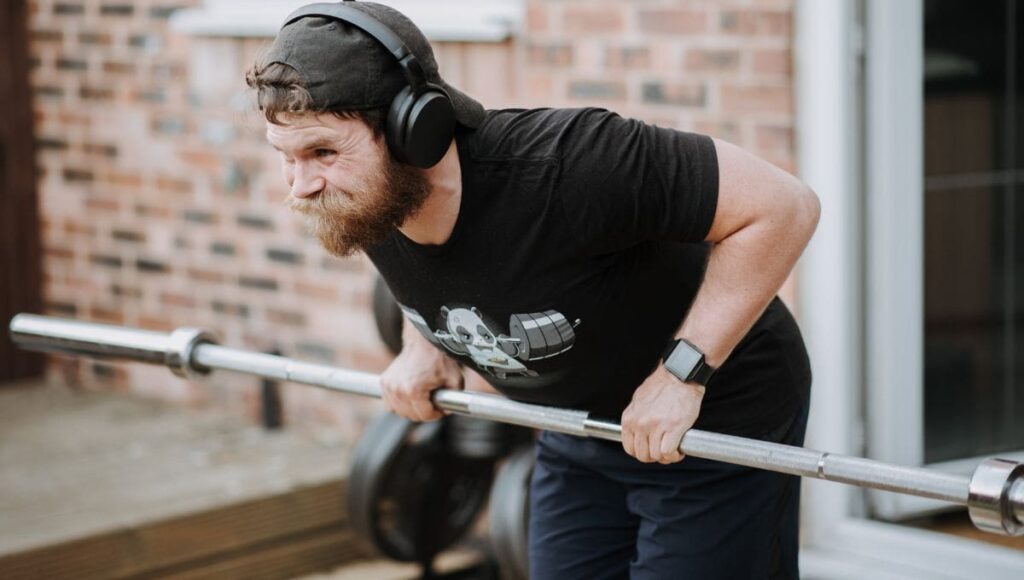
The bent-over barbell row lets you train both sides of your back together while holding a barbell. It involves the lats and upper-back muscles, with the hips and trunk working to maintain your bent-over position. A study comparing common pulling exercises recorded activity in the latissimus dorsi and trapezius during the bent-over row, though short-term muscle activity readings do not tell us exactly how much muscle an exercise will build over time.
How to do it
Stand with your feet about hip-width apart and hold a barbell with your hands just outside your legs. Bend at the hips, keep a slight bend in your knees, and lean forward while maintaining a stable spine. Let the bar hang below your shoulders, then pull it toward your lower ribs or upper abdomen. Lower it with control and repeat.
The exact torso angle can vary, but it should stay steady throughout the set. Avoid rounding your lower back or using a sudden hip drive to swing the bar upward. If your back position becomes difficult to hold, choose a lighter weight or try the single-arm row with bench support.
Start with two to four sets of six to 12 repetitions. The barbell row can be demanding because your back muscles and trunk must maintain position at the same time, so prioritize control over adding weight.
3. Dumbbell Pullover
The dumbbell pullover trains the shoulder movement of bringing the arms back from an overhead position. The lats contribute to this movement, but the chest and other muscles also take part. Research examining pullover variations has found that muscle activity can differ with joint position and the way the exercise is performed. That makes the pullover a useful accessory, rather than a guaranteed lat isolation exercise.
How to do it
Lie on a bench with your upper back supported and your feet firmly on the floor. Hold one dumbbell securely with both hands above your chest, keeping a slight bend in your elbows. Slowly lower the weight behind your head as far as you can while maintaining a comfortable shoulder position and stable torso. Bring the dumbbell back over your chest by drawing your arms forward.
Use a moderate load and move slowly, especially as the dumbbell travels behind your head. Do not force a deep stretch if it causes shoulder discomfort or makes your lower back arch. You should feel the movement mainly around your shoulders and upper torso, without pain.
Try two to three sets of 10 to 15 repetitions. Since the pullover can challenge the shoulders in a stretched position, it is sensible to begin lighter than you think you need and increase the load only when you can control the full movement.
4. Dumbbell Lateral Raise
The dumbbell lateral raise targets shoulder abduction, the movement of lifting your arms out to the sides. The middle portion of the deltoid contributes to this movement, which makes the exercise a useful choice for building shoulder width. A review of electromyography research on common shoulder exercises found that abduction exercises, including lateral raises, tend to show substantial activity in the middle deltoid. That evidence describes muscle activity during exercise, not a direct comparison of long-term muscle growth.
How to do it
Stand with a dumbbell in each hand and your arms resting by your sides. Keep a slight bend in your elbows and raise your arms out to the sides until your hands approach shoulder height. Lower the dumbbells slowly. Keep your shoulders relaxed and avoid shrugging or swinging your torso to get the weights moving.
Many people use too much weight on this exercise. A lighter pair of dumbbells often makes it easier to control the movement and keep tension on the shoulders. Raise your arms in a comfortable path slightly forward of your torso if that feels more natural than moving directly out to the sides.
Perform two to four sets of 10 to 20 repetitions. Stop the set if you have to use momentum or if your shoulder becomes painful. Smooth repetitions matter more here than lifting the heaviest dumbbells in the gym.
5. Dumbbell Overhead Press
The overhead press trains the front and middle deltoids, along with the triceps and muscles that help control the shoulder blades. It complements the lateral raise by training the shoulders through a pressing movement with a heavier load. Research comparing overhead press variations has measured activity in the deltoids and other shoulder muscles, but the exact result can depend on the equipment, body position, and technique used.
How to do it
Stand or sit with a dumbbell in each hand at shoulder height. Keep your wrists stacked over your elbows and your ribs comfortably down. Press the weights upward until your arms are extended without forcing your elbows into a hard lock. Lower the dumbbells under control back to shoulder height.
Standing presses require you to maintain balance and brace your trunk. Sitting with back support can make it easier to focus on the shoulder movement. Either version can work. Choose the position that lets you press comfortably without leaning back or arching your lower back to finish a repetition.
Complete two to four sets of six to 12 repetitions. Use a load that allows you to keep the dumbbells moving in a steady path. If overhead movement causes pain, stop and choose a comfortable alternative or seek advice from a qualified health professional.
How to Put the Exercises Together
You can train these exercises in one upper-body session or divide them across two workouts each week. One straightforward session could include the barbell row, dumbbell overhead press, single-arm dumbbell row, lateral raise, and pullover. Start with two or three sets per exercise, then adjust based on your training experience, recovery, and progress.
For many people, training each movement with a controlled technique and gradually increasing the challenge is more useful than changing exercises every week. You might add a repetition, use a slightly heavier dumbbell, or complete another set once your current work feels manageable. Weekly training volume is associated with muscle growth, but more sets are not automatically better if they reduce exercise quality or interfere with recovery.
3 Best Exercises for Building the Upper Body Beginners Often Ignore
Rest long enough between sets to perform the next set with good technique. Track your weights and repetitions so you can see whether your performance is improving over time. If your shoulders, elbows, or back hurt during an exercise, stop the set and reassess your technique, load, or range of motion.
A V-shaped look is influenced by more than exercise selection. Your frame and individual muscle attachments affect your proportions, and body composition changes how clearly your muscles show. A consistent resistance training routine can develop the shoulders and back, but results vary from person to person.
Key Takeaways
| Goal | Exercise | Main training focus |
|---|---|---|
| Train each side of the back | Single-arm dumbbell row | Lats and upper back |
| Build back strength with a barbell | Bent-over barbell row | Lats and upper back, with trunk stabilization |
| Add a shoulder extension movement | Dumbbell pullover | Lats and chest contribute to the movement |
| Emphasize shoulder width | Dumbbell lateral raise | Middle deltoids |
| Train the shoulders with a press | Dumbbell overhead press | Deltoids and triceps |
References
- American College of Sports Medicine, 2009. Progression models in resistance training for healthy adults. Medicine & Science in Sports & Exercise, 41(3), pp. 687–708.
- Calatayud, J., Borreani, S., Colado, J.C., Martin, F., Tella, V. and Andersen, L.L., 2015. Muscle activation during push-ups with different suspension training systems. Journal of Sports Science & Medicine, 14(3), pp. 603–609.
- de Salles, B.F., Simao, R., Miranda, F., Novaes, J.S., Lemos, A. and Willardson, J.M., 2009. Rest interval between sets in strength training. Sports Medicine, 39(9), pp. 765–777.
- Lehman, G.J., Buchan, D.D., Lundy, A., Myers, N. and Nalborczyk, A., 2004. A comparison of the muscle activation pattern during the push-up and bench press exercises. Journal of Strength and Conditioning Research, 18(2), pp. 356–361.
- Saeterbakken, A.H. and Fimland, M.S., 2013. Effects of body position and loading modality on muscle activity and strength in shoulder presses. Journal of Strength and Conditioning Research, 27(7), pp. 1824–1831.
- Schoenfeld, B.J., Ogborn, D. and Krieger, J.W., 2017. Dose-response relationship between weekly resistance training volume and increases in muscle mass: a systematic review and meta-analysis. Journal of Sports Sciences, 35(11), pp. 1073–1082.
- Schoenfeld, B.J. and Grgic, J., 2020. Effects of range of motion on muscle development during resistance training interventions: a systematic review. SAGE Open Medicine, 8, pp. 1–8.
- Soares, E.G., Brown, A.F., Goss-Sampson, M.A. and Rodrigues, B.M., 2022. Differences between pullover and pulldown exercises on maximal isometric force and myoelectric activity in recreationally trained men. Journal of Human Kinetics, 82, pp. 5–14.
- Welsch, E.A., Bird, M. and Mayhew, J.L., 2005. Electromyographic activity of the pectoralis major and anterior deltoid muscles during three upper-body lifts. Journal of Strength and Conditioning Research, 19(2), pp. 449–452.