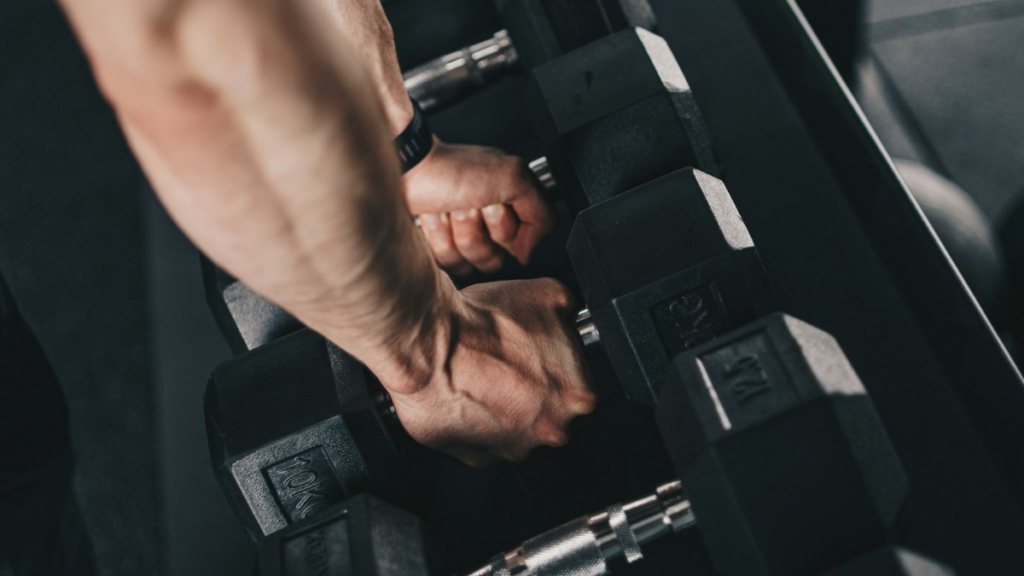
Dumbbells are useful, but they are not a requirement for building bigger biceps. A beginner can make excellent arm gains with a pull up bar, a barbell, a cable machine, or even a simple resistance band. What matters most is that the biceps are challenged through a controlled range of motion, training is repeated consistently, and the resistance gradually becomes more demanding.
The biceps brachii crosses both the shoulder and elbow joints. Its main jobs are flexing the elbow and turning the palm upward, which is called supination. That is why exercises such as chin ups, curls, and band curls can all contribute to biceps growth, even though they look different. The brachialis and brachioradialis also help bend the elbow and can add visible thickness to the upper arm and forearm.


Research consistently shows that resistance training increases muscle size when enough challenging work is performed. You do not need to use extremely heavy weights to grow. Lower loads can produce similar hypertrophy to heavier loads when sets are taken sufficiently close to muscular failure. For a beginner, that makes bodyweight exercises, bands, cables, and lighter barbells highly effective options.
The three exercises below are simple to learn, easy to progress, and capable of building noticeably bigger biceps without a single dumbbell.
What Actually Makes Biceps Grow
Biceps training should be hard enough to create fatigue in the target muscles, but controlled enough that technique remains solid. A curl only works as a curl if the elbow bends because the biceps are doing the work. Swinging the torso, driving the hips forward, or allowing the shoulders to take over may let you lift more weight, but it reduces the quality of the stimulus on the arms.
Total training volume also matters. Studies show a dose response relationship between the number of challenging resistance training sets performed and increases in muscle mass. This does not mean beginners should perform endless curls. It means that one easy set each week is unlikely to be enough. A practical starting point is six to ten challenging direct sets for the biceps per week, split over two workouts if possible.
Training close to failure is another useful tool. You do not need to force every set until the bar cannot move, particularly while learning. However, your final repetitions should feel demanding. You should usually finish a set feeling that you could have completed roughly one to three more clean repetitions. Evidence suggests that hypertrophy tends to improve as sets are performed closer to muscular failure, although exact failure is not necessary for every set.
Good biceps training also requires progression. When you can complete the top end of your target repetition range with clean form, add a small amount of resistance, perform another repetition, or choose a harder variation. This simple approach gives your muscles a reason to adapt.
1. Chin Ups
Chin ups are one of the best compound exercises for building bigger biceps. Unlike a standard pull up, where the palms face away from you, a chin up uses an underhand grip with the palms facing toward you. This position places the biceps in a strong role during the pulling movement while also training the lats, upper back, forearms, and grip.
Research comparing chin ups and pull ups has found that both movements strongly activate the major pulling muscles, including the biceps brachii. Chin ups are particularly valuable for beginners because they teach the arms to produce force while the body moves as one unit. They also make your biceps work with loads far greater than most beginners can curl.
How to Perform Chin Ups
Grab a stable bar with an underhand grip about shoulder width apart. Hang with straight arms, then tighten your stomach and keep your rib cage controlled. Start the movement by drawing your shoulders down and pulling your elbows toward your sides. Continue until your chin clears the bar, then lower yourself slowly until your arms are straight again.
Avoid kicking your legs or throwing your head toward the bar. Think about driving your elbows down rather than trying to pull with your hands. This cue often helps beginners feel the biceps and back working together.
If you cannot yet perform a full chin up, start with an assisted chin up machine, a resistance band attached to the bar, or slow lowering repetitions. For a lowering repetition, step onto a box, begin with your chin above the bar, and lower over three to five seconds. Eccentric focused training can improve strength and help beginners develop the control needed for full repetitions.
How to Program Chin Ups
Perform two to four sets of five to ten repetitions, resting for at least two minutes between sets. If you are using assistance, choose a level that allows smooth repetitions with a full range of motion. When you can complete ten clean bodyweight repetitions, add resistance gradually with a weight belt or a backpack.
Chin ups do not isolate the biceps, but that is part of their appeal. They build useful upper body strength while providing a meaningful biceps stimulus. For beginners who want bigger arms and a stronger back, they are an efficient starting point.
2. Standing Barbell Curls
The standing barbell curl is one of the simplest direct biceps exercises available. It lets you use both arms together, making it easier to control the bar and add resistance over time. A straight bar, an EZ curl bar, or even a light fixed barbell can work well.
The main advantage of the barbell curl is progressive overload. Because the movement is stable and easy to measure, you can gradually add small amounts of weight as your strength improves. This is important because muscle growth is driven by repeated exposure to resistance that challenges your current capacity.
Studies examining curl variations show that grip and wrist position can change the relative involvement of muscles around the elbow. However, beginners should not overcomplicate this. A comfortable underhand grip, controlled elbow flexion, and consistent effort will do more for arm growth than constantly changing exercises.
How to Perform Standing Barbell Curls
Stand tall with your feet about hip width apart and hold the bar with an underhand grip. Start with the bar against your thighs and your arms fully straight. Keep your upper arms close to your torso, then curl the bar upward by bending your elbows.
Stop when your forearms are close to vertical or when the bar reaches the front of your shoulders. Squeeze your biceps briefly, then lower the bar under control until your elbows are straight. Take two to three seconds to lower each repetition.
The common mistake is turning the exercise into a full body movement. A small amount of natural body movement can happen with harder sets, but beginners should resist the urge to lean backward and swing the bar. If you cannot control the lowering phase, the load is too heavy.
How to Program Standing Barbell Curls
Perform three sets of eight to fifteen repetitions. Start with a load that lets you keep your wrists neutral and your upper arms mostly still. When you can complete fifteen clean repetitions on every set, increase the load slightly and return to the lower end of the range.
A barbell curl works especially well after chin ups. Chin ups train the biceps with a demanding compound movement, while curls add direct work that lets you focus on elbow flexion and accumulating quality repetitions.
3. Resistance Band Curls
Resistance band curls are an underrated beginner biceps exercise. They are inexpensive, easy to use at home, and provide resistance without requiring a rack, bench, or dumbbell set. Bands also make it easy to adjust the difficulty by changing the band thickness, stepping farther away from the anchor point, or adding repetitions.
Unlike a free weight, a band becomes harder as it stretches. That means the resistance is often greatest near the top of the curl, where the elbow is more flexed. This creates a different resistance profile from a barbell curl, but it does not make the exercise less effective. Muscle growth can occur across a range of loading methods when the muscle is trained with sufficient effort.
Research comparing elastic resistance training with conventional resistance training indicates that bands can produce similar strength gains when training volume and effort are appropriately matched. For beginners who train at home or do not have access to a gym, that makes band curls a genuinely useful muscle building option rather than a temporary substitute.
How to Perform Resistance Band Curls
Stand in the middle of a resistance band and hold one end in each hand with your palms facing forward. Begin with your arms straight and your hands by your thighs. Curl your hands toward your shoulders while keeping your elbows close to your sides.
Pause briefly at the top, then lower slowly until your arms are fully straight. Keep your chest tall and avoid leaning backward as the band tension increases. If the band is too easy, step wider on it to shorten the available length and create more resistance. If it is too difficult, use a lighter band or stand with a narrower stance.
You can also perform the exercise one arm at a time. Single arm band curls are useful if one side is noticeably weaker or if you find it easier to concentrate on the biceps when each arm works independently.
How to Program Resistance Band Curls
Perform two to four sets of twelve to twenty five repetitions. Bands are often best used with slightly higher repetitions because the resistance may be lighter at the start of the movement. Make the final few repetitions challenging while keeping your shoulders and torso stable.
Band curls are also useful as a finishing exercise after chin ups or barbell curls. They allow you to add biceps volume without placing a large additional load on the joints. For beginners, this can be a smart way to practice controlled repetitions and learn how close to failure feels.
A Simple Beginner Biceps Workout Without Dumbbells
You do not need to perform all three exercises every day. Muscles need recovery as well as training. A practical approach is to train the biceps twice per week, leaving at least one day between sessions.
Start with chin ups while you are fresh, because they require the most coordination and total body strength. Follow them with barbell curls for direct mechanical tension, then finish with band curls for additional controlled repetitions. This combination gives you both compound pulling work and direct biceps isolation.
Blow Up Your Pecs Using These 3 Exercises in the Gym
A beginner could begin with three sets of assisted chin ups, three sets of barbell curls, and two sets of band curls. Keep the first few weeks focused on technique. Once the movement patterns feel natural, gradually add repetitions or resistance. Consistency over several months matters far more than finding a perfect exercise variation.
Eat enough protein, sleep adequately, and avoid changing your program every week. Resistance training works because the body adapts to repeated demands. Give the exercises enough time to work, record your progress, and aim to make small improvements regularly.
The Bottom Line
You can build bigger biceps without dumbbells. Chin ups provide heavy compound pulling that challenges the biceps and upper back. Standing barbell curls offer a straightforward way to build strength and add load over time. Resistance band curls provide an accessible option for home training and higher repetition work.
The best exercise is the one you can perform safely, progressively, and consistently. Learn the basics, train with effort, and focus on improving your performance over time. Bigger biceps are not created by complicated training. They are built through patient, challenging, repeatable work.
Key Takeaways
| Exercise | Main benefit | Beginner starting point | Progression method |
|---|---|---|---|
| Chin ups | Trains biceps with bodyweight while building back and grip strength | Two to four sets of assisted or bodyweight repetitions | Reduce assistance, add repetitions, then add resistance |
| Standing barbell curls | Provides direct biceps work and easy load progression | Three sets of eight to fifteen repetitions | Add a small amount of weight after reaching fifteen clean repetitions |
| Resistance band curls | Accessible home training with adjustable resistance | Two to four sets of twelve to twenty five repetitions | Use a thicker band, widen your stance, or add repetitions |
| Weekly approach | Supports sufficient quality training volume | Train biceps twice per week | Add work gradually while maintaining clean technique |
| Effort level | Helps create a meaningful hypertrophy stimulus | Finish most sets with one to three repetitions left | Increase resistance when the target range becomes manageable |
References
- Aboodarda, S.J., Spence, A.J. and Button, D.C. (2016) ‘Pain pressure threshold of a muscle tender spot increases following local and non local rolling massage’, BMC Musculoskeletal Disorders, 16, 265.
- Calatayud, J., Borreani, S., Colado, J.C., Martin, F., Flandez, J., Page, P. and Andersen, L.L. (2015) ‘Bench press and push up at comparable levels of muscle activity results in similar strength gains’, Journal of Strength and Conditioning Research, 29(1), pp. 246 to 253.
- Karpinski, B., Angielski, S., Karpinski, M. and Szymanski, J. (2018) ‘Differences in electromyographic activity of biceps brachii and brachioradialis while performing three variants of curl’, Journal of Strength and Conditioning Research, 32(10), pp. 2865 to 2871.
- Lixandrão, M.E., Ugrinowitsch, C., Berton, R., Vechin, F.C., Conceição, M.S., Damas, F., Libardi, C.A. and Roschel, H. (2018) ‘Magnitude of muscle strength and mass adaptations between high load resistance training versus low load resistance training to failure: A systematic review and meta analysis’, Journal of Strength and Conditioning Research, 32(10), pp. 2959 to 2964.
- Lopes, J.S.S., Machado, A.F., Micheletti, J.K., Almeida, A.C., Cavina, A.P., Pastre, C.M. and Padovani, C.R. (2019) ‘Effects of training with elastic resistance versus conventional resistance on muscular strength: A systematic review and meta analysis’, SAGE Open Medicine, 7, pp. 1 to 11.
- Robinson, Z.P., Pelland, J.C., Remmert, J.F., Refalo, M.C., Jukic, I., Steele, J. and Zourdos, M.C. (2024) ‘Exploring the dose response relationship between estimated resistance training proximity to failure, strength gain, and muscle hypertrophy: A series of meta regressions’, Sports Medicine, 54(9), pp. 2209 to 2231.
- Schoenfeld, B.J., Ogborn, D. and Krieger, J.W. (2016) ‘Effects of resistance training frequency on measures of muscle hypertrophy: A systematic review and meta analysis’, Sports Medicine, 46(11), pp. 1689 to 1697.
- Schoenfeld, B.J., Ogborn, D. and Krieger, J.W. (2017) ‘Dose response relationship between weekly resistance training volume and increases in muscle mass: A systematic review and meta analysis’, Journal of Sports Sciences, 35(11), pp. 1073 to 1082.
- Youdas, J.W., Budach, B.D., Ellerbusch, J.V., Stucky, C.M., Wait, K.R. and Hollman, J.H. (2010) ‘Comparison of muscle activation during the pull up and three different grip positions’, Journal of Strength and Conditioning Research, 24(12), pp. 3404 to 3414.