

Strong, muscular biceps can make your arms look noticeably more developed, improve your pulling strength, and help you feel more confident in the gym. Beginners often make the mistake of treating biceps training as an afterthought, adding a few rushed curls at the end of a workout without a clear plan. That can work for a while, but it is not the most reliable way to build bigger arms.
The biceps respond to the same principles that grow every other muscle. They need challenging resistance, enough quality training volume, good technique, progressive overload, adequate nutrition, and recovery. The good news is that beginners do not need a huge selection of exercises or complicated bodybuilding methods. A few well performed movements, repeated consistently and progressed over time, can create excellent results.



Your biceps brachii has two heads, commonly called the long head and short head. Together, they bend the elbow and help turn the palm upward, a motion called supination. The brachialis, which sits underneath the biceps, also bends the elbow and can contribute substantially to upper arm thickness. Training should therefore include controlled elbow flexion through a useful range of motion, with exercises that you can perform safely and load progressively.
Here are three evidence based tips to help beginners build more muscular biceps.
Tip 1: Prioritize Controlled Curls Through a Full Range of Motion
The most important starting point is simple: choose curls that you can perform with control. A curl only becomes a good biceps exercise when the biceps are doing most of the work. If your lower back is swinging, your shoulders are throwing the weight upward, or your elbows are moving dramatically on every repetition, the target muscles are receiving less useful tension.
Use Exercises You Can Feel and Control
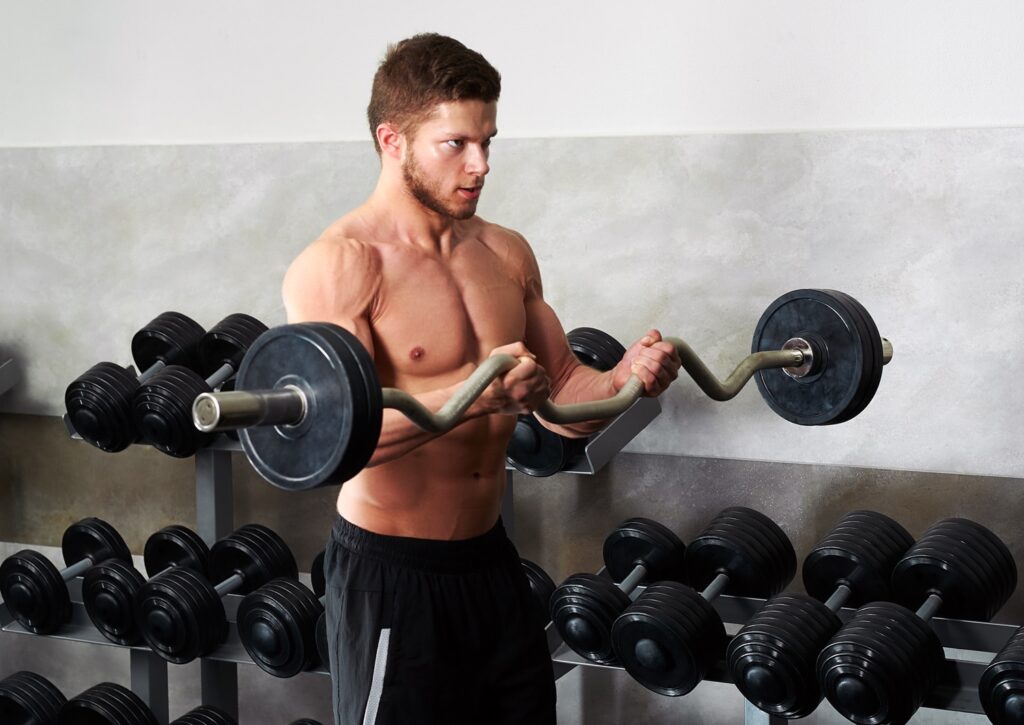
For most beginners, dumbbell curls, cable curls, and machine preacher curls are excellent choices. Dumbbells allow each arm to work independently and give you the freedom to rotate your hands naturally as you lift. Cables maintain resistance throughout much of the repetition and can be easier to control than free weights. A preacher curl bench supports the upper arm, limiting momentum and making it harder to turn the movement into a full body lift.
Start with a standard standing dumbbell curl if you have access to dumbbells. Hold the weight with your palms facing forward, keep your upper arms close to your torso, and curl the dumbbells toward your shoulders. Lower them until your elbows are close to fully straight, then repeat. You do not need to lock out aggressively, but using a large, comfortable range of motion gives the biceps repeated exposure to tension while lengthened and shortened.
Research suggests that resistance training performed through a full range of motion can produce at least as much muscle growth as partial range training, while also improving strength through a broader movement range. For beginners, full range repetitions are also useful because they make it easier to develop consistent technique and recognize when the load is becoming too heavy.
Lower the Weight With Intention
The lowering portion of a curl matters. Your biceps work while they lengthen as you lower a dumbbell or cable handle back to the starting position. This is called an eccentric contraction. Eccentric training can contribute to muscular adaptations and strength gains, although it also creates greater fatigue and soreness when introduced too aggressively.
3 Best Beginner Exercises for Wider and More Muscular Pecs
You do not need to use extremely slow repetitions. Instead, aim to lift with control, pause briefly near the top if it helps you avoid swinging, then lower the weight over roughly two to three seconds. This gives you enough control to keep tension on the target muscles without turning a set of curls into an endurance challenge.
A useful beginner target is eight to 15 repetitions per set. This range provides enough practice with the movement while allowing you to use a load that is challenging but manageable. Muscle growth can occur across a broad range of loads, provided sets are performed with sufficient effort. Moderate repetition ranges are simply practical for learning curls and accumulating quality training volume.
Keep Your Shoulders Quiet
Your shoulders will naturally move a little during many curling variations, but excessive movement usually indicates that the weight is too heavy. Keep your chest tall, brace your abs gently, and think about bending your elbow rather than throwing the dumbbell upward.
If standing curls are difficult to control, switch to seated dumbbell curls or cable curls. A seated position removes much of the temptation to use the hips and lower back. Better technique may mean using less weight at first, but it will make your training more productive.
Tip 2: Do Enough Hard Sets and Progress Them Over Time
Biceps do receive some work from pulling exercises such as rows, pullups, chinups, and lat pulldowns. However, direct curling work is still valuable if building larger arms is a priority. Compound pulling exercises involve the biceps, but they also distribute effort across the back, grip, shoulders, and other muscles. Direct curls allow you to give the elbow flexors focused work.
Start With a Manageable Weekly Volume
Training volume is one of the major drivers of muscle growth. In practical terms, volume means the number of challenging sets you perform for a muscle each week. Research examining resistance training volume has found a general dose response relationship, with more weekly hard sets often producing greater muscle growth up to the point where recovery becomes limiting.

Beginners do not need extremely high volumes to grow. Start with six challenging direct biceps sets per week. For example, you could perform three sets of dumbbell curls and three sets of cable curls across two weekly workouts. This amount gives you enough practice and stimulus without making your elbows, forearms, and recovery demands overwhelming.
After several weeks, assess your progress. If your technique is solid, you are recovering well, and your repetitions or loads have stopped improving, you can gradually increase to eight or 10 weekly direct sets. Make changes slowly. Adding one or two sets per week is usually more sensible than suddenly doubling your training.
You can train biceps once or twice per week. When total weekly volume is matched, training frequency itself appears less important for muscle growth. However, two sessions are often useful for beginners because the work is spread across the week. Instead of doing many exhausting sets in one workout, you can do a few high quality sets on two separate days.
Use Progressive Overload
Your biceps need a reason to adapt. Progressive overload means gradually asking the muscles to do more over time. This does not mean forcing a heavier weight every workout. It can also mean performing more repetitions with the same weight, improving range of motion, using cleaner technique, or adding a set once your current workload is well tolerated.
Keep a simple training log. Record the exercise, load, and repetitions for each set. If you perform three sets of 10 dumbbell curls with 20 pound dumbbells, aim to eventually complete three sets of 11, then 12, using the same weight and good form. Once you can reach the top of your chosen repetition range for every set, increase the load slightly and begin again near the lower end of the range.
For example, you might begin with 20 pound dumbbells for three sets of eight repetitions. Over several sessions, you work toward three sets of 15. When you can complete that with controlled form, move to 22.5 or 25 pound dumbbells and work back up from eight repetitions. This approach is easy to follow and reduces the urge to use sloppy repetitions just to add weight.
Do Not Chase Variety Too Soon
Exercise variety can be useful, but beginners often change exercises so often that they never become skilled at any of them. Use one or two primary curling movements for at least six to eight weeks. This gives you time to learn the exercise and track whether you are getting stronger.
You can then make small changes if needed. A hammer curl, where the palms face each other, can be a useful addition because it challenges the brachialis and brachioradialis alongside the biceps. An incline dumbbell curl places the upper arm behind the torso and may feel more demanding in the stretched position. Neither movement is magic. The best choice is the one that you can perform pain free, control well, and progress consistently.
Tip 3: Train Close to Failure, Then Support Growth With Recovery
A set must be difficult enough to stimulate growth. Easy curls that stop well before fatigue may feel pleasant, but they are unlikely to provide the same signal for adaptation as challenging sets. This does not mean every set needs to end with a failed repetition. It means you should finish most working sets knowing that you had only a small number of clean repetitions left.
Finish Most Sets With One to Three Repetitions in Reserve
Repetitions in reserve is a simple way to judge effort. If you finish a set and believe you could have completed two more clean repetitions, you had two repetitions in reserve. For most beginner biceps work, finishing sets with one to three repetitions in reserve is a useful target.
This level of effort is hard enough to challenge the muscle while leaving room to protect technique. Training to complete failure can also build muscle, but evidence indicates that it is not essential for hypertrophy when sets are already performed close to failure. Failure can increase fatigue, make form deteriorate, and reduce the quality of later sets.
On the final set of a stable exercise such as a machine preacher curl or cable curl, it can be reasonable to occasionally push closer to failure if your form remains controlled. On standing dumbbell curls, stop when you can no longer lift and lower the weight without obvious swinging or shoulder movement.
Eat Enough Protein and Calories
Resistance training creates the stimulus, but your body needs enough nutrition to recover and build tissue. Protein provides amino acids that support muscle protein synthesis. Research suggests that daily protein intakes around 1.4 to 2.0 grams per kilogram of body weight are sufficient for many active adults aiming to support resistance training adaptations.
Spread protein across your day in meals you can maintain consistently. Lean meat, fish, eggs, dairy foods, soy products, beans, lentils, and protein powders can all help you reach your target. You do not need a perfect meal plan to build biceps, but regularly under eating protein makes the process harder.
If you are trying to gain muscle and are not already carrying substantial body fat, a modest calorie surplus can support weight gain and muscle development. If fat loss is your main goal, you can still gain strength and build some muscle as a beginner, but progress may be slower because energy availability is lower.
Respect Recovery and Elbow Health
Biceps are relatively small muscles, but they are involved in many upper body exercises. Hard pulling workouts, heavy rows, chinups, curls, gripping work, and manual labor can all add fatigue to the elbows and forearms. More training is not automatically better if your joints are constantly sore.
Allow at least a day between hard direct biceps sessions when possible. Sleep is also important because inadequate sleep can impair recovery, training performance, and muscle protein synthesis. Aim for a consistent sleep routine and avoid treating soreness as proof that you need more work.
If you feel sharp pain in the front of the elbow, persistent tendon discomfort, numbness, or pain that worsens from session to session, reduce the aggravating exercise and seek guidance from a qualified health professional. Muscle fatigue is normal. Joint pain is not a training goal.
A Simple Beginner Biceps Plan
A straightforward approach is to train biceps twice per week after your main back or upper body exercises. On the first day, perform three sets of standing dumbbell curls for eight to 15 repetitions. On the second day, perform three sets of cable curls or preacher curls for 10 to 15 repetitions.
Keep one to three repetitions in reserve on most sets. Rest for around one to two minutes between sets so that you can maintain good form. When you reach the upper end of the repetition range on every set, increase the load slightly. Continue this approach for at least six weeks before deciding whether you need more volume or a different exercise.
Building more muscular biceps is not about finding a secret curl variation. It is about performing controlled repetitions, accumulating enough challenging weekly work, progressing gradually, and recovering well enough to repeat the process. Stay patient, track your training, and focus on quality. Those basics will take you much further than random arm workouts ever will.
References
- American College of Sports Medicine (2009) ‘American College of Sports Medicine position stand: Progression models in resistance training for healthy adults’, Medicine and Science in Sports and Exercise, 41(3), pp. 687–708.
- Grgic, J., Schoenfeld, B.J., Orazem, J., Sabol, F., Smajić, M., Bishop, D.J. and Pedisic, Z. (2022) ‘Effects of resistance training performed to repetition failure or non failure on muscular strength and hypertrophy: A systematic review and meta analysis’, Journal of Sport and Health Science, 11(2), pp. 202–211.
- Morton, R.W., Murphy, K.T., McKellar, S.R., Schoenfeld, B.J., Henselmans, M., Helms, E., Aragon, A.A., Devries, M.C., Banfield, L., Krieger, J.W. and Phillips, S.M. (2018) ‘A systematic review, meta analysis and meta regression of the effect of protein supplementation on resistance training induced gains in muscle mass and strength in healthy adults’, British Journal of Sports Medicine, 52(6), pp. 376–384.
- Schoenfeld, B.J. (2010) ‘The mechanisms of muscle hypertrophy and their application to resistance training’, Journal of Strength and Conditioning Research, 24(10), pp. 2857–2872.
- Schoenfeld, B.J., Ogborn, D. and Krieger, J.W. (2016) ‘Effects of resistance training frequency on measures of muscle hypertrophy: A systematic review and meta analysis’, Sports Medicine, 46(11), pp. 1689–1697.
- Schoenfeld, B.J., Ogborn, D. and Krieger, J.W. (2017) ‘Dose response relationship between weekly resistance training volume and increases in muscle mass: A systematic review and meta analysis’, Journal of Sports Sciences, 35(11), pp. 1073–1082.
- Schoenfeld, B.J., Grgic, J., Ogborn, D. and Krieger, J.W. (2017) ‘Strength and hypertrophy adaptations between low versus high load resistance training: A systematic review and meta analysis’, Journal of Strength and Conditioning Research, 31(12), pp. 3508–3523.
- Schoenfeld, B.J., Grgic, J., Van Every, D.W. and Plotkin, D.L. (2021) ‘Loading recommendations for muscle strength, hypertrophy, and local endurance: A re examination of the repetition continuum’, Sports, 9(2), 32.
- Schoenfeld, B.J., Grgic, J., Haun, C., Itagaki, T., Helms, E.R. and Phillips, S.M. (2021) ‘Resistance training volume enhances muscle hypertrophy but with diminishing returns: A meta analysis and meta regression’, Journal of Sports Sciences, 39(11), pp. 1273–1282.
- Schoenfeld, B.J. and Grgic, J. (2020) ‘Effects of range of motion on muscle development during resistance training interventions: A systematic review’, SAGE Open Medicine, 8, pp. 1–12.
- Simpson, N.S., Gibbs, E.L. and Matheson, G.O. (2017) ‘Optimizing sleep to maximize performance: Implications and recommendations for elite athletes’, Scandinavian Journal of Medicine and Science in Sports, 27(3), pp. 266–274.
Key Takeaways
| Focus | What beginners should do | Why it matters |
|---|---|---|
| Exercise technique | Use controlled curls through a large, comfortable range of motion. | Better technique keeps tension on the biceps and makes progress easier to measure. |
| Weekly training | Begin with around six direct biceps sets per week, split across one or two sessions. | This provides a manageable growth stimulus while allowing recovery. |
| Progressive overload | Add repetitions first, then increase the load slightly once you reach the top of your target range. | Your biceps need gradually increasing demands to keep adapting. |
| Set effort | Finish most working sets with one to three repetitions still possible with clean form. | Challenging sets can stimulate growth without the excessive fatigue of frequent failure training. |
| Recovery | Eat sufficient protein, sleep consistently, and reduce training if elbow pain persists. | Training adaptations occur between workouts, not only during them. |