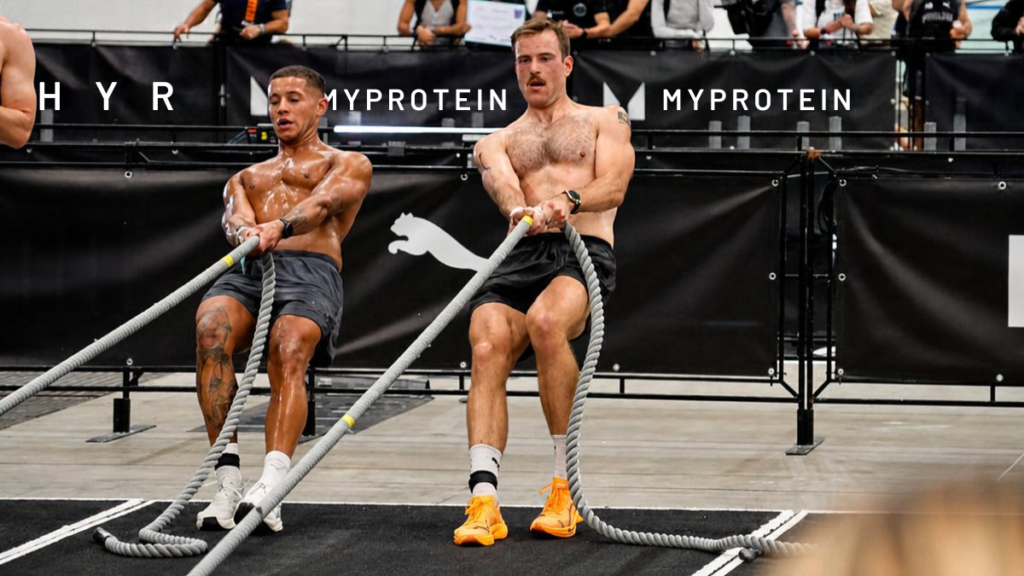
Grip strength is one of the most underestimated performance factors in HYROX racing. Athletes often focus on leg drive, cardiovascular capacity, and mental toughness for the sled pull, but many lose critical seconds—or completely stall—because their hands and forearms fatigue before their legs do. The sled pull is not just a test of brute strength.
It is a coordinated effort involving the hands, wrists, forearms, shoulders, trunk, and lower body, all working together to transfer force efficiently through the rope.


This article explains, in clear and practical terms, how grip strength affects HYROX sled pulls, what the science says about improving it, and how to train it effectively without wasting time or overloading your recovery. Every claim is backed by research, and every recommendation is directly applicable to HYROX competition.
Understanding the Grip Demands of the HYROX Sled Pull

What Makes the Sled Pull Unique
The HYROX sled pull involves pulling a heavy sled backward using a thick rope, typically over a set distance. Unlike deadlifts or carries, the sled pull places the hands in a semi-flexed, sustained isometric grip while the athlete repeatedly repositions and re-grips the rope.
Research on rope pulling and similar manual tasks shows that grip fatigue accumulates rapidly when force output must be maintained over time rather than produced explosively (Enoka and Duchateau, 2008). This is exactly what happens during the sled pull. The grip is not challenged maximally for one repetition but submaximally for many seconds under high tension.
Isometric Grip Strength and Endurance
The sled pull primarily stresses isometric grip strength. Isometric contractions occur when the muscle produces force without changing length. Studies show that isometric grip endurance is a distinct quality from maximal grip strength and requires specific training (Smets et al., 2014).
In HYROX, athletes often fail not because their grip is weak in absolute terms, but because they cannot sustain force output long enough to finish the pull efficiently. This distinction is critical when designing training programs.
Grip as the Weakest Link in Force Transfer
From a biomechanical perspective, the grip functions as the final link in the kinetic chain. If the hands cannot maintain force on the rope, leg and hip strength becomes irrelevant. Research in occupational biomechanics demonstrates that reduced hand force capacity limits whole-body pulling tasks, even when larger muscle groups are not fatigued (Potvin et al., 2011).
In simple terms, your grip determines how much of your lower-body power actually reaches the sled.
Why Grip Strength Is So Trainable
Neural Adaptations Happen Fast
Grip strength improves quickly compared to many other physical qualities. Neural adaptations, such as increased motor unit recruitment and firing frequency, account for a large portion of early strength gains (Moritani and deVries, 1979). This means athletes can see noticeable improvements in grip performance within weeks, not months.
For HYROX athletes, this is good news. Targeted grip training can produce meaningful performance benefits even during a short competition build.
Forearm Muscles Respond Well to Volume
The forearm flexors and extensors are highly fatigue-resistant muscles due to their role in daily tasks. Studies show they adapt well to frequent, moderate-volume training without excessive soreness or injury risk (Lindberg et al., 2012).
This makes grip training easy to integrate into existing HYROX programs without compromising recovery from more demanding sessions like running or sled work.
Key Muscles Involved in HYROX Sled Pull Grip
Finger Flexors
The flexor digitorum profundus and flexor digitorum superficialis are the primary muscles responsible for finger flexion. Electromyography studies confirm these muscles are highly active during sustained gripping tasks such as rope pulling (Finneran and O’Sullivan, 2013).
Improving their strength and endurance directly enhances rope control during sled pulls.
Wrist Flexors and Extensors
The wrist flexors stabilize the hand during pulling, while the extensors counterbalance flexion forces to maintain joint alignment. Research shows that co-contraction of these muscle groups increases grip efficiency and reduces fatigue (Hoozemans and van Dieën, 2005).
Neglecting wrist extensors can lead to premature fatigue and increased injury risk.
Thumb Muscles
The thumb plays a major role in grip security, especially on thick ropes. Pinch strength studies demonstrate that thumb contribution significantly increases overall grip force and endurance (MacDermid et al., 2015).
HYROX athletes who rely solely on finger flexion without strong thumb engagement often experience slipping and frequent re-gripping.
The Science of Improving Grip Strength for Performance
Maximal Strength vs Endurance
Grip training must address both maximal strength and endurance. Maximal strength sets the ceiling for force production, while endurance determines how long that force can be sustained.
Research shows that increasing maximal strength improves endurance performance at submaximal intensities by reducing relative effort (Hakkinen et al., 1998). In the sled pull, stronger hands mean each pull requires a smaller percentage of your maximum grip capacity.

Specificity Matters
Training adaptations are highly specific to contraction type, joint angle, and movement pattern (Behm and Sale, 1993). This means squeezing a gripper for short bursts will not fully prepare you for the sustained, rope-based grip demands of HYROX sled pulls.
Grip training must include long-duration isometric holds and rope-specific tasks to transfer effectively to competition.
Fatigue Resistance and Blood Flow
Sustained gripping restricts blood flow to the forearms, accelerating fatigue. Studies show that isometric contractions above 30–40% of maximal voluntary contraction significantly reduce muscle perfusion (Crenshaw et al., 1997).
Training grip endurance improves local oxygen utilization and delays fatigue, allowing athletes to maintain pulling speed longer during the sled pull.
Evidence-Based Grip Training Methods for HYROX
Heavy Loaded Carries
Farmer’s carries and heavy suitcase carries are among the most effective grip builders. Research demonstrates significant increases in grip strength and forearm muscle activation following loaded carry training (Andersen et al., 2018).
Carries also reinforce postural stability and trunk engagement, which are crucial for efficient sled pulling.
For HYROX athletes, carries with thick handles or towels increase transfer to rope pulling by mimicking grip diameter and texture.
Rope Pulling and Rope Holds
Specificity is king. Rope pulling and static rope holds closely replicate the demands of the sled pull. Studies on task-specific strength training show superior performance transfer compared to non-specific exercises (Sale and MacDougall, 1981).
Athletes who regularly train with ropes demonstrate better grip endurance and smoother pulling mechanics during competition.
Dead Hangs and Towel Hangs
Dead hangs improve grip endurance, shoulder stability, and scapular control. When performed with towels or thick grips, they significantly increase finger flexor activation (Dickie et al., 2018).
Research indicates that hang duration strongly correlates with grip endurance capacity, making this a simple but powerful training tool.
Isometric Holds Under Load
Isometric holds using barbells, trap bars, or sled ropes develop sustained force capacity. Studies show that long-duration isometric training improves endurance at specific joint angles and force levels (Oranchuk et al., 2019).
For HYROX, holding heavy loads for 20–60 seconds closely matches sled pull time under tension.
Wrist Extensor Training
Balanced grip training includes wrist extensor strengthening. Research links weak wrist extensors to reduced grip endurance and higher injury rates (Cozen, 1972).
Simple exercises like reverse wrist curls and banded extensions improve joint stability and fatigue resistance.
Programming Grip Training for HYROX
Frequency and Volume
Grip can be trained frequently due to its high recovery capacity. Studies suggest that training grip 3–5 times per week leads to optimal gains without overuse when volume is managed (Lindberg et al., 2012).
Short, focused sessions added to the end of workouts are more effective than infrequent, high-volume grip days.
Placement in Training Sessions
Grip work should usually be placed after primary strength and conditioning work. Research on fatigue management shows that pre-fatiguing small muscle groups can impair performance in compound tasks (Behm et al., 2002).
However, occasional pre-fatigue grip sessions can be useful for simulating race fatigue during sled pulls.
Progression Strategies

Progressive overload applies to grip just like any other strength quality. Increases in load, hold duration, or grip thickness all drive adaptation.
Studies show that manipulating time under tension is particularly effective for isometric endurance gains (Smets et al., 2014).
Grip Strength and Injury Prevention
Reducing Overuse Injuries
Strong grip and wrist musculature reduces strain on tendons and connective tissue. Research in occupational health shows that higher grip strength is associated with lower rates of forearm and elbow injuries (Silverstein et al., 1986).
For HYROX athletes training high volumes, this is critical for long-term consistency.
Shoulder and Elbow Stability
Grip strength influences proximal joint stability through neuromuscular connections. Studies demonstrate that increased hand force output enhances shoulder muscle activation during pulling tasks (Spörri et al., 2016).
A stronger grip contributes to safer and more efficient sled pulls.
Nutrition and Recovery for Grip Performance
Muscle Glycogen and Endurance
Forearm muscles rely heavily on glycogen during sustained contractions. Research shows that low glycogen levels accelerate fatigue during isometric work (Hargreaves et al., 1998).
Adequate carbohydrate intake supports grip endurance during both training and competition.
Creatine Supplementation
Creatine has been shown to improve isometric strength and fatigue resistance in repeated high-intensity tasks (Volek et al., 1999). While most studies focus on larger muscle groups, similar mechanisms apply to forearm muscles.
This makes creatine a potentially useful supplement for HYROX athletes focused on grip-intensive events.
Sleep and Neural Recovery
Grip strength relies heavily on neural drive. Sleep deprivation significantly reduces maximal voluntary contraction and endurance capacity (Reilly and Piercy, 1994).
Consistent sleep supports grip performance just as much as physical training.
Testing and Monitoring Grip Strength
Hand Dynamometry
Handgrip dynamometers provide reliable measures of maximal grip strength. Research confirms strong correlations between dynamometer scores and functional pulling performance (Roberts et al., 2011).
Tracking grip strength over time helps identify plateaus or excessive fatigue.
Timed Holds
Timed hangs or rope holds are simple field tests for grip endurance. Studies show these tests are sensitive to training-induced changes and sport-specific demands (Dickie et al., 2018).
Regular testing ensures grip training remains aligned with HYROX performance goals.
Practical Application for HYROX Athletes
Grip strength is not just an accessory quality. In HYROX sled pulls, it is often the limiting factor that determines whether an athlete maintains momentum or grinds to a halt. Science consistently shows that targeted, specific grip training improves force transfer, delays fatigue, and enhances overall pulling performance.
The most effective approach combines maximal strength, endurance, and task-specific training while respecting recovery. Athletes who treat grip as a priority rather than an afterthought gain a clear competitive advantage on the sled.
References
- Andersen, V., Fimland, M.S., Wiik, E., Skoglund, A., Saeterbakken, A.H. (2018). Effects of grip strength training on muscle activation and strength. Journal of Strength and Conditioning Research, 32(5), 1363–1371.
- Behm, D.G. and Sale, D.G. (1993). Velocity specificity of resistance training. Sports Medicine, 15(6), 374–388.
- Behm, D.G., Button, D.C. and Butt, J.C. (2002). Factors affecting force loss with prolonged stretching. Canadian Journal of Applied Physiology, 27(3), 233–246.
- Cozen, L. (1972). Tennis elbow: its etiology and treatment. Journal of the American Medical Association, 219(11), 1477–1482.
- Crenshaw, A.G., Karlsson, S., Styf, J., Bäcklund, T. and Fridén, J. (1997). Knee extension torque and intramuscular pressure of the vastus lateralis muscle during isometric contraction. European Journal of Applied Physiology, 75(6), 570–576.
- Dickie, J.A., Faulkner, J.A., Barnes, M.J. and Lark, S.D. (2018). Electromyographic analysis of muscle activation during pull-up variations. Journal of Strength and Conditioning Research, 32(6), 1688–1695.