

If you want bigger, stronger biceps, chin ups deserve a central place in your training. While many people still associate arm growth with curls, the chin up is one of the most effective compound exercises for building upper arm mass. It combines high levels of muscle activation, progressive overload potential, and functional strength development in a way that few isolation exercises can match.
The biceps brachii is not just responsible for elbow flexion. It also contributes to shoulder flexion and forearm supination. Chin ups train all of these functions simultaneously. This is why they can produce significant hypertrophy when performed correctly and consistently.


Research using electromyography has shown that chin ups activate the biceps at very high levels, often comparable to or even exceeding traditional curl variations. When combined with the involvement of larger muscle groups such as the lats and upper back, chin ups allow you to handle more total load, which is a key driver of muscle growth.
This article will break down three science backed tips to maximize biceps growth using chin ups. You will learn how grip selection influences activation, how to optimize loading and volume, and how to manipulate technique to place more tension on the biceps.
Why Chin Ups Are So Effective for Biceps Growth
High Muscle Activation
Chin ups are performed with a supinated grip, meaning your palms face toward you. This position places the biceps in a mechanically advantageous position. Studies comparing pull up variations show that the supinated grip leads to significantly greater biceps activation than pronated grips.

The reason is simple. The biceps is both an elbow flexor and a supinator of the forearm. When you perform chin ups, both of these functions are engaged at the same time. This dual role increases the demand placed on the muscle.
Mechanical Tension and Overload
Muscle growth is largely driven by mechanical tension. Chin ups allow you to progressively increase resistance through added weight or higher repetition ranges. Unlike curls, where loading can be limited by grip strength or joint stress, chin ups allow for greater total loading due to the involvement of multiple muscle groups.
Long Range of Motion
Chin ups train the biceps through a large range of motion. Starting from a fully extended position places the biceps under stretch, which is an important factor for hypertrophy. Research suggests that training muscles at longer muscle lengths can enhance growth due to increased mechanical tension and stretch mediated signaling.
Tip 1: Use the Right Grip to Maximize Biceps Activation
Supinated Grip is Key
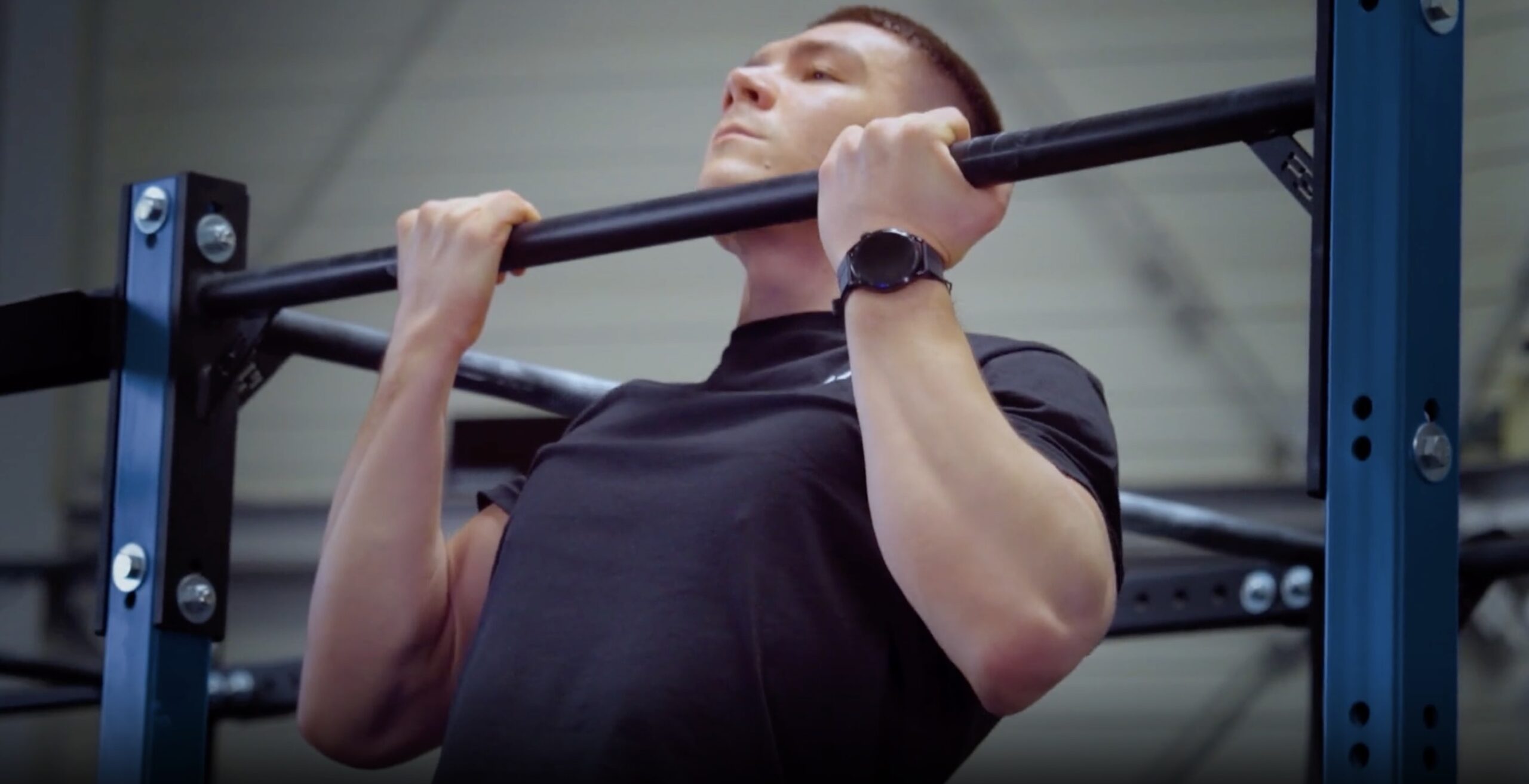
If your goal is to build massive biceps, grip selection is not optional. It is essential. The standard chin up grip, where your palms face toward you, is the most effective variation for targeting the biceps.
Studies measuring muscle activation during pull up variations consistently show that the supinated grip produces the highest biceps activation. This is because the muscle is directly involved in both pulling and stabilizing the movement.
Grip Width Matters
Grip width can significantly influence how much the biceps contribute to the movement.
A narrow grip tends to increase elbow flexion demands, which shifts more work onto the biceps. A wider grip places more emphasis on the lats and reduces the relative contribution of the arms.
For maximum biceps growth, a shoulder width or slightly narrower grip is ideal. This allows for strong elbow flexion while still maintaining good overall pulling mechanics.
Neutral Grip as a Secondary Option
Neutral grip chin ups, where your palms face each other, are also effective. They tend to reduce strain on the wrists and elbows while still engaging the biceps significantly.
However, research suggests that neutral grips typically result in slightly lower biceps activation compared to supinated grips. They can still be useful for variation and joint health.
Practical Application
To maximize biceps involvement:
• Use a supinated grip as your primary chin up variation
• Keep your hands at shoulder width or slightly narrower
• Focus on actively pulling with your arms, not just your back
Tip 2: Train Through Full Range and Control the Eccentric
Full Range of Motion Drives Growth
One of the biggest mistakes people make with chin ups is shortening the range of motion. Partial repetitions limit muscle stretch and reduce overall tension.
Performing chin ups from a dead hang to a full contraction ensures that the biceps are trained through their entire functional range. This increases both mechanical tension and muscle fiber recruitment.
Research has shown that training through a full range of motion leads to greater hypertrophy compared to partial repetitions. This is especially true when the muscle is loaded in a stretched position.
The Importance of the Eccentric Phase
The eccentric phase, or lowering portion of the chin up, plays a crucial role in muscle growth. During this phase, the muscle produces force while lengthening, which creates high levels of mechanical tension.
Studies have demonstrated that eccentric training can lead to greater increases in muscle size and strength compared to concentric focused training alone.
When you control the descent of a chin up, your biceps are forced to resist gravity. This increases time under tension and enhances muscle damage, both of which contribute to hypertrophy.
Tempo Guidelines
To maximize results:
• Pull up explosively but under control
• Pause briefly at the top to ensure full contraction
• Lower yourself slowly over two to four seconds
• Avoid dropping into the bottom position
Avoid Momentum
Using momentum reduces the load on the biceps and shifts work away from the target muscles. Swinging or kipping may allow you to perform more repetitions, but it decreases the effectiveness of each rep for hypertrophy.
Strict form ensures that the biceps remain under constant tension throughout the movement.
Tip 3: Progressively Overload with Volume and Load
Progressive Overload is Essential
No muscle grows without progressive overload. This means gradually increasing the demands placed on the muscle over time. With chin ups, this can be achieved in several ways:
• Increasing the number of repetitions
• Adding external weight
• Increasing total training volume
• Improving time under tension
Research consistently shows that higher training volumes are associated with greater muscle growth, as long as recovery is managed properly.
Weighted Chin Ups for Maximum Growth
Once you can perform more than ten to twelve bodyweight chin ups with good form, adding weight becomes one of the most effective ways to continue progressing.
Weighted chin ups increase mechanical tension, which is a primary driver of hypertrophy. Studies on resistance training show that heavier loads can lead to greater increases in muscle size when performed with proper technique.
Optimal Rep Ranges
Both moderate and higher rep ranges can stimulate hypertrophy. For chin ups:
• Lower rep ranges with added weight build strength and tension
• Moderate rep ranges build muscle size
• Higher rep ranges increase metabolic stress
A combination of these approaches is ideal for long term growth.
Weekly Volume Targets
For optimal hypertrophy, research suggests that training each muscle group with multiple sets per week is beneficial. A practical approach for biceps via chin ups:
• Perform ten to twenty total working sets per week
• Spread volume across two to four sessions
• Ensure adequate recovery between sessions
Mind Muscle Connection
Focusing on the biceps during each repetition can enhance activation. While the mind muscle connection is often debated, some studies suggest that consciously focusing on a muscle can increase its activation during training. To apply this:
• Think about pulling with your elbows
• Focus on squeezing your biceps at the top
• Avoid letting your back dominate the movement
Common Mistakes That Limit Biceps Growth

Over Reliance on Lat Dominance
Many lifters perform chin ups as a back exercise and neglect the role of the biceps. While the lats are heavily involved, failing to actively engage the arms reduces biceps stimulation.
Incomplete Range of Motion
Stopping short of full extension or failing to reach the top position limits muscle activation and growth potential.
Lack of Progression
Doing the same number of repetitions week after week will eventually lead to stagnation. Progressive overload must be applied consistently.
Poor Recovery
Muscle growth occurs during recovery, not just during training. Insufficient sleep, poor nutrition, and excessive training volume can all limit progress.
Supporting Factors for Biceps Growth
Nutrition
Muscle growth requires a caloric surplus and adequate protein intake. Research suggests that consuming around 1.6 to 2.2 grams of protein per kilogram of body weight is optimal for hypertrophy. Carbohydrates also play an important role by fueling training performance and supporting recovery.

Frequency
Training frequency can influence muscle growth. Higher frequency allows for more total volume and better distribution of workload.
Training chin ups multiple times per week can help maximize biceps development.
Recovery and Sleep
Sleep is critical for muscle repair and hormonal regulation. Poor sleep has been shown to negatively impact muscle growth and performance.
Aim for seven to nine hours of quality sleep per night.
Sample Chin Up Program for Bigger Biceps
Beginner
• 3 sessions per week
• 3 to 5 sets per session
• 6 to 10 repetitions per set
• Focus on full range of motion and control
Intermediate
• 3 to 4 sessions per week
• 4 to 6 sets per session
• Mix of bodyweight and weighted chin ups
• Include slow eccentric repetitions
Advanced
• 4 sessions per week
• 5 to 8 sets per session
• Heavy weighted chin ups in lower rep ranges
• Additional high rep sets for metabolic stress
Conclusion
Chin ups are one of the most powerful tools for building massive biceps when performed correctly. By using the right grip, training through a full range of motion, and applying progressive overload, you can maximize muscle activation and growth.
The key is to treat chin ups not just as a back exercise, but as a primary driver of arm development. When combined with proper nutrition, recovery, and consistent training, they can produce impressive results.
Focus on quality repetitions, gradual progression, and intentional execution. Over time, these principles will lead to stronger, larger biceps and improved overall upper body strength.
References
• Schoenfeld, B.J. (2010). The mechanisms of muscle hypertrophy and their application to resistance training. Journal of Strength and Conditioning Research, 24(10), 2857–2872.
• Schoenfeld, B.J. (2016). Science and development of muscle hypertrophy. Human Kinetics Journal, 1(1), 1–20.
• Signorile, J.F., Zink, A.J. and Szwed, S.P. (2002). A comparative electromyographical investigation of muscle utilization patterns using various hand positions during the lat pull down. Journal of Strength and Conditioning Research, 16(4), 539–546.
• Youdas, J.W., Amundson, C.L., Cicero, K.S., Hahn, J.J., Harezlak, D.T. and Hollman, J.H. (2010). Surface electromyographic activation patterns and elbow joint motion during pull up variations. Journal of Strength and Conditioning Research, 24(12), 3404–3414.
• Wakahara, T., Fukutani, A., Kawakami, Y. and Yanai, T. (2013). Nonuniform muscle hypertrophy: its relation to muscle activation in training session. Medicine and Science in Sports and Exercise, 45(11), 2158–2165.
• Douglas, J., Pearson, S., Ross, A. and McGuigan, M. (2017). Eccentric exercise: physiological characteristics and acute responses. Sports Medicine, 47(4), 663–675.