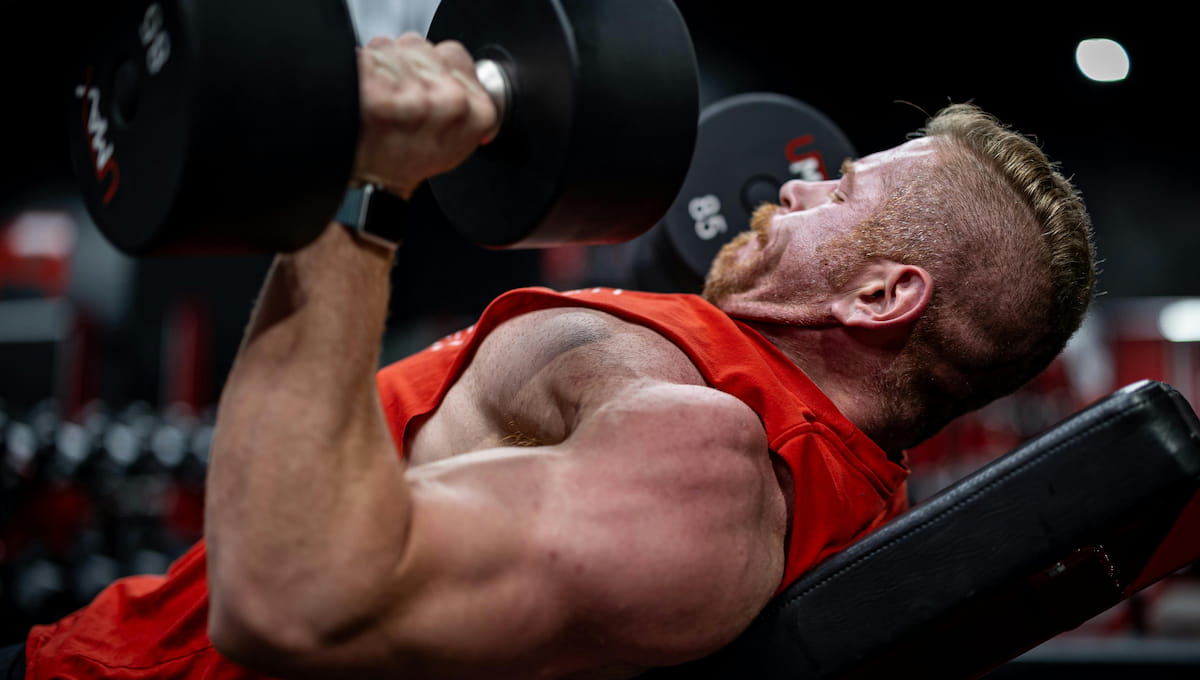


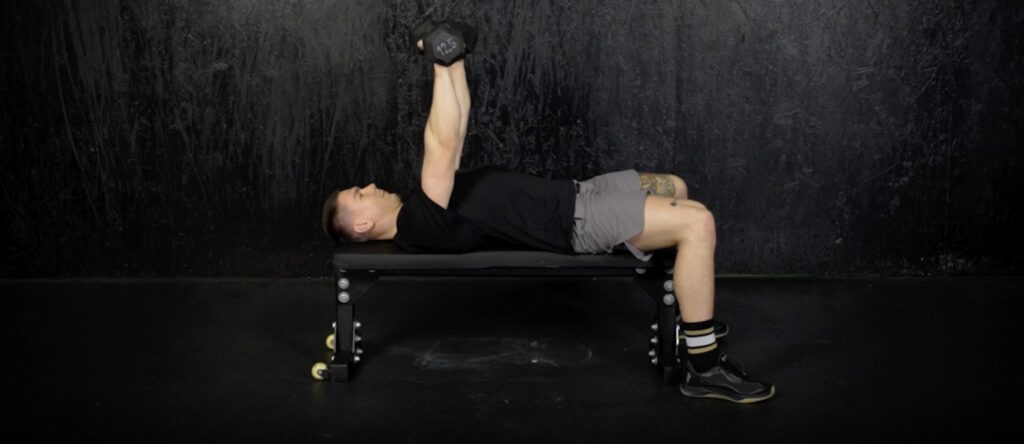
The dumbbell bench press is one of the best exercises for building upper body strength and muscle. It trains the chest, shoulders, and triceps while demanding more stability and coordination than the traditional barbell bench press. Because each arm works independently, it also exposes strength imbalances that can limit long term progress. One of the most common questions people ask is simple. How much should I be able to dumbbell bench press?
The answer depends on your body weight, training experience, age, and technique. A beginner lifting 25 pound dumbbells for repetitions may already have good strength relative to their experience, while an advanced lifter pressing 100 pound dumbbells demonstrates exceptional upper body strength.


This guide explains realistic dumbbell bench press standards, what they mean for your level of fitness, and how to improve your numbers safely using evidence based training principles.
Why the Dumbbell Bench Press Matters
The dumbbell bench press is more than just an alternative to the barbell bench press. Research shows that unilateral loading and independent limb movement increase stabilization demands and require greater neuromuscular coordination.
Unlike a barbell, dumbbells allow each shoulder to move more naturally through the pressing motion. This can improve comfort for many lifters while reducing compensatory movement from the stronger side.

Electromyography studies have found that dumbbell bench pressing produces high activation of the pectoralis major, anterior deltoid, and triceps brachii. Muscle activation is comparable to the barbell bench press when loads are appropriately matched, although the absolute weight lifted is usually lower.
Because of these characteristics, the dumbbell bench press has become a staple exercise for athletes, bodybuilders, powerlifters, and recreational lifters alike.
How Much Should You Be Able to Dumbbell Bench Press?
Unlike the barbell bench press, there is no universally accepted performance standard because lifters use two separate dumbbells instead of one combined load.
The numbers below represent the weight of each dumbbell for a single set of approximately five to eight technically sound repetitions.
Men
| Strength Level | Dumbbell Weight Per Hand |
|---|---|
| Beginner | 20 to 35 lb |
| Novice | 35 to 50 lb |
| Intermediate | 50 to 70 lb |
| Advanced | 70 to 100 lb |
| Elite | 100 lb or more |
Women
| Strength Level | Dumbbell Weight Per Hand |
|---|---|
| Beginner | 10 to 20 lb |
| Novice | 20 to 30 lb |
| Intermediate | 30 to 45 lb |
| Advanced | 45 to 60 lb |
| Elite | 60 lb or more |
These standards assume proper depth, full control throughout the movement, and no assistance getting the dumbbells into position.
Relative Strength Matters More Than Absolute Weight
Comparing yourself to someone much larger is rarely helpful. A 140 pound athlete pressing 70 pound dumbbells demonstrates significantly greater relative upper body strength than a 250 pound athlete using the same weights.
Muscle cross sectional area is one of the strongest predictors of maximal force production, but body mass alone does not explain strength differences. Neural adaptations, muscle architecture, tendon stiffness, and years of training all contribute.
For this reason, evaluating your progress against your previous performances is often more meaningful than comparing yourself with other gym members.
What Is Considered Strong?
Many recreational lifters never progress beyond pressing 50 pound dumbbells. Once you can perform multiple controlled repetitions with 70 pound dumbbells, you are already stronger than the average commercial gym member.
How Long Should You Be Able to Hold a Dead Hang?
Pressing 90 to 100 pound dumbbells with full range of motion represents an advanced level of upper body strength that usually requires years of consistent training.
Athletes who can perform clean repetitions with 120 pound or heavier dumbbells belong to an exceptionally small percentage of lifters. At that point, strength development requires careful programming, excellent recovery, and highly refined technique.
How Does the Dumbbell Bench Compare With the Barbell Bench Press?
Most people cannot lift the same combined weight using dumbbells as they can with a barbell.
This difference exists because each arm must stabilize its own load while preventing rotation and lateral movement. More stabilizer muscles become involved, reducing the amount of force that can be directed into pressing the weight.
Research comparing barbell and dumbbell pressing consistently shows that barbell lifts allow greater maximal loading, while dumbbells increase stabilization demands and may produce slightly greater activation of smaller shoulder stabilizers.
As a general guideline, the combined weight of two dumbbells is often around 75 to 90 percent of a person’s barbell bench press for similar repetition ranges, although individual differences are considerable.
For example, someone capable of bench pressing 225 pounds for five repetitions might typically use two 80 to 90 pound dumbbells for similar effort.
Factors That Influence Your Dumbbell Bench Press
Training Experience
The largest improvements occur during the first year of structured resistance training. Early strength gains come primarily from improvements in nervous system efficiency. The brain becomes better at recruiting muscle fibers and coordinating movement.
After the beginner stage, muscle hypertrophy plays an increasingly important role in continued progress.
Body Weight and Muscle Mass
Larger individuals generally lift more weight because they possess greater muscle mass. However, body composition matters far more than body weight alone. Two people weighing 200 pounds may have dramatically different strength levels depending on how much lean muscle they carry.
Technique
Small technical improvements often produce surprisingly large strength gains. Keeping the shoulder blades retracted, maintaining upper back tension, controlling the lowering phase, and pressing in a consistent path all improve force production while reducing unnecessary stress on the shoulders.
Using excessive range of motion by allowing the shoulders to roll forward at the bottom of the lift may actually reduce performance while increasing injury risk.
Training Frequency
Meta analyses consistently show that training a muscle group at least twice per week generally produces superior hypertrophy compared with once weekly training when total training volume is similar. More frequent practice also improves motor learning and technical consistency.
Common Mistakes That Limit Strength
Many lifters never reach their potential because they make predictable training errors. The first is selecting weights that are too heavy. Partial repetitions may look impressive, but they reduce mechanical tension across the full range of motion and limit long term development.
The second mistake is rushing every repetition. Controlled eccentric lowering improves muscle growth and enhances technical consistency. Another common problem is neglecting upper back training. Strong scapular stabilizers provide a more stable foundation for pressing heavier loads.
Finally, many people avoid progressive overload. Muscles become stronger only when training demands gradually increase over time.
How to Increase Your Dumbbell Bench Press
Build More Muscle
Muscle size strongly predicts strength potential. Research consistently shows that performing approximately 10 to 20 challenging weekly sets per muscle group produces substantial hypertrophy for most trained individuals.
Working mostly within the six to twelve repetition range while approaching muscular fatigue appears particularly effective for building muscle.
Train Heavy
Strength adaptations require exposure to relatively heavy loads. Including sets of three to six repetitions develops maximal force production while maintaining good technique. Combining heavy strength work with moderate repetition hypertrophy training often produces the best long term results.
Improve Triceps Strength
The triceps contribute significantly during the lockout portion of the dumbbell bench press. Exercises such as close grip bench presses, dips, overhead triceps extensions, and cable pushdowns strengthen this important muscle group.
Strengthen the Upper Back
Rows, pull ups, lat pulldowns, face pulls, and rear delt exercises improve shoulder stability and pressing mechanics. A stronger upper back creates a stable platform from which to generate force.
Prioritize Recovery
Strength develops during recovery rather than during training itself. Adults generally require sufficient sleep, adequate dietary protein, and appropriate recovery between hard sessions to maximize adaptation.
Protein intakes between approximately 1.6 and 2.2 grams per kilogram of body weight each day appear highly effective for supporting muscle growth during resistance training.
How Long Does It Take to Reach Advanced Strength?
Progress varies enormously. A healthy beginner following a well designed resistance training program may reach 50 pound dumbbells within the first year. Progress toward 70 to 90 pound dumbbells often requires several years of consistent training, nutrition, and recovery.
Reaching elite standards above 100 pounds per hand may require exceptional genetics, years of progressive overload, and highly structured programming. The timeline matters less than consistent improvement. Adding five pounds every few months eventually produces remarkable strength gains.
Final Thoughts
The dumbbell bench press is one of the most valuable upper body exercises because it combines strength, muscle building, stability, and balanced development.
For most men, pressing 70 pound dumbbells with excellent form represents a strong intermediate to advanced performance. For most women, pressing 45 pound dumbbells demonstrates impressive upper body strength.
Remember that numbers alone never tell the whole story. Full range of motion, controlled technique, consistency, and gradual progression matter far more than ego lifting.
If you continue training intelligently, recover well, and progressively challenge yourself over time, your dumbbell bench press will steadily improve while building stronger muscles, healthier joints, and better overall athletic performance.
Key Takeaways
| Topic | Key Information |
|---|---|
| Best exercise benefits | Builds chest, shoulders, triceps, stability, and unilateral strength |
| Strong male standard | Around 70 pound dumbbells per hand for quality repetitions |
| Strong female standard | Around 45 pound dumbbells per hand for quality repetitions |
| Elite performance | 100 pound or heavier dumbbells per hand for men and 60 pound or heavier for women |
| Most important factor | Progressive overload with excellent technique |
| Ideal training frequency | Train pressing muscles at least twice per week |
| Best repetition ranges | Three to six repetitions for strength and six to twelve repetitions for hypertrophy |
| Recovery priority | Sleep, adequate protein intake, and consistent programming support long term progress |
References
- American College of Sports Medicine. (2009). Progression models in resistance training for healthy adults. Medicine & Science in Sports & Exercise, 41(3), 687 to 708.
- Grgic, J., Schoenfeld, B.J., Orazem, J. and Sabol, F. (2022). Effects of resistance training performed to repetition failure or non failure on muscular strength and hypertrophy. Scandinavian Journal of Medicine & Science in Sports, 32(11), 1427 to 1453.
- Krzysztofik, M., Wilk, M., Wojdala, G. and Golas, A. (2019). Maximizing muscle hypertrophy through resistance training. International Journal of Environmental Research and Public Health, 16(24), 4897.
- Morton, R.W., Murphy, K.T., McKellar, S.R., Schoenfeld, B.J., Henselmans, M., Helms, E., Aragon, A.A., Devries, M.C., Banfield, L., Krieger, J.W. and Phillips, S.M. (2018). A systematic review, meta analysis and meta regression of protein supplementation on resistance training induced gains in muscle mass and strength in healthy adults. British Journal of Sports Medicine, 52(6), 376 to 384.
- Saeterbakken, A.H., van den Tillaar, R. and Fimland, M.S. (2011). A comparison of muscle activity and one repetition maximum strength of three chest press exercises with different stability requirements. Journal of Strength and Conditioning Research, 25(2), 533 to 538.