

Building a muscular upper body does not require a complicated exercise plan. For beginners, a barbell can be one of the most effective tools in the gym because it allows you to train several major muscle groups with stable, repeatable movements. You can add small amounts of weight over time, practice the same key lifts regularly, and develop the strength that supports visible muscle growth.
The best beginner barbell exercises are not necessarily the most advanced or impressive looking. They are movements that train a large amount of muscle, can be learned with good coaching and sensible loading, and give you a clear way to progress. The barbell bench press, bent over barbell row, and standing barbell overhead press meet those standards.


Together, these three exercises train the chest, shoulders, triceps, upper back, lats, biceps, forearms, and core. They also create a strong foundation for future training. You do not need to chase maximum weights or train to complete failure on every set. You need consistent technique, enough challenging work, and gradual progression.
Research consistently shows that resistance training increases muscle size and strength in untrained people. Muscle growth can occur across a wide range of rep ranges when sets are performed with sufficient effort, although moderate loads are often practical for beginners because they allow meaningful practice without excessive fatigue. Training each muscle group with enough weekly volume and progressively increasing the challenge are key parts of an effective muscle building program.
Why Barbells Work So Well for Beginners
Barbell training gives beginners a simple way to measure progress. If you can perform the same exercise with better form, more repetitions, or slightly more weight than before, you have a clear sign that you are improving. This process is called progressive overload, and it is one of the most important principles of resistance training.
Compound exercises are especially useful because they train multiple joints and muscle groups within one movement. A barbell bench press trains the chest, shoulders, and triceps together. A row develops the upper back while involving the biceps and forearms. An overhead press builds the shoulders and triceps while demanding control from the trunk and lower body.
This does not mean isolation exercises have no value. Curls, lateral raises, and triceps extensions can all help you add training volume to specific muscles. However, a beginner who has limited time and energy will usually get more overall return from first learning a few productive compound lifts.
A review of resistance training research found that multiple sets tend to produce greater strength and muscle gains than single set programs. Another large review found a dose response relationship between weekly resistance training volume and hypertrophy. In practical terms, you need more than occasional hard workouts. You need regular exposure to challenging sets that you can recover from and repeat.
1. Barbell Bench Press
The barbell bench press is one of the best exercises for building a bigger chest, stronger triceps, and more muscular front shoulders. It is popular for good reason. When performed with control through a comfortable range of motion, it allows you to load the pressing muscles heavily and make steady long term progress.
The chest is made up primarily of the pectoralis major, a large muscle that helps move the upper arm across the body. The bench press also involves the anterior deltoids at the front of the shoulders and the triceps on the back of the upper arms. This makes it a highly efficient upper body lift.
How to Perform the Barbell Bench Press
Set the bar in a rack at a height that allows you to remove it with straight arms without losing shoulder position. Lie on the bench with your eyes roughly beneath the bar. Place your feet firmly on the floor and create a stable base before lifting.
Grip the bar slightly wider than shoulder width, although the exact hand position should feel comfortable for your wrists and shoulders. Pull your shoulder blades gently back and down into the bench. Lower the bar under control toward the lower portion of your chest, then press it upward until your elbows are straight.
You do not need to force an extreme arch in your lower back. A small natural arch is normal, but the priority is a stable body position, controlled bar path, and pain free movement. If you are training alone, use a power rack with safety pins set at an appropriate height or ask a competent spotter for help.
How the Bench Press Builds Muscle
Studies comparing different resistance training approaches show that muscle hypertrophy is strongly influenced by total training volume and effort. The bench press allows beginners to accumulate productive pressing volume with an exercise that is easy to track. Adding one repetition to a set, or adding a small amount of weight while keeping your technique solid, can create a meaningful training stimulus over time.
Want More Muscular Shoulders? Do These 3 Barbell Exercises
A full range of motion is generally useful for muscle development because it trains the muscles through a larger portion of their working length. However, your individual shoulder comfort matters. If the bottom position causes pain, reduce the load, check your technique, and consider working with a qualified coach or health professional before pushing through discomfort.
Common Beginner Bench Press Mistakes
The most common mistake is loading the bar too heavily before your technique is ready. A beginner often benefits more from performing eight controlled repetitions than from fighting through three unstable ones. Another common issue is allowing the shoulders to roll forward at the bottom of each repetition. Keep your upper back engaged against the bench and control the descent.
Avoid bouncing the bar off your chest. This reduces control and can make the lift less consistent. Lower the bar with intention, briefly touch the chest, and press with force while maintaining your position.
2. Bent Over Barbell Row
A strong upper body needs more than pressing. Rows train the muscles of the upper back, including the latissimus dorsi, trapezius, rhomboids, and rear deltoids. They also challenge the biceps, forearms, spinal erectors, and core. If you want a more balanced, powerful physique, horizontal pulling needs to be a regular part of your training.
The bent over barbell row is a valuable beginner exercise because it teaches you to control your torso while pulling a load toward your body. It can help develop the thickness of the upper back and support stronger performance in other lifts.
How to Perform the Bent Over Barbell Row
Start with the bar on the floor or in a rack at about knee height. Stand with your feet around hip width apart and grip the bar with your hands just outside your legs. Push your hips back and bend your knees slightly until your torso is angled forward.
Keep your spine neutral and brace your abdominal muscles as if preparing for a light punch. Let the bar hang beneath your shoulders, then pull it toward your lower ribs or upper abdomen. Drive your elbows behind you and keep the bar close to your body. Lower it slowly until your elbows are fully extended, then repeat.
The exact torso angle can vary. Some people row with their torso closer to parallel with the floor, while others use a more upright position. A slightly more upright position is often easier for beginners to control. The key is to avoid turning the exercise into a jerking, full body movement.
How Rows Support Muscle Growth
Training the back through pulling movements is important for muscular balance. Resistance training studies show that muscles grow in response to repeated mechanical tension, sufficient volume, and progressive overload. The barbell row provides a way to load the back and arm muscles with a relatively simple movement pattern.
Rows also balance the high amount of pressing that many beginners perform. While training balance is not about perfectly matching every exercise, including both pushing and pulling work can help you build a more complete upper body and avoid a program that only emphasizes the chest and front shoulders.
The barbell row requires your trunk muscles to work isometrically, meaning they contract to hold your body position rather than create large visible movement. This makes the exercise more demanding than a machine row, but it also means you should use a load that lets you maintain a stable torso.
Common Beginner Barbell Row Mistakes
The biggest mistake is using momentum instead of muscular control. If your torso swings upward during every repetition, the weight is likely too heavy. Reduce the load and focus on keeping your chest proud, hips back, and spine stable.
Another mistake is shrugging the shoulders toward the ears. Think about pulling your elbows behind your body and bringing your shoulder blades together naturally. You do not need to exaggerate the squeeze, but you should feel the upper back working rather than only your arms.
If holding the bent over position causes lower back discomfort, lower the weight, reduce the number of repetitions, and work on your hip hinge. A chest supported row can be a useful temporary alternative while you develop the strength and confidence for barbell rows.
3. Standing Barbell Overhead Press
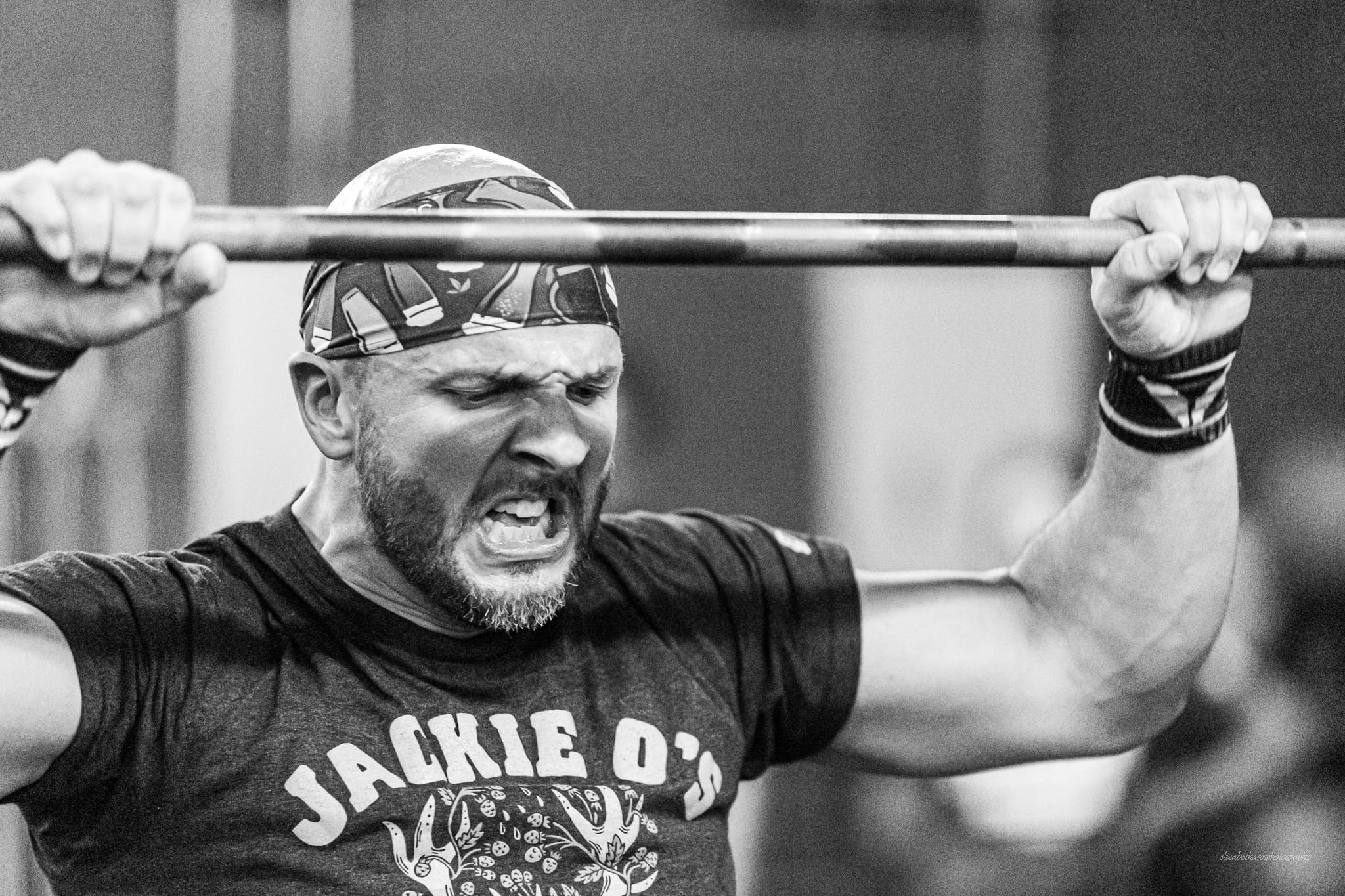
The standing barbell overhead press is one of the most effective exercises for building stronger, more muscular shoulders and triceps. It also demands coordination from the upper back, abdominal muscles, glutes, and legs because you must keep the bar balanced over your body.
Unlike the bench press, the overhead press places the shoulders in a position where they must work directly against gravity through a large range of motion. This makes it a highly productive movement for developing the deltoids, especially the front portion of the shoulders.
How to Perform the Standing Barbell Overhead Press
Set the bar in a rack around upper chest height. Stand with your feet about hip width apart and grip the bar just outside shoulder width. Position the bar across the upper chest with your elbows slightly in front of it.
Before pressing, squeeze your glutes and brace your midsection. Press the bar upward while moving your head slightly back to allow the bar to travel close to your face. Once the bar passes your forehead, bring your head forward so the bar finishes above the middle of your body.
At the top, your elbows should be straight and the bar should feel stacked above your shoulders, hips, and feet. Lower the bar under control to the upper chest before beginning the next repetition.
How the Overhead Press Builds a More Muscular Upper Body
The overhead press trains several muscles at once, but its main targets are the deltoids and triceps. It also requires the upper back to stabilize the shoulder blades and the trunk to resist excessive leaning. For beginners, this creates a useful whole body strength challenge without needing a complicated exercise selection.
Resistance training can produce muscle growth with lighter and heavier loads when sets are taken sufficiently close to fatigue. Still, beginners should not turn every overhead press set into a maximal effort. Good technique matters because pressing overhead with an unstable torso or excessive lower back arch can make the exercise less comfortable and less effective.
Start with a weight that allows you to press smoothly while keeping your ribs controlled and your glutes engaged. If you cannot maintain that position, the load is currently too heavy.
Common Beginner Overhead Press Mistakes
The most common error is leaning too far backward as the bar leaves the chest. A small amount of natural movement is normal, but excessive back arching usually means you are trying to lift more weight than you can control. Squeeze your glutes, brace your abs, and reduce the load if necessary.
Another error is pressing the bar away from the body. Keep the bar path as close to your face as is comfortable. This usually improves balance and reduces the feeling that the bar is pulling you forward.
Some beginners also rush the lowering phase. Lowering the bar with control improves consistency and gives you more time to practice the movement. You do not need an extremely slow descent, but you should always be in control of the weight.
How to Program These Exercises for Muscle Growth
A beginner can make excellent progress by training these three movements two or three times per week. You do not need to perform all three in every session, although that can work with sensible volume. The goal is to build skill while giving your muscles enough weekly work to grow.
For the bench press and barbell row, start with two or three sets of six to ten repetitions. For the overhead press, two or three sets of six to ten repetitions also works well, although many beginners find eight to twelve repetitions more manageable while learning the movement.
Choose a weight that leaves roughly one to three repetitions in reserve at the end of each set. This means you finish knowing you could probably have performed a small number of additional repetitions with good technique. Training close to failure can support muscle growth, but constantly reaching complete failure is not necessary for beginners and may make recovery harder.
When you can complete the upper end of your target repetition range for all planned sets with strong form, add a small amount of weight at your next session. For many people, adding 2.5 to 5 pounds to upper body barbell lifts is enough. Slow, consistent increases are more valuable than large jumps that damage technique.
Nutrition and Recovery Matter Too
Training provides the stimulus for growth, but your body needs enough energy, protein, and recovery to adapt. Research suggests that daily protein intakes around 1.6 grams per kilogram of body weight are sufficient for maximizing resistance training related muscle gains for many people, with some individuals benefiting from somewhat higher intakes.
Sleep also matters. Poor sleep can affect physical performance, recovery, and training quality. You do not need a flawless lifestyle to make progress, but regular sleep, adequate food intake, and consistent training will make your results more predictable.
If your goal is to get jacked, do not judge progress only by what you see in the mirror from week to week. Track your lifts, take occasional photos under similar conditions, and pay attention to how your clothes fit. Muscle growth is gradual, but it becomes obvious when months of consistent work accumulate.
The Bottom Line
The barbell bench press, bent over barbell row, and standing barbell overhead press give beginners a powerful foundation for upper body muscle and strength. They train the major pushing and pulling muscles, provide clear progression opportunities, and fit easily into a simple training program.
Focus on good technique, controlled repetitions, and gradual progression. Train consistently, eat enough protein, and allow time for recovery. You do not need a huge list of exercises to build an impressive upper body. You need a few effective movements performed well for long enough to let the results show.
Key Takeaways
| Exercise | Main muscles trained | Beginner focus | Productive starting range |
|---|---|---|---|
| Barbell bench press | Chest, triceps, front shoulders | Stable upper back, controlled bar path, gradual loading | Two to three sets of six to ten repetitions |
| Bent over barbell row | Lats, upper back, rear shoulders, biceps | Neutral spine, hips back, minimal momentum | Two to three sets of six to ten repetitions |
| Standing barbell overhead press | Shoulders, triceps, upper back, core | Braced torso, close bar path, controlled lockout | Two to three sets of six to ten repetitions |
| Progression | Whole upper body | Add repetitions first, then small amounts of weight | Leave one to three repetitions in reserve |
| Recovery | Muscle repair and adaptation | Eat enough protein and maintain consistent sleep | Aim for about 1.6 grams of protein per kilogram of body weight daily |
References
- American College of Sports Medicine (2009) ‘American College of Sports Medicine position stand: Progression models in resistance training for healthy adults’, Medicine and Science in Sports and Exercise, 41(3), pp. 687 to 708.
- Grgic, J., Schoenfeld, B.J., Orazem, J., Sabol, F., Wolf, A., and Pedisic, Z. (2022) ‘Effects of resistance training performed to repetition failure or nonfailure on muscular strength and hypertrophy: A systematic review and meta analysis’, Journal of Sport and Health Science, 11(2), pp. 202 to 211.
- Morton, R.W., Murphy, K.T., McKellar, S.R., Schoenfeld, B.J., Henselmans, M., Helms, E., Aragon, A.A., Devries, M.C., Banfield, L., Krieger, J.W., and Phillips, S.M. (2018) ‘A systematic review, meta analysis and meta regression of the effect of protein supplementation on resistance training induced gains in muscle mass and strength in healthy adults’, British Journal of Sports Medicine, 52(6), pp. 376 to 384.
- Schoenfeld, B.J., Ogborn, D., and Krieger, J.W. (2017) ‘Dose response relationship between weekly resistance training volume and increases in muscle mass: A systematic review and meta analysis’, Journal of Sports Sciences, 35(11), pp. 1073 to 1082.
- Schoenfeld, B.J., Grgic, J., Ogborn, D., and Krieger, J.W. (2017) ‘Strength and hypertrophy adaptations between low versus high load resistance training: A systematic review and meta analysis’, Journal of Strength and Conditioning Research, 31(12), pp. 3508 to 3523.
- Schoenfeld, B.J., Grgic, J., Van Every, D.W., and Plotkin, D.L. (2021) ‘Loading recommendations for muscle strength, hypertrophy, and local endurance: A re examination of the repetition continuum’, Sports, 9(2), 32.
- Schoenfeld, B.J., Ogborn, D., and Krieger, J.W. (2016) ‘Effects of resistance training frequency on measures of muscle hypertrophy: A systematic review and meta analysis’, Sports Medicine, 46(11), pp. 1689 to 1697.
- Krieger, J.W. (2010) ‘Single versus multiple sets of resistance exercise for muscle hypertrophy: A meta analysis’, Journal of Strength and Conditioning Research, 24(4), pp. 1150 to 1159.
- Vitale, J.A., Owens, R., Hopkins, S.R., and Malhotra, A. (2019) ‘Sleep hygiene for optimizing recovery in athletes: Review and recommendations’, International Journal of Sports Medicine, 40(8), pp. 535 to 543.